
Philadelphia, and Thoughts on Colonial Brewing
My “day job” (i.e., the one that pays me) sent me to Philadelphia this week. Today I was lucky enough to get a chance to venture out of the cozy suburb where my employer has its offices and into the exciting bustle of one of the oldest cities on the continent. I saw the Liberty Bell and Independence Hall, had a cheesesteak that blew my damn mind, and drove in a circle past the Philadelphia Museum of Art (the famous steps from Rocky).
Philadelphia has had a profound effect on me. The city appears to have been designed with the intent of sending a message to visitors: “Hey, you know that place between Canada and Mexico that the entire world has been watching for centuries? The one with the Bill of Rights and the guns and the Coca-Cola? Yeah, the United States of America. We invented that place, bro.” Everything here is named after George Washington or Benjamin Franklin. The city logo is a bell with a crack in it. The shadiest-looking strip malls have words like independence and liberty in their names. And though it may not be the first thought on the mind of every modern Philadelphian, there is a feeling in the ground itself here that the spot you’re standing on is one where something important happened.
Now I’m back at my hotel, packed and ready to board a plane to return to Austin tomorrow. And because sitting alone in a hotel room drinking Yeungling Lager and listening to the Stone Roses would just be too pathetic, I’ve been inspired by my wanderings today to read about colonial brewing. And thinking it’s high time I do something of the sort.
Summer is around the corner, and a low-alcohol historic colonial brew may be just the thing for backyard refreshment in the Texas heat. And since come May it will be very hard to keep fermentation temperatures down in the swamp cooler in the Harry Potter closet, I can rationalize any esters in the brew as part of the “colonial charm”.
The gravity and bitterness should be similar to that of an English bitter, around 1.040 and 16 IBU. But I’ll get there with 6.5 lbs of American 2-row malt mashed at around 153-154°F. In the boil:
- 1 lb Molasses
- 0.5 oz Northern Brewer (~9% AA) for 60 minutes
- 1 oz Horehound for 5 minutes
I could replace the Northern Brewer with East Kent Goldings, an older and certainly more “English” hop, but that would push the recipe closer to an English bitter than I’d like. Ultimately, I don’t think it matters much because the hops are just for bittering. The flavor and aroma will come from the horehound, which I’m using as a thujone-free substitute for wormwood (an attested colonial ale ingredient). For yeast, White Labs WLP 008 East Coast Ale Yeast is the obvious choice.
Earlier this evening, I read a quote from William Penn himself: “Our Beer was mostly made of Molasses which well boyld, until it makes a very tolerable drink, but note they make Mault, and Mault Drink begins to be common, especially in the Ordinaries and the Houses of the more substantial People.” One can imagine the pride Penn must have felt at explaining to his reader how his city, once a town of molasses-quaffing hooligans, was changing into a place where “substantial” people were starting to prosper enough that they could afford to drink real malt beer. I like to think my brew will be one that Penn would be proud of, and a fitting tribute to how far his city (and the nation conceived here) have come since he landed on the bank of the Delaware in 1682: familiar but changed, refined but true to the spirit of improvisation out of necessity.
The plan is to make this my first brew for May, after this weekend’s New Orleans-inspired café au lait stout (details Saturday!). And if I find myself inspired by any other great American cities, who knows what will be next?
For more on Philadelphia brewing throughout history (including the colonial period) see this article by Rich Wagner from the Spring 1991 issue of Zymurgy.
From the Cellar: Boulevard Saison-Brett
The closet under the stairs – affectionately referred to as the Harry Potter closet – is the coolest, darkest part of the house. It’s where I keep all my fermenting beers and where I “cellar” store-bought beers in bombers. I seem to collect them faster than I can drink them, taking them out mainly for special occasions: a Chateau Jiahu on my birthday, a Brooklyn Sorachi Ace to celebrate the purchase of a new Japanese film on Criterion Blu-Ray, that sort of thing. But once in a while, we open one just for the hell of it.
Saturday night was one such time. Thirsty from the effort of arranging our new outdoor furniture into Tetris-style configurations on our limited square of backyard patio, my wife Lisa and I decided to open a bottle of Boulevard Saison-Brett that we’d been eying predatorily for months since we’d bought it.
The words “farmhouse” and “sour” are bandied about so much in the craft brew community lately, it’s easy to forget that just a few short years ago, the word “rustic” was a euphemism for “needs time,” and Brettanomyces (the aggressive wild yeast responsible for the funky flavor in many wild fermentations and notoriously hard to clean out of one’s brewhouse once it’s been introduced) was spoken of in hushed tones like Jack the Ripper was in the back alleys of Whitechapel in the 1880’s. Now many craft beer lovers are on a first name basis with “Brett” and we like a little funk to shake our glasses. But there are no doubt still some brew aficionados out there who haven’t jumped on the funk train just yet. To them I say: this beer’s for you.
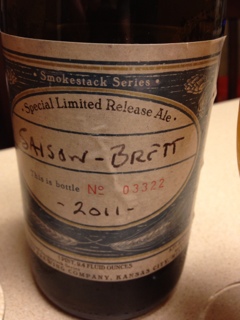
The first word that comes to mind when I think of this beer is “accessible”. It’s the same word people use to describe Frank Zappa’s Apostrophe(‘) album, or the Lars von Trier film Melancholia. Boulevard Saison-Brett is as good an entry point for the newbie down the rabbit hole of “sour” beer as those works are into the intimidating corpora of those artists’ careers.
The beer pours a cloudy orange-straw color. The color reminded me of photos from Belgian breweries that I’ve spent hours gazing at online with longing, like a lonely teen with an Internet girlfriend. The head is pure white and rocky, with big bubbles you want to dive right into. There’s a respectable amount of sediment in the bottle, but not too much. To call the aroma “floral” is an understatement. It’s perfumey, with citrus notes and just the tiniest hint of barnyard aromatics from the Brett.
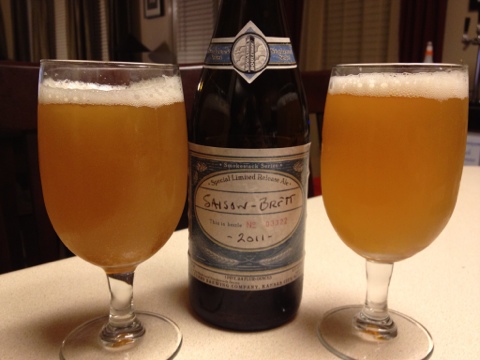
The flavor starts out much the same: perfume on the front end, with a tart and citrusy middle. But this is where it gets interesting. Once the citrus leaves the palate, astringency and sherry-like oxidation notes scrub it right away, leaving the finish very dry. It’s almost like champagne and just as refreshing. There’s not a hint of boozy flavor in this brew, which boasts a not-too-shabby 8.5% ABV.
I paired mine with some crumbled blue cheese, fig spread, and sesame crackers. I had to remind myself to take bites of my snack between sips, as the dry finish left me wanting to wet my whistle again and again.
As for the funk, it was present, but in the background – not the star of the show. Think George Clinton backup singer, not Bootsy Collins standing radiant in all his platform-booted, star-shaped-spectacled glory. There was very little of the barnyard, musty flavor typically associated with Brett beers, but that could very well be because we drank it so soon. Brett character tends to evolve over time, and I just couldn’t wait to try this one; but with a few more months in the cellar, the funky character may have come more to the foreground.
All in all it was a fantastic beer, and I wish I had bought a second bottle to hold onto and see how it ages. Once I get through a few more of the bombers in the Harry Potter closet, I will make sure to save some room for another couple of Saison-Brett bottles if and when Boulevard decides to release another.
Bacillusferatu: the Undead Berliner Weisse
Part of the awesomeness of homebrewing is being able to drink a beer that you can’t buy. If you want to make a chocolate mint stout with a little bit of cardamom in it because it reminds you of your groom’s cake, you can. If you want to make a wheat ale inspired by the 13th-century Italian civil war between the Guelphs and the Ghibellines, you can (I might). And if you hear about an obscure beer that people are enjoying in another part of the world, instead of shaking your fist at the heavens and cursing the wretched stars for the circumstances of your birth, you can just make the beer yourself.
In February 2011, I saw a vial of White Labs WLP630 Berliner Weisse Blend at my local homebrew shop. I’d read a lot about Berliner Weisse, a refreshing, low-alcohol sour wheat beer fermented with ale yeast and Lactobacillus bacteria. It sounded delicious, and apparently is available everywhere in Northern Germany, even hot dog carts (frankfurterwagens in the vernacular, I believe) and brothels. But it’s hard to come by on this side of the Atlantic. I was stoked to find the necessary yeast blend – all I needed now were some common malts and hops. “At last! You will be mine!” I shouted, and cackled as I slipped the vial containing the precious mix of microbes into my shopping basket.
Then I got home and started reading about brewing sour beers, which I had never done before. The first rule of Sour Club is you need to be very careful to avoid cross-contamination: that is, you don’t want the bacteria in the sour beer to infect equipment you use to make traditional “clean” beers that ferment with just yeast, because they can turn all your “clean” beers sour. Plastic equipment is very susceptible to cross-contamination, because plastic surfaces get tiny scratches over time that harbor bacteria. I use almost exclusively plastic (I’m clumsy, and would so drop a glass carboy filled with 5 gallons of beer), so for me this basically meant that I needed a whole new set of brewing gear. I panicked. I didn’t have the money to invest in a second set of equipment just to make a beer I wasn’t even sure I’d like. So I stuck the vial in the fridge and forgot about it.
The yeast blend expired in May 2011, but I held onto it for weeks. Weeks became months. Soon it was February, and for all I knew, 99% of the yeast blend was probably dead. It was only then, having become a man with nothing to lose, that I found my courage.
I decided to make a 1-gallon batch of Berliner Weisse, my rationale being:
- A new set of small batch gear was cheaper than a new set of 5-gallon gear.
- If most of the yeast blend was dead, I’d have better luck with a smaller volume of wort.
- I wasn’t sure how much Berliner Weisse I’d need around the house anyway.
I brewed it on March 3. The recipe was based on “Saures Biergesicht” from Jamil Zainasheff and John Palmer’s Brewing Classic Styles, scaled for smaller volume but lower efficiency:
- 1 lb Bohemian Pilsner malt
- .75 lb White Wheat malt
I mashed at 149°F for 90 minutes in a pot on the stove; brew-in-a-bag, no sparge. I added .22 oz of Hallertau Saphir hops (4.2% AA) and boiled for 15 minutes. I transferred 5.5 quarts of wort with a gravity of 1.035 into a 2-gallon bucket I’d outfitted with a stopper and airlock. Then came the moment of truth: pitching the year-old yeast/lacto blend.
On account of the Teutonic heritage of the style and the unholy act of bringing microbes back from the dead, I named the brew “Bacillusferatu” after my second favorite German expressionist horror film (I plan to honor my favorite one soon with a pyment mead of buckwheat honey and Cab Sauv grape juice called “The Cabernet of Doctor Caligari”). But I never had much hope that my creation would live. Surely there was not enough magic left in that vial.
But man, was I wrong. It took a couple of days to get started, but it did. And it fermented wonderfully.
I racked Bacillusferatu into a small carboy 3 weeks later at gravity 1.006. Now it sleeps quietly, the bacteria continuing to ferment the beer and develop its characteristic tartness. In 6 months or so, it should be ready to emerge from its slumber and be unleashed upon the world …

"Is this your carboy? What a lovely neck."
I still have no idea how this beer will turn out. Right now it tastes good and funky, but with no tartness yet. But I have learned two important lessons from brewing it. #1 – As a homebrewer, I alone control my drinking destiny. #2 – Douglas Adams and Charlie Papazian were right. Don’t panic. Relax, don’t worry, have a homebrew. To which I’d add: Never be afraid to try something new.
A Vigorous Starter
My name is Shawn, and I’m a homebrewer. I’m also a home meadmaker and home ciderer. In other words, I make my own alcoholic beverages.
There are those who prefer the term zymurgist, since it covers the making of all types of fermented beverages. I admit I like the sound of the word, which comes from one of my favorite Greek roots: zyme, a noun meaning the stuff we now know as yeast. But according to the dictionary definitions I’ve read, a zymurgist is a scientist who studies the chemistry of fermentation, not just a dude cooking up hooch in his backyard. I’m certainly not a scientist; and aside from a burning passion for a good sci-fi story (I make those too) and a screaming man-crush on Neil deGrasse Tyson, I don’t think of myself as having a scientific mind. Rational? Yes. Logical? I hope so. But scientific? By Ninkasi, I fear not. So I tend to avoid describing myself as a zymurgist.
But I’m not just about cooking up hooch in my backyard, either. The first time I explain that I’m a homebrewer to someone I’ve just met, I often get asked a question like, “I bet you make some pretty strong stuff, huh?” with the same sly wink that Snuffy Smith used to get from neighbors lauding the potency of his corn squeezin’s. The person asking is usually surprised to learn that the answer is No. The strongest beer I’ve ever made was about 8% alcohol by volume (twice the strength of Bud Light, but there are countless commercial craft beers in the 10% range, and many that are even higher). The strongest mead I’ve made was 14%, not uncommon for a wine. For me, homebrewing is not about getting hammered. In fact, it’s rare for me to drink one or more alcoholic beverages every day in a single week.
For me, homebrewing is about making something that I can share with my friends, that makes us relaxed and sociable and happy. It’s about history, about being part of a tradition of preparing fermented beverages that goes back at least 9,000 years. Many ancient civilizations, from the Sumerians down to the Romans, had deities of brewing and alcohol. The individuals who prepared these sacred beverages were shamans, respected elders; because they alone held the secrets by which grain and honey and grapes could be transmuted into an elixir that was healthy (in moderation) and brought people together in friendship, that led thinkers to new ideas and awakened the creativity of artists.
That’s why I’ve jokingly started calling myself a zyme lord. Sure, it’s bombastic and silly (Doctor Who fans will get the joke). But it also sounds ancient. Noble. And it alludes to the power that a brewer has in a society: the power to bring people together, to create a work of art that many people can come together to appreciate through shared experience, but each be affected in a profoundly different way. Brewing is a kind of storytelling, in the language of grain and hops, honey and fruit, water and yeast.
In this blog, I’ll write about what I’m brewing and what I’m drinking. I’ll share recipes. I’ll also write about how brewing intersects with my other interests: fiction, film, food, and others. I hope you enjoy reading it, and if my stories help you find your way to new ideas and awaken your creativity, then that’s the most a zyme lord can hope for. Prosit!
 myBrewHome