
He who controls the spice …
I had to take a break from blogging last week due to the Thanksgiving holiday here in the United States, during which I played host to my in-laws for several days of family hijinks to the tune of college football, backyard-fire-pit s’mores, an Eddie Murphy retrospective on BET, and lots and lots of imbibed homebrew. I return with many stories I’ll share in the coming days: a rousing adventure of a non-traditional 3-course Thanksgiving beer dinner, and a saga of a Black Friday brew day so bitter it took six bowls to contain all the hop additions.
But first, an update on Colonial Progress Ale. After nearly 4 weeks in the fermenter, it’s just about finished with a gravity of 1.007. That’s a bit more attenuation than I expected, so it will be higher in alcohol, but that may not be a bad thing for a winter session ale.
I’m pleased to report that as the yeast slowly flocculates out, it’s leaving the beer with a much cleaner taste than I was getting from it even a week ago. When I sampled it on Thanksgiving, it was fruity and a little sulfuric. Now it’s clean tasting and very dry, with only a hint of mineral flavor from the molasses and a burst of herbal bitterness from the late spice addition of sweet gale and juniper berries.
What’s missing is any sign of herb or spice in the aroma/flavor arena. So today, a few days before kegging, I made a “spice potion” with the remaining sweet gale and juniper berries.
What’s a spice potion? Despite sounding like something from a Dune or Harry Potter book (or some sick and unnecessary crossover that I would nevertheless read because I friggin’ love both those series: Harry Potter and the Floating Fat Baron? House Elves of Dune? I’m looking at you, J.K. Rowling and Brian Herbert) a spice potion is a method for adding spices or herbs to homebrew without boiling – and thus losing many of the volatile compounds that give those ingredients their distinguishing features – and that’s more elegant than simply throwing them in the fermenter.
It’s simply soaking the herbs/spices in distilled liquor to extract the essence. As I understand it, this works because alcohol is a better solvent than water, so more of the flavor and aroma compounds are extracted than in water steeping, and no heat means the subtler characteristics of the ingredient are retained. And since it’s distilled spirit, it’s safe to add to the beer without fear of infection. Any spirit will do. Vodka is common because of its neutral flavor, but depending on the specific ingredient being extracted, I’ve heard of people using rum, tequila, or whiskey (whose name, incidentally, comes from the Gaelic phrase uisce beatha meaning “water of life”, which is also a solution of pure spice essence in the Dune series – and now we’ve come full geek circle).
I used vodka. And since quality isn’t really important for the small amount that will end up in the beer, I used the cheapest vodka I keep on hand: the stuff that comes in a 1.75-liter bottle for $9, which I use to fill my airlocks (never for drinking). I muddled a quarter ounce of juniper berries with a gram of sweet gale in a mortar and then placed it in a sanitized glass with about 2 ounces of vodka. The resulting mixture wasn’t pretty to look at, but had an herbal/tart aroma pleasantly similar to gin.
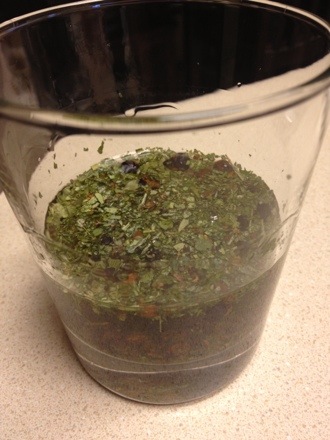
Only the Water of Life will free what can save us.
I’ll let the potion steep, covered with sanitized foil, from now until Sunday. Then I’ll strain out the chunks, add the essence to the keg, and rack the beer on top of that. Since the bitterness is already prominent in the brew, I think this is the last little flavor kick the beer needs to make it ready for prime time.
Watch this space for the next few days as I share my stories from Thanksgiving week. Since there’s no turkey or shopping involved in either of them, I’m sure you’ll enjoy them despite the passage of time.
Until then, keep the spice – and the beer – flowing.
Unfinished business
With November half over, I'm faced with several unfinished brewing projects and more on the way.
A few days ago, I racked my ginger mead to a carboy for conditioning. Because of my pathological aversion to work which isn't absolutely necessary, I'm a believer in long primaries and won't rack beer to a carboy unless there's a damned good reason (no empty keg available, need the primary vessel for a new beer, cat fur stuck to the inside wall of the bucket, etc.) and I get good beer with up to 6 weeks on the yeast cake.
But for mead, we're talking upwards of 6 months of conditioning, and for that there's no way around racking to a carboy. Not only is it better to get the mead off that autolyzing yeast for the extended aging, but it's essential for clarity: the mead won't clarify until it's removed from the gross lees. It's amazing, in fact, how quickly it does start to clarify as soon as it's racked. Just a few days have passed since I racked it, and it's already several shades darker than it was in the primary due to the yeast flocculating out.
At racking time, the gravity measured 1.001 and the mead had a fruity, floral taste with a little ginger bite but sadly no hint of ginger in the flavor or aroma. My fermentation chamber did its job well keeping the fermentation cool, and it had none of the fusel alcohols my other (uncontrolled temperature) meads had this early on. It might even be ready in less than 6 months, but I have reasons for waiting until April to bottle it. Until then, I'll rack it every 6-8 weeks, add a few Campden tablets occasionally to prevent oxidation, and maybe hit it with some Sparkolloid closer to bottling time. And definitely some more ginger before bottling.
I also took the first gravity sample from the Colonial Progress Ale I brewed 11 days ago. The wort turned out a bit more fermentable than I expected and is currently at 1.009, with an ABV of 4.8% (and the WLP008 yeast, a notoriously slow flocculator, might still be working). It's got a fruity tang I expected from this yeast, and very minimal cidery character from the simple sugar of the molasses. It's really a nice easy-drinking session beer that should be very enjoyable when the yeast settles out. The juniper and sweet gale have largely faded, though. I'll add more spices to the fermenter before kegging. Who knows, I might even rack the beer for the occasion.
The next project on the horizon is an inventory cleaning extravaganza! I've got lots of open hop packets from over the course of the past year that I'll use in a beer to be brewed the day after Thanksgiving. I spent some time tonight rubbing hop pellets between my fingers (while watching Moonshiners on Discovery Channel … now those guys are pros) smelling them and even tasting some of them to make sure they were still hoppy and had none of the telltale cheesiness of bad hops. Fortunately, only a half ounce of Warrior left over from February had any distinctive cheesy notes, so back into the freezer it went to keep on aging until it magically changes from “cheesy” to “aged” and I can use it in a lambic. The other open hops made the cut and will be used next week. More on that recipe soon!
Vote for Progress … hops
Saturday was Learn to Homebrew Day in the USA, and today is Election Day. To honor both events, I did what any patriotic and pedantic zyme lord would. I made beer.
I called it Colonial Progress Ale, and it’s something between an English bitter and an English brown ale. “Colonial” comes from the fermentables, adapted from a recipe I envisioned for a colonial-style ale during a trip to Philadelphia earlier this year. I ended up with:
- 6.5 lbs American 2-row
- 1 lb Victory malt
- 8 oz Flaked wheat
- 8 oz Flaked oats
- 1 lb Molasses
Each of these ingredients was chosen for a reason, starting with American 2-row malt as the base. Wheat is common in colonial ale recipes, including one attributed to Thomas Jefferson. Victory and oats I had no historic precedent for, but I added them for body in the finished beer, along with some bready/biscuity flavor (Victory) and silky smoothness (oats) to accentuate the English-inspired malt profile. I mashed at 153°F for medium fermentability, counting on the highly fermentable molasses to dry the beer out.
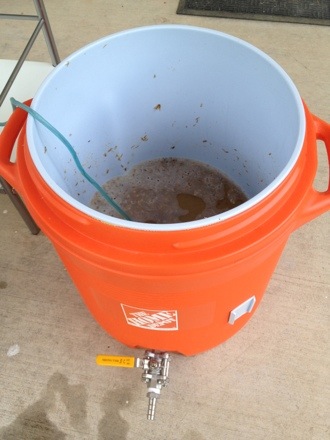
The mash begins.
Ohhh, molasses. A common ingredient in beer in early colonial Philadelphia (according to a quote from William Penn), I can eat the stuff right out of the jar. But I was nervous about using it after reading John Palmer’s tasting notes ranging from “rumlike” and “sweet” (woohoo!) to “harsh” and “bitter” (ergh). But further research online suggested that harsher flavors were associated with fermenting mineral-rich blackstrap molasses, not the regular unsulphured kind. I went with regular, and added them at the beginning of the boil with high hopes.
The “Progress” part came from the hops: one ounce of 6.6% AA Progress at the 60-minute mark for bittering, and another quarter ounce at 15 minutes for flavor. Progress is a UK varietal related to Fuggle hops, a good choice for English-style ales.
But that wasn’t all I added to the boil. Hops were available to some colonial brewers, but apparently not all that prevalent, so other bittering herbs were common. My original plan was to use horehound, but I realized the medicinal flavor might overpower a low-gravity ale. I thought of rosemary, but was talked out of it by the sages (ha, ha) at Austin Homebrew Supply. I landed on:
- .25 oz Juniper berries (crushed in mortar)
- .5 grams Sweet Gale (dried)
I added the herbs in the last minute of the boil and let them steep during cooling and whirlpool. I may add more later during conditioning.
The wort had an OG of 1.046, a true session ale for the upcoming winter (insert witty apropos Valley Forge reference; I can’t think of one). I pitched the slurry from a 2-liter starter of WLP008 East Coast Ale Yeast – reportedly the Sam Adams house strain – in keeping with the colonial theme. I set the fermentation chamber to an ambient 65-68°F, a little warmer than typical to coax some vintage ester flavor from this low-flocculating yeast.

Fermentation underway after 24 hours.
By this time tomorrow, the future of the United States will be written for the next four years. But regardless of whether my guy wins or not, I’ll have something to look forward to: a beverage in the tradition of the first beers brewed on American soil. Beer has always been a part of American culture, even before there was a United States, and from #1 on down to #44 many presidents have been homebrew aficionados: George Washington, Thomas Jefferson and James Madison were homebrewers and Barack Obama bought a homebrew kit for the White House with his own money. And beer remains one of the few things people can agree on regardless of personal politics.
Don’t forget to vote today, no matter who you’re supporting. Red and blue be damned. We can all party together in the colors of the SRM scale.
The boldness of new beginnings
Foaming with abandon in the Harry Potter closet is a 2-liter Erlenmeyer flask on a stir plate, filled with a starter of White Labs WLP008 East Coast Ale Yeast.

She ain’t pretty, but she’s mah baby.
Anyone reading this who has been using liquid yeast without a starter should jump on the starter train. Seriously. It’s as easy as making a tiny unhopped extract brew, because that’s exactly what you’re doing. Just bring 1-2 liters of water to a boil – higher gravity worts will need bigger starters; see YeastCalc for the volume recommended for your batch – add dry malt extract at a rate of 100 grams per liter and some yeast nutrient if you’ve got it. This will make a wort of 1.035-1.040, which is perfect for a starter regardless of the OG of the batch it’s going in. Boil, cool and pitch the yeast. Ferment for 2 days, then cool in the fridge for at least 24 hours before making the “real” wort. Most of the yeast will drop out when chilled, leaving clear (but vile – don’t drink it) “beer” which should be decanted, leaving behind the yeast cake and just enough liquid to swirl up into a slurry. Pitch and watch the magic happen. If you’ve got good sanitation techniques, making a starter carries minimal risk. The rewards are higher pitching rates and better beer. And it’s so easy, there’s no reason not to.
This starter was pitched with yeast that expired in July. I’ve worked with expired yeast before. The yeast/bacteria blend in my Bacillusferatu Berliner Weisse was expired for ten months before I pitched it, though that was into a 1-gallon test batch of a low-gravity wort intended for souring. This starter is going into five gallons of wort for a very different beer: my long-overdue Colonial Progress Ale, from a recipe slightly modified from one I posted in April. Details forthcoming after I brew it this weekend.
As the photo above shows, the expired yeast is spewing so much krauesen I had to wrap it in a paper towel. The expired yeast are healthy as can be, and that’s no surprise. Sure, the expired vial had no more than about 10% of its original population of viable yeast cells, but so what? Yeast cells are dying every day in every carboy, keg and cask in the world, but fermentation continues. Many homebrewers culture yeast from commercial bottle dregs and make great beer with it. Given enough time, even a few sad, dying yeast cells will get their freak on, reproduce and ferment wort. It’s just that the first generations will be weak and languid, and make lots of foul-tasting byproducts doing it.
The purpose of the starter is to make sure those nasty byproducts end up in a beer that’s destined for the drain, not your gullet … while the real wort gets inoculated with a healthy colony of the naturally selected descendants of those few Saccharomycean pioneers who survived the long winter.
So don’t ever be afraid to use expired yeast. Don’t throw it away. You should be making a starter anyway. For fresh yeast, a starter is a leg up. For expired yeast, it’s a new beginning.
Speaking of new beginnings, best of luck to my friends and fellow writers undertaking National Novel Writing Month (“NaNoWriMo”) this November. The goal is to write 50,000 words of a novel in 30 days: fast, raw, unedited. I’ve done it four of the last five years and made it across the 50k mark each time. But I won’t be doing it officially this year. I’ve got too many short stories I want to work on, and a novel already in progress, and I don’t want to distract myself with something new. But I am using November as an excuse to write every day: a blog post, story, novel chapter, anything. I did catch wind of a blog-centric version (“NaBloPoMo”), but I love my readers far too much to subject you all to a bunch of hurried blog posts on whatever random bullshit I can think of to write about.
What do you mean, too late?
Austin Beer Week 2012: Ommegang Beer Dinner at Easy Tiger
I’ve had a few beers before from New York’s Brewery Ommegang, but not many. So it was with curiosity and an empty stomach that I entered the hallowed halls of Easy Tiger Bake Shop & Beer Garden on Tuesday night for their Austin Beer Week Ommegang Beer Dinner. It was my second beer dinner at Easy Tiger (my first was in July) so I came expecting an all-stops-out delicious meal designed by chef Andrew Curren with the beer remaining the star. The menu was promising indeed:

The menu, before I smeared it with messy but memorable victuals.
Easy Tiger’s wait staff turned the hospitality up to eleven, bringing my first beer within moments of being seated. That was Ommegang’s Octoberly-named Scythe & Sickle, an ale celebrating the harvest season with barley, oats, wheat and rye in the grain bill. It poured a cloudy orange with an initial tart, acidic aroma that gave way to spicy clove esters and floral notes upon tasting. I had fun trying to pick out all the different grains. The oats gave a creamy texture to the brew, and spicy rye was also evident; but the most distinctive flavor I got was a raisin-currant character typical of Belgian crystal malts like Special B. The beer was accompanied by Easy Tiger’s “Harvest Mix” of popcorn, potato sticks, peanuts and dill: not your father’s party mix.

Beer #0: Scythe & Sickle. Yes, that’s a full glass pour.
Then the real fun began.
First Course: Biere d’Hougoumont with Herbed grits, roasted mushrooms, quail egg, lemon hazelnut gremolata – This limited-edition bière de garde includes French ale yeast and French Strisselspalt hops in the recipe, and was aged on white oak and hard maple. It was light orange in color with a quickly dissipating head and smelled of honey and floral hops. A boozy character like that of simple sugars (honey, or candi sugar?) in the wort was strong on the palate, but no alcohol burn. It balanced well with the earthy mushroom flavor dominating the grits.
Second Course: Goudenhop with Orange-lacquered grilled pork belly, creamed Swiss chard, crispy leeks – Ostensibly a Belgian-style blonde, the beer lived up to its name (meaning “golden hop” in Flemish) with citrusy hops on the nose and palate that slowly gave way to a long-lasting bitterness. It seemed an odd pairing with the nutty creamed chard and rich slab of pork belly that actually melted in my mouth, until I recognized it as a genius combination of opposites. The Goudenhop offered a refreshing lifeline from a dish easy to drown in (albeit happily), like orange juice next to a heaping plate of morning bacon. Folks, it just doesn’t get any better than this.
Third Course: Gnomegang with Pecan-crusted red fish, sweet potato & Granny Smith apple hash, parsley brown butter – A big golden beer with a thick head and aromas of tart fruits and the unoffensive cheese notes of Belgian yeast. It was incredibly full bodied, packed a boozy punch, and would make a great mainstay for a Belgian abbey’s Lenten fast. The rich, oily fish paired very nicely with it, and I’ve never disliked anything with Granny Smith apples in it.
Fourth Course: Art of Darkness with Chuck roast, potatoes, carrots and Art of Darkness bread – This smooth, velvety black ale (I wouldn’t call it a stout; there was no roasted barley character at all) had the hallmark flavors of oats and (I’m guessing) debittered black malt. The beer was good, but I must confess I was more entranced by the wedge of artisan bread on my plate, made with that same beer. I had waited all night to get my hands on some of Easy Tiger’s legendary bread, and its appearance made me a happy man. My apologies to the roast; it was succulent and savory, but I had already given my heart to another.
Fifth Course: Chocolate Indulgence with Pumpkin pie, milk chocolate, candied orange, hazelnuts – The last ale on the menu was as dark as the previous one, and had the roast character its predecessor lacked. More coffee-like than it was chocolatey, it was very good on its own but a little heavy next to a light and flaky specimen of one of my favorite fall desserts. The pie itself was delicious, and thankfully not cloyingly sweet. I loved each on their own but wasn’t crazy about the two together.
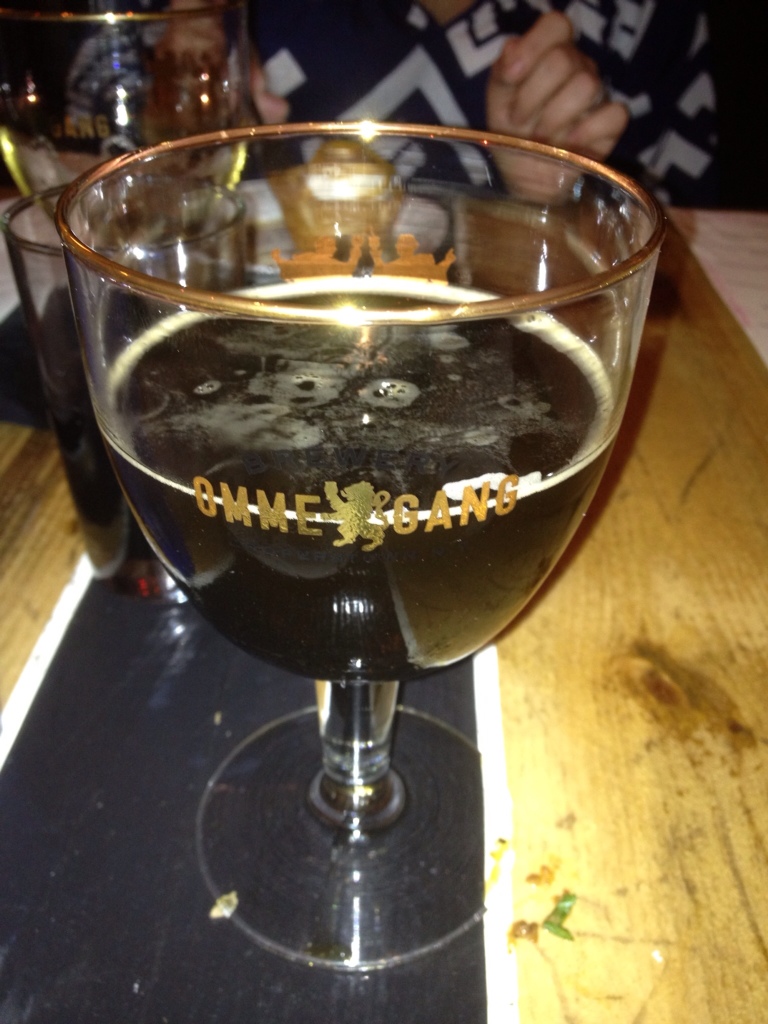
Beer #5: Chocolate Indulgence. And another sweet glass for my collection.
But the night wasn’t over yet! Easy Tiger and Ommegang surprised us with a final course: a plate of soft cheese, fennel relish, and another fresh baked bread (EDIT: Nancy’s Camembert from Hudson Valley, fennel marmalade and Pan au Levain roll – a sort of French “sourdough” – thanks Chef Andrew Curren for confirming) accompanied by a flute of Aphrodite lambic. The lambic was sweet and fruity with the color and flavor of raspberry (and just a little pear) all but masking a thread of Brett funk, and was an admirable way to end the night. It went fine with the cheese, but I kept thinking how well it would have paired with the pumpkin pie … though I would hate to have missed out on this latter offering of house bread.
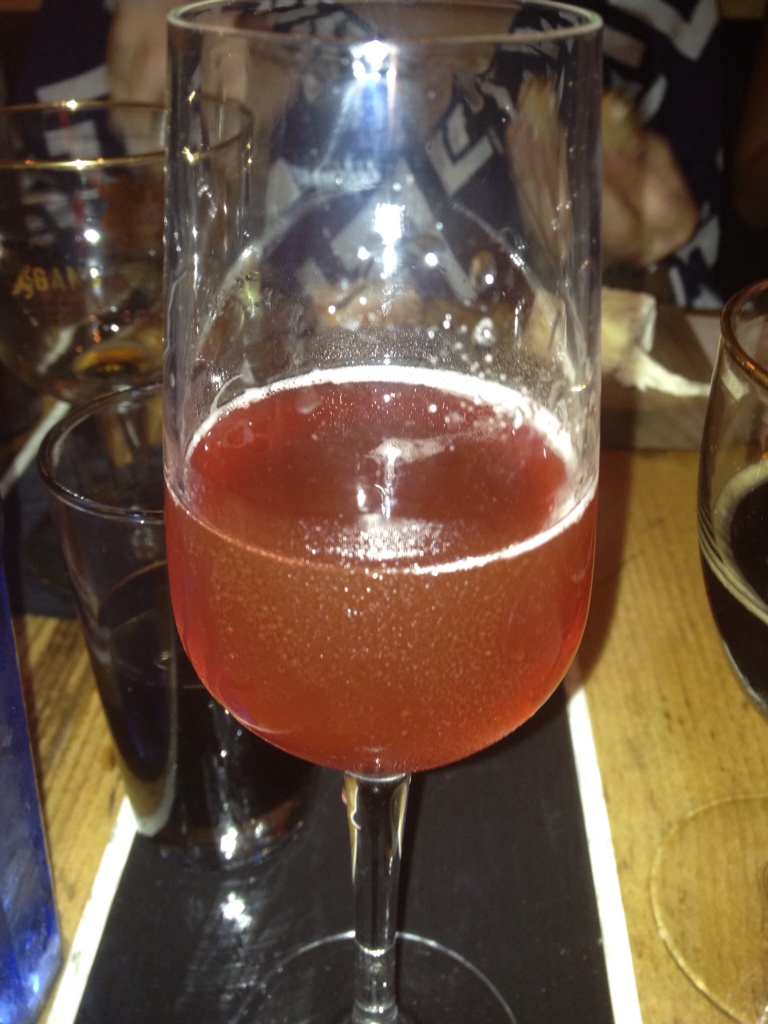
Beer #6: The mighty Aphrodite.
Much like schnitzengrubens, them strong Belgian-style beers can wipe you out, especially when taken with good food. By the end of the night I had one foot in brewhound Valhalla, tethered to the mortal plane by robust conversation with several fellow beer geeks in attendance that I had the pleasure to meet that night – including John Rubio of The Beerists podcast and Austin Chronicle beer culture writer Ivy Le and her husband. But bedtime loomed, and before long I emerged from the rathskeller to find my way home, happily smacked down by another spectacular Easy Tiger beer dinner.
You win another round, Easy Tiger. Well done. Name the time, and I’ll be there for the rematch.
Austin Beer Week 2012 finally begins (for me)
Finally! I get to start celebrating Austin Beer Week in earnest tonight with the Ommegang Beer Dinner at Easy Tiger Bake Shop & Beer Garden. The Real Ale beer dinner at Easy Tiger a few months ago excited my palate (and loosened my typing fingers; I waxed blogtastic about it here and here), so I’m thrilled to be starting my Austin Beer Week festivities there.
If I didn’t already have a reservation at Easy Tiger, though, I’d be starting my Austin Beer Week tonight at my favorite place in town, the Alamo Drafthouse Cinema. The Alamo has a tradition of multi-course feasts, pairing chef-prepared selections with great beverages and fantastic films (like their annual all-day Lord of the Rings Trilogy Hobbit Feasts: seven courses in twelve hours of movie with the occasional lembas bread intermezzo). Tonight, the Lake Creek location is showing the Indian sci-fi spectacle Endhiran: The Robot (starring Tamil screen legend Rajinikanth and Aishwarya Rai) with a five-course Indian meal paired with five local IPAs. I saw Endhiran at an Alamo screening last year and found it bizarre, hilarious and touching, combining modern sci-fi tropes with classic monster movie hijinks, and yes – lots and lots of Indian musical numbers. If you’re into Bollywood, Kollywood, or just have an open mind for a totally new experience, I highly recommend it.
Speaking of totally new experiences, yesterday I went to Black Star Co-op to try their new cask ale, Molly Moocher: their Double Dee amber(ish) ale cask conditioned on morel mushrooms. I’m sure I’ve had mushrooms in beer before, but must confess that morel mushrooms terrify me, with those shriveled alien-egg-looking caps, fleshy and pitted with shadowy tunnels into deep, Lovecraftian darkness (shudder). But October is right for fright, so I jumped in eagerly. Amazingly, I didn’t lose my soul or sanity to the Great Old Ones. I just … drank mushroom beer. It was well attenuated and had a rich earthiness from the mushrooms, complemented by earthy hop character. High attenuation and low carbonation combined to make the beer come across as a little thin, but that’s not uncommon for cask ales.
The better beer that day at Black Star was Old Sour Dewberry, a sour English old ale that poured a deep ruby red with a roaring fizzy head. It popped on my palate with refreshing, effervescent fruitiness, like an alcoholic cherry soda. It was so good I wish it had come in larger than a 9-oz pour, but it packed a punch and was worth slowly savoring. I’ll be back for that one soon.
But now: looking ahead to Easy Tiger tonight by eating as close to nothing as possible today. I’ll post details on the dinner including my favorite dish, favorite beer and pairing reactions in the next day or two.
Beer Guy’s Burden
A friend reaches into his cooler at a BYOB party and pulls out two cans from Austin Beerworks: a Pearl Snap Pils and a Fire Eagle IPA. Knowing his preference, I hold my hand out for the IPA while he keeps the Pils. As our cans crack open in unison, he asks me, “Why don’t I like that one again?”
I think for a split second. “Because it’s got more hops, which makes it more bitter,” I say. “But it’s also sweeter and has more alcohol. It’s really just more everything.”
I’ve opened with a quip, and I’m considering going into more detail. But while I’m thinking about what to say next, everyone at the table laughs, and the conversation resumes. The moment has passed, and the chance to say more about what makes those beers different is gone.
Of the friends I hang out with regularly, I’m #1 or #2 in beer geekdom, and the only one currently homebrewing. That makes me the “beer guy” in the group. All my friends like craft beer, but most aren’t into it like I am. They come to me with their beer questions. I’ve been asked to order for my friends at bars and to suggest thematically appropriate beers for parties. It’s a role I’m honored to play, but it comes with responsibility.
I’d love for my friends to love beer as much as I do. If they knew it like I do, they’d love it like I do, right? I must tell them everything I know! Right?
But no. When asked a question, I have to be careful with my answer. I have to give just the right amount of information. To cover the basics in enough detail to keep their interest piqued, but not to get so bogged down in the minutiae that I lose them along the way.
At the BYOB party, if I answered my friend with an hour-long lecture on the difference between the noble hops in the Pils and American hops in the IPA, I can just about bet no one at that table would ever ask me a question about beer again. I know I’m a damned interesting guy, but even I don’t want to listen to me speaking for that long. If I scare my friend away from wanting to ask me about beer, then I’m doing it wrong. The mission is to nurture his curiosity, give him information so he can make a decision about when and where he’ll try that IPA on his on (if ever).
So I chose a simple, funny answer. A few facts and a tacit invitation to ask me more. He didn’t ask me more – not then, anyway, but maybe I had planted a seed.
I hope everyone reading this has at least one or two people they can seriously geek out about beer with. But even if you do, I know you’d love to get all the rest of your friends on board too. But they’re not all going to. Some may be on their way, and some of them will get there eventually. Not all, but some.
What can we do to help them along? Be there for them, but don’t push. Be their sherpa on the climb up the mountain. Give them the information and the encouragement they need. They’re your friends. You know them. You know what they need to hear. Answer their questions but don’t bore them or scare them away. Let them take baby steps. Craft beer is booming, and to the neophyte, the options are intimidating (don’t we all remember our first time?). Help them navigate those options with comfortable sojourns outside their comfort zone, and don’t go too wild too fast. Be gentle. They’re new to this.
Offer a schwarzbier to a friend who always reaches for Guinness. Offer a light beer drinker a Bohemian-style pilsner or even an APA. If they like that, give them an IPA (not an Imperial!). If your friend trusts you enough to take your recommendation, honor that by introducing them to something they’ll like, and thank you for later.
I see it as a sacred duty. But of course, I get a little too serious about stuff like this sometimes.
As for my friend, I talked with him again a couple of days later. He told me that after spending the previous afternoon downing Pearl Snaps, his tastebuds had gotten tired of it and so he went looking for something with a little more flavor. He reached for one of those IPAs left over from the BYOB, and enjoyed it so much he had a second one.
Mission accomplished. Phase one, at least.
Austin Beer Week 2012: Calendar
Austin Beer Week starts in 3 days! Taking place from October 20-28, Austin Beer Week 2012 promises to offer an abundance of tastings, cask tappings, pairing dinners, happy hours and meet-the-brewers-es, and is sure to be a fun time for anyone in Austin who loves good beer.
The calendar of events can be found online here. I’m hoping to catch at least a few of these events and report on them, but there’s no way to make them all. I’m going to Houston for a family reunion on Saturday, so that’s one day out already, but I’ll participate as much as my schedule, my wallet and my body will allow.
Going to any of these events? Comment here, tweet me at @shawnbou21, or email me at zymelord @ gmail.com to tell me how it was! I’ll post my own experiences as the week goes on.
Prosit to all, and see you out there at Austin Beer Week!
Getting Medieval with Ginger Mead
Anyone reading this blog regularly will notice that for the past few months I haven’t really been brewing. I’ve been out of the house a lot, so my homebrew stock hasn’t depleted. Brewing would just net me a backlog of new beer waiting to get stale, not to mention the challenges of brewing outdoors in the Texas summer heat. But now that fall is here, I’ve returned to brewing with a ginger mead from a new recipe. Because ginger is a spice, ginger mead qualifies as a metheglin.
The history/fantasy geek in me loves mead, and it’s hard to find in stores. Most commercial examples are too sweet, better suited to mulling and heating; and my desire to make good easy-drinking mead was a big part of my initial interest in homebrewing. And here’s the big secret: it’s really easy. Meadmaking offers some new challenges for a beer brewer, but the brew day itself is fast and straightforward, especially compared to all-grain brewing. My mead brew day takes 2-3 hours; beer brewing takes me 8 hours from setup to cleanup. There’s no missing mash temperatures. No stuck sparges. No boilovers. No boiling at all – the aroma compounds in honey are volatile and boil off quickly, and honey’s natural antimicrobial properties make sanitizing the must (the pre-fermentation mixture of honey and water) unnecessary.
Preparing a 5-gallon mead must is as simple as heating 2-3 gallons of water on the stovetop, just enough to dissolve the honey (around 110°F), and mixing that with top-off water in the fermenter. I used the 7.5-gallon aluminum pot that usually serves as my hot liquor tank:
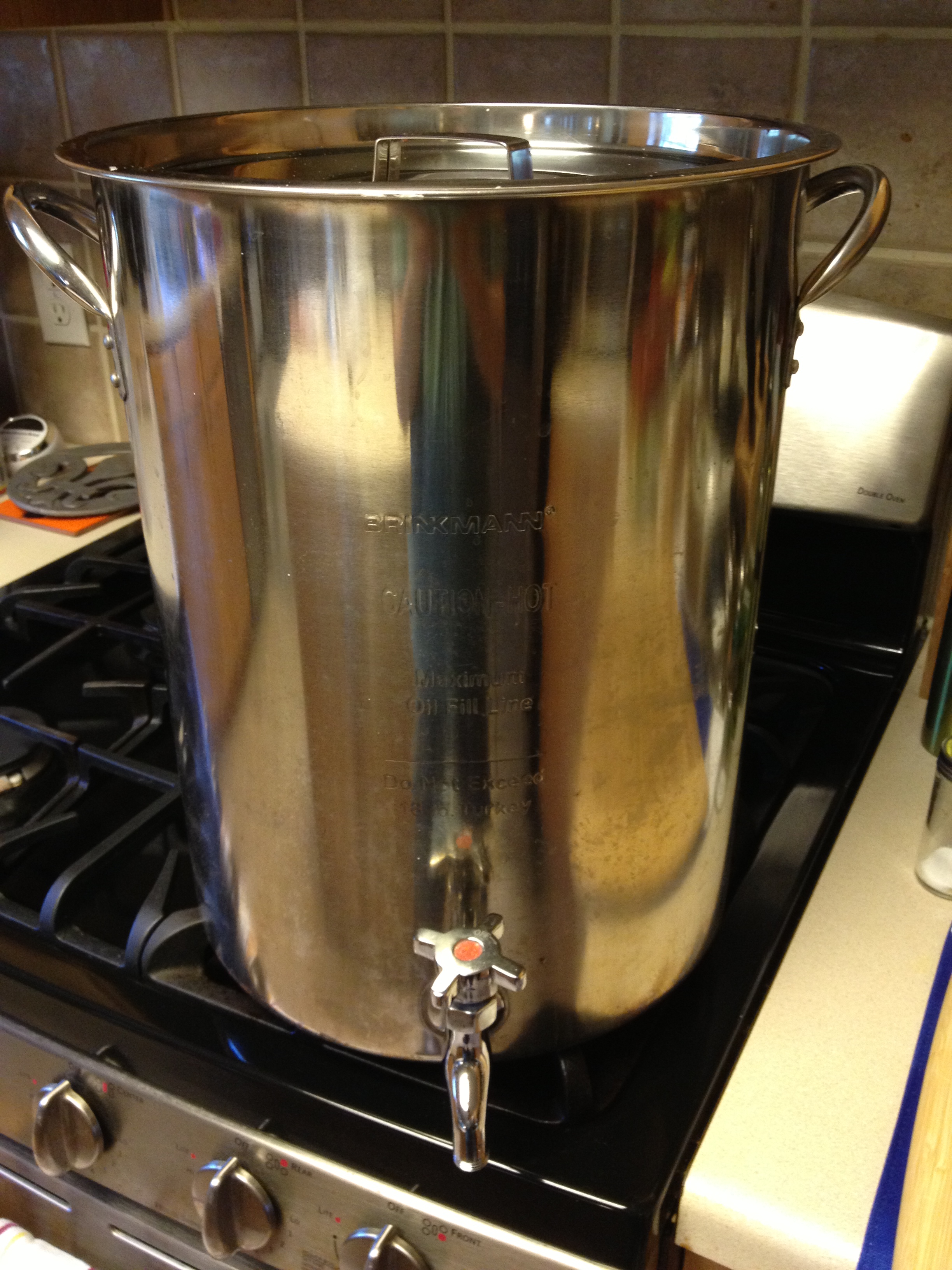
In tonight’s performance, “Kettle” will be played by “HLT”.
I used bottled spring water – for no other reason except that I wanted to pre-chill the top-off water, and Target had it on sale. I’ve made great mead with filtered tap water in the past. I heated 2.5 gallons to 120°F while Lisa peeled and diced fresh ginger root.

Chopping action shot!
- 10 lbs Kirkland Signature Clover Honey (Costco store brand)
- 4 lbs Round Rock Honey (local premium wildflower honey)

Los Fermentables.

… and a sore right arm.
I racked this to my fermenter and topped it off to 5.25 gallons with refrigerated spring water. The must temperature equalized at about 80°F with an OG of 1.101. I’m targeting 1.005 FG for medium-dry residual sugar and an ABV of roughly 13%.
Meanwhile, I rehydrated 10 grams (2 dry packets) of Lallemand Lalvin K1-V1116 wine yeast in 2/3 cup of cooled boiled water with 12.5 grams Lallemand Go-Ferm rehydration nutrient. Unlike barley malt, honey is very low in nutrients yeast need to thrive, so adding nutrients to the must is … well, a must. I follow the staggered nutrient addition schedule recommended by a user named hightest on the board HomeBrewTalk.com, which calls for 4.5 grams each of diammonium phosphate (DAP) and Lallemand Fermaid-K nutrient at pitching, with additional nutrient additions later during fermentation (there’s tons of great information from this guy here – as invaluable as Ken Schramm’s The Compleat Meadmaker, which I’ve read cover to cover). I mixed the DAP and Fermaid-K into the must with a healthy beating from my drill-mounted aeration whip, pitched the yeast slurry, and shoved it into the fermentation chiller.
All this week, I’ll be aerating the must twice daily with the whip and adding additional yeast nutrients as necessary. Once primary fermentation is complete, I’ll rack to a carboy and age it for at least six months before bottling. I expect to have to add more ginger again for some additional spice after all that aging, which I’ll add directly to the carboy. If it finishes too dry, I’ll stabilize it and add some of the leftover Round Rock Honey.
Meadmaking is extremely rewarding, and a great step outside the box for any brewer. Even extract beer brewers can make mead easily with a minimum of additional equipment, unlike jumping from extract to all-grain beer brewing. And with so few meads available commercially, it’s a great way to share with friends this ancient libation so rich in history, and yet so mysterious to many.
A taste of local at the Texas Craft Brewers Festival
Fiesta Gardens in East Austin was the hoppiest place in town on October 6 as about two dozen breweries from all over Texas gathered for the annual Texas Craft Brewers Festival, sponsored by the Young Men’s Business League of Austin. Featuring over 115 beers, the event promised to be a carnival of discovery. I walked through the gates holding my tasting glass eagerly, like an explorer taking his first steps on a newly discovered shore with a trusty saber in hand.
The format was a familiar one: a booth from each brewery in attendance (arranged in alphabetical order, wow) offering pours of their most popular and/or most interesting beers. $20 bought admission, a 4 oz. plastic tasting glass and six tickets, with additional tickets available for purchase at two for $3. Most of the pours cost one ticket, with some of the rarer/higher-gravity offerings going for two.
I sprung for the $65 VIP pass. It didn’t come with any additional tickets (bummer), but I did get a T-shirt and imperial pint glass along with noon entry, two hours before everyone else. The early entry was worth it, because the place got nuts at 2:00 when the gates opened to general admission. VIP’s also got a “meet-and-greet” round robin tasting in the main pavilion from 1:00 to 2:00. Brewers and brewery representatives walked around the pavilion with pitchers, pouring samples and answering questions.
I love talking to brewers who have a real passion for brewing. The ones who are visibly energized by talking to kindred spirits. The ones whose eyes light up when asked why they chose one yeast strain over another, or who get excited when you taste something subtle in the beer that they were specifically trying for. They’re the stewards of our community, the true shamans of our tribal craft brew culture. I’d especially like to thank Jeff Stuffings of Jester King Craft Brewery, Diane Rogness of Rogness Brewing Company, Jud Mulherin of Circle Brewing Company and Grant Wood of Revolver Brewing Company for stopping for a few minutes on a busy day to talk to me – one of many admirers clamoring for their time – about their ingredients, their craft, and why they do what they do.
The beers themselves presented a fascinating snapshot of where Texas craft brew is today. Several things became apparent over the course of the day:
- Sour beer no longer a thing? The event website boasted “at least four sours”. That’s a much smaller number than I would have predicted a year ago, when sours were seemingly the next big wave in craft brewing. But now it seems Texas brewers are looking elsewhere for innovation. Real Ale Scots Gone Wild and Austin Beerworks Einhorn Berliner Weisse were on tap along with some sours from Jester King, but I didn’t see anything on the menu that I hadn’t tried before. I made a beeline to the Jester King booth for what I thought was a new sour – the Viking-inspired Gotlandsdricka – and got a surprise. Jeff Stuffings informed me his Gotlandsdricka was intended to be a modern interpretation, not a historically accurate recreation of the ancient ale, and was clean-fermented with just Saccharomyces cerevisiae. I’m a sucker for anything Nordic, and I liked it a lot, but I’m still curious to taste the sour version they may release in a few months.
- Flavorings are where it’s at. For a region so rich in German heritage, Texas brewers sure don’t know the meaning of Reinheitsgebot. Spices and fruits abounded. Rogness OST Porter with coffee and coconut and Yogi Amber with chai spice, Thirsty Planet ChiGoatle Amber with peppers, Revolver Blood & Honey Wheat with blood orange zest and spices, and Jester King Gotlandsdricka with sweet gale and juniper all made impressions on me. Even Reinheitsgebot champions Circle Brewing have jumped into the flavor fray with Smokin’ Beech, a refreshing Rauchbier with a bacony character from malt beechwood-smoked according to a traditional Bamberg process that Jud Mulherin described to me in reverent detail.
- Tea is the new coffee. Coffee porters and stouts remain popular, but Texas brewers are starting to notice coffee’s hot stepsister from across the ocean, with very different takes on the concept. Live Oak poured an Oaktoberfest infused with lapsang souchong China black tea, lending a vegetal smokiness tailored for slow sipping. Jester King poured their kombucha farmhouse ale Buddha’s Brew. Rogness Yogi Amber doesn’t actually have tea in it, but recreates the experience of chai tea in an amber beer with chai spices and unfermentable sugars. Diane Rogness called Yogi “her baby”, and she should be proud of it. I enjoyed drinking it and have thought about it a lot since Saturday.
- Dallas-Fort Worth is growing. Lakewood Brewing and Revolver Brewing are two names from the Metroplex that seem to have made their Austin debut at the event, alongside DFW stalwarts Deep Ellum and Southern Star. I didn’t get a chance to try Lakewood (sorry!) but Revolver’s Blood & Honey Wheat is a surprisingly complex lawnmower beer with blood orange zest and savory spices. Head brewer Grant Wood invited me to guess which spices he used. I guessed incorrectly, and when I pressed him for the correct answer, he said smiling, “We’ve gotta have some secrets.” Touché.
Finally, the day brought great news to the mead lover in me. I had a chance to speak to Eric Lowe of Meridian Hive Meadery, a new Austin company getting their brewhouse (meadhouse?) assembled currently, and who will hopefully be releasing their first meads in early 2013. There’s a mead gap in Austin, and I welcome them with open arms and a thirsty palate.
Photos of the event are below (including one of your friend and humble narrator in a yellow shirt), courtesy of Roy Moore and Control Images. Thanks to the YMBL and all who made the event what it was.


 myBrewHome