
An homage to UK pubs (and a classic monster movie)
I vote we go back to the Slaughtered Lamb. – Jack Goodman, An American Werewolf in London
Homebrew inspiration can come from strange places. My favorite homebrews are the ones that were inspired not just by an imagined set of flavors, but by places I’ve visited, stories I’ve read, movies I’ve watched, etc. I love using the language of malt, hops, and yeast to tell a story about something more than beer. The trick, though, is that brewing is not an abstract art. A good concept might make for a great conversation starter, but no matter how high-concept a brew is, if it doesn’t taste good I don’t want to be stuck with five gallons of it (I graduated from a Catholic university in New Orleans, but that doesn’t make it a good idea to brew a crawfish & Bananas Foster porter with Trappist ale yeast for the alumni picnic). Finding the right balance between concept and taste is the ultimate goal.
In spring 2011, Lisa and I visited the United Kingdom for three weeks and spent a lot of time in pubs. We drank real ales from so many regional breweries whose names I can’t remember (except for Brains – #1 among zombies in South Wales) served at cellar temperature, often from beer engines – though at one awesome hole-in-the-wall in a one-road hamlet in Scotland I think I remember drinking beer dispensed from a cardboard box. The taste and aroma of real British ale, even the sight of the interior of a British pub, are vivid and powerful memories for me.
In summer 2012, I saw John Landis’ 1981 film An American Werewolf in London for the first time and my nostalgia was kindled by an early scene in the film at a fictitious Yorkshire pub called the “Slaughtered Lamb”. So I brewed a special bitter with English malts and American hops that I named Kessler’s Rampage Special Bitter in homage to the film’s main character and titular werewolf. Not long after I kegged it my sister-in-law and her husband, a native Sussaxon*, came to visit for a week and emptied the keg while I wasn’t looking. I took that as a compliment, and decided to brew it again this summer.
The 2013 version was 94% (8 lbs) Fawcett’s Optic malt, reportedly the base used by Fuller’s and other UK breweries. 4 oz each of Crystal 40 and Crystal 150 rounded out the grain bill. Last year I used Crystal 120 instead of Crystal 150, but otherwise the malt profile was the same in both versions and pretty typical of the style. The mash was one hour at 155°F.
The hops were my chance to freestyle. American homebrewers can be pretty predictable in their hop selections for English pale ales – occasionally someone might get bold and use a little Fuggles, but generally it’s either East Kent Goldings, East Kent Goldings, or another … what’s it called? oh yeah, East Kent Goldings. I suppose that’s what judges look for in competition, but the lack of originality disappoints me. American pale ales and English pale ales are cousin styles, and I see no reason why American hops can’t play a role in a damn fine English bitter if the right ones are chosen – i.e., probably not the 4 C’s (though I suspect someone has done it well).
In 2012, I used exclusively American hops in keeping with the inspiration (you can see both recipes here). For 2013, I deviated with one English hop in the mix:
- 0.5 oz Warrior (15% AA) at 60 minutes
- 0.5 oz Progress (6.6% AA) at 15 minutes
- 0.4 oz Willamette (4% AA) at 5 minutes
Although Progress is English and Willamette is American, both are Fuggle derivatives, so I thought they would pair nicely together despite being a slight variation on the original inspiration. Consider it an homage to Jenny Agutter’s character Alex in the film, the English love interest of the American David Kessler (yes, I can rationalize anything with my artsy symbolic bullshit).
I pitched Safale S-04 into the wort with an OG of 1.046. True to the old adage that “English yeast do it faster,” the fermentation bottomed out at 1.010 less than 48 hours later, leaving me with an ABV of 4.7%, palpable but still sessionable. I kegged it after 4 weeks, and after 2 weeks under refrigeration it’s just starting to get good enough to drink.
I don’t have any of last year’s batch left over to do a true vertical tasting, but I’m a little disappointed in this year’s model. I’m not sure the Progress hops were a good addition (sorry, Jenny). I’ve used them in more robust English-style beers like porters and stouts to great effect, but with so little malt character to hide behind, I’m getting a strong tropical fruit flavor though it is mellowing with time in the keg. The other fault is less diacetyl than I like in this style, though it may be hiding under all those Progress hops and may become more obvious as the hop flavor mellows.
So the beer’s not perfect. But considering I half expected the skies to open up, swarms of locusts and some ancient BJCP curse to fall upon me when I put hops other than East Kent Goldings in a special bitter, I think I’m still coming out ahead. I don’t get the feeling of being an American lost in Britain in this version, but my second Transatlantic ale experiment is good enough to brew again. And again. Until I get it right.
*Sussaxon: a native of East or West Sussex. My brother-in-law assures me this although this term is technically accurate, no one uses it. We both like it because it makes us think of the people of Sussex as mud-splattered, armor-clad Saxons performing great acts of manly savagery like raiding cottages across the southern coast of Great Britain. They’re not.
Old Froglegs, or: How I learned to stop worrying and love brewing barleywine
Daddy loves Froggy. Froggy love Daddy? Ribbit. – Hedy Lamarr (that’s Hedley!), Blazing Saddles
Big beers seem to be the norm for some homebrewers. The word “imperial” is thrown around at homebrew club meetings more than at Star Wars conventions, and barleywines seem far more prevalent at the homebrew level than commercially. I suspect many people become homebrewers just to hoard gallons of nose-hair singeing strong ales for a fraction of the cost of buying it commercially. Not me. I mostly drink beers around 8% ABV or lower, and my brewing habits reflect that.
Like many homebrewers, my mash efficiency suffers with bigger grain bills. I get great efficiency with beers around the 1.050 mark, but with beers around 1.070 it’s decent (not astounding). Satisfied with brewing beers mostly in the 1.050-1.080 range, I’ve haven’t bothered to rock the boat by trying a bigger brew. Over time, the idea of brewing a really big beer like an American barleywine became a little intimidating. Imagine a whole category of the BJCP Style Guidelines staring back at you when you close your eyes, whispering, “You’re not man enough to brew me, and you know it.”
Oh, but there’s nothing like having a baby to change your perspective. Faced with responsibility for an adorable but needy new organism while surviving on Clif bars and fifteen hours of sleep a week, the most intimidating non-baby-related activity in the world sounds like a vacation. That first month, I probably could’ve been talked into skydiving. So when someone suggested I brew a barleywine to commemorate Lucian’s birth, my enthusiastic response of “WHY THE HELL NOT!?” was, I’m sure, loud enough to be heard across the Texas Hill Country. I decided to make it the first beer I brewed after he was born.
I started with a name: Old Froglegs American Barleywine, after a nickname we gave Lucian within hours of being born (his legs were constantly crossed as a newborn). The recipe was big but simple, in keeping with my recent emphasis on fewer carefully chosen ingredients. 19 pounds of Maris Otter formed the base: a premium malt more expensive than plain American 2-row, and on a grain bill this big cost adds up. But Maris Otter has great flavor, and besides, how many “first beer after my baby was born”s do you get? I added 3 pounds of light Munich for melanoidins and a half-pound each of Crystal 60 and Crystal 150 for caramel and dark fruit notes. If you’re counting, that’s 23 pounds of grain (plus rice hulls) that would go into my 10-gallon cooler mash tun.
Expecting that high a ratio of grain weight to mash tun volume to seriously impact my efficiency, I took a few measures to compensate:
- Milled my own grain
- Increased sparge water/runoff and extended the boil
- Included kettle sugars for extra fermentables
By milling my own grain I hoped to achieve a finer crush than what I’d get at the homebrew store – admittedly a crap shoot, not knowing how their mills are set. I didn’t actually buy my new Barley Crusher MaltMill for this brew, but it happened to be its maiden voyage. Earlier this year I realized that brewing with a newborn around would require flexibility, since daddy tasks might pop up unexpectedly on the weekend (I was right). With a malt mill in my arsenal, I can buy unmilled grain and crush it on brew day, ensuring fresh malt even if brew day is postponed by a week or more.

Pictured above: the quantity of grain known to maltsters as a metric assload.
I doughed in at a stiff 1 qt/lb and added the rest of the liquor (to 1.25 qt/lb) only after I was sure that my mash tun would fit it all. It did, barely. I sparged to collect just shy of ten gallons of wort, which didn’t fit in the brew kettle, so I saved the extra in a pitcher and added it to the kettle as it boiled down. I didn’t actually start the boil timer until all the wort had been added and boiled down to my usual starting volume. All in all, the boil lasted about 150 minutes.

On the edge of boiling over. He’s a madman! A maaadmaaan!
Once boiling was underway I added a pound – 2 pressed cones – of piloncillo (a.k.a. panela), an unrefined cane sugar particular to Latin American cuisine. I’d had it in the pantry for some time and it seemed a great addition to a barleywine, with its rich molasses flavor and high fermentability leaving the beer high in alcohol and low on cloying sweetness. Protip: smashing the cones with a meat tenderizer before adding them is great stress relief.
I added only 60-minute hop additions to the boil for bitterness. I had 1.75 ounces of Warrior and 1 ounce of Galena in the freezer, so I used them. I also added yeast nutrient to the boil because of the high gravity and 4% adjunct sugars.
I met my gravity target and then some, achieving an OG of 1.114. I pitched 2.5 packets of Safale US-05 dry (I ran out of time to rehydrate) and it took off like a rocket, with bubbles coming through the airlock less than 16 hours later. Two weeks later, the beer was at 1.023, which appears to be its final gravity. I racked it to a carboy at the end of May.
It’s going to stay there for months. I plan to bottle it in November so it’s ready to drink on Lucian’s first Christmas. Since I’m not an everyday barleywine kind of guy, I’ll save it for special occasions, birthdays and other milestones. I think I can get several years of good aging out of it if I treat it right. Even if it starts to decline after a while, I have to save at least one bottle to share with Lucian on his 21st birthday.
And then I can embarrass the hell out of him with the Froglegs thing.
One Drink Minimum: A Father’s Day and an author’s day
I was blue mouldy for the want of that pint. – unnamed narrator, “Cyclops” episode of Ulysses
June 16, 2013 was Father's Day, the first I celebrated as a father myself, thanks to the arrival of this guy:

This picture now has more Likes on Facebook than that one picture of that cat doing that spastic thing.
His mother insisted on taking me to brunch at Banger's Sausage House & Beer Garden, one of my favorite beer spots in Austin. Although I balked at first – as much as I love being a father, I'd just as soon celebrate in my own quiet way and not have anyone make a fuss over me – I agreed, and started my day with a Stone Double Dry Hopped Ruination IPA and then a Dogfish Head Sixty-One (also known as 61 Minute IPA – a less-than-accurate moniker that implies more hops than can be detected in this blend of IPA and Syrah grape must). The beers were great, and the food was good too even though Banger's was out of the one thing on the menu I really wanted: the “Irishman's Hangover Cure” – basically an English breakfast with black and white pudding (US readers: despite the name, those are sausages). A mighty meal, I'm sure, but unavailable on account of a shortage of black pudding (how a hypertrendy brew-and-grub spot in downtown Austin runs out of blood sausage is beyond me, but okay). I settled for an elevated Eggs Benedict instead, a dish that has never disappointed me.
It really was a shame about missing out on that Irish breakfast, though, because June 16 was also Bloomsday to fans of Irish novelist James Joyce and his magnum opus Ulysses. Observed each year on the anniversary of the date the novel took place – June 16, 1904 – it's a spectacle in Joyce's native Dublin, where participants and spectators don boater hats, eat kidneys, and participate in readings, re-enactments, and other themed events at parks, pubs, museums and locations mentioned in the novel. We've celebrated Bloomsday in my house for the last four years with Irish food (no kidneys, thanks) and stout by pints, with one exception in 2011 when we actually went to Dublin for it.
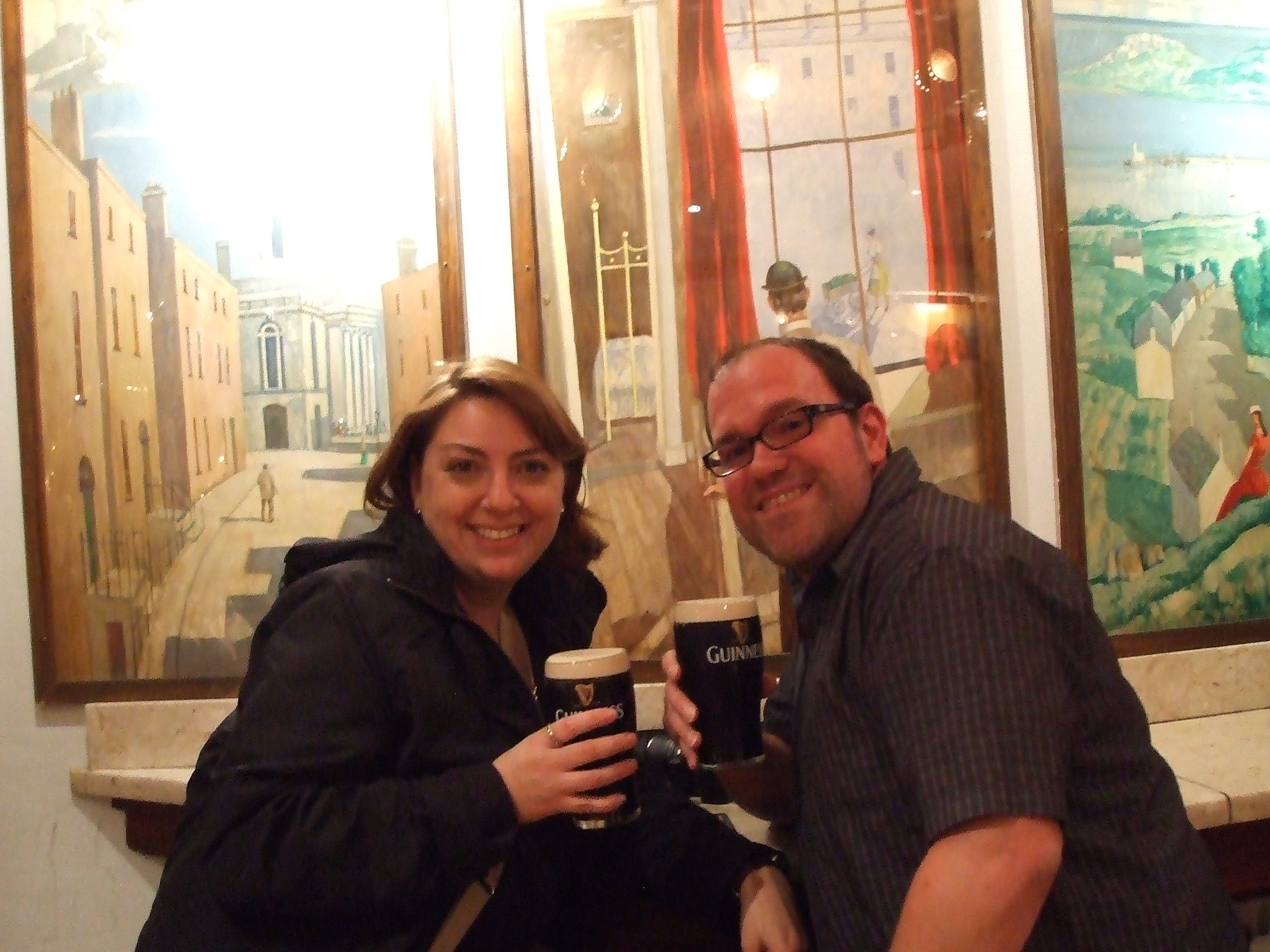
My wife Lisa and me at Davy Byrne's pub in Dublin, June 16 2011.
Readers who remember my St. Patrick's Day post may recall that Bloomsday is one of the three days a year that I consider myself “Irish by bullshit”, and I toast to Joyce with at least one pint of Guinness and a Jameson nightcap. Granted, although Bloomsday is big in Dublin and recognized in a handful of American cities, it doesn't have a reputation as a hardcore Irish drinking occasion like St. Paddy's or your average Irish funeral. It's seen as more of a sophisticated affair. In Dublin two years ago, I got the impression that Dubliners view it as a society event. Most of the costumed participants looked like upper-class types, the cream of Dublin's social/academic elite doing their duty for an event that is important to the city, regardless of whether any of them have any meaningful personal connection to Joyce's work. Most of them were sipping wine.
Wine. Irish men and women in pubs in the city where Guinness and Jameson were born, gathered to celebrate an Irish cultural hero, and they were drinking … wine. A nod to protagonist Leopold Bloom ordering a glass of red wine at Davy Byrne's pub for his afternoon tipple in the “Lestrygonians” episode of Ulysses? Perhaps, but although I did see a few glasses of red in Bloomsdayers' hands that day, most of them were drinking white.
Snooty? Maybe. Pretentious? Most likely. But don't be put off by that, or by the fact that your English-major roommate in college used to drag you to bars on Thursday nights and forced you to listen to him debate his friends on the topic of James Joyce's work using words like ineluctable and dropping references to secondary sources like the most boring deleted scene from Good Will Hunting. Never mind all that. Ulysses is a damned entertaining book full of laugh-out-loud hilarious moments. It's a great read to enjoy while drinking and is full of interesting details about the life of the turn-of-the-century urban Irishman drinker. It contains several references to “Guinness's porter” (a description that may confuse today's beer geeks, until we realize that stout was considered a substyle of porter until the 20th Century). There's an extended sequence of drunken hallucination in a brothel written as a play script, complete with cross-dressing, and a memorable scene of a sexy barmaid working the … ahem … “polished knob” of a tap handle with delicate hands.
Oh yeah, that's the other thing. Ulysses is full of dick and fart jokes. In my opinion, that makes it perfect for dads everywhere. Why not combine it with Father's Day? So I ended my day with a miniature Irish feast for Bloomsday.
Not long after Lucian's birth, I kegged an Irish-style dry stout that I brewed in late March (first discussed in the above St. Patrick's Day post) and named it Anna Livia Dry Stout in honor of a character from another Joyce novel, Finnegans Wake. The recipe for the brew can be found here in my new recipes section. I brewed the stout as a substitute for Guinness specifically for this occasion, and it didn't disappoint: deep black and roasty, dry but with a touch of sweetness in the middle and a robust mouthfeel that I found wanting the last time I drank canned Guinness Draught. Best of all, Anna Livia came in at a very sessionable 4% ABV. The only thing that was lacking was the trademark tang that Guinness achieves by adding a little bit of soured beer to each batch. The next time I make it, I'll try to recreate that effect by adding a little lactic acid to the wort. Sure, it's cheating and I don't generally like to add extraneous ingredients, but seeing as how the alternative would be to use sour beer and risk infecting my good equipment, I think I can make an exception.
To go with the stout, we had cabbage braised in the same stout with bacon, and a selection of cheeses: Irish cheddar, Gorgonzola (in honor of Leopold Bloom's Gorgonzola sandwich from Davy Byrne's), and English Red Leicester (not a Ulysses reference but great cheddarish cheese that reminds me of my time in the British Isles).
I also baked a raisin-free soda bread from this recipe from IslandVittles.com. Of course, I substituted Anna Livia for the Guinness. Though I've been baking bread for a couple of months now, this was my first soda bread. It was so good I will be making it again: crumbly and sweet, an excellent counterpart to the Gorgonzola. And the leftover slices were spectacular with butter and honey a day later.

Not quite the culinary equivalent of a James Joyce novel, but easier to get through in one sitting.
It was a great way to spend a first Father's Day, and I got off light in that I was able to divert much of the fuss away from myself and onto one of my favorite annual geek observances. It also gave me a great excuse to brew something special for the occasion, something I'd love to do again in the future. But with Father's Day falling the day before Bloomsday next year, I think I'm going to need a new angle if I want to do a Father's Day brew.
Anyone have any Father's Day brews they'd like to share the recipe for? I need your ideas! Only 364 days left to plan.
Homebrew Tips for New Dads: Commemorating the event, a great excuse to drink!
Well, I’m back. – Samwise Gamgee
I haven’t written for this blog in nearly two months, as I’ve gradually adjusted to the ups and downs of being a father to my first child. Learning how to change, bathe, and sing Queen songs (including a special diaper-time version of “Bohemian Rhapsody” with peepee-related lyrics) to my newborn son Lucian was only the beginning. I also learned to deal with: an increased share of the housework to help Momma, an upheaval of my sleep schedule, a return to my day job, and the happy stress of many wonderful visits from friends and family anxious to meet the little dude in the blue onesie.
With all of that going on it was hard to find time to write, which was fine because I wasn’t doing all that much to write about. If your blog is about homebrewing, when you ain’t homebrewing you ain’t got much to say.
Did you catch that? Practically no homebrewing for two months. The horror! Almost as horrific as the fact that “bottle washing” means something entirely new to me now that I have a baby (interestingly, I don’t dread washing baby bottles like I did beer bottles – no labels).
Even though I haven’t done much brewing, I have partaken liberally of the fruits of my homebrewing labor. Thanks to some careful planning before the birth, I’ve managed to keep the pipeline flowing during my hiatus. But preparing for these brewless weeks wasn’t just about making sure I had enough booze to get through the newborn period. Far from it. You see, I’m a commemorator.
The things we create – a beverage, a story, a carpentry project, even the name we give to a child – form a record of our past. Each creation is a snapshot of who we were when we created it, a representational image of our brain at the moment of creation. Those snapshots exist long after the “me” responsible for the creation has changed forever – years after, if we’re lucky – and are like little running shoes for the feet of our memories. That’s one of the reasons why I believe every human being should create … something.
Of course, if what you create is consumable food products like beers and meads, there’s a shelf life to consider, so they won’t last forever. Sure, the right brews (imperial stouts, barleywines, meads, fruit wines) can be cellared for years if designed and handled properly, but at some point you’ll open and empty the last bottle. They’re not quite as permanent as other creations can be. But the unique thing about brewing to commemorate important life events is that the enjoyment of those creations (i.e., the drinking of the beer after it’s fermented/aged) creates its own memories that are worth holding onto in their turn.
The day we brought Lucian home from the hospital, Lisa and I shared a bomber of Le Petit Plésiosaure Saison, a Summit-hopped saison loosely adapted from Brooklyn Sorachi Ace that I brewed in February. The name (French for “the Little Plesiosaurus”) is an homage to an adorable cartoon poster of the Loch Ness Monster we have hanging in Lucian’s room. We gave bottles of the saison out as favors to friends who came to our baby shower and asked them not to open it until we announced the birth, and we did the same.

C’est bon ça!
I’m thrilled to report that this saison exceeded my expectations and also wowed my friends, not all of them beer geeks: a refreshing, dry, aromatic and spicy saison perfect for late spring/early summer that hides its 8% ABV under layers of citrus, chamomile and subtle phenolics. We’ve made it through nearly all of the bottles we had left over, and that’s okay. This beer was intended for drinking fresh in hot weather, for refreshing breaks from the hard work of keepin’ this baby happy. When I have my last taste of it later this summer, I’ll pause to celebrate the end of the first phase of Lucian’s life and the beginning of the next. In fact, his 3-month birthday sounds like a great time to finish off the batch. Challenge accepted.
The other commemorative brew I’m enjoying between sessions of therapeutic baby bouncing is Lucian’s Landing Ginger Metheglin, a ginger mead I made in October with the goal of bottling it right before the baby was born (but Lucian landed early, so I didn’t bottle it until after). I aged it from October to April, by which time all of the fresh ginger root aromatics in the must had evaporated – only a pleasant ginger tang on the palate remained. To replace the lost aromatics, I steeped 3.5 oz of fresh ginger root in 8 oz of boiled water to make a ginger tea and added that to the carboy along with 4 oz of crystallized ginger in a muslin hop sack. After 4 weeks, I bottled it and had labels printed with my own design evoking the inspiration for my son’s name, a second-century work of early science fiction satire called True Story (often translated as True History) by Lucian of Samosata.

Protip: Even when buried beneath housework and baby care chores, always find time for Photoshop.
We plan to drink some fresh and save some bottles for special occasions (first Christmas, birthday, etc.), so the snazzy bottles were a must. Most recently we opened a bottle on Sunday, Lucian’s 2-month birthday, and found that mead paired quite well thematically with a marathon viewing of Game of Thrones Season 3 before the finale Sunday night. Pale golden and nearly crystal clear, it has just enough ginger to tickle the nose and palate before the unmistakable earthen notes of honey come in, then recede giving way to a fruity, ginger ale-like finish. I’m proud of it.

Deceptively elegant at 13.7% ABV.
I like to think that someday Lucian will appreciate things like the fact that his dad made a special mead in honor of his birth, even though he couldn’t enjoy it himself (though maybe one day, who knows …). There’s no way of knowing now, of course, but I suppose it doesn’t matter. I’ll keep doing it for myself. Being a father is hard work, and I’m sure it’s only going to get harder. Though it’s already proving to be well worth all the effort I put into it, finding time to remember “me” amid the multitude of self-sacrificing tasks to be completed has been an important step in retaining my sanity. And that’s who me is (erm, I am): A homebrewer. A commemorator. A big frickin’ sap.
My more perceptive readers may have noticed that above I mentioned “practically no homebrewing”. Don’t tell anyone, but I did manage to squeeze in one brewday before April – the month of my son’s birth – was over. That was yet another commemorative brew, but one I won’t be drinking for a long time. I’ll tell you all about it in an upcoming post. The only hint I’ll offer before then is: Ribbit.
This Sunday, remember to wish a Happy Father’s Day to your dad or a dad you know (or yourself if the gift-wrapped dress socks fit) … and to my fellow new dads out there, just starting out on this difficult but rewarding journey: have a homebrew with me. We deserve it.
Parenting: it’s like brewing a person
On April 9, my son Lucian was born.

Less than 1 day old.
Far be it from me to claim I’m an expert on the subject after doing it once, but the months leading up to the birth of a first child are a whirlwind. Preparing for the birth is like a new hobby, one that fills only a weekend or two per month early on, but quickly escalates to every weekend and eventually every day. Months pass quickly, measured in weeks between ultrasounds, the impending due date consuming more time and mental bandwidth as the trimesters tick by. There’s a nursery to paint. Furniture to pick out and assemble. Classes to take. Bags to pack for the hospital. As our due date of April 22 approached, the to-do list kept getting longer, and we sacrificed other pursuits – social life, writing, movie night – in an attempt to reach our goal of being “ready” by April 1 so we could a) leave for the hospital at a moment’s notice, and b) relax and enjoy the last few weeks of our pre-parental life before we took the big plunge.
I also prepared a number of activities to “keep me busy” during my four weeks off from work. I formulated a couple of special homebrew recipes: ready to brew. Made substantial progress on mapping out the plot of my novel: ready to draft. Worked with my screenwriting partners to complete the first draft of a feature screenplay: ready to edit. And I stocked up on DVDs and books to watch/read in my downtime.
I’ll pause here to give a moment to my readers who are experienced parents. Please, laugh derisively at my naive delusion.
By April 1, we were a little behind schedule on the prep-work but not too far behind. We were all ready to buckle down and get it done in time for April 22. Then suddenly, boom. Lucian came 13 days early, smacking me in the face with a +2 spiked club of reality. I’m still shaking my head, trying to clear the ring of stars and chirping birds circling me.
It’s amazing how quickly I transformed from “me” into this new version of me that exists primarily to serve as one half of a round-the-clock life support system for another human being. In my rare contemplative moments, I think back to those last frantic weeks of expectancy with nostalgia, like memories of a relaxing vacation.
Don’t get me wrong. The instant I first laid eyes on my son in the delivery room, a profound and inexplicable emotion anchored in my psyche immediately. I was literally overwhelmed, almost hyperventilating as my brain refused to believe what my heart felt – that there was a new person on this planet, that I had co-created him and would co-author his formative years, and that I loved him in a way I never realized was possible. I wouldn’t trade that feeling for anything, and I’m glad he decided to come 13 days early. Someday, many years from now when our days together are numbered, I’ll look back and be thankful for the extra time.
But with all that said, the last nine days have challenged my naive assumptions of what raising a newborn would be like. That stack of things to “keep me busy”? Collecting dust. I haven’t read anything that’s not baby-related. I haven’t written (until now). I’ve watched a little TV, but seeing as how it takes 4 hours to get through a single episode of Game of Thrones or Mad Men, I don’t think I’ll be making much headway on that stack of DVDs. And as for the pipe dream of scraping together eight consecutive hours to brew beer, well, I barely even have time to drink a beer.
But I dove in head first, learning the right way for each new paternal task with zeal. Every time I tried something new, I looked it up in at least two baby books and online to see if I was doing it right (I’m not bragging; it was a crutch and a hindrance). I filled my head with so much information it eventually just started dripping out of my ears unused. I soon got overwhelmed and started making mistakes: confusing Lucian’s hunger cry for his diaper cry, chilling his sensitive butt with a frigid baby wipe, failing to shield his eyes from the sun for every microsecond outdoors. Every mistake left me feeling sick to my stomach and afraid of the next mistake, certain the baby wouldn’t survive two weeks in my care. What had I gotten myself into? How stupid was I to make him cry for literally hours in the middle of the night, while I racked my brain trying to figure out what was wrong? I was clueless, in over my head. The worst father in the world. I almost welcomed the idea of Texas Child Protective Services busting down the door of my house at 4:00 am, declaring me unfit for parenthood, and taking Lucian away to someone else who could raise him right. Unlike me.
And then one night, four or five days ago but a lifetime away, was my dark night of the soul. Listening to the earsplitting (I now know what this word means) cry of my frustrated newborn, terrified that any new minute on the clock might mark the breaking point for this poor innocent creature mistakenly entrusted to my ignorant care, I wished only that I could be somewhere else. Anywhere, anywhen, back in time, off in space, a place with bright sun and serene air and good ale on tap.
The thought of beer, coupled with a crippling fear of failure, triggered memories. I remembered my first forays into homebrewing, those exciting but terrifying new days filled with similar fear and self-doubt.
For my first few homebrew batches, I sought validation for every choice I made online and in the pages of the beginner books written by Charlie Papazian and John Palmer. Was I mixing the extract and water enough? Was I cleaning my steeping bag the right way? Were plastic carboys really fine, or was I going to oxidize my brew? Was I wasting my time, and would my beer end up tasting terrible? Was I the worst brewer ever, and should I just give up?
But I wasn’t, and I shouldn’t, and I wasn’t wasting my time. I was learning on the job. It was a painful, arduous process that was nonetheless absolutely necessary. The beer wasn’t perfect, but it was far from terrible. And as I got more and more experience, I realized that so much of homebrewing was not about right vs. wrong, but just about choices. I learned to be comfortable with the choices I made, knowing they were the right choices for me – at least at the time – and for nurturing the best possible beer out of my homebrew setup. I learned to have faith that even if I made little mistakes that needed to be corrected or even apologized for, the beer would be fine.
An epiphany began to blossom in my head. I looked down at my screaming, red-faced infant son and smiled. I remembered Charlie Papazian’s oft-quoted advice to new homebrewers: Relax. Don’t worry. Have a homebrew. And I did.
Well, I didn’t have the homebrew until the next day, but you get the idea. As I drank that homebrew, I reflected on how raising a newborn is not entirely different from homebrewing. Sure, it’s a much bigger commitment and the stakes are waaaay higher. But it can be approached in the same way.
Relax. Don’t worry. Enjoy your child.
Nine days in, I’m still making mistakes and I’m still stressed out – sleep deprivation will do that to you. But amazingly, I’m starting to get the hang of it. I can tell the difference between a hunger cry and a diaper cry. I’m guessing with sufficient accuracy when Lucian needs feeding or changing, and when he just wants to suck on a finger or listen to white noise. I’m starting to feel like I sort of know what I’m doing when it comes to the basics, and I’m enjoying experimenting as I figure out how to parent more efficiently. I feel myself on the verge of a stage of parenthood analogous to being an intermediate brewer: straying from established recipes with my own adjuncts and flavors, controlling variables in my own way, putting my own twist on process and technique. And I realize the beginning wasn’t so bad. It didn’t take long at all.
Someday, though I’m sure it’s a long way away, I’ll level up to advanced, “all grain” parenting. I’ll have enough knowledge and experience to have my own ideas about how to make my child happy. I’ll be the one dispensing advice and recommendations to my friends who become parents after me. I’ll still screw up, of course. But with the wisdom of experience behind me, I’ll view my mistakes as something constructive; to paraphrase James Joyce, “portals of discovery”. I’ll screw up and fix it and clean up and apologize and analyze and solve the problem to become a better parent in the future.
And someday, I’ll pass that knowledge on to my son, perhaps over a pint of a well-crafted homebrew that he may someday brew himself.
Welcome to life, Lucian. For now, keep doing what you’re doing. Cry if you have to, but sleep when you can. You’ll need your rest. Brewing is hard work, and we’ll be doing it together soon.
More Irish than Guinness?
March is nearly over, and I haven’t blogged for a while. I just finished two consecutive restless weeks that left little time for writing: first a trip to California for my day job, and then several days of cleaning, organizing and baby-gear-assembling at the behest of my wife Lisa, who has become a prolific nester in the last weeks of her pregnancy. But if one event could pull me out of my unintended hiatus, it would be that annual celebration of all things Irish and all things alcoholic: St. Patrick’s Day.
I don’t have any Irish ancestry that I’m aware of, though there are gaps in my family tree that make it possible. But I do love all things Gaelic. Green is my favorite color. The Pogues are in heavy rotation on my iPod. James Joyce is one of my favorite authors. There’s even that whole “being named Shawn” thing. So I’m claiming partial Irish heritage until someone presents me with a notarized document proving I’m not. I call it being “Irish by bullshit,” but it is sincere bullshit.
While St. Patrick’s Day is most people’s favorite day of the year to be Irish by bullshit, for me it’s third behind June 16 (Bloomsday, the celebration of James Joyce’s Ulysses) and February 2 (Joyce’s birthday, and coincidentally the day after mine). On those days, it’s possible to find a seat in an Irish pub in Austin if I want to. On St. Pat’s, however, it ain’t. Having an aversion to drunken crowds slurring “Whiskey in the Jar”, I prefer to do my celebrating at home.
So Lisa cooked lamb-and-Guinness stew with potatoes, and sautéed cabbage on the side. The fact that she considered cooking an Irish-themed dish at all, after I once asked her to make pork kidneys for breakfast on Bloomsday, was surprising enough. But there were more surprises in store.
We bought a four-pack of Guinness Draught. She only needed one can for the stew, so that left three for me to “dispose of” without her help, on account of the little leprechaun in her belly. So I took one – er, three – for the team and drank them.
When I visited Dublin in June 2011, I drank draft Guinness constantly, because it was astoundingly delicious in the city of its birth. But back home, with homebrew and so many American craft brews available, it just doesn’t rise high enough on my list to seek it out, and I hadn’t had one since Bloomsday 2012. It’s become for me a special-occasion beer, for my “Irish days,” because it figures so heavily in the Irish culture I’m celebrating.
Let me stop you before you protest. I’ve heard the counterarguments and the accusations of Irish stereotyping. I’ve heard the assertion that Guinness is not Irish and never has been. I’ve read that it’s not popular among today’s hip Dubliners, who prefer imported lagers and craft beer. I know that its British parent company Diageo has taken a lot of criticism – most of it probably deserved – from craft beer circles. But those are modern complaints.
Maybe my outsider’s perspective is skewed, but I’ve studied Irish history. I’ve read Irish authors. I’ve listened to traditional Irish music, and I have noticed that Guinness has been celebrated in Irish culture for centuries. It’s part of Ireland’s history, and its identity as the Irish beer seems, for better or worse, to be here to stay. And I don’t mind, because I’ve always liked it.
So imagine my surprise when I poured one on March 17 and found myself disappointed at its complete lack of flavor.
I remember enjoying it last June. It seems preposterous that my taste buds could have changed so much in nine months (he said, as his pregnant wife listened in annoyed disbelief). But I’ve had a lot of great beers over the last year, many of them full of aggressive hops or intensely rich malts. Maybe I’ve desensitized my palate to the relatively tame Guinness. Whatever the reason, it tasted like nothing. No roast flavor, no sourness, no booziness. It was lacking in every way, and made me a little sad.
Maybe it was just a bad batch, but with Bloomsday coming up, I’m not taking any chances. So I’m putting my Irish-by-bullshit status to the test in a brew-off against the Bubblin’ from Dublin, with myself as judge. If I can brew my own dry stout that puts me more in the mood for a James Joyce reading than the venerable black from St. James’s Gate, maybe I can call myself worthy of that imaginary Irish heritage after all.
In the meantime, I’m sorry, Guinness, but I think we need a break from each other. It’s not you, it’s me. My palate craves a challenge. You really are a well-made beer, and lots of people are going to want to drink you, but I just need a little … more. More what? I don’t know, more roasted barley, maybe a little more alcohol. Just … more. A stouter stout.
But I promise, next time I’m in Dublin, we’ll spend lots of time together. Until then, sláinte, baby.
Here’s one for the English majors
Last night when reading Mitch Steele’s book IPA: Brewing Techniques, Recipes and the Evolution of India Pale Ale, I came across this excerpt from a poem by British poet A. E. Housman which Steele used as a chapter epigraph. I recognized two lines, which will be familiar to many of my readers:
Say, for what were hop-yards meant,
Or why was Burton built on Trent?
Oh many a peer of England brews
Livelier liquor than the Muse,
And malt does more than Milton can
To justify God’s ways to man.
Ale, man, ale’s the stuff to drink
For fellows whom it hurts to think.
Spot the familiar lines? I’ll explain just in case. The quote “Malt does more than Milton can / To justify God’s ways to man” is referenced frequently in beer culture. It appears on T-shirts and in books, and is quoted endlessly on websites dealing with homebrewing and craft beer.
It’s one of those quotes we use to validate our passion, to reclaim some respect in a world that doesn’t always understand our love of beer and occasionally confuses us with the common alcoholic. With such quotes, we seek to remind the world that many drinkers are also great thinkers: from poets (Housman) to politicians (another famous quote is uncertainly attributed to Benjamin Franklin) to philosophers (ditto, Plato).
The Housman quote has always caught my eye because of the reference to John Milton’s Paradise Lost, which Milton wrote to – in his own words – “justify the ways of God to men”, something Housman appears to claim beer can do even better. I’m not Milton’s biggest fan, but I’ve read and enjoyed Paradise Lost and was always impressed that Housman seemed to echo one of my beliefs: that a good beer is a work of art as inspiring and enlightening as the world’s great stories. But I never read the rest of Housman’s poem until today.
So imagine my surprise when I read the last two lines above: “Ale, man, ale’s the stuff to drink / For fellows whom it hurts to think.”
Wait, what? Did Housman just say that ale is for guys who can’t think?
I was shocked and confused. I felt unfairly ridiculed and indignant. Was Housman calling beer drinkers morons? Was the malt/Milton quip actually intended as a mordant satire of the self-professed mental acuity of beer drinkers Housman saw as deluded, stupid oafs? Worse still, had beer lovers around the world been bandying this quote around proudly but out of context, little realizing that if Housman were still alive he’d be laughing at us behind his awe-inspiring mustache?
Beer guys aren’t smart? Preposterous! I mean, we all know someone who fits the Hank Hill profile: a canned-lager guzzler of simple tastes, few words and fewer thoughts. But that’s just a guy who drinks beer. A beer guy is a different breed of cat entirely. Beer guys are typically nerds of a unique variety: walking encyclopedias of zythological wisdom, holding databases worth of information in their heads about beer styles, hop profiles, and personal tasting notes collected over years of self-study. Many of the smartest and most educated people I know are beer guys, and are also brilliant in other unrelated professional/creative fields. And that’s not even counting the many scientifically-minded beer writers I don’t know personally, but who have amazed me with complex descriptions of brewing chemistry and biology in terms far beyond the comprehension of my degree in English literature and classical studies.
Which brings me back to Housman, and the fact that if there’s one beer-related skill I learned in college (let’s qualify that with in class) it’s how to analyze a poem about beer. If I wanted to understand what Housman was trying to say, I needed to read the poem in its entirety. It’s entitled “Terence, This Is Stupid Stuff” and the complete text of it is here. It’s from a collection of poems entitled A Shropshire Lad, and I’ll spare you the chore of getting through a full analysis of the poem. I’ve written enough of those for one life.
The gist of it is that some drinking buddies complain to their poet friend that the poems he recites are depressing, and they’d rather have him sing a dancing song to cheer them up. The poet replies that if they want cheer, they need look no further than the beer in their cups. But he cautions his friends that the joy gained by drinking is false and temporary, and once the buzz is past, the harsh realities of life remain. Poetry, he says, should be somber, to inure oneself against these harsh realities.
The poet doesn’t have anything against beer or the people who drink it; in fact, he’s a lover of it himself. He calls it “livelier than the Muse”, and better than Milton at showing humanity a fleeting glimpse of the divine. The “fellows whom it hurts to think” are all of us – beer guys, wine guys, even guys who don’t drink. He’s not saying we’re stupid and it hurts our brains to think, but that we are human and it hurts our souls to think about the world’s imperfections.
And so my short-lived indignation on behalf of my fellow beer nerds proved unnecessary. Far from making fun of us, Housman offers a poignant, if somewhat sobering, message on the role of alcohol and art in our lives. All things considered, it’s a pro-beer message, though with a warning that beer offers only a temporary distraction from reality (but what else can we ask for from the sensory pleasures of food, drink or entertainment?).
But in context, the quote isn’t quite the joyous celebration of beer’s awesome power that I thought it was, and I bet I’m not the only one surprised. It’s a valuable lesson in the importance of learning the context of anyone’s words before we go around quoting them.
Bottling shortcuts for the bottling-averse homebrewer
No task in homebrewing gives me such mixed feelings as bottling. On one hand, it’s the last leg of the beer’s journey from grain to glass, and when the cap goes on I know the next time I interact with this brew will be when I taste it. On the other hand, it’s involved: boiling priming sugar, sanitizing 55 bottles, racking, filling and capping by hand, then breaking everything down and filling with PBW for an overnight soak takes more steps and time than any other brewing task I do except the brew day itself (and brew day leaves me with a much greater sense of accomplishment).
So when I started kegging over a year ago, I never looked back. It’s just so easy and fast: 30 minutes is about all I need to sanitize and fill a 5-gallon keg, and some homebrewers cut that time in half by keeping kegs full of sanitizing solution when not in use.
But I also make the odd 1-2 gallon test batch from time to time, and I don’t keg those. I could find smaller kegs, I suppose, but that would mean dedicating one of my three taps to small-batch experimental beer, which I’d rather not. So my test batches still get bottled. At least in theory.
In reality, I’ve been putting off bottling test batches for a while now because of the hassle. The two test batches I did over the last year – a Berliner Weisse from March 2012 and a Bronze Age Fig Beer in January – were still in fermenters in the Harry Potter closet, rapidly approaching the point where more additional time wouldn’t help them. I finally had to do what I had been putting off. And since necessity is the mother of invention, I devised ways to make it easier.
First, I got smaller bottling buckets. I used to just use my full 6-gallon bottling bucket regardless of batch size. After all, unlike the fermentation vessel, the bottling bucket is not going to hold beer for more than a couple of hours at the most, so there’s no reason not to just use the biggest one you’ve got, right?
But after thinking, I came up with several reasons why having a smaller bottling bucket would make bottling a small batch easier:
- Less surface area to sanitize
- Narrower vessel = higher fill level in the bucket, making it easier to submerge the outlet of the racking hose
- Narrower vessel = more pressure out of the spigot = faster bottle fills
- Less surface area to clean afterwards
So I made 2-gallon bottling buckets from plastic pails identical to those I use for small-batch fermenters. Instead of drilling a hole in the lid for a stopper and airlock, I drilled a hole near the base for a spigot with a 1″ spade bit:

Easy, even for someone as DIY-challenged as myself.
If you try it at home, keep a firm hand on the bucket and drill and be aware that it will cut through plastic very quickly, so a momentary loss of control can send you back to the store to buy a new bucket and start over. 1″ was the perfect diameter for my spigot, but I slipped and gouged a little extra chunk outside of the intended hole. Fortunately I was able to carefully hand-tighten the spigot to compress the interior gasket enough so that it spread to cover the leak.
The other shortcut I used was Coopers Carbonation Drops instead of bulk priming the entire batch. I’ve used these things on and off since my beginnings as an extract brewer, and I’ve been spoiled. Even now, weighing, boiling and cooling priming sugar is for some reason a huge annoyance to me and ranked among my worst first-world problems. But bulk priming does carbonate a little more consistently than the Coopers drops, so I do it, usually. But not with test batches. I consider them experiments anyway, so I’m not concerned about minute and virtually undetectable carbonation variations from bottle to bottle.
It took me an hour to sanitize two sets of equipment, rack two batches, and package 13 bottles of fig beer and 9 bottles of Berliner Weisse.
I still find kegging to be easier, and I’ll keg full-size batches whenever possible unless I have a reason to bottle them, in which case I’ll have to break out the big bucket and clear a couple of hours on my calendar. I also have a new Blichmann BeerGun I haven’t yet used which can bottle force-carbonated beer from the keg, but I’ll probably limit its use to bottling a few off the keg to give to friends. For test batches, I think I’ve found my process.
And the right equipment makes every process easier. It’s great to know that now, with a few additions to my homebrew arsenal, bottling is no longer a chore to dread, but a milestone to look forward to.
Une saison à la maison
Saison.
In French, the word means season, as in the seasons of the year. Spring, summer, autumn, or winter. A generic term, a category with specimens so varied that each is the opposite of another.
Perhaps it’s no coincidence that the beer style we call “saison” is a varied, open-ended style as well. Call it a seasonal beer unattached to a particular season.
Okay, that’s not entirely true. Look it up anywhere from Wikipedia to the BJCP Style Guidelines, and you’ll learn that saison has its roots in the farmhouses of the French-speaking Walloons of Belgium who spent the winter brewing spicy, refreshing ales to be consumed in the summer by workers pulling long shifts in the fields. So traditionally it’s a summer beer.
But the Wallonian brewing tradition was highly improvisational and localized. Each farmhouse brewed their own beer with the ingredients available at the time, often raised on their own farms. The resulting beers were, unsurprisingly, vastly different from place to place and from month to month.
So unlike the seasonal beers of, say, Germany – which tend toward profile standards of characteristic Teutonic rigidity, with names easy to mark on your calendar like Märzen, Maibock, and Oktoberfest – this traditional Belgian seasonal can be light or dark, strong or sessiony, and anything in between. A December 2006 Style Profile article from Brew Your Own magazine lists a wide disparity of characteristics for the modern style in regards to color, mouthfeel, residual sweetness, strength, hop profile, and spices. The main common thread is the yeast, descended from traditional Belgian strains that produce a characteristic spiciness, an estery je ne sais quoi that makes these beers decidedly farmhousey, even when made in the (sub)urban backyard.
With that range of profiles, I’d say seasonality goes out the window. A strong, dark, spicy saison would be a great nightcap on a cold winter night. I like light, refreshing saisons in spring (I’m pretty sure spring in Texas feels like summer in Belgium anyway). So I brewed one now to be ready by the last week of March.
There was another reason for my timing besides the oncoming vernal equinox. The last beer my wife and I drank together was a bomber of Brooklyn Sorachi Ace, the day before we learned she was pregnant. Our baby is due in April, so what better beer to have on hand to celebrate her return to the world of the ethanol-metabolizing than a hop-forward saison?
I started my brew with a clone recipe of Brooklyn Sorachi Ace from the December 2011 issue of Brew Your Own and a Gallic sense of laissez-faire. The recipe called for 11 lbs (5 kg) of Belgian Pilsner malt, which I increased to 11.75 lbs (5.33 kg) to compensate for lower efficiency on my system (more on that below). This made up the bulk of the fermentables along with 1 lb (453 g) of dextrose in the boil. The recipe also used a 3-step mash, which I did not. I did a single infusion mash at 146°F (63°C). The low mash temperature makes a more fermentable wort, but saccharification takes a little longer so I mashed for 90 minutes instead of my usual 60.
Brooklyn Sorachi Ace is hopped entirely with Sorachi Ace hops, which I couldn’t get locally. Instead of replacing it with a similar substitute, I took a different path entirely. I used 16% AA Warrior hops for neutral bittering, two additions of .37 oz (10.5 g) each at 60 and 30 minutes (~6 AAU in each addition). At flameout, I added 3 oz (85 g) of 15% AA Summit.
I had prepared a 2-liter starter of White Labs WLP 560, an Austin Homebrew Supply-exclusive Classic Saison Yeast Blend. That starter was decanted and pitched into a wort with an OG of 1.073, eleven points higher than my target OG of 1.062. Eleven points!

Not your grand-père’s farmhouse brewery.
Little mishaps are common in brewing, and usually a good sign. Minor, easily correctable problems during the brew day keep the brewer on his/her toes, and (I think) make us less prone to serious mistakes that can’t be fixed. But overshooting target gravity by this much is a new kind of problem for me.
Is it even a problem? Obviously my efficiency is much higher than I thought – I’m noting the data for future batches – and the extra malt I added was unnecessary: a “problem” many brewers would love to have. I’m not entering any contests, so the fact that my OG landed past the upper limit of the BJCP range for saison doesn’t concern me. If it fails to attenuate completely, I may end up with a beer that’s too sweet. But if I got the kind of fermentability I was shooting for out of my low mash, that extra sugar should ferment out, leaving me with an ABV higher than I intended.
So if I’m lucky, I’ll be welcoming the spring with a dry, high-alcohol saison. Maybe it won’t be strong enough to qualify as an “imperial saison”, but it should be worthy of some noble title. I’d settle for “ducal saison” or better yet, “marchional saison”. With its extra kick, it might be a little too intense for farm work, but it sounds about right for celebrating the birth of a new Marchese.
Zyme Lord, Episode I: The phantom menace of extract-and-sugar kits
Several days ago I celebrated my 37th birthday, which was also the fourth anniversary of the day I became a homebrewer.
The day I became a homebrewer was not the day I brewed my first beer. That day was long ago in the remote fog of memory we call the 1990’s. It was the year I turned 21, and I got a 2-gallon Mr. Beer starter kit for Christmas. It came with a can of prehopped malt extract and called for a pound of table sugar. There was no boil and I think Fleischmann’s baking yeast was involved. At bottling (a week later!) I spooned loose sugar into each bottle for priming as directed.
The beers tasted like cider vinegar. Carbonation varied wildly from bottle to bottle. At the time, I assumed bad taste and inconsistency were inevitable. After all, I made beer at home, dude! I laughed at the comments and pinched faces of the friends drinking with me and enjoyed the buzz. Remember, I was 21.
And despite the results, I had fallen in love with the idea of brewing my own beer.
I was also trying to finish college, and didn’t find time to brew again. When I left home for grad school, Mr. Beer traveled with me. But it stayed in the box, and for years I kept it in the closet of one apartment after another until one day I finally just threw it out, vowing to brew again “someday”.
Four years ago, I got another starter kit on my birthday: the Coopers Micro-Brew Kit. In some ways it was like Mr. Beer grown up. The fermenter was bigger (30 liters/7.9 gallons). It came with proper brewing yeast and sugar drops for consistent priming. But the extract was still canned and prehopped, it still incorporated simple sugar (dextrose boxed with the kit) and recommended no boil. The beer also came out cidery, not how I wanted.
But I also got several books about brewing that birthday. Charlie Papazian’s The Complete Joy of Homebrewing and John Palmer’s How to Brew piqued my interest immediately and I read them from cover to cover. My homebrew wasn’t great, but I was reading about how great homebrew could be. I soon understood why extract-and-sugar kits yielded cidery beers. I realized what my own mistakes were. I looked forward to the next batch and considered what I would do better.
I had become a living embodiment of learning, ambition and self-challenge in the pursuit of better beer. I had become a homebrewer.
I brewed four Coopers batches before I ever touched grain or hops. Then I started working with extract, steeping grains and hop pellets. Then partial mashes for a year, and my first mead and cider. Less than two years after I got my Coopers kit, I brewed my first all-grain beer.
Now when I drink a pint of beer made from scratch from my own recipe, I’m often amazed how far I’ve come. And from what humble beginnings.
Extract-and-sugar systems like Coopers or Mr. Beer (which was purchased by Coopers in April 2012) are looked down on by many homebrewers. Some of that contempt is deserved. These systems oversimplify brewing to a fault: by limiting exposure to real ingredients and brewing processes, they take a lot of risk out of brewing, but at the cost of greatness. It’s almost impossible to fail to make beer with them, but equally impossible to make very good beer with them as sold. It’s disheartening to think of how many “homebrew curious” people must walk away from the hobby forever after tasting one batch of Coopers or Mr. Beer and assuming that’s as good as it gets.
There are also those who deride the kits for taking all the brewing out of “brewing”, and compare them to powdered drink mixes or boxed cake mix. Okay, maybe. You can’t just pour tomato sauce out of a jar onto microwaved pasta and say you made spaghetti from scratch (at least not in the Marchese family). You get more out of brewing when you put more of yourself into it, sure, but everyone has to start somewhere. With extract-and-sugar kits, you learn the basics of sanitation, fermentation, and carbonation: three essential skills a new brewer has to master, and for which there is simply no workaround in the home setting.
So extract-and-sugar is “brewing” more so than buying a six-pack is, just like jarred spaghetti sauce is “cooking” more so than going to a restaurant is. To say Coopers/Mr. Beer is “not brewing” implies that there is such a thing a “real homebrewing”, which I find a bit pompous.
Is it any wonder that some people are intimidated by our hobby? Walking into a homebrew shop for the first time can be terrifying for the uninitiated: shelf after shelf of mysterious products, bro-chatter filling the air with arcane jargon, and opinionated staff members with eccentric facial hair. My wife Lisa once ranked the homebrew shop as equal with the neighborhood comic book store as an intimidating bastion of male geekdom (and she lists beer and comics among the things she geeks on).
And there’s the cost. Extract-and-sugar kits offer a reasonably priced entry point into a hobby that can be expensive to break into, with a minimum of specialized equipment and ingredients so that if you don’t get bitten by the bug, you haven’t blown the baby’s college fund on shit you’ll never use again. These days, there are other inexpensive options available such as the Brooklyn Brew Shop 1-gallon all-grain kits that can be found at many non-specialty stores. Those kits didn’t exist when I started brewing, so I don’t know anything about how good they are. I’ll admit they seem cool.
But all-grain brewing introduces a lot of variables. I wouldn’t be surprised to hear that Brooklyn Brew Shop kits produce better beer than extract-and-sugar kits in a best-case scenario. But if something goes wrong, there’s a lot to troubleshoot. Why not master a few basic techniques first and then learn additional techniques one at a time?
Ultimately, there are many paths to the same goal of making the beer you like in the way you enjoy making it. The point I’m making is just that there’s no shame in the simple extract-and-sugar kits. With a little knowledge, like I had, they can be the start down a road to bigger challenges and better beer. And that, after all, is why we do it.
 myBrewHome
