
Old Froglegs, or: How I learned to stop worrying and love brewing barleywine
Daddy loves Froggy. Froggy love Daddy? Ribbit. – Hedy Lamarr (that’s Hedley!), Blazing Saddles
Big beers seem to be the norm for some homebrewers. The word “imperial” is thrown around at homebrew club meetings more than at Star Wars conventions, and barleywines seem far more prevalent at the homebrew level than commercially. I suspect many people become homebrewers just to hoard gallons of nose-hair singeing strong ales for a fraction of the cost of buying it commercially. Not me. I mostly drink beers around 8% ABV or lower, and my brewing habits reflect that.
Like many homebrewers, my mash efficiency suffers with bigger grain bills. I get great efficiency with beers around the 1.050 mark, but with beers around 1.070 it’s decent (not astounding). Satisfied with brewing beers mostly in the 1.050-1.080 range, I’ve haven’t bothered to rock the boat by trying a bigger brew. Over time, the idea of brewing a really big beer like an American barleywine became a little intimidating. Imagine a whole category of the BJCP Style Guidelines staring back at you when you close your eyes, whispering, “You’re not man enough to brew me, and you know it.”
Oh, but there’s nothing like having a baby to change your perspective. Faced with responsibility for an adorable but needy new organism while surviving on Clif bars and fifteen hours of sleep a week, the most intimidating non-baby-related activity in the world sounds like a vacation. That first month, I probably could’ve been talked into skydiving. So when someone suggested I brew a barleywine to commemorate Lucian’s birth, my enthusiastic response of “WHY THE HELL NOT!?” was, I’m sure, loud enough to be heard across the Texas Hill Country. I decided to make it the first beer I brewed after he was born.
I started with a name: Old Froglegs American Barleywine, after a nickname we gave Lucian within hours of being born (his legs were constantly crossed as a newborn). The recipe was big but simple, in keeping with my recent emphasis on fewer carefully chosen ingredients. 19 pounds of Maris Otter formed the base: a premium malt more expensive than plain American 2-row, and on a grain bill this big cost adds up. But Maris Otter has great flavor, and besides, how many “first beer after my baby was born”s do you get? I added 3 pounds of light Munich for melanoidins and a half-pound each of Crystal 60 and Crystal 150 for caramel and dark fruit notes. If you’re counting, that’s 23 pounds of grain (plus rice hulls) that would go into my 10-gallon cooler mash tun.
Expecting that high a ratio of grain weight to mash tun volume to seriously impact my efficiency, I took a few measures to compensate:
- Milled my own grain
- Increased sparge water/runoff and extended the boil
- Included kettle sugars for extra fermentables
By milling my own grain I hoped to achieve a finer crush than what I’d get at the homebrew store – admittedly a crap shoot, not knowing how their mills are set. I didn’t actually buy my new Barley Crusher MaltMill for this brew, but it happened to be its maiden voyage. Earlier this year I realized that brewing with a newborn around would require flexibility, since daddy tasks might pop up unexpectedly on the weekend (I was right). With a malt mill in my arsenal, I can buy unmilled grain and crush it on brew day, ensuring fresh malt even if brew day is postponed by a week or more.

Pictured above: the quantity of grain known to maltsters as a metric assload.
I doughed in at a stiff 1 qt/lb and added the rest of the liquor (to 1.25 qt/lb) only after I was sure that my mash tun would fit it all. It did, barely. I sparged to collect just shy of ten gallons of wort, which didn’t fit in the brew kettle, so I saved the extra in a pitcher and added it to the kettle as it boiled down. I didn’t actually start the boil timer until all the wort had been added and boiled down to my usual starting volume. All in all, the boil lasted about 150 minutes.

On the edge of boiling over. He’s a madman! A maaadmaaan!
Once boiling was underway I added a pound – 2 pressed cones – of piloncillo (a.k.a. panela), an unrefined cane sugar particular to Latin American cuisine. I’d had it in the pantry for some time and it seemed a great addition to a barleywine, with its rich molasses flavor and high fermentability leaving the beer high in alcohol and low on cloying sweetness. Protip: smashing the cones with a meat tenderizer before adding them is great stress relief.
I added only 60-minute hop additions to the boil for bitterness. I had 1.75 ounces of Warrior and 1 ounce of Galena in the freezer, so I used them. I also added yeast nutrient to the boil because of the high gravity and 4% adjunct sugars.
I met my gravity target and then some, achieving an OG of 1.114. I pitched 2.5 packets of Safale US-05 dry (I ran out of time to rehydrate) and it took off like a rocket, with bubbles coming through the airlock less than 16 hours later. Two weeks later, the beer was at 1.023, which appears to be its final gravity. I racked it to a carboy at the end of May.
It’s going to stay there for months. I plan to bottle it in November so it’s ready to drink on Lucian’s first Christmas. Since I’m not an everyday barleywine kind of guy, I’ll save it for special occasions, birthdays and other milestones. I think I can get several years of good aging out of it if I treat it right. Even if it starts to decline after a while, I have to save at least one bottle to share with Lucian on his 21st birthday.
And then I can embarrass the hell out of him with the Froglegs thing.
Homebrew Tips for New Dads: Commemorating the event, a great excuse to drink!
Well, I’m back. – Samwise Gamgee
I haven’t written for this blog in nearly two months, as I’ve gradually adjusted to the ups and downs of being a father to my first child. Learning how to change, bathe, and sing Queen songs (including a special diaper-time version of “Bohemian Rhapsody” with peepee-related lyrics) to my newborn son Lucian was only the beginning. I also learned to deal with: an increased share of the housework to help Momma, an upheaval of my sleep schedule, a return to my day job, and the happy stress of many wonderful visits from friends and family anxious to meet the little dude in the blue onesie.
With all of that going on it was hard to find time to write, which was fine because I wasn’t doing all that much to write about. If your blog is about homebrewing, when you ain’t homebrewing you ain’t got much to say.
Did you catch that? Practically no homebrewing for two months. The horror! Almost as horrific as the fact that “bottle washing” means something entirely new to me now that I have a baby (interestingly, I don’t dread washing baby bottles like I did beer bottles – no labels).
Even though I haven’t done much brewing, I have partaken liberally of the fruits of my homebrewing labor. Thanks to some careful planning before the birth, I’ve managed to keep the pipeline flowing during my hiatus. But preparing for these brewless weeks wasn’t just about making sure I had enough booze to get through the newborn period. Far from it. You see, I’m a commemorator.
The things we create – a beverage, a story, a carpentry project, even the name we give to a child – form a record of our past. Each creation is a snapshot of who we were when we created it, a representational image of our brain at the moment of creation. Those snapshots exist long after the “me” responsible for the creation has changed forever – years after, if we’re lucky – and are like little running shoes for the feet of our memories. That’s one of the reasons why I believe every human being should create … something.
Of course, if what you create is consumable food products like beers and meads, there’s a shelf life to consider, so they won’t last forever. Sure, the right brews (imperial stouts, barleywines, meads, fruit wines) can be cellared for years if designed and handled properly, but at some point you’ll open and empty the last bottle. They’re not quite as permanent as other creations can be. But the unique thing about brewing to commemorate important life events is that the enjoyment of those creations (i.e., the drinking of the beer after it’s fermented/aged) creates its own memories that are worth holding onto in their turn.
The day we brought Lucian home from the hospital, Lisa and I shared a bomber of Le Petit Plésiosaure Saison, a Summit-hopped saison loosely adapted from Brooklyn Sorachi Ace that I brewed in February. The name (French for “the Little Plesiosaurus”) is an homage to an adorable cartoon poster of the Loch Ness Monster we have hanging in Lucian’s room. We gave bottles of the saison out as favors to friends who came to our baby shower and asked them not to open it until we announced the birth, and we did the same.

C’est bon ça!
I’m thrilled to report that this saison exceeded my expectations and also wowed my friends, not all of them beer geeks: a refreshing, dry, aromatic and spicy saison perfect for late spring/early summer that hides its 8% ABV under layers of citrus, chamomile and subtle phenolics. We’ve made it through nearly all of the bottles we had left over, and that’s okay. This beer was intended for drinking fresh in hot weather, for refreshing breaks from the hard work of keepin’ this baby happy. When I have my last taste of it later this summer, I’ll pause to celebrate the end of the first phase of Lucian’s life and the beginning of the next. In fact, his 3-month birthday sounds like a great time to finish off the batch. Challenge accepted.
The other commemorative brew I’m enjoying between sessions of therapeutic baby bouncing is Lucian’s Landing Ginger Metheglin, a ginger mead I made in October with the goal of bottling it right before the baby was born (but Lucian landed early, so I didn’t bottle it until after). I aged it from October to April, by which time all of the fresh ginger root aromatics in the must had evaporated – only a pleasant ginger tang on the palate remained. To replace the lost aromatics, I steeped 3.5 oz of fresh ginger root in 8 oz of boiled water to make a ginger tea and added that to the carboy along with 4 oz of crystallized ginger in a muslin hop sack. After 4 weeks, I bottled it and had labels printed with my own design evoking the inspiration for my son’s name, a second-century work of early science fiction satire called True Story (often translated as True History) by Lucian of Samosata.

Protip: Even when buried beneath housework and baby care chores, always find time for Photoshop.
We plan to drink some fresh and save some bottles for special occasions (first Christmas, birthday, etc.), so the snazzy bottles were a must. Most recently we opened a bottle on Sunday, Lucian’s 2-month birthday, and found that mead paired quite well thematically with a marathon viewing of Game of Thrones Season 3 before the finale Sunday night. Pale golden and nearly crystal clear, it has just enough ginger to tickle the nose and palate before the unmistakable earthen notes of honey come in, then recede giving way to a fruity, ginger ale-like finish. I’m proud of it.

Deceptively elegant at 13.7% ABV.
I like to think that someday Lucian will appreciate things like the fact that his dad made a special mead in honor of his birth, even though he couldn’t enjoy it himself (though maybe one day, who knows …). There’s no way of knowing now, of course, but I suppose it doesn’t matter. I’ll keep doing it for myself. Being a father is hard work, and I’m sure it’s only going to get harder. Though it’s already proving to be well worth all the effort I put into it, finding time to remember “me” amid the multitude of self-sacrificing tasks to be completed has been an important step in retaining my sanity. And that’s who me is (erm, I am): A homebrewer. A commemorator. A big frickin’ sap.
My more perceptive readers may have noticed that above I mentioned “practically no homebrewing”. Don’t tell anyone, but I did manage to squeeze in one brewday before April – the month of my son’s birth – was over. That was yet another commemorative brew, but one I won’t be drinking for a long time. I’ll tell you all about it in an upcoming post. The only hint I’ll offer before then is: Ribbit.
This Sunday, remember to wish a Happy Father’s Day to your dad or a dad you know (or yourself if the gift-wrapped dress socks fit) … and to my fellow new dads out there, just starting out on this difficult but rewarding journey: have a homebrew with me. We deserve it.
From the Cellar: an Auld Lang Stout
With highland-like winter winds dropping the temperature outside to near freezing and the tune of “Auld Lang Syne” still in my head, it’s no surprise that my thoughts turned to Scotland for my first cellar beer of 2013. My attention was captured by a couple of bottles from BrewDog that I’ve been cellaring for the better part of a year.
I consider myself a BrewDog fan. Based in northern Scotland, they’ve earned a reputation for extreme beers. Three of their beers – Tactical Nuclear Penguin, Sink the Bismarck!, and The End of History – were freeze distilled to achieve ABVs of 32%, 41%, and 55% making each the “strongest beer ever made” at the time it was released. I stopped into their brewpub in Edinburgh twice while visiting the UK in 2011 and tried both Tactical Nuclear Penguin and Sink the Bismarck!. Served at a premium price in tiny pours (I believe they were 50 mL, not quite 2 ounces) and made for sipping, they weren’t drinks I would ever reach for when I wanted a “beer”, but they were enjoyable, unique and worthy of the recognition they received worldwide.
But BrewDog’s history of record-chasing hasn’t brought them unanimous appreciation at home. They’ve courted controversy, been targeted by industry watchdogs, and feuded with London-based international beverage giant Diageo. A couple of UK natives I’ve spoken to have even told me they didn’t appreciate BrewDog bringing American-style brewing excess to the British Isles, though their growth and success suggest that’s a minority opinion. In any case, from here in the USA – where excess in brewing often manifests itself through the same old tricks: higher gravity, more hops, stranger microbes, etc. – BrewDog’s innovative excess looks very original to me, and I’m glad they’re in business.
A 12-ounce bottle of BrewDog Paradox Isle of Arran Imperial Stout, barrel aged in scotch whisky barrels and 10% ABV, sounded perfect to stave off the cold. I put it in the fridge for a few hours to chill slightly and served it up.

The beer poured almost black, with chocolatey brown hues showing when the light hit the pouring beer just right. It didn’t pour nearly as thick or syrupy as I expected it to, suggesting a thinner body than many other imperial stouts. Once in the glass, it was tar black with no head.

The aroma was strong with scotch whisky at first, and burned my nose a little. As I continued to sniff, it faded to a barleywine-like booziness with raisin and black cherry notes along with blackstrap molasses and mouthwatering caramel.
Strangely, the flavor was very mellow – a bit too much so. I tasted more raisin than anything, with a little oaky whisky flavor underneath but very little indicative of an imperial stout; it tasted more like a very dark English old ale. As the beer warmed to room temperature, a little bit of roasty stout character emerged, but not enough to balance the whisky notes. And as the pour suggested, the beer was very thin, with very little residual sugar to hold up the whisky and raisin notes.
I suspect that I aged this beer too long, which is a shame. It didn’t taste stale, but was unbalanced, as though some flavor notes faded faster than others. For a brewery known for extreme beers, this one came across as soft in the wrong ways. But I won’t fault BrewDog for that. I’d love to buy another bottle and try it again someday, but it seems the Paradox line has moved on to other things.
Whatever is next, I’ll be watching.
From the Cellar: December, bomber by bomber
I have an ever-growing collection of 22 oz and 750 ml bottles of beer cellaring in the Harry Potter closet. I save them for interesting meal pairings or other special occasions (which includes “another Sunday”). So December – a time of parties, good meals, multiple Christmas celebrations and the new year – is a perfect time to catch up on the cellar back stock. By which I mean drink them, of course.
It’s also when a lot of breweries release special beers, so I’ve found a few to fill the empty spaces in my cellar as I drink them up. Here’s a quick review of some recent bombers I’ve tasted and bought, and a preview of what I’m uncapping next.
This past Saturday, I opened a Stone Enjoy By 12.21.12 IPA. The occasion? Nothing more than resting up after seeing The Hobbit twice on Friday, and a December evening warm enough to put some filet mignons on the backyard grill. Steak and IPA aren’t two things I pair often, especially not when the steak is seasoned boldly (I used some coffee-chipotle rub left over from Thanksgiving), but time was running out on this time bomb of a bomber. The spicy beef and spicy beer matched better than I expected. The beer was light in color, with less melanoidin flavor than I usually want from an IPA, but I didn’t mind the hops overtaking the light malt profile. It was fresh, grassy, floral and spicy. Like a morning stroll through an English garden in spring. With a steak.
Then on Sunday, my wife Lisa and I had an early “Christmas” dinner: leg of lamb with garlic, lemon and herbs, which I paired with a bottle of Boulevard Collaboration No. 3 – Stingo that I’ve had for several months. Not knowing anything about “stingo” – a strong English style – except what was on the label, I expected deep malt and spice with a hint of sour tartness. I thought it would be a natural pairing for lamb with a little tangy mint sauce, but I was disappointed. There was some malt roastiness and a tang on the finish, but nothing in between. Not enough malt backbone, not enough depth, and not enough sourness to be pleasant. I had a lot of trouble finishing it, and that’s the first time I can say that about a Boulevard beer. Realizing it had been in storage for a while, I checked the date on the label, and it wasn’t out of date. Just not my thing, I guess.
I also bought a few new beers for my collection: a Stone 12.12.12 Vertical Epic Ale, a Brooklyn Black Ops, and a Samuel Adams Thirteenth Hour. I predict at least 2 of those won’t live to see spring.
Speaking of not living to see spring, this Friday night (December 21) I’ll open a bottle of Dogfish Head Theobroma in honor of the winter solstice and the end of the Mayan calendar. Since “theobroma” (a.k.a. cacao) is the food of the gods, this should be an excellent way to gain favor with Bolon Yokte K’uh, the Mayan god of war and creation who might be coming to destroy us all. If he is not amused and punishes me for my insolence – or if, more likely, he forgets to show up and the world continues to turn – at least I’ll be enjoying one of my favorite beers.
Saturday morning, assuming we’re alive and not already on the Dark Rift road to the Mayan underworld Xibalba, we drive to New Orleans to spend Christmas with our families there. I’m bringing a couple of bottles of Samuel Adams Norse Legend Sahti for Christmas Day. I haven’t tried it yet, but it should be something interesting to introduce to non-beer geeks in the family. The label might even open up some geeky discussion about Norse mythology, which I recommend highly as an excellent conversation topic, especially over grandmother’s Christmas lasagna.
Then there’s a bottle of Samichlaus Bier Helles which won’t see any action until New Year’s Eve. January 1 is Lisa’s birthday, and this year she can’t drink to celebrate thanks to our bouncing, kicking bun in the oven. So we’re having a small celebration at home starting on New Year’s Eve. Samichlaus, a rare Helles bock brewed only once each year by Brauerei Schloss Eggenberg in Austria, will be a fitting send-off to 2012: a very special beer for a very good year.
Unfinished business
With November half over, I'm faced with several unfinished brewing projects and more on the way.
A few days ago, I racked my ginger mead to a carboy for conditioning. Because of my pathological aversion to work which isn't absolutely necessary, I'm a believer in long primaries and won't rack beer to a carboy unless there's a damned good reason (no empty keg available, need the primary vessel for a new beer, cat fur stuck to the inside wall of the bucket, etc.) and I get good beer with up to 6 weeks on the yeast cake.
But for mead, we're talking upwards of 6 months of conditioning, and for that there's no way around racking to a carboy. Not only is it better to get the mead off that autolyzing yeast for the extended aging, but it's essential for clarity: the mead won't clarify until it's removed from the gross lees. It's amazing, in fact, how quickly it does start to clarify as soon as it's racked. Just a few days have passed since I racked it, and it's already several shades darker than it was in the primary due to the yeast flocculating out.
At racking time, the gravity measured 1.001 and the mead had a fruity, floral taste with a little ginger bite but sadly no hint of ginger in the flavor or aroma. My fermentation chamber did its job well keeping the fermentation cool, and it had none of the fusel alcohols my other (uncontrolled temperature) meads had this early on. It might even be ready in less than 6 months, but I have reasons for waiting until April to bottle it. Until then, I'll rack it every 6-8 weeks, add a few Campden tablets occasionally to prevent oxidation, and maybe hit it with some Sparkolloid closer to bottling time. And definitely some more ginger before bottling.
I also took the first gravity sample from the Colonial Progress Ale I brewed 11 days ago. The wort turned out a bit more fermentable than I expected and is currently at 1.009, with an ABV of 4.8% (and the WLP008 yeast, a notoriously slow flocculator, might still be working). It's got a fruity tang I expected from this yeast, and very minimal cidery character from the simple sugar of the molasses. It's really a nice easy-drinking session beer that should be very enjoyable when the yeast settles out. The juniper and sweet gale have largely faded, though. I'll add more spices to the fermenter before kegging. Who knows, I might even rack the beer for the occasion.
The next project on the horizon is an inventory cleaning extravaganza! I've got lots of open hop packets from over the course of the past year that I'll use in a beer to be brewed the day after Thanksgiving. I spent some time tonight rubbing hop pellets between my fingers (while watching Moonshiners on Discovery Channel … now those guys are pros) smelling them and even tasting some of them to make sure they were still hoppy and had none of the telltale cheesiness of bad hops. Fortunately, only a half ounce of Warrior left over from February had any distinctive cheesy notes, so back into the freezer it went to keep on aging until it magically changes from “cheesy” to “aged” and I can use it in a lambic. The other open hops made the cut and will be used next week. More on that recipe soon!
The Buddha and the King
On a beautiful, cool Saturday afternoon wedged between days of thunderstorms, Jester King Craft Brewery released their new Buddha’s Brew ale during their weekly open house. Beer hipsters (and garden variety hipsters) descended on the brewery for a turnout that scuttlebutt suggests was the biggest the brewery has ever seen on a “non-event” Saturday.
The new ale is a collaboration between Jester King and Austin kombucha company Buddha’s Brew. It’s Jester King’s first beer fermented entirely in oak. The wheat ale wort was pitched with bacteria and fermented in the barrel, then aged for nine months before blending it with Buddha’s Brew Classic Flavor Kombucha. Buddha’s Brew was also on location Saturday giving out free kombucha by the sample and cup. I’ve been a fan of their kombucha for years, so I was excited about the collaboration.
I haven’t been to Jester King in several months, so I was surprised to find a new system in place for the beer tasting. In the old system, $10 bought you a tulip glass and three full pours of whatever you wanted. Now, for $10 you get a card listing the day’s menu with a check box next to each of the 7 beers available:

One ticket to paradise, with a kombucha to go.
The bartenders poured 5.5 oz of whatever you ordered and marked the box next to it on the card. If you tried them all, it would equate to a little over two pints of beer and a keepsake glass for $10. So it’s not the steal it used to be, but it’s still a great value, especially if you can get there early enough to go back through the (very long) line 7 times during the 3-hour window they’re open. Even though this new system effectively raises the price per ounce over the previous system, it encourages beer flights instead of pounding pints as quickly as possible. The limited-release selections du jour are thus available to more attendees, and fewer frat boys are stumbling around drunk from too many Black Metals. I’m not sure if the new system was just for this event or if this is how they do it every week now, but I’m a fan of it in theory … if they can get the line moving a little faster.
I started with Buddha’s Brew, the hot new starlet on the set. It was straw-colored with little head and smelled like a Berliner Weisse: lactic, light and wheaty, though I was hoping for more fruitiness on the nose. It tasted like a Berliner Weisse too. Tart, refreshing and wheaty with some vinegar notes and a pleasant mouth-puckering tartness. My only complaint was that it was less complex than I expected. The kombucha didn’t add much flavor; no fruitiness, no earthiness. Nor any oakiness or vanilla from the barrel aging. It could have been any sour wheat ale, albeit a well-made one. Note that I would gladly drink it again if there weren’t more interesting beers available.


My third pour was Mad Meg, an organic bière de provision – a high-alcohol continental style intended for extended aging. At 9.6% ABV, it was a step up from my earlier tastings but smooth enough not to be a shock. It poured a handsome red-orange I attribute to Cara-Munich malt, but I enjoyed thinking of it as an “albino amber”. The aroma was mouth-watering: floral hops and a rich mandarin-like citrus with noticeable alcohol. The flavor didn’t disappoint, either, delivering piney hop bitterness at the start and boozy, bready malt on the finish with no alcohol burn. It was smooth and brilliantly balanced, easy to drink on a fall afternoon or warm enough for a cool night.
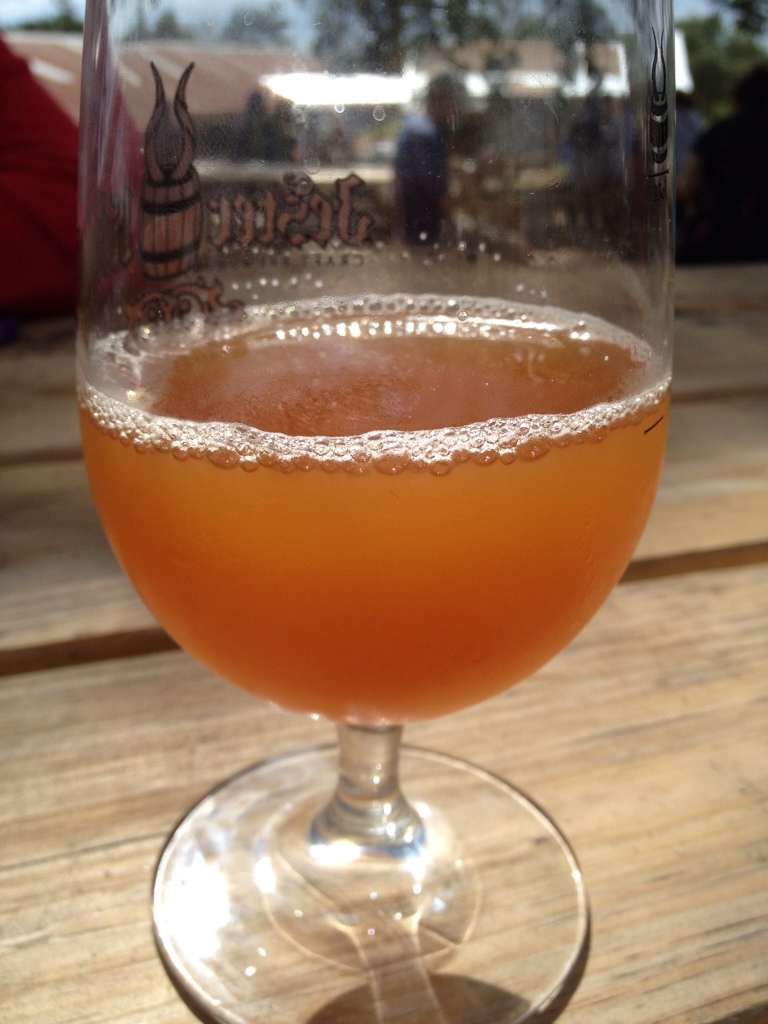
I made my way through the tastings leisurely and only got three in my 90 minutes there, but it was well worth the price of admission. Between beers I cleansed my palate with lots of free kombucha from the Buddha’s Brew tent (thanks!). Peach and Pineapple-Super Greens flavors were on tap and delicious.
I left happy (alcohol + probiotics, mmm mmm good!) and inspired. I’ve been thinking about homebrewing kombucha for a long time, and I might start soon using some Buddha’s Brew dregs to culture a starter SCOBY. Someday I actually hope to have draft kombucha in the kegerator for those non-beer occasions. I’m not sure I’ll ever use it in a beer myself, but who knows? And I toast Jester King for their innovation. After all, that’s what supporting local business is all about.
Tips for Retailers and Homebrewers alike
Close on the heels of the recent battle with my kegerator over the pressure of my kegs (which I’m happy to report has been stable at 8 PSI since my last post), I saw an article shared on Facebook dealing with storing and dispensing draft beer. The article, written by Julia Herz and published on craftbeer.com back in January, is here:
“Frosted Glassware Is Not Cool: Temperature Tips for Craft Beer Retailers” by Julia Herz
Ostensibly a “cheat sheet” for craft beer retailers to teach them to properly store, dispense and serve craft beer consistent with the demands of an ever-more-knowledgeable clientele of brew enthusiasts, it’s still great information for a homebrewer to have. Especially one who’s kegging and serving their homebrew on draft.
It’s also timely advice for a lot of Central Texas taprooms, now that we’re in the hottest month of the summer. Many bars here are used to serving tall frothy helpings of pee-colored American lager in frozen mugs to guys coming in off the hot asphalt and looking for something cold, wet and flavorless to slake their thirst … not knowing better, many of them assume colder is better and serve craft beer in frozen mugs too.
No.
Frozen glasses are never right for craft beer. Never. Seriously. They numb the tongue and desensitize the tastebuds. Next time you’re at a pub and you order a glass of some rare new offering from Belgium or California or Rehoboth Beach at $9 for 12 ounces, and your bartender brings it to you in a frozen glass: send it back.
I don’t care how hot it is outside. You paid premium for that beer. You deserve to taste it. And you should tell them so. Otherwise, how are they ever gonna learn?
The one thing in this article I don’t fully agree with is the assertion that all bottled and kegged beers should be kept refrigerated. For bars and pubs, maybe. They need to turn out the freshest product possible. But taken out of context and at face value, this “rule” can be interpreted too broadly.
Case in point: high-end bombers sold in groceries and liquor stores. Many beers sold in 750 ml bombers benefit from long-term storage before drinking. Brett ferments and wild ales, barrel-aged and oaked stouts/porters, barley wines, and Belgian abbey-style ales all develop interesting flavor characteristics when cellared correctly (read: cool – but not cold – and dark) for several months or more. The natural microbe and oxygen reactions that develop these flavors don’t happen at refrigerator temperatures.
But too many stores selling bombers are keeping them refrigerated, presumably in an attempt to keep these high-ticket items fresher (and sellable) longer. The problem for those of us who want to age them is that unpasteurized beers don’t respond well to going from room temp, to fridge temp, to cellar temp. It won’t turn them instantly to cat piss, but it’s not recommended. A bomber that’s been refrigerated at the store has effectively had its long-term aging potential reduced – even if you slowly raise the temperature and cellar it, it’s not going to have the shelf stability it would have had otherwise. I won’t buy refrigerated bombers unless I plan to drink them soon, and I’ve been politely informing the staff at a high-end grocery store in my neighborhood of this for several weeks. I’m sure I’m not the only one fighting this fight, and I’d hate to see this cheat sheet work against our efforts if misinterpreted.
But aside from this small split in our ideologies, I think it’s full of great information, and I hope you will too. Read, learn and enjoy. Prosit.
 myBrewHome