
Homebrew Tips for New Dads: Commemorating the event, a great excuse to drink!
Well, I’m back. – Samwise Gamgee
I haven’t written for this blog in nearly two months, as I’ve gradually adjusted to the ups and downs of being a father to my first child. Learning how to change, bathe, and sing Queen songs (including a special diaper-time version of “Bohemian Rhapsody” with peepee-related lyrics) to my newborn son Lucian was only the beginning. I also learned to deal with: an increased share of the housework to help Momma, an upheaval of my sleep schedule, a return to my day job, and the happy stress of many wonderful visits from friends and family anxious to meet the little dude in the blue onesie.
With all of that going on it was hard to find time to write, which was fine because I wasn’t doing all that much to write about. If your blog is about homebrewing, when you ain’t homebrewing you ain’t got much to say.
Did you catch that? Practically no homebrewing for two months. The horror! Almost as horrific as the fact that “bottle washing” means something entirely new to me now that I have a baby (interestingly, I don’t dread washing baby bottles like I did beer bottles – no labels).
Even though I haven’t done much brewing, I have partaken liberally of the fruits of my homebrewing labor. Thanks to some careful planning before the birth, I’ve managed to keep the pipeline flowing during my hiatus. But preparing for these brewless weeks wasn’t just about making sure I had enough booze to get through the newborn period. Far from it. You see, I’m a commemorator.
The things we create – a beverage, a story, a carpentry project, even the name we give to a child – form a record of our past. Each creation is a snapshot of who we were when we created it, a representational image of our brain at the moment of creation. Those snapshots exist long after the “me” responsible for the creation has changed forever – years after, if we’re lucky – and are like little running shoes for the feet of our memories. That’s one of the reasons why I believe every human being should create … something.
Of course, if what you create is consumable food products like beers and meads, there’s a shelf life to consider, so they won’t last forever. Sure, the right brews (imperial stouts, barleywines, meads, fruit wines) can be cellared for years if designed and handled properly, but at some point you’ll open and empty the last bottle. They’re not quite as permanent as other creations can be. But the unique thing about brewing to commemorate important life events is that the enjoyment of those creations (i.e., the drinking of the beer after it’s fermented/aged) creates its own memories that are worth holding onto in their turn.
The day we brought Lucian home from the hospital, Lisa and I shared a bomber of Le Petit Plésiosaure Saison, a Summit-hopped saison loosely adapted from Brooklyn Sorachi Ace that I brewed in February. The name (French for “the Little Plesiosaurus”) is an homage to an adorable cartoon poster of the Loch Ness Monster we have hanging in Lucian’s room. We gave bottles of the saison out as favors to friends who came to our baby shower and asked them not to open it until we announced the birth, and we did the same.

C’est bon ça!
I’m thrilled to report that this saison exceeded my expectations and also wowed my friends, not all of them beer geeks: a refreshing, dry, aromatic and spicy saison perfect for late spring/early summer that hides its 8% ABV under layers of citrus, chamomile and subtle phenolics. We’ve made it through nearly all of the bottles we had left over, and that’s okay. This beer was intended for drinking fresh in hot weather, for refreshing breaks from the hard work of keepin’ this baby happy. When I have my last taste of it later this summer, I’ll pause to celebrate the end of the first phase of Lucian’s life and the beginning of the next. In fact, his 3-month birthday sounds like a great time to finish off the batch. Challenge accepted.
The other commemorative brew I’m enjoying between sessions of therapeutic baby bouncing is Lucian’s Landing Ginger Metheglin, a ginger mead I made in October with the goal of bottling it right before the baby was born (but Lucian landed early, so I didn’t bottle it until after). I aged it from October to April, by which time all of the fresh ginger root aromatics in the must had evaporated – only a pleasant ginger tang on the palate remained. To replace the lost aromatics, I steeped 3.5 oz of fresh ginger root in 8 oz of boiled water to make a ginger tea and added that to the carboy along with 4 oz of crystallized ginger in a muslin hop sack. After 4 weeks, I bottled it and had labels printed with my own design evoking the inspiration for my son’s name, a second-century work of early science fiction satire called True Story (often translated as True History) by Lucian of Samosata.

Protip: Even when buried beneath housework and baby care chores, always find time for Photoshop.
We plan to drink some fresh and save some bottles for special occasions (first Christmas, birthday, etc.), so the snazzy bottles were a must. Most recently we opened a bottle on Sunday, Lucian’s 2-month birthday, and found that mead paired quite well thematically with a marathon viewing of Game of Thrones Season 3 before the finale Sunday night. Pale golden and nearly crystal clear, it has just enough ginger to tickle the nose and palate before the unmistakable earthen notes of honey come in, then recede giving way to a fruity, ginger ale-like finish. I’m proud of it.

Deceptively elegant at 13.7% ABV.
I like to think that someday Lucian will appreciate things like the fact that his dad made a special mead in honor of his birth, even though he couldn’t enjoy it himself (though maybe one day, who knows …). There’s no way of knowing now, of course, but I suppose it doesn’t matter. I’ll keep doing it for myself. Being a father is hard work, and I’m sure it’s only going to get harder. Though it’s already proving to be well worth all the effort I put into it, finding time to remember “me” amid the multitude of self-sacrificing tasks to be completed has been an important step in retaining my sanity. And that’s who me is (erm, I am): A homebrewer. A commemorator. A big frickin’ sap.
My more perceptive readers may have noticed that above I mentioned “practically no homebrewing”. Don’t tell anyone, but I did manage to squeeze in one brewday before April – the month of my son’s birth – was over. That was yet another commemorative brew, but one I won’t be drinking for a long time. I’ll tell you all about it in an upcoming post. The only hint I’ll offer before then is: Ribbit.
This Sunday, remember to wish a Happy Father’s Day to your dad or a dad you know (or yourself if the gift-wrapped dress socks fit) … and to my fellow new dads out there, just starting out on this difficult but rewarding journey: have a homebrew with me. We deserve it.
Une saison à la maison
Saison.
In French, the word means season, as in the seasons of the year. Spring, summer, autumn, or winter. A generic term, a category with specimens so varied that each is the opposite of another.
Perhaps it’s no coincidence that the beer style we call “saison” is a varied, open-ended style as well. Call it a seasonal beer unattached to a particular season.
Okay, that’s not entirely true. Look it up anywhere from Wikipedia to the BJCP Style Guidelines, and you’ll learn that saison has its roots in the farmhouses of the French-speaking Walloons of Belgium who spent the winter brewing spicy, refreshing ales to be consumed in the summer by workers pulling long shifts in the fields. So traditionally it’s a summer beer.
But the Wallonian brewing tradition was highly improvisational and localized. Each farmhouse brewed their own beer with the ingredients available at the time, often raised on their own farms. The resulting beers were, unsurprisingly, vastly different from place to place and from month to month.
So unlike the seasonal beers of, say, Germany – which tend toward profile standards of characteristic Teutonic rigidity, with names easy to mark on your calendar like Märzen, Maibock, and Oktoberfest – this traditional Belgian seasonal can be light or dark, strong or sessiony, and anything in between. A December 2006 Style Profile article from Brew Your Own magazine lists a wide disparity of characteristics for the modern style in regards to color, mouthfeel, residual sweetness, strength, hop profile, and spices. The main common thread is the yeast, descended from traditional Belgian strains that produce a characteristic spiciness, an estery je ne sais quoi that makes these beers decidedly farmhousey, even when made in the (sub)urban backyard.
With that range of profiles, I’d say seasonality goes out the window. A strong, dark, spicy saison would be a great nightcap on a cold winter night. I like light, refreshing saisons in spring (I’m pretty sure spring in Texas feels like summer in Belgium anyway). So I brewed one now to be ready by the last week of March.
There was another reason for my timing besides the oncoming vernal equinox. The last beer my wife and I drank together was a bomber of Brooklyn Sorachi Ace, the day before we learned she was pregnant. Our baby is due in April, so what better beer to have on hand to celebrate her return to the world of the ethanol-metabolizing than a hop-forward saison?
I started my brew with a clone recipe of Brooklyn Sorachi Ace from the December 2011 issue of Brew Your Own and a Gallic sense of laissez-faire. The recipe called for 11 lbs (5 kg) of Belgian Pilsner malt, which I increased to 11.75 lbs (5.33 kg) to compensate for lower efficiency on my system (more on that below). This made up the bulk of the fermentables along with 1 lb (453 g) of dextrose in the boil. The recipe also used a 3-step mash, which I did not. I did a single infusion mash at 146°F (63°C). The low mash temperature makes a more fermentable wort, but saccharification takes a little longer so I mashed for 90 minutes instead of my usual 60.
Brooklyn Sorachi Ace is hopped entirely with Sorachi Ace hops, which I couldn’t get locally. Instead of replacing it with a similar substitute, I took a different path entirely. I used 16% AA Warrior hops for neutral bittering, two additions of .37 oz (10.5 g) each at 60 and 30 minutes (~6 AAU in each addition). At flameout, I added 3 oz (85 g) of 15% AA Summit.
I had prepared a 2-liter starter of White Labs WLP 560, an Austin Homebrew Supply-exclusive Classic Saison Yeast Blend. That starter was decanted and pitched into a wort with an OG of 1.073, eleven points higher than my target OG of 1.062. Eleven points!

Not your grand-père’s farmhouse brewery.
Little mishaps are common in brewing, and usually a good sign. Minor, easily correctable problems during the brew day keep the brewer on his/her toes, and (I think) make us less prone to serious mistakes that can’t be fixed. But overshooting target gravity by this much is a new kind of problem for me.
Is it even a problem? Obviously my efficiency is much higher than I thought – I’m noting the data for future batches – and the extra malt I added was unnecessary: a “problem” many brewers would love to have. I’m not entering any contests, so the fact that my OG landed past the upper limit of the BJCP range for saison doesn’t concern me. If it fails to attenuate completely, I may end up with a beer that’s too sweet. But if I got the kind of fermentability I was shooting for out of my low mash, that extra sugar should ferment out, leaving me with an ABV higher than I intended.
So if I’m lucky, I’ll be welcoming the spring with a dry, high-alcohol saison. Maybe it won’t be strong enough to qualify as an “imperial saison”, but it should be worthy of some noble title. I’d settle for “ducal saison” or better yet, “marchional saison”. With its extra kick, it might be a little too intense for farm work, but it sounds about right for celebrating the birth of a new Marchese.
Austin Beer Week 2012: Ommegang Beer Dinner at Easy Tiger
I’ve had a few beers before from New York’s Brewery Ommegang, but not many. So it was with curiosity and an empty stomach that I entered the hallowed halls of Easy Tiger Bake Shop & Beer Garden on Tuesday night for their Austin Beer Week Ommegang Beer Dinner. It was my second beer dinner at Easy Tiger (my first was in July) so I came expecting an all-stops-out delicious meal designed by chef Andrew Curren with the beer remaining the star. The menu was promising indeed:

The menu, before I smeared it with messy but memorable victuals.
Easy Tiger’s wait staff turned the hospitality up to eleven, bringing my first beer within moments of being seated. That was Ommegang’s Octoberly-named Scythe & Sickle, an ale celebrating the harvest season with barley, oats, wheat and rye in the grain bill. It poured a cloudy orange with an initial tart, acidic aroma that gave way to spicy clove esters and floral notes upon tasting. I had fun trying to pick out all the different grains. The oats gave a creamy texture to the brew, and spicy rye was also evident; but the most distinctive flavor I got was a raisin-currant character typical of Belgian crystal malts like Special B. The beer was accompanied by Easy Tiger’s “Harvest Mix” of popcorn, potato sticks, peanuts and dill: not your father’s party mix.

Beer #0: Scythe & Sickle. Yes, that’s a full glass pour.
Then the real fun began.
First Course: Biere d’Hougoumont with Herbed grits, roasted mushrooms, quail egg, lemon hazelnut gremolata – This limited-edition bière de garde includes French ale yeast and French Strisselspalt hops in the recipe, and was aged on white oak and hard maple. It was light orange in color with a quickly dissipating head and smelled of honey and floral hops. A boozy character like that of simple sugars (honey, or candi sugar?) in the wort was strong on the palate, but no alcohol burn. It balanced well with the earthy mushroom flavor dominating the grits.
Second Course: Goudenhop with Orange-lacquered grilled pork belly, creamed Swiss chard, crispy leeks – Ostensibly a Belgian-style blonde, the beer lived up to its name (meaning “golden hop” in Flemish) with citrusy hops on the nose and palate that slowly gave way to a long-lasting bitterness. It seemed an odd pairing with the nutty creamed chard and rich slab of pork belly that actually melted in my mouth, until I recognized it as a genius combination of opposites. The Goudenhop offered a refreshing lifeline from a dish easy to drown in (albeit happily), like orange juice next to a heaping plate of morning bacon. Folks, it just doesn’t get any better than this.
Third Course: Gnomegang with Pecan-crusted red fish, sweet potato & Granny Smith apple hash, parsley brown butter – A big golden beer with a thick head and aromas of tart fruits and the unoffensive cheese notes of Belgian yeast. It was incredibly full bodied, packed a boozy punch, and would make a great mainstay for a Belgian abbey’s Lenten fast. The rich, oily fish paired very nicely with it, and I’ve never disliked anything with Granny Smith apples in it.
Fourth Course: Art of Darkness with Chuck roast, potatoes, carrots and Art of Darkness bread – This smooth, velvety black ale (I wouldn’t call it a stout; there was no roasted barley character at all) had the hallmark flavors of oats and (I’m guessing) debittered black malt. The beer was good, but I must confess I was more entranced by the wedge of artisan bread on my plate, made with that same beer. I had waited all night to get my hands on some of Easy Tiger’s legendary bread, and its appearance made me a happy man. My apologies to the roast; it was succulent and savory, but I had already given my heart to another.
Fifth Course: Chocolate Indulgence with Pumpkin pie, milk chocolate, candied orange, hazelnuts – The last ale on the menu was as dark as the previous one, and had the roast character its predecessor lacked. More coffee-like than it was chocolatey, it was very good on its own but a little heavy next to a light and flaky specimen of one of my favorite fall desserts. The pie itself was delicious, and thankfully not cloyingly sweet. I loved each on their own but wasn’t crazy about the two together.
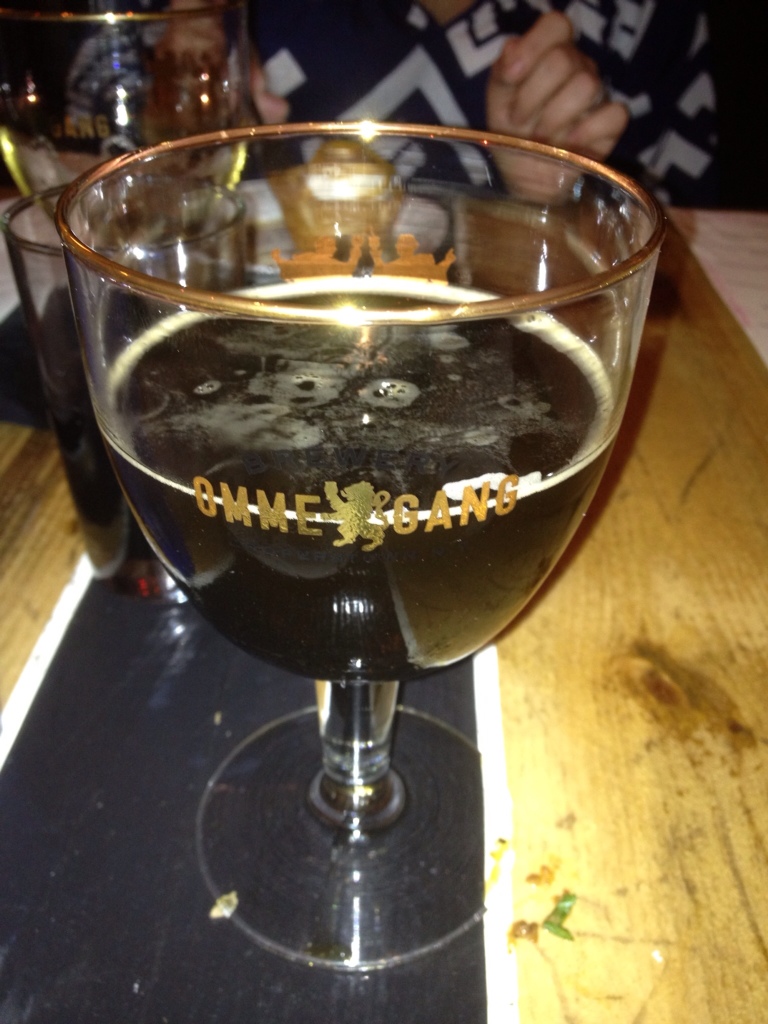
Beer #5: Chocolate Indulgence. And another sweet glass for my collection.
But the night wasn’t over yet! Easy Tiger and Ommegang surprised us with a final course: a plate of soft cheese, fennel relish, and another fresh baked bread (EDIT: Nancy’s Camembert from Hudson Valley, fennel marmalade and Pan au Levain roll – a sort of French “sourdough” – thanks Chef Andrew Curren for confirming) accompanied by a flute of Aphrodite lambic. The lambic was sweet and fruity with the color and flavor of raspberry (and just a little pear) all but masking a thread of Brett funk, and was an admirable way to end the night. It went fine with the cheese, but I kept thinking how well it would have paired with the pumpkin pie … though I would hate to have missed out on this latter offering of house bread.
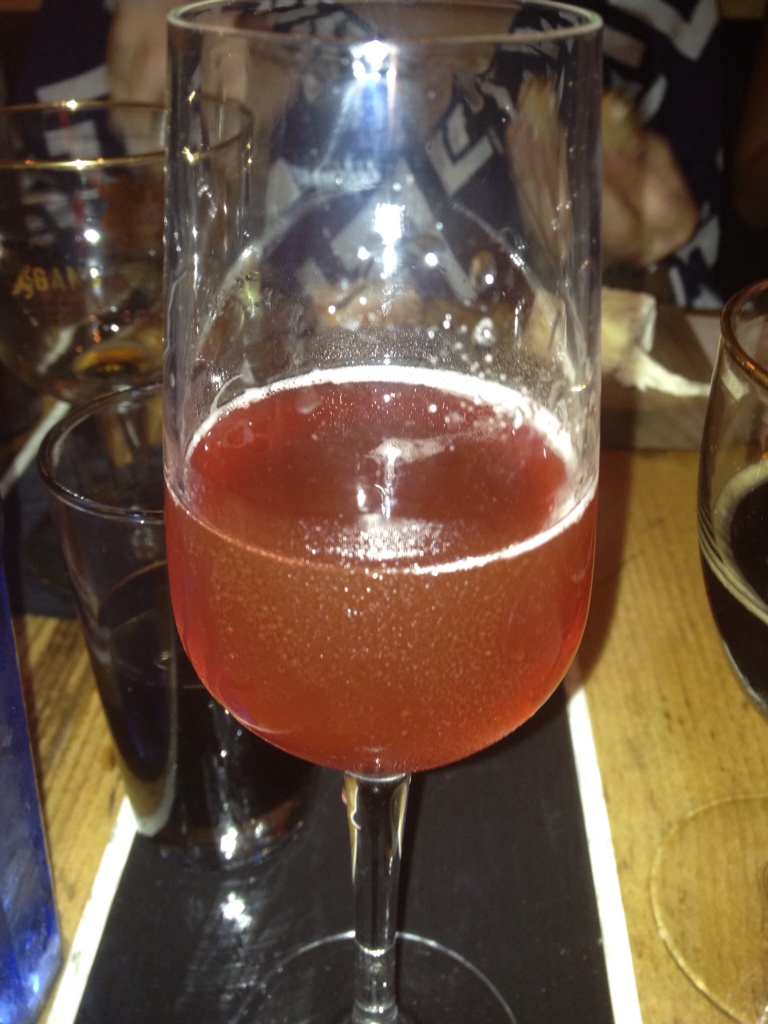
Beer #6: The mighty Aphrodite.
Much like schnitzengrubens, them strong Belgian-style beers can wipe you out, especially when taken with good food. By the end of the night I had one foot in brewhound Valhalla, tethered to the mortal plane by robust conversation with several fellow beer geeks in attendance that I had the pleasure to meet that night – including John Rubio of The Beerists podcast and Austin Chronicle beer culture writer Ivy Le and her husband. But bedtime loomed, and before long I emerged from the rathskeller to find my way home, happily smacked down by another spectacular Easy Tiger beer dinner.
You win another round, Easy Tiger. Well done. Name the time, and I’ll be there for the rematch.
 myBrewHome