
Bottling shortcuts for the bottling-averse homebrewer
No task in homebrewing gives me such mixed feelings as bottling. On one hand, it’s the last leg of the beer’s journey from grain to glass, and when the cap goes on I know the next time I interact with this brew will be when I taste it. On the other hand, it’s involved: boiling priming sugar, sanitizing 55 bottles, racking, filling and capping by hand, then breaking everything down and filling with PBW for an overnight soak takes more steps and time than any other brewing task I do except the brew day itself (and brew day leaves me with a much greater sense of accomplishment).
So when I started kegging over a year ago, I never looked back. It’s just so easy and fast: 30 minutes is about all I need to sanitize and fill a 5-gallon keg, and some homebrewers cut that time in half by keeping kegs full of sanitizing solution when not in use.
But I also make the odd 1-2 gallon test batch from time to time, and I don’t keg those. I could find smaller kegs, I suppose, but that would mean dedicating one of my three taps to small-batch experimental beer, which I’d rather not. So my test batches still get bottled. At least in theory.
In reality, I’ve been putting off bottling test batches for a while now because of the hassle. The two test batches I did over the last year – a Berliner Weisse from March 2012 and a Bronze Age Fig Beer in January – were still in fermenters in the Harry Potter closet, rapidly approaching the point where more additional time wouldn’t help them. I finally had to do what I had been putting off. And since necessity is the mother of invention, I devised ways to make it easier.
First, I got smaller bottling buckets. I used to just use my full 6-gallon bottling bucket regardless of batch size. After all, unlike the fermentation vessel, the bottling bucket is not going to hold beer for more than a couple of hours at the most, so there’s no reason not to just use the biggest one you’ve got, right?
But after thinking, I came up with several reasons why having a smaller bottling bucket would make bottling a small batch easier:
- Less surface area to sanitize
- Narrower vessel = higher fill level in the bucket, making it easier to submerge the outlet of the racking hose
- Narrower vessel = more pressure out of the spigot = faster bottle fills
- Less surface area to clean afterwards
So I made 2-gallon bottling buckets from plastic pails identical to those I use for small-batch fermenters. Instead of drilling a hole in the lid for a stopper and airlock, I drilled a hole near the base for a spigot with a 1″ spade bit:

Easy, even for someone as DIY-challenged as myself.
If you try it at home, keep a firm hand on the bucket and drill and be aware that it will cut through plastic very quickly, so a momentary loss of control can send you back to the store to buy a new bucket and start over. 1″ was the perfect diameter for my spigot, but I slipped and gouged a little extra chunk outside of the intended hole. Fortunately I was able to carefully hand-tighten the spigot to compress the interior gasket enough so that it spread to cover the leak.
The other shortcut I used was Coopers Carbonation Drops instead of bulk priming the entire batch. I’ve used these things on and off since my beginnings as an extract brewer, and I’ve been spoiled. Even now, weighing, boiling and cooling priming sugar is for some reason a huge annoyance to me and ranked among my worst first-world problems. But bulk priming does carbonate a little more consistently than the Coopers drops, so I do it, usually. But not with test batches. I consider them experiments anyway, so I’m not concerned about minute and virtually undetectable carbonation variations from bottle to bottle.
It took me an hour to sanitize two sets of equipment, rack two batches, and package 13 bottles of fig beer and 9 bottles of Berliner Weisse.
I still find kegging to be easier, and I’ll keg full-size batches whenever possible unless I have a reason to bottle them, in which case I’ll have to break out the big bucket and clear a couple of hours on my calendar. I also have a new Blichmann BeerGun I haven’t yet used which can bottle force-carbonated beer from the keg, but I’ll probably limit its use to bottling a few off the keg to give to friends. For test batches, I think I’ve found my process.
And the right equipment makes every process easier. It’s great to know that now, with a few additions to my homebrew arsenal, bottling is no longer a chore to dread, but a milestone to look forward to.
The Buddha and the King
On a beautiful, cool Saturday afternoon wedged between days of thunderstorms, Jester King Craft Brewery released their new Buddha’s Brew ale during their weekly open house. Beer hipsters (and garden variety hipsters) descended on the brewery for a turnout that scuttlebutt suggests was the biggest the brewery has ever seen on a “non-event” Saturday.
The new ale is a collaboration between Jester King and Austin kombucha company Buddha’s Brew. It’s Jester King’s first beer fermented entirely in oak. The wheat ale wort was pitched with bacteria and fermented in the barrel, then aged for nine months before blending it with Buddha’s Brew Classic Flavor Kombucha. Buddha’s Brew was also on location Saturday giving out free kombucha by the sample and cup. I’ve been a fan of their kombucha for years, so I was excited about the collaboration.
I haven’t been to Jester King in several months, so I was surprised to find a new system in place for the beer tasting. In the old system, $10 bought you a tulip glass and three full pours of whatever you wanted. Now, for $10 you get a card listing the day’s menu with a check box next to each of the 7 beers available:

One ticket to paradise, with a kombucha to go.
The bartenders poured 5.5 oz of whatever you ordered and marked the box next to it on the card. If you tried them all, it would equate to a little over two pints of beer and a keepsake glass for $10. So it’s not the steal it used to be, but it’s still a great value, especially if you can get there early enough to go back through the (very long) line 7 times during the 3-hour window they’re open. Even though this new system effectively raises the price per ounce over the previous system, it encourages beer flights instead of pounding pints as quickly as possible. The limited-release selections du jour are thus available to more attendees, and fewer frat boys are stumbling around drunk from too many Black Metals. I’m not sure if the new system was just for this event or if this is how they do it every week now, but I’m a fan of it in theory … if they can get the line moving a little faster.
I started with Buddha’s Brew, the hot new starlet on the set. It was straw-colored with little head and smelled like a Berliner Weisse: lactic, light and wheaty, though I was hoping for more fruitiness on the nose. It tasted like a Berliner Weisse too. Tart, refreshing and wheaty with some vinegar notes and a pleasant mouth-puckering tartness. My only complaint was that it was less complex than I expected. The kombucha didn’t add much flavor; no fruitiness, no earthiness. Nor any oakiness or vanilla from the barrel aging. It could have been any sour wheat ale, albeit a well-made one. Note that I would gladly drink it again if there weren’t more interesting beers available.


My third pour was Mad Meg, an organic bière de provision – a high-alcohol continental style intended for extended aging. At 9.6% ABV, it was a step up from my earlier tastings but smooth enough not to be a shock. It poured a handsome red-orange I attribute to Cara-Munich malt, but I enjoyed thinking of it as an “albino amber”. The aroma was mouth-watering: floral hops and a rich mandarin-like citrus with noticeable alcohol. The flavor didn’t disappoint, either, delivering piney hop bitterness at the start and boozy, bready malt on the finish with no alcohol burn. It was smooth and brilliantly balanced, easy to drink on a fall afternoon or warm enough for a cool night.
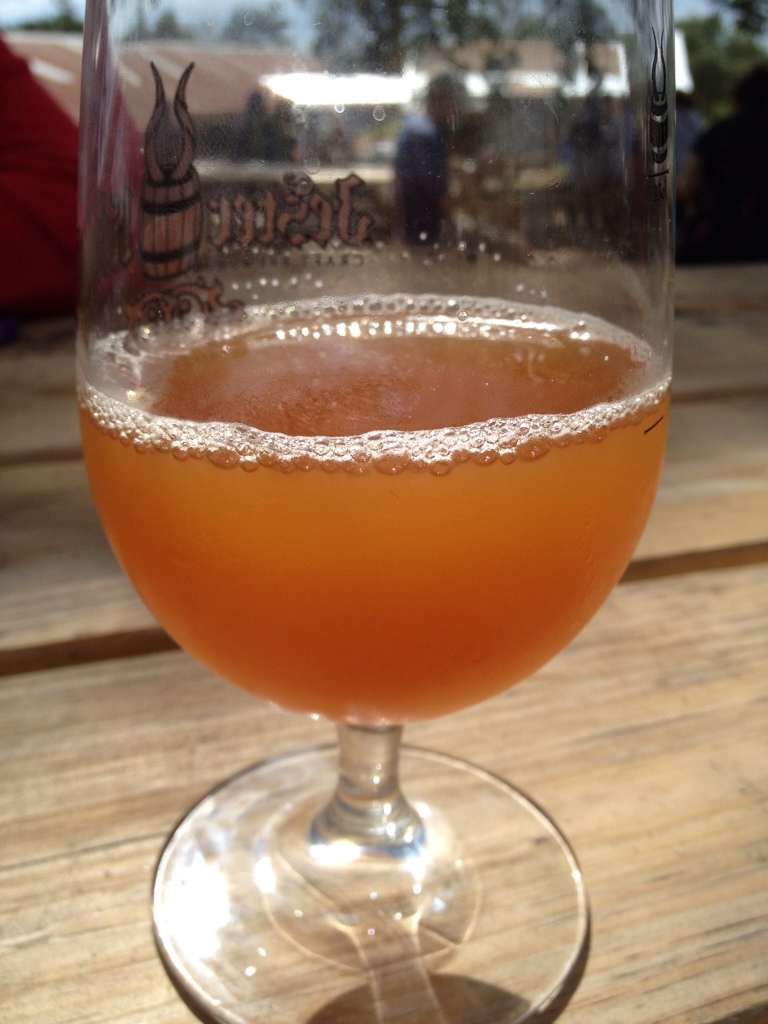
I made my way through the tastings leisurely and only got three in my 90 minutes there, but it was well worth the price of admission. Between beers I cleansed my palate with lots of free kombucha from the Buddha’s Brew tent (thanks!). Peach and Pineapple-Super Greens flavors were on tap and delicious.
I left happy (alcohol + probiotics, mmm mmm good!) and inspired. I’ve been thinking about homebrewing kombucha for a long time, and I might start soon using some Buddha’s Brew dregs to culture a starter SCOBY. Someday I actually hope to have draft kombucha in the kegerator for those non-beer occasions. I’m not sure I’ll ever use it in a beer myself, but who knows? And I toast Jester King for their innovation. After all, that’s what supporting local business is all about.
 myBrewHome