
Insert something witty here
Let’s start today at the BJCP Style Guidelines. Scroll through the list of styles. What do you see? Sure, it’s a manual, a valuable tool for any brewer. But for the beer lover, it’s also one part journal and one part little black book, with mental check marks next to the styles you’ve tasted and/or brewed … while unfamiliar styles call to you siren-like, the anticipation of conquests you haven’t yet made. Just like flipping through the pages of an old journal, you’re bound to have some regrets, some “what was I thinking?” moments (style 1A. Lite American Lager, anyone?). But also like a journal, the later entries leave you feeling a lot less embarrassed than the earlier ones, and certainly by the time you get to the English Pale Ales (starting with 8A. Standard/Ordinary Bitter) you’re starting to be proud of what you’ve accomplished.
Then halfway through, you see it: that entry that makes you question your judgment all over again, sitting drab and dull like a cat turd in the gold mine of your zymurgical adventures. The reminder of the giant noob you once were. And you ask yourself again, “What in the world was I thinking?”
I speak, of course, of 16A. Witbier.
Whether you call them wits, wittes, Belgian whites, or even bières blanches, chances are that you or someone you know has laughed derisively at this light, easy-drinking style in the recent past. And I’m not sure why that is. Maybe because so many commercial examples are so-called “crafty” offerings from industrial lager producers padding out their product portfolios with under-attenuated, over-flavored wits to provide a clawhold onto the elusive craft beer market and a talon in the door of the non-beer-drinker. Or maybe because witbiers are something we see as behind us, the non-threatening gateway beers we drank before graduating to today’s Imperial Everythings, and IPAs with IBUs approaching the GDP of Luxembourg. Witbiers are familiar, and after all we’ve been through … boring.
But it doesn’t have to be that way. With a little creativity, witbiers are a useful addition to the recipe book. They’re very forgiving of temperature fluctuations during fermentation (i.e., great for beginners), and are especially handy when you need a batch of beer to go from grain to glass in a couple of weeks (i.e., great for anyone strapped for time).
The traditional wit recipe is roughly equal parts continental Pilsner malt and unmalted/flaked wheat, with oats on top of that at around 5-10% of the grain bill. A multi-step mash is usually performed with a beta-glucan rest at 110°F (or a protein rest at 120°F) and a saccharification rest around 154°F. The multi-step mash breaks down proteins that make the flaked grains gummy, avoiding the frustration of a stuck mash (replacing it, in my opinion, with the frustration of missing multiple step temperatures in my converted cooler mash tun … but more on that in a moment). In the boil, a small early addition of noble hops for bittering is typical, with coriander and orange peel (often Curaçao bitter orange, also known as laraha) added near the end.
My variation was developed in response to the need for an easy brewday and my desire for a bit more flavor than is offered by most commercial witbiers. First, the grain:
- 4.25 lbs Belgian Pilsner malt
- 4.25 lbs white wheat malt
- 1 lb flaked oats
- 0.25 lbs (4 oz) Munich malt
The substitution of malted white wheat for flaked wheat eliminates the need to do a multi-step mash, but just to be safe – since I still had about 10% flaked oats – I included 8 oz of rice hulls to keep the lauter flowing freely and did a single infusion mash at 151°F. The Munich was included to bring a little color and a touch of malty flavor.
I boiled for 100 minutes – longer than my usual 90, but just by accident. I added 0.55 oz of 8.2% AA American Santiam hops at the 60-minute mark. Santiam is a hop I hadn’t used before, but being related to German Tettnanger and Hallertauer Mittelfrüh (and thus more noble than American “Tettnang” hops which are actually descended from Fuggles) it seemed a worthy candidate. I got floral and peppery notes from it.
But the end of the boil was where things really got interesting. With 1 minute left in the boil, I added:
- 0.2 oz dried bitter orange peel (left over from a previous batch)
- 1 oz fresh blood orange zest (about 4 oranges’ worth)
- 12 g crushed coriander
- 3 g crushed grains of paradise
The original gravity was 1.053, technically a point past the upper end of the style, but I’m not complaining. I pitched a starter of White Labs WLP400 Belgian Wit Ale Yeast, an obvious choice for the style – but underpitched slightly by using a 900 mL starter. This should lead the yeast to produce more clove phenols to counterpoint the fresh zest and peppery spices. I started the fermentation at 68°F, but gradually heated the chamber up to 72°F by the third day, which should also accentuate the phenols. If it seems like I’m hedging my bets on phenol production, I am. This is my third wit, and the other two didn’t have nearly the fermentation flavor I was looking for.
I keg it two weeks from brewday, and I’ll be serving it just in time for the beginning of March and my ultimate reason for brewing this: a month of Game of Thrones viewings to prepare for the new season starting in April. It’s the reason I named this brew Wit Walker White Ale, and I think it’ll be a perfect beer to have on tap for Game of Thrones catch-up. It’s light enough to go with a variety of snacks. It’s sessiony enough to keep drinking through hours of viewings without getting drowsy or losing the plot in a beery stupor. And yes, it’s accessible enough to share with all my friends, even those who aren’t on the hardcore brew bandwagon yet. And by loading it up with flavors I like, I can guarantee myself something I can still be proud to drink along with everyone else … something so familiar, but completely new.
Homebrew Tips for New Dads: Commemorating the event, a great excuse to drink!
Well, I’m back. – Samwise Gamgee
I haven’t written for this blog in nearly two months, as I’ve gradually adjusted to the ups and downs of being a father to my first child. Learning how to change, bathe, and sing Queen songs (including a special diaper-time version of “Bohemian Rhapsody” with peepee-related lyrics) to my newborn son Lucian was only the beginning. I also learned to deal with: an increased share of the housework to help Momma, an upheaval of my sleep schedule, a return to my day job, and the happy stress of many wonderful visits from friends and family anxious to meet the little dude in the blue onesie.
With all of that going on it was hard to find time to write, which was fine because I wasn’t doing all that much to write about. If your blog is about homebrewing, when you ain’t homebrewing you ain’t got much to say.
Did you catch that? Practically no homebrewing for two months. The horror! Almost as horrific as the fact that “bottle washing” means something entirely new to me now that I have a baby (interestingly, I don’t dread washing baby bottles like I did beer bottles – no labels).
Even though I haven’t done much brewing, I have partaken liberally of the fruits of my homebrewing labor. Thanks to some careful planning before the birth, I’ve managed to keep the pipeline flowing during my hiatus. But preparing for these brewless weeks wasn’t just about making sure I had enough booze to get through the newborn period. Far from it. You see, I’m a commemorator.
The things we create – a beverage, a story, a carpentry project, even the name we give to a child – form a record of our past. Each creation is a snapshot of who we were when we created it, a representational image of our brain at the moment of creation. Those snapshots exist long after the “me” responsible for the creation has changed forever – years after, if we’re lucky – and are like little running shoes for the feet of our memories. That’s one of the reasons why I believe every human being should create … something.
Of course, if what you create is consumable food products like beers and meads, there’s a shelf life to consider, so they won’t last forever. Sure, the right brews (imperial stouts, barleywines, meads, fruit wines) can be cellared for years if designed and handled properly, but at some point you’ll open and empty the last bottle. They’re not quite as permanent as other creations can be. But the unique thing about brewing to commemorate important life events is that the enjoyment of those creations (i.e., the drinking of the beer after it’s fermented/aged) creates its own memories that are worth holding onto in their turn.
The day we brought Lucian home from the hospital, Lisa and I shared a bomber of Le Petit Plésiosaure Saison, a Summit-hopped saison loosely adapted from Brooklyn Sorachi Ace that I brewed in February. The name (French for “the Little Plesiosaurus”) is an homage to an adorable cartoon poster of the Loch Ness Monster we have hanging in Lucian’s room. We gave bottles of the saison out as favors to friends who came to our baby shower and asked them not to open it until we announced the birth, and we did the same.

C’est bon ça!
I’m thrilled to report that this saison exceeded my expectations and also wowed my friends, not all of them beer geeks: a refreshing, dry, aromatic and spicy saison perfect for late spring/early summer that hides its 8% ABV under layers of citrus, chamomile and subtle phenolics. We’ve made it through nearly all of the bottles we had left over, and that’s okay. This beer was intended for drinking fresh in hot weather, for refreshing breaks from the hard work of keepin’ this baby happy. When I have my last taste of it later this summer, I’ll pause to celebrate the end of the first phase of Lucian’s life and the beginning of the next. In fact, his 3-month birthday sounds like a great time to finish off the batch. Challenge accepted.
The other commemorative brew I’m enjoying between sessions of therapeutic baby bouncing is Lucian’s Landing Ginger Metheglin, a ginger mead I made in October with the goal of bottling it right before the baby was born (but Lucian landed early, so I didn’t bottle it until after). I aged it from October to April, by which time all of the fresh ginger root aromatics in the must had evaporated – only a pleasant ginger tang on the palate remained. To replace the lost aromatics, I steeped 3.5 oz of fresh ginger root in 8 oz of boiled water to make a ginger tea and added that to the carboy along with 4 oz of crystallized ginger in a muslin hop sack. After 4 weeks, I bottled it and had labels printed with my own design evoking the inspiration for my son’s name, a second-century work of early science fiction satire called True Story (often translated as True History) by Lucian of Samosata.

Protip: Even when buried beneath housework and baby care chores, always find time for Photoshop.
We plan to drink some fresh and save some bottles for special occasions (first Christmas, birthday, etc.), so the snazzy bottles were a must. Most recently we opened a bottle on Sunday, Lucian’s 2-month birthday, and found that mead paired quite well thematically with a marathon viewing of Game of Thrones Season 3 before the finale Sunday night. Pale golden and nearly crystal clear, it has just enough ginger to tickle the nose and palate before the unmistakable earthen notes of honey come in, then recede giving way to a fruity, ginger ale-like finish. I’m proud of it.

Deceptively elegant at 13.7% ABV.
I like to think that someday Lucian will appreciate things like the fact that his dad made a special mead in honor of his birth, even though he couldn’t enjoy it himself (though maybe one day, who knows …). There’s no way of knowing now, of course, but I suppose it doesn’t matter. I’ll keep doing it for myself. Being a father is hard work, and I’m sure it’s only going to get harder. Though it’s already proving to be well worth all the effort I put into it, finding time to remember “me” amid the multitude of self-sacrificing tasks to be completed has been an important step in retaining my sanity. And that’s who me is (erm, I am): A homebrewer. A commemorator. A big frickin’ sap.
My more perceptive readers may have noticed that above I mentioned “practically no homebrewing”. Don’t tell anyone, but I did manage to squeeze in one brewday before April – the month of my son’s birth – was over. That was yet another commemorative brew, but one I won’t be drinking for a long time. I’ll tell you all about it in an upcoming post. The only hint I’ll offer before then is: Ribbit.
This Sunday, remember to wish a Happy Father’s Day to your dad or a dad you know (or yourself if the gift-wrapped dress socks fit) … and to my fellow new dads out there, just starting out on this difficult but rewarding journey: have a homebrew with me. We deserve it.
Bronze Age Fig Beer, Part 2: The Reckoning
In my last post, I described the brew day for my Bronze Age-inspired fig beer, which ended with me pitching a yeast starter made from Dogfish Head Midas Touch dregs. I didn’t have an especially good reason for fermenting this brew with Midas Touch dregs, except for thinking that it would be good luck for my ancient ale experiment. Moreover, it was my first time cultivating bottle dregs, and I didn’t really study up on it that much ahead of time. I was making it up as I went.
I watched the fermenter, counting the hours of the lag phase and waiting for signs of fermentation. 24 hours passed. Then 48. The airlock refused to bubble. I didn’t panic, knowing that the lid on the small-batch fermenter I “made myself” (translate: “bought a 2-gallon pail and drilled a hole in the lid to fit a stopper and airlock” – sorry, I’m not exactly Bob Vila) doesn’t always seal perfectly and gas might be escaping from somewhere besides the airlock.
After three days, I picked up the pail and looked through the translucent wall for krauesen. Seeing nothing, I decided it was time to intervene.
When I cracked the lid, it was like looking at the surface of a dead alien planet. The wort was still and clear, reflecting the concerned look on my face like a pane of amber glass. The only blemishes on the surface were a few bits of fig seed that had started to grow mold. Aside from that, there was no sign that anything was living in there.
The first thing I did was remove the moldy fig seeds with sanitized tongs. Well, no – the first thing I did was drop an F-bomb. Then I removed the moldy fig seeds.
I took a sample of the wort and tested the gravity. It was 1.073, 5 points down from original gravity, which I attribute to the fact that the OG was taken before I added a relatively high volume of lower-gravity starter. In other words, fermentation had not commenced.
I tasted the sample, finding it as sweet as the day I made it. I tasted honey, figs and malt. No alcohol, no bready yeast flavor and no transitional fermentation by-products like acetaldehyde. Fortunately, there was no apparent infection flavor, either: no musty mold taste and no sign of bacterial souring. So it was in stasis, not ruined.
There was really nothing to do except to pitch fresh yeast. I had a packet of Fermentis Safbrew T-58 on hand for exactly this emergency, so I measured out 6 grams and pitched it. I attempted to stir it with my drill-mounted whip to re-aerate the wort, but the drill battery was inexplicably dead (I’ve recently deduced that I have a kleptomaniac poltergeist in the house with an eyewear fetish; perhaps it’s fond of power tools as well). No matter, I closed the fermenter back up and within 12 hours the airlock was gurgling like a freshly risen zombie.
To be honest, I wasn’t that surprised that I didn’t get viable yeast from the bottle. I never did see any definite fermentation activity in either the first or the second stage starter. And the second stage starter had me a little nervous all along. I couldn’t say what was wrong with it, but it never looked right.
What did I learn from all this? Quite a lot, actually. Here are the CliffsNotes:
- Leaving something as important as yeast selection to superstition isn’t going to get us anywhere.
- Read up on new techniques before trying them. Always.
- When winging it, expect setbacks and have a Plan B.
- Trust instinct more when something doesn’t seem right.
- Always check the drill battery the night before it might be needed.
There’s one more thing I learned. This was my first infection ever in four years of brewing. It happened in a wort that contained solid fruit and that I essentially didn’t pitch yeast into for 3 days. And the extent of unwanted microbial growth was two mere spots of mold on floating fig seeds, nothing more. That’s evidence that my sanitation practices are legit. I’ll drink to the knowledge that I’m doing something right.
Brew in a Bag: Bronze Age Fig Beer
I finally brought to life my Bronze Age Fig Beer, inspired by archaeological findings at Kissonerga-Skalia in Cyprus, in a small-batch brew day that had me flying by the seat of my pants from start to finish.
For small batches, I use the “Brew In a Bag” (BIAB) technique described in the October 2012 issue of Brew Your Own magazine, and also online here. The mash is done directly in the kettle with the grist contained in a nylon mesh bag. BIAB is great for the all-grain brewer looking to save time on brew day, because there’s no sparge. Lautering is as easy as lifting a bag of wet grains (which can admittedly be heavy, if like me, the only workout you get regularly is the ol’ 16-ounce curl). It’s also a great way for extract or partial mash brewers on a budget to explore all-grain brewing without expensive new equipment: just a brew kettle and the same mesh bag you may already be steeping grains in.
Most BIAB brews call for all the brewing liquor up front. The result is a very thin mash – 4 qts/lb in my case – but once the saccharification is done, the bag comes out and the wort can be brought to a boil immediately without sparging. Efficiency suffers, but this can be compensated for with a little extra grain. BIAB works for any batch size, provided the kettle is big enough for the grist and full volume of liquor, but I personally keep it to small batches. This batch was 6 quarts.
The Bronze Age brewer didn’t have a lot of specialty grains to choose from, so I kept my grain bill simple. The only specialty grain was German rauch malt, included to replicate the smoky flavor of malt kilned in a wood-burning oven in a small Bronze Age structure:
- 2 lbs 2-row malt
- 8 oz rauch malt
I mashed in with 10 quarts of water to stabilize the mash at 155 degrees and mashed for an hour, with the kettle wrapped in towels to retain heat. I still had to fire the burner a few times to keep the mash temperature high enough. If you do this, make sure to either take the bag out while the burner is on, or place a plate at the bottom of the kettle to dissipate the direct heat. Nylon mesh bags melt very easily.

Every man should learn how to roll and tuck his bag to keep it safely away from open flames.
Fresh figs are hard to find right now, so I bought dried figs in bulk from the local Whole Foods. I chopped 4 oz, leaving me with a sticky knife, and added them to the kettle to boil for 60 minutes to develop flavor and brown the sugars.
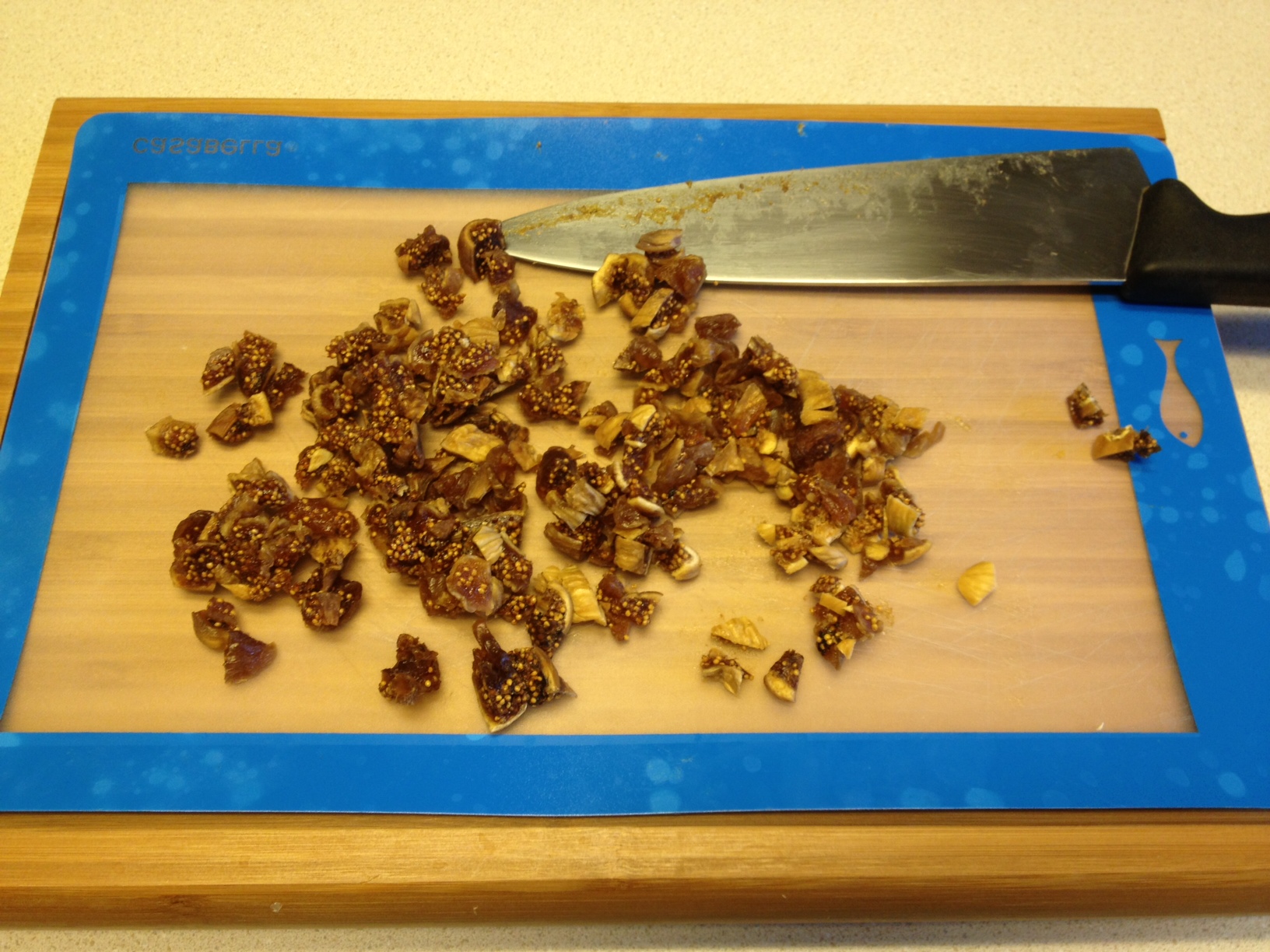
I meant to say really sticky.
Hops were not used in barley beer until the 11th century CE, so I didn’t use any. Instead, I delved into a fantastic book called The Flavor Bible for inspiration on bittering ingredients that might go well with fig. I settled on a quarter ounce of dried bitter orange peel (a traditional ingredient in Belgian witbiers, and available at most homebrew shops) and 7 sprigs of fresh thyme, and added these to the boil with 5 minutes left, along with another 1.5 oz of chopped figs.
Before boiling, the gravity was a measly 1.026, which would likely have boiled down to something in the 1.030-1.040 range. That’s fine for a session beer, but not for a rustic brew worthy of an ancient Cypriot warrior. To raise the potential alcohol, I added a pound of wildflower honey at flameout. According to Patrick McGovern’s Uncorking the Past (another fantastic book), many ancient brews were “grogs” made by mixing fermentable sugars – malt, grapes, honey, other fruits – so I was still channeling my Bronze Age forebears here, though this could technically qualify as a “braggot” by modern standards.

Straining out the chunky bits.
When all was said and done, with sugars from malt, figs, and honey, the wort at pitching time was 1.078, a fairly big brew. I pitched a 600 mL starter made from Dogfish Head Midas Touch dregs I cultivated from a bottle.

The offering, prepped and ready for sacrifice.
Would the ancient brew gods reward my efforts with the dulcet tones of a gurgling airlock? Find out in my next update.
He who controls the spice …
I had to take a break from blogging last week due to the Thanksgiving holiday here in the United States, during which I played host to my in-laws for several days of family hijinks to the tune of college football, backyard-fire-pit s’mores, an Eddie Murphy retrospective on BET, and lots and lots of imbibed homebrew. I return with many stories I’ll share in the coming days: a rousing adventure of a non-traditional 3-course Thanksgiving beer dinner, and a saga of a Black Friday brew day so bitter it took six bowls to contain all the hop additions.
But first, an update on Colonial Progress Ale. After nearly 4 weeks in the fermenter, it’s just about finished with a gravity of 1.007. That’s a bit more attenuation than I expected, so it will be higher in alcohol, but that may not be a bad thing for a winter session ale.
I’m pleased to report that as the yeast slowly flocculates out, it’s leaving the beer with a much cleaner taste than I was getting from it even a week ago. When I sampled it on Thanksgiving, it was fruity and a little sulfuric. Now it’s clean tasting and very dry, with only a hint of mineral flavor from the molasses and a burst of herbal bitterness from the late spice addition of sweet gale and juniper berries.
What’s missing is any sign of herb or spice in the aroma/flavor arena. So today, a few days before kegging, I made a “spice potion” with the remaining sweet gale and juniper berries.
What’s a spice potion? Despite sounding like something from a Dune or Harry Potter book (or some sick and unnecessary crossover that I would nevertheless read because I friggin’ love both those series: Harry Potter and the Floating Fat Baron? House Elves of Dune? I’m looking at you, J.K. Rowling and Brian Herbert) a spice potion is a method for adding spices or herbs to homebrew without boiling – and thus losing many of the volatile compounds that give those ingredients their distinguishing features – and that’s more elegant than simply throwing them in the fermenter.
It’s simply soaking the herbs/spices in distilled liquor to extract the essence. As I understand it, this works because alcohol is a better solvent than water, so more of the flavor and aroma compounds are extracted than in water steeping, and no heat means the subtler characteristics of the ingredient are retained. And since it’s distilled spirit, it’s safe to add to the beer without fear of infection. Any spirit will do. Vodka is common because of its neutral flavor, but depending on the specific ingredient being extracted, I’ve heard of people using rum, tequila, or whiskey (whose name, incidentally, comes from the Gaelic phrase uisce beatha meaning “water of life”, which is also a solution of pure spice essence in the Dune series – and now we’ve come full geek circle).
I used vodka. And since quality isn’t really important for the small amount that will end up in the beer, I used the cheapest vodka I keep on hand: the stuff that comes in a 1.75-liter bottle for $9, which I use to fill my airlocks (never for drinking). I muddled a quarter ounce of juniper berries with a gram of sweet gale in a mortar and then placed it in a sanitized glass with about 2 ounces of vodka. The resulting mixture wasn’t pretty to look at, but had an herbal/tart aroma pleasantly similar to gin.
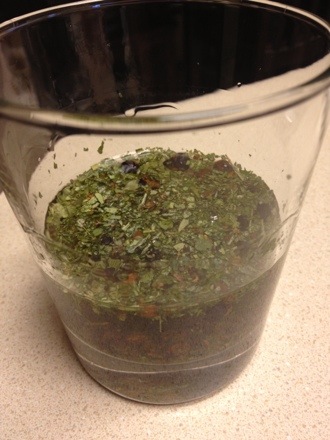
Only the Water of Life will free what can save us.
I’ll let the potion steep, covered with sanitized foil, from now until Sunday. Then I’ll strain out the chunks, add the essence to the keg, and rack the beer on top of that. Since the bitterness is already prominent in the brew, I think this is the last little flavor kick the beer needs to make it ready for prime time.
Watch this space for the next few days as I share my stories from Thanksgiving week. Since there’s no turkey or shopping involved in either of them, I’m sure you’ll enjoy them despite the passage of time.
Until then, keep the spice – and the beer – flowing.
Unfinished business
With November half over, I'm faced with several unfinished brewing projects and more on the way.
A few days ago, I racked my ginger mead to a carboy for conditioning. Because of my pathological aversion to work which isn't absolutely necessary, I'm a believer in long primaries and won't rack beer to a carboy unless there's a damned good reason (no empty keg available, need the primary vessel for a new beer, cat fur stuck to the inside wall of the bucket, etc.) and I get good beer with up to 6 weeks on the yeast cake.
But for mead, we're talking upwards of 6 months of conditioning, and for that there's no way around racking to a carboy. Not only is it better to get the mead off that autolyzing yeast for the extended aging, but it's essential for clarity: the mead won't clarify until it's removed from the gross lees. It's amazing, in fact, how quickly it does start to clarify as soon as it's racked. Just a few days have passed since I racked it, and it's already several shades darker than it was in the primary due to the yeast flocculating out.
At racking time, the gravity measured 1.001 and the mead had a fruity, floral taste with a little ginger bite but sadly no hint of ginger in the flavor or aroma. My fermentation chamber did its job well keeping the fermentation cool, and it had none of the fusel alcohols my other (uncontrolled temperature) meads had this early on. It might even be ready in less than 6 months, but I have reasons for waiting until April to bottle it. Until then, I'll rack it every 6-8 weeks, add a few Campden tablets occasionally to prevent oxidation, and maybe hit it with some Sparkolloid closer to bottling time. And definitely some more ginger before bottling.
I also took the first gravity sample from the Colonial Progress Ale I brewed 11 days ago. The wort turned out a bit more fermentable than I expected and is currently at 1.009, with an ABV of 4.8% (and the WLP008 yeast, a notoriously slow flocculator, might still be working). It's got a fruity tang I expected from this yeast, and very minimal cidery character from the simple sugar of the molasses. It's really a nice easy-drinking session beer that should be very enjoyable when the yeast settles out. The juniper and sweet gale have largely faded, though. I'll add more spices to the fermenter before kegging. Who knows, I might even rack the beer for the occasion.
The next project on the horizon is an inventory cleaning extravaganza! I've got lots of open hop packets from over the course of the past year that I'll use in a beer to be brewed the day after Thanksgiving. I spent some time tonight rubbing hop pellets between my fingers (while watching Moonshiners on Discovery Channel … now those guys are pros) smelling them and even tasting some of them to make sure they were still hoppy and had none of the telltale cheesiness of bad hops. Fortunately, only a half ounce of Warrior left over from February had any distinctive cheesy notes, so back into the freezer it went to keep on aging until it magically changes from “cheesy” to “aged” and I can use it in a lambic. The other open hops made the cut and will be used next week. More on that recipe soon!
Vote for Progress … hops
Saturday was Learn to Homebrew Day in the USA, and today is Election Day. To honor both events, I did what any patriotic and pedantic zyme lord would. I made beer.
I called it Colonial Progress Ale, and it’s something between an English bitter and an English brown ale. “Colonial” comes from the fermentables, adapted from a recipe I envisioned for a colonial-style ale during a trip to Philadelphia earlier this year. I ended up with:
- 6.5 lbs American 2-row
- 1 lb Victory malt
- 8 oz Flaked wheat
- 8 oz Flaked oats
- 1 lb Molasses
Each of these ingredients was chosen for a reason, starting with American 2-row malt as the base. Wheat is common in colonial ale recipes, including one attributed to Thomas Jefferson. Victory and oats I had no historic precedent for, but I added them for body in the finished beer, along with some bready/biscuity flavor (Victory) and silky smoothness (oats) to accentuate the English-inspired malt profile. I mashed at 153°F for medium fermentability, counting on the highly fermentable molasses to dry the beer out.
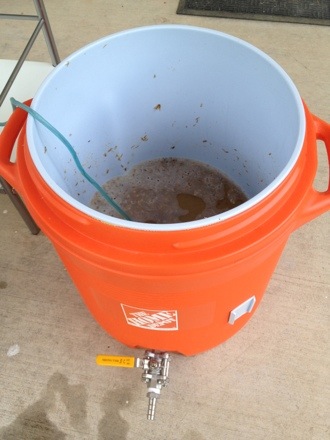
The mash begins.
Ohhh, molasses. A common ingredient in beer in early colonial Philadelphia (according to a quote from William Penn), I can eat the stuff right out of the jar. But I was nervous about using it after reading John Palmer’s tasting notes ranging from “rumlike” and “sweet” (woohoo!) to “harsh” and “bitter” (ergh). But further research online suggested that harsher flavors were associated with fermenting mineral-rich blackstrap molasses, not the regular unsulphured kind. I went with regular, and added them at the beginning of the boil with high hopes.
The “Progress” part came from the hops: one ounce of 6.6% AA Progress at the 60-minute mark for bittering, and another quarter ounce at 15 minutes for flavor. Progress is a UK varietal related to Fuggle hops, a good choice for English-style ales.
But that wasn’t all I added to the boil. Hops were available to some colonial brewers, but apparently not all that prevalent, so other bittering herbs were common. My original plan was to use horehound, but I realized the medicinal flavor might overpower a low-gravity ale. I thought of rosemary, but was talked out of it by the sages (ha, ha) at Austin Homebrew Supply. I landed on:
- .25 oz Juniper berries (crushed in mortar)
- .5 grams Sweet Gale (dried)
I added the herbs in the last minute of the boil and let them steep during cooling and whirlpool. I may add more later during conditioning.
The wort had an OG of 1.046, a true session ale for the upcoming winter (insert witty apropos Valley Forge reference; I can’t think of one). I pitched the slurry from a 2-liter starter of WLP008 East Coast Ale Yeast – reportedly the Sam Adams house strain – in keeping with the colonial theme. I set the fermentation chamber to an ambient 65-68°F, a little warmer than typical to coax some vintage ester flavor from this low-flocculating yeast.

Fermentation underway after 24 hours.
By this time tomorrow, the future of the United States will be written for the next four years. But regardless of whether my guy wins or not, I’ll have something to look forward to: a beverage in the tradition of the first beers brewed on American soil. Beer has always been a part of American culture, even before there was a United States, and from #1 on down to #44 many presidents have been homebrew aficionados: George Washington, Thomas Jefferson and James Madison were homebrewers and Barack Obama bought a homebrew kit for the White House with his own money. And beer remains one of the few things people can agree on regardless of personal politics.
Don’t forget to vote today, no matter who you’re supporting. Red and blue be damned. We can all party together in the colors of the SRM scale.
 myBrewHome