
Insert something witty here
Let’s start today at the BJCP Style Guidelines. Scroll through the list of styles. What do you see? Sure, it’s a manual, a valuable tool for any brewer. But for the beer lover, it’s also one part journal and one part little black book, with mental check marks next to the styles you’ve tasted and/or brewed … while unfamiliar styles call to you siren-like, the anticipation of conquests you haven’t yet made. Just like flipping through the pages of an old journal, you’re bound to have some regrets, some “what was I thinking?” moments (style 1A. Lite American Lager, anyone?). But also like a journal, the later entries leave you feeling a lot less embarrassed than the earlier ones, and certainly by the time you get to the English Pale Ales (starting with 8A. Standard/Ordinary Bitter) you’re starting to be proud of what you’ve accomplished.
Then halfway through, you see it: that entry that makes you question your judgment all over again, sitting drab and dull like a cat turd in the gold mine of your zymurgical adventures. The reminder of the giant noob you once were. And you ask yourself again, “What in the world was I thinking?”
I speak, of course, of 16A. Witbier.
Whether you call them wits, wittes, Belgian whites, or even bières blanches, chances are that you or someone you know has laughed derisively at this light, easy-drinking style in the recent past. And I’m not sure why that is. Maybe because so many commercial examples are so-called “crafty” offerings from industrial lager producers padding out their product portfolios with under-attenuated, over-flavored wits to provide a clawhold onto the elusive craft beer market and a talon in the door of the non-beer-drinker. Or maybe because witbiers are something we see as behind us, the non-threatening gateway beers we drank before graduating to today’s Imperial Everythings, and IPAs with IBUs approaching the GDP of Luxembourg. Witbiers are familiar, and after all we’ve been through … boring.
But it doesn’t have to be that way. With a little creativity, witbiers are a useful addition to the recipe book. They’re very forgiving of temperature fluctuations during fermentation (i.e., great for beginners), and are especially handy when you need a batch of beer to go from grain to glass in a couple of weeks (i.e., great for anyone strapped for time).
The traditional wit recipe is roughly equal parts continental Pilsner malt and unmalted/flaked wheat, with oats on top of that at around 5-10% of the grain bill. A multi-step mash is usually performed with a beta-glucan rest at 110°F (or a protein rest at 120°F) and a saccharification rest around 154°F. The multi-step mash breaks down proteins that make the flaked grains gummy, avoiding the frustration of a stuck mash (replacing it, in my opinion, with the frustration of missing multiple step temperatures in my converted cooler mash tun … but more on that in a moment). In the boil, a small early addition of noble hops for bittering is typical, with coriander and orange peel (often Curaçao bitter orange, also known as laraha) added near the end.
My variation was developed in response to the need for an easy brewday and my desire for a bit more flavor than is offered by most commercial witbiers. First, the grain:
- 4.25 lbs Belgian Pilsner malt
- 4.25 lbs white wheat malt
- 1 lb flaked oats
- 0.25 lbs (4 oz) Munich malt
The substitution of malted white wheat for flaked wheat eliminates the need to do a multi-step mash, but just to be safe – since I still had about 10% flaked oats – I included 8 oz of rice hulls to keep the lauter flowing freely and did a single infusion mash at 151°F. The Munich was included to bring a little color and a touch of malty flavor.
I boiled for 100 minutes – longer than my usual 90, but just by accident. I added 0.55 oz of 8.2% AA American Santiam hops at the 60-minute mark. Santiam is a hop I hadn’t used before, but being related to German Tettnanger and Hallertauer Mittelfrüh (and thus more noble than American “Tettnang” hops which are actually descended from Fuggles) it seemed a worthy candidate. I got floral and peppery notes from it.
But the end of the boil was where things really got interesting. With 1 minute left in the boil, I added:
- 0.2 oz dried bitter orange peel (left over from a previous batch)
- 1 oz fresh blood orange zest (about 4 oranges’ worth)
- 12 g crushed coriander
- 3 g crushed grains of paradise
The original gravity was 1.053, technically a point past the upper end of the style, but I’m not complaining. I pitched a starter of White Labs WLP400 Belgian Wit Ale Yeast, an obvious choice for the style – but underpitched slightly by using a 900 mL starter. This should lead the yeast to produce more clove phenols to counterpoint the fresh zest and peppery spices. I started the fermentation at 68°F, but gradually heated the chamber up to 72°F by the third day, which should also accentuate the phenols. If it seems like I’m hedging my bets on phenol production, I am. This is my third wit, and the other two didn’t have nearly the fermentation flavor I was looking for.
I keg it two weeks from brewday, and I’ll be serving it just in time for the beginning of March and my ultimate reason for brewing this: a month of Game of Thrones viewings to prepare for the new season starting in April. It’s the reason I named this brew Wit Walker White Ale, and I think it’ll be a perfect beer to have on tap for Game of Thrones catch-up. It’s light enough to go with a variety of snacks. It’s sessiony enough to keep drinking through hours of viewings without getting drowsy or losing the plot in a beery stupor. And yes, it’s accessible enough to share with all my friends, even those who aren’t on the hardcore brew bandwagon yet. And by loading it up with flavors I like, I can guarantee myself something I can still be proud to drink along with everyone else … something so familiar, but completely new.
Vote for Progress … hops
Saturday was Learn to Homebrew Day in the USA, and today is Election Day. To honor both events, I did what any patriotic and pedantic zyme lord would. I made beer.
I called it Colonial Progress Ale, and it’s something between an English bitter and an English brown ale. “Colonial” comes from the fermentables, adapted from a recipe I envisioned for a colonial-style ale during a trip to Philadelphia earlier this year. I ended up with:
- 6.5 lbs American 2-row
- 1 lb Victory malt
- 8 oz Flaked wheat
- 8 oz Flaked oats
- 1 lb Molasses
Each of these ingredients was chosen for a reason, starting with American 2-row malt as the base. Wheat is common in colonial ale recipes, including one attributed to Thomas Jefferson. Victory and oats I had no historic precedent for, but I added them for body in the finished beer, along with some bready/biscuity flavor (Victory) and silky smoothness (oats) to accentuate the English-inspired malt profile. I mashed at 153°F for medium fermentability, counting on the highly fermentable molasses to dry the beer out.
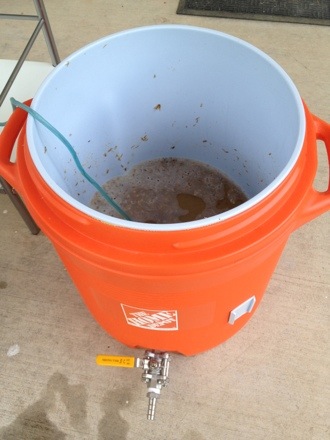
The mash begins.
Ohhh, molasses. A common ingredient in beer in early colonial Philadelphia (according to a quote from William Penn), I can eat the stuff right out of the jar. But I was nervous about using it after reading John Palmer’s tasting notes ranging from “rumlike” and “sweet” (woohoo!) to “harsh” and “bitter” (ergh). But further research online suggested that harsher flavors were associated with fermenting mineral-rich blackstrap molasses, not the regular unsulphured kind. I went with regular, and added them at the beginning of the boil with high hopes.
The “Progress” part came from the hops: one ounce of 6.6% AA Progress at the 60-minute mark for bittering, and another quarter ounce at 15 minutes for flavor. Progress is a UK varietal related to Fuggle hops, a good choice for English-style ales.
But that wasn’t all I added to the boil. Hops were available to some colonial brewers, but apparently not all that prevalent, so other bittering herbs were common. My original plan was to use horehound, but I realized the medicinal flavor might overpower a low-gravity ale. I thought of rosemary, but was talked out of it by the sages (ha, ha) at Austin Homebrew Supply. I landed on:
- .25 oz Juniper berries (crushed in mortar)
- .5 grams Sweet Gale (dried)
I added the herbs in the last minute of the boil and let them steep during cooling and whirlpool. I may add more later during conditioning.
The wort had an OG of 1.046, a true session ale for the upcoming winter (insert witty apropos Valley Forge reference; I can’t think of one). I pitched the slurry from a 2-liter starter of WLP008 East Coast Ale Yeast – reportedly the Sam Adams house strain – in keeping with the colonial theme. I set the fermentation chamber to an ambient 65-68°F, a little warmer than typical to coax some vintage ester flavor from this low-flocculating yeast.

Fermentation underway after 24 hours.
By this time tomorrow, the future of the United States will be written for the next four years. But regardless of whether my guy wins or not, I’ll have something to look forward to: a beverage in the tradition of the first beers brewed on American soil. Beer has always been a part of American culture, even before there was a United States, and from #1 on down to #44 many presidents have been homebrew aficionados: George Washington, Thomas Jefferson and James Madison were homebrewers and Barack Obama bought a homebrew kit for the White House with his own money. And beer remains one of the few things people can agree on regardless of personal politics.
Don’t forget to vote today, no matter who you’re supporting. Red and blue be damned. We can all party together in the colors of the SRM scale.
 myBrewHome