
A Crescent City Concoction, part 2
On Monday I finally kegged my Crescent Moon Café au Lait Stout after 4 weeks in the fermenter. I also finally added the eponymous coffee to the beer, crossing the line from a plain old milk stout (albeit one made by my own from-scratch recipe) into something truly unique.
The coffee and chicory was cold brewed on Lisa’s Toddy system: combining a pound of ground coffee with 9 cups of cold water, and letting it steep overnight, we brewed about 40 oz of concentrated coffee extract. Theoretically, this coffee extract is stronger than regular brewed coffee, but when we mixed a little bit of the extract with a sample of the beer at the planned ratio of 16-24 oz of coffee and chicory per 5 gallons of milk stout, there just wasn’t nearly enough coffee flavor. So we ramped it up, added more and more coffee until we got to a point where we were happy. The ratio we landed on was 64(!) oz of extract in the 5 gallon batch of beer. That’s a lot more than any coffee/beer recipe I’ve ever seen, but I let my tastebuds do the deciding. And I did want a bold coffee flavor.
The extract was added directly to the keg, and the beer was racked on top of that. This displaced a half gallon of the beer, so we ended up with .5 gallons of coffee extract to 4.5 gallons of beer, or a ratio of 1 part coffee to 9 parts stout. What I sampled really did taste like café au lait, so I’m pleased. Now it’s carbonating in the kegerator, and will be ready to drink in a few days.
This beer has made me feel like being a newbie homebrewer all over again: The anxious counting of day after day while I wait for the beer to be ready. The adventurous experimentation. The excitement over the unknown. If these phrases sound like ways to describe a brand new romance, it’s no accident. I’m in love with homebrewing, and this stout has reminded me why I fell in love with it in the first place. I want more of this thrill.
With June nearly upon us, I’ll look to a wheat beer for my next brew, as they’re much more forgiving to make in the heat of a Central Texas summer, even in my air-conditioned home. I’ve talked about a blood orange or other citrus wheat for a while now. I could resurrect one of my wheats from previous summers – lemongrass, ginger, or agave – but the wanderlust of experimentation is consuming me, and I think I’m itching for something new.
Read my original post about the recipe and brew day for the café au lait stout here.
A Crescent City Concoction
For a long time now I’ve been in love with milk stouts, and have wanted to brew one. Lisa has also been asking for a coffee stout, specifically one using New Orleans-style coffee and chicory (we’re both New Orleanians by birth), to slake her thirst for java. In a flash of inspiration, I decided to combine the coffee/chicory stout and milk stout into one brew: a “café au lait” stout. You know, just like Café du Monde on Decatur Street would serve if they had a liquor license.
A sweet stout is a great beer style to honor my hometown. Like New Orleans, sweet stout is dark and mysterious, but full of character. It may be intimidating to the uninitiated, even harsh at first; but it’s warm and inviting when you know what to expect. And you discover something new about it with each new taste. That’s all very poetic, I know, but it’s a lot to explain when filling a glass. So adding the ingredients of a real French Market café au lait was exactly what I needed to bring my lofty symbolic interpretation of the city back down to earth.
I named the brew Crescent Moon Café au Lait Stout in honor of New Orleans’ nickname “the Crescent City” and a current obsession I have with all things lunar. I’d like to give a quick toast here to the HomeBrewTalk.com community, and the great people at Austin Homebrew Supply, for helping me finalize the recipe. The grain bill:
- 9 lbs 2-row malt
- 1.5 lb Coffee Malt
- .75 lb Roasted Barley
- .5 lb Crystal 90L
I chose specialty grains with coffee-like flavor profiles to accentuate the coffee in the finished product. I’d never used coffee malt (which despite the name is just barley malt – it has no actual coffee in it) before, but it was advertised as being kilned to 130-170L with a smell and taste like coffee, and it didn’t disappoint. Roasted barley, too, is known for its coffee characteristics, so I opted for it instead of black patent malt to get a little more flavor. The medium-dark crystal malt was added to round out the malt profile of the beer and leave some respectable body.
I started the mash at 153°F, and it dropped to 152°F by the end of the 60-minute mash.
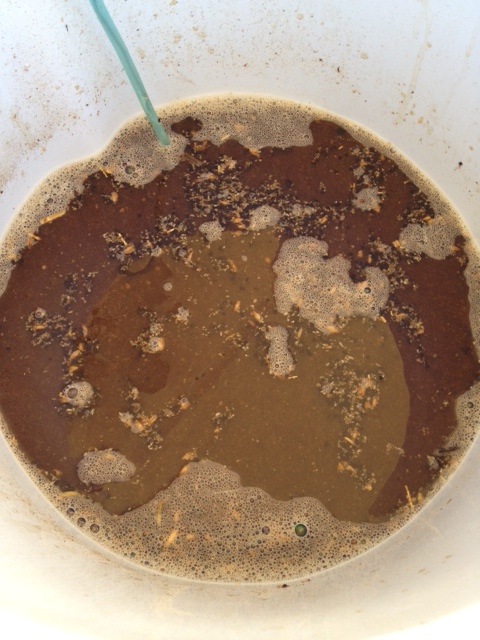
Gore from severed starch molecules splatters the walls of my mash tun like a scene from Dexter.
I did two batch sparges and ran 7.75 gallons of 1.032 wort into the kettle. For my last several brews, I have been forced to run off extra wort and boil it down for 90 minutes to hit my target OG. Someday I’ll figure out why that’s the case, but for now I don’t mind the longer boils. It gives me time to catch up on reading and Words With Friends.
I took a sort of bare-minimum approach to the hops, as I really wasn’t interested in a lot of hop character. I want the aroma and bitterness of the coffee and chicory to come through. So I added just .75 oz of 12.4% AA Nugget hop pellets to the boil with 60 minutes left to go, and no late hop additions. I added 1 lb of lactose (the ingredient that makes a milk stout a milk stout) later in the boil, with 20 minutes left.
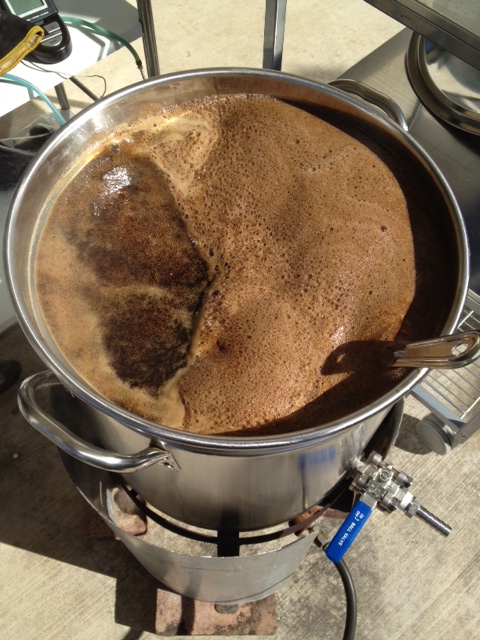
It's not just pretty to look at. The backyard smelled like a Starbucks.
Notice that I haven’t actually added the coffee and chicory yet. So far, this café au lait stout is just a milk stout begging for a wake-up, but it’s amazing how much it already smells like coffee, thanks to the malts I used. At kegging time, we’ll cold brew between 16-24 oz of coffee and chicory and rack the beer onto that. Cold brewed coffee is recommended because of its smoothness, and it’s really the only way we drink coffee and chicory in this house anyway.
The OG of the wort was 1.064, and I pitched 14 grams of rehydrated Fermentis Safale S-04 yeast. After years of using liquid yeast and rarely using the same strain twice, I’ve recently started using more dry yeast, and this simple English ale strain is rapidly becoming my go-to strain. That’s partly because I’ve been making a lot of British styles, and partly because my busy schedule hasn’t left me with much time to properly prepare liquid yeast for pitching (making a starter, etc.). But I couldn’t have settled down with a finer microbe, because S-04 works fast and flocculates like a rock star, leaving some fruity esters behind but mostly a very clean beer. I brewed this beer on Saturday, and as of yesterday, the kraeusen was already starting to fall.

Moments after pitching the yeast. They may be stooges, but they keep my fermentations cool.
I’m really excited about this brew. So much so that I couldn’t wait to make it, even though my timing means that I’m going to have a thick, malty stout on tap during the brutal Texas summer. But a friend said to me recently, “Any season is the right season for stout,” and I couldn’t agree more. Especially when my respite from the heat will be a tall, delicious pint of the Big Easy.
So, who’s bringing the beignets?
 myBrewHome