On-Tap Recap: Beers for the aging former headbanger
I was a metal kid in the late 80’s. Although I liked the music, it was the album art that drew me in. Iron Maiden, Dio, Ozzy, any album with demons or creepy magical glyphs on the cover was fair game for my tape collection when I was about twelve. See, back in the late 80’s before Viggo Mortensen and Peter Dinklage, it was hard out there for fantasy geeks. We didn’t strut proudly down the street shaking our D&D dice in their little bag, shouting about how geeky we were to passersby. Just being seen with a paperback of The Lord of the Rings was enough to get your ass kicked. But wearing a T-shirt or pin with album art from a metal band was, if not exactly “cool”, at least likely to scare people away so they’d leave you alone. It was a subtle way to get your geek on while people around you just assumed you were into something more socially acceptable than fantasy, like consuming heavy drugs or worshipping Satan.
The parental shock value of the album art was a factor as well. As an honor-roll student in the suburbs of a southern American city, there were few ways I could terrify my parents more than by hanging a life-size poster of Iron Maiden’s mascot Eddie the Head next to my bed, where it hung for almost ten years. My wife – who has been with me since we were teenagers – still has fond memories of that poster, recalling our first evenings as a couple (studying, always studying) under the leering visage of Eddie in his Somewhere in Time cyborg form. And they say teenage boys know nothing of romance.
Today is the twentieth anniversary of my first date with that wonderful woman I married, so I’m celebrating the past by recapping two beers that I think the twelve-year-old me who bought that poster would be proud of.
Eddie himself stars in my first tasting, snarling at me in 19th-century dragoon uniform from the label of a pint-sized bottle of Trooper by Robinsons Brewery, named for – and featuring the art from the 1983 single release of – the Iron Maiden song “The Trooper”.

Billed by Robinsons as a hand-crafted real ale “developed” by Maiden frontman Bruce Dickinson with “true depth of character”, it sounded about right for my taste. It poured a deep orange-gold with a thicker head than I expected, with the brassy, crackery aroma I love in an English ale. The taste was fine, a little astringent and earthy with a hint of slick, oily mouthfeel like one gets with oats in the grain bill, though I don’t know if there were any in this one. I don’t know about “true depth of character” but it was a pleasant enough pint at a sessiony 4.7% ABV. A friend of mine who is both a homebrewer and an Iron Maiden obsessive described the beer as “not as good as you want it to be”, and that was true. It’s a gimmick, plain and simple, and I bought into it; the beer was pleasant but not as remarkable as the song it’s named for. I could drink it again, but would rather drink my own English-style homebrew … though I will save the bottle.
Drawn in a style reminiscent of a seventeenth-century woodcut, a three-headed demon towers over a burning sea of tortured mortals beneath a ring of runes and glyphs on the label of Blakkr Imperial Black Ale, a collaborative brew between the self-proclaimed “unholy trinity” of Three Floyds Brewing in Indiana, Surly Brewing in Minnesota, and Real Ale Brewing in Central Texas, brought together by their “love of brewing and love of metal”. The black double IPA is available in 4-packs of – what else? – metal cans. Twelve-year-old me would totally have worn a pin of this label on his jean jacket.
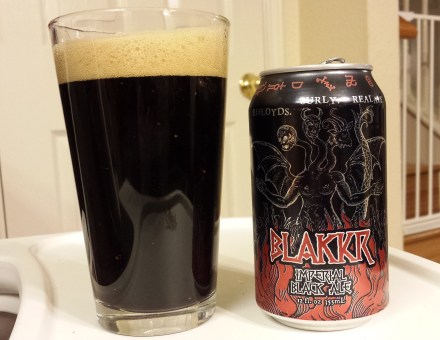
How’s the beer? Well, it’s black. With a thick beige head and a citrus aroma that leans towards bitter orange and lime. But it’s surprisingly drinkable for an imperial brew with an ABV of 9%. I don’t find it syrupy at all. There’s a crisp bitterness on the front end from traditional American pale ale hops, though as I empty the glass and my palate becomes fatigued, I notice the hops less and the roastiness of black malts comes to the foreground, like a dessert of dark chocolate cake after a pungent salad. But for all that, the beer isn’t that memorable. It’s tasty, and I would drink it again (good thing since I have three more) but I’m not sure that it lives up to the awesomeness of the label art.
Which means we have a trend here. Wicked art that satisfies your inner twelve-year-old and tie-ins with your favorite metal band are neat, but only get you so far in craft beer. Both beers could have been worse, but could have been better. I’ve learned I’ll buy a beer once on a gimmick, but I won’t rush out and buy it again. And it seems that you can’t judge a beer by its label.
An homage to UK pubs (and a classic monster movie)
I vote we go back to the Slaughtered Lamb. – Jack Goodman, An American Werewolf in London
Homebrew inspiration can come from strange places. My favorite homebrews are the ones that were inspired not just by an imagined set of flavors, but by places I’ve visited, stories I’ve read, movies I’ve watched, etc. I love using the language of malt, hops, and yeast to tell a story about something more than beer. The trick, though, is that brewing is not an abstract art. A good concept might make for a great conversation starter, but no matter how high-concept a brew is, if it doesn’t taste good I don’t want to be stuck with five gallons of it (I graduated from a Catholic university in New Orleans, but that doesn’t make it a good idea to brew a crawfish & Bananas Foster porter with Trappist ale yeast for the alumni picnic). Finding the right balance between concept and taste is the ultimate goal.
In spring 2011, Lisa and I visited the United Kingdom for three weeks and spent a lot of time in pubs. We drank real ales from so many regional breweries whose names I can’t remember (except for Brains – #1 among zombies in South Wales) served at cellar temperature, often from beer engines – though at one awesome hole-in-the-wall in a one-road hamlet in Scotland I think I remember drinking beer dispensed from a cardboard box. The taste and aroma of real British ale, even the sight of the interior of a British pub, are vivid and powerful memories for me.
In summer 2012, I saw John Landis’ 1981 film An American Werewolf in London for the first time and my nostalgia was kindled by an early scene in the film at a fictitious Yorkshire pub called the “Slaughtered Lamb”. So I brewed a special bitter with English malts and American hops that I named Kessler’s Rampage Special Bitter in homage to the film’s main character and titular werewolf. Not long after I kegged it my sister-in-law and her husband, a native Sussaxon*, came to visit for a week and emptied the keg while I wasn’t looking. I took that as a compliment, and decided to brew it again this summer.
The 2013 version was 94% (8 lbs) Fawcett’s Optic malt, reportedly the base used by Fuller’s and other UK breweries. 4 oz each of Crystal 40 and Crystal 150 rounded out the grain bill. Last year I used Crystal 120 instead of Crystal 150, but otherwise the malt profile was the same in both versions and pretty typical of the style. The mash was one hour at 155°F.
The hops were my chance to freestyle. American homebrewers can be pretty predictable in their hop selections for English pale ales – occasionally someone might get bold and use a little Fuggles, but generally it’s either East Kent Goldings, East Kent Goldings, or another … what’s it called? oh yeah, East Kent Goldings. I suppose that’s what judges look for in competition, but the lack of originality disappoints me. American pale ales and English pale ales are cousin styles, and I see no reason why American hops can’t play a role in a damn fine English bitter if the right ones are chosen – i.e., probably not the 4 C’s (though I suspect someone has done it well).
In 2012, I used exclusively American hops in keeping with the inspiration (you can see both recipes here). For 2013, I deviated with one English hop in the mix:
- 0.5 oz Warrior (15% AA) at 60 minutes
- 0.5 oz Progress (6.6% AA) at 15 minutes
- 0.4 oz Willamette (4% AA) at 5 minutes
Although Progress is English and Willamette is American, both are Fuggle derivatives, so I thought they would pair nicely together despite being a slight variation on the original inspiration. Consider it an homage to Jenny Agutter’s character Alex in the film, the English love interest of the American David Kessler (yes, I can rationalize anything with my artsy symbolic bullshit).
I pitched Safale S-04 into the wort with an OG of 1.046. True to the old adage that “English yeast do it faster,” the fermentation bottomed out at 1.010 less than 48 hours later, leaving me with an ABV of 4.7%, palpable but still sessionable. I kegged it after 4 weeks, and after 2 weeks under refrigeration it’s just starting to get good enough to drink.
I don’t have any of last year’s batch left over to do a true vertical tasting, but I’m a little disappointed in this year’s model. I’m not sure the Progress hops were a good addition (sorry, Jenny). I’ve used them in more robust English-style beers like porters and stouts to great effect, but with so little malt character to hide behind, I’m getting a strong tropical fruit flavor though it is mellowing with time in the keg. The other fault is less diacetyl than I like in this style, though it may be hiding under all those Progress hops and may become more obvious as the hop flavor mellows.
So the beer’s not perfect. But considering I half expected the skies to open up, swarms of locusts and some ancient BJCP curse to fall upon me when I put hops other than East Kent Goldings in a special bitter, I think I’m still coming out ahead. I don’t get the feeling of being an American lost in Britain in this version, but my second Transatlantic ale experiment is good enough to brew again. And again. Until I get it right.
*Sussaxon: a native of East or West Sussex. My brother-in-law assures me this although this term is technically accurate, no one uses it. We both like it because it makes us think of the people of Sussex as mud-splattered, armor-clad Saxons performing great acts of manly savagery like raiding cottages across the southern coast of Great Britain. They’re not.
 myBrewHome