
Vote for Progress … hops
Saturday was Learn to Homebrew Day in the USA, and today is Election Day. To honor both events, I did what any patriotic and pedantic zyme lord would. I made beer.
I called it Colonial Progress Ale, and it’s something between an English bitter and an English brown ale. “Colonial” comes from the fermentables, adapted from a recipe I envisioned for a colonial-style ale during a trip to Philadelphia earlier this year. I ended up with:
- 6.5 lbs American 2-row
- 1 lb Victory malt
- 8 oz Flaked wheat
- 8 oz Flaked oats
- 1 lb Molasses
Each of these ingredients was chosen for a reason, starting with American 2-row malt as the base. Wheat is common in colonial ale recipes, including one attributed to Thomas Jefferson. Victory and oats I had no historic precedent for, but I added them for body in the finished beer, along with some bready/biscuity flavor (Victory) and silky smoothness (oats) to accentuate the English-inspired malt profile. I mashed at 153°F for medium fermentability, counting on the highly fermentable molasses to dry the beer out.
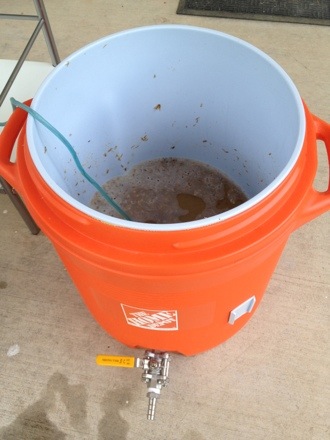
The mash begins.
Ohhh, molasses. A common ingredient in beer in early colonial Philadelphia (according to a quote from William Penn), I can eat the stuff right out of the jar. But I was nervous about using it after reading John Palmer’s tasting notes ranging from “rumlike” and “sweet” (woohoo!) to “harsh” and “bitter” (ergh). But further research online suggested that harsher flavors were associated with fermenting mineral-rich blackstrap molasses, not the regular unsulphured kind. I went with regular, and added them at the beginning of the boil with high hopes.
The “Progress” part came from the hops: one ounce of 6.6% AA Progress at the 60-minute mark for bittering, and another quarter ounce at 15 minutes for flavor. Progress is a UK varietal related to Fuggle hops, a good choice for English-style ales.
But that wasn’t all I added to the boil. Hops were available to some colonial brewers, but apparently not all that prevalent, so other bittering herbs were common. My original plan was to use horehound, but I realized the medicinal flavor might overpower a low-gravity ale. I thought of rosemary, but was talked out of it by the sages (ha, ha) at Austin Homebrew Supply. I landed on:
- .25 oz Juniper berries (crushed in mortar)
- .5 grams Sweet Gale (dried)
I added the herbs in the last minute of the boil and let them steep during cooling and whirlpool. I may add more later during conditioning.
The wort had an OG of 1.046, a true session ale for the upcoming winter (insert witty apropos Valley Forge reference; I can’t think of one). I pitched the slurry from a 2-liter starter of WLP008 East Coast Ale Yeast – reportedly the Sam Adams house strain – in keeping with the colonial theme. I set the fermentation chamber to an ambient 65-68°F, a little warmer than typical to coax some vintage ester flavor from this low-flocculating yeast.

Fermentation underway after 24 hours.
By this time tomorrow, the future of the United States will be written for the next four years. But regardless of whether my guy wins or not, I’ll have something to look forward to: a beverage in the tradition of the first beers brewed on American soil. Beer has always been a part of American culture, even before there was a United States, and from #1 on down to #44 many presidents have been homebrew aficionados: George Washington, Thomas Jefferson and James Madison were homebrewers and Barack Obama bought a homebrew kit for the White House with his own money. And beer remains one of the few things people can agree on regardless of personal politics.
Don’t forget to vote today, no matter who you’re supporting. Red and blue be damned. We can all party together in the colors of the SRM scale.
Weizen Up
Sorry, Internet, I've been holding out on you. Weiss Blau Weiss Bavarian Hefeweizen, my experiment in simplicity that I brewed in June, has been pouring for over a week now, and I've had several pints of it already; but I haven't yet written about it. It's high time I did, so you can enjoy it vicariously as much as I've been enjoying it … well … the regular way.
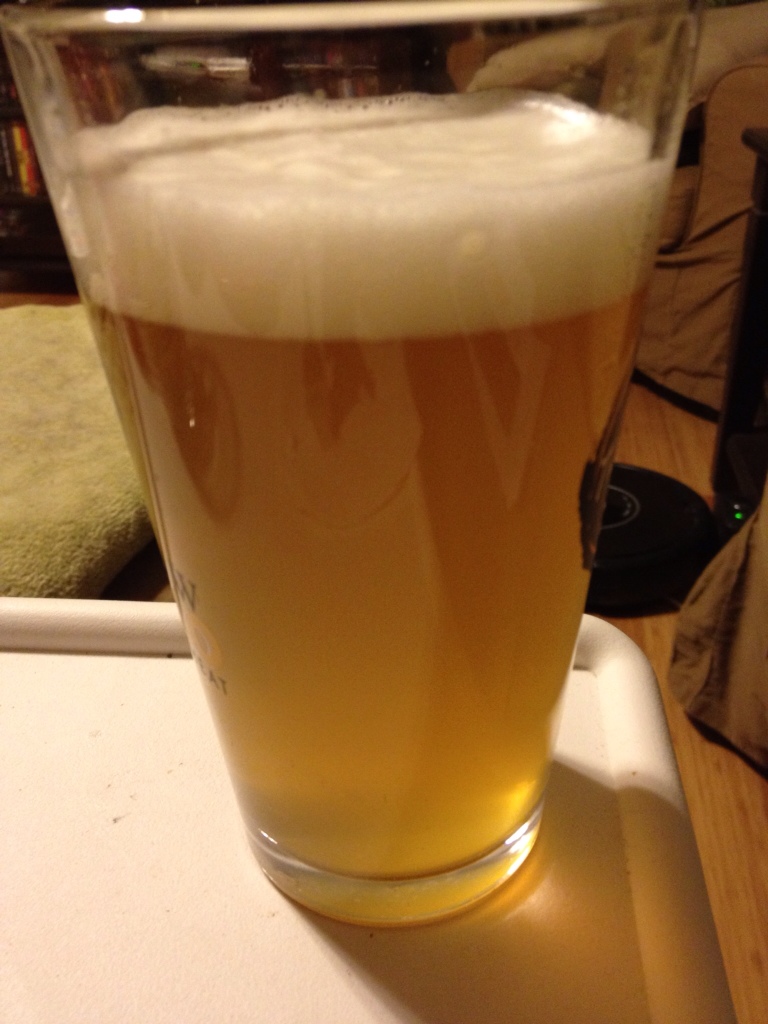
Shinin' like Rhine-gold.
It pours beautifully: a creamy golden color with a gleaming white head. It's cloudy, as a hefeweizen should be, and except for a little bit of floating sediment, it looks as good as any commercially brewed hefeweizen I've ever had. The sediment should clear up once I pour a few more pints off the keg. I did use Irish moss for this brew – as I do for most of my brews – but there are many who choose not to use kettle finings for hefeweizens, and it's possible this worked against me in that it precipitated more particles out to the bottom of the keg. But I'm sure it'll be fine in a few more pours.
The aroma is spectacular. Exactly what I wanted: lots of banana esters, a touch of the sweet, grainy aroma of crisp continental Pilsner malt, and the faintest whiff of clove spiciness. That's about it. No hops on the nose at all. Nothing confusing or muddling. You can tell instantly what ingredient created every single component of the olfactory signature of this beer.
The taste is good, too. It's light, of course, and perfect patio refreshment for my next summer brew session. The yeasty character doesn't lead in the flavor department the way I was hoping it would, not like it leads the aroma. I don't usually bother with that little slice of citrus that most brewheads outside of Bavaria are so fond of in their weizens, but I could see a lemon wedge adding something to this beer, just because it could use a bit more zing (sadly, I don't have any in the house). I don't blame the recipe for this little flaw, rather my fermentation temperature. Next time I make it, I'll ferment a couple of degrees higher for the first couple of days.
The mouthfeel is just right for a summer afternoon: refreshing, not too astringent. It goes down smooth and easy, and at 5.2% ABV is pretty session friendly.
So there you have it. Weiss Blau Weiss Bavarian Hefeweizen was an overall success, not despite its simple recipe but because of it. In fact, it seems to me that my efforts to introduce unnecessary complexity to the process – namely, using kettle finings and overchilling during fermentation – was the main thing that kept it from being (to me) a perfect beer. But that's okay; it's still plenty drinkable, and I'm sure I'll be emptying this keg pretty quickly … no complaints here, because I'd love to make it again. Can I make it even simpler next time? Probably not much so, but the lesson has been hammered home: one doesn't need a mile-long list of ingredients to make a damn good beer.
Of course, the Bavarians have been trying to tell us that for centuries.
Trying to keep my cool
With the summer solstice behind us and 3-digit temperatures facing Central Texas, I’ve been giving lots of thought to fermentation temperature control. Fermentation temperature is the most important variable a brewer can control during fermentation, and has a huge impact on flavor. Ales should be kept between 65-72°F during active fermentation, and ideally between 66-68°F for most yeast strains. Too hot and you start to get banana, clove, and bubblegum flavors from esters produced by the yeast (hotter than 80°F and you get fusel alcohols, which give that acrid “firewater” taste associated with cheap spirits). Too cold and ale yeast start go dormant, so fermentation may not complete – although lager yeasts ferment best between 45-55°F.
Here in Texas, “too cold” has never been a problem – with sympathy for my friends in Minnesota and Canada – but “too hot” frequently is. So I use a “swamp cooler” to keep my fermentations cool. This is where you place the fermenter in a big tub filled with cold water, and keep the water cold by periodically swapping out frozen ice packs. I also cover the fermenter with a T-shirt to wick cold water up the sides – some brewers even add a fan to the system. Whatever specific variation you go with, it’s a great way to keep fermentation cool on a budget: for the price of a $7 plastic tub at Target, a decent-sized collection of ice packs (or frozen water bottles), an old shirt and that broken fan in your garage that stopped oscillating in 1998, you can easily keep your fermenter 10°F colder than the room it’s in. My Weiss Blau Weiss Bavarian Hefeweizen didn’t get above 73° all last week, despite ambient temperatures in the house of up to 80°. And the only reason it got that high was because I wanted it to.
But this method has its drawbacks. For one, temperatures fluctuate quickly, and you need to be able to swap out ice packs every few hours. I work from home, so I can do this; but I can’t imagine making this work with a job outside the house. And overnight, the temperature usually goes up 5-7° by morning (sorry, beer: I love you, but not enough to wake up every 2 hours during the night for you) and it takes time to bring it back down.
It’s also messy. Keeping a few gallons of stagnant water in a dark closet for 7-10 days isn’t always a pretty sight. Sometimes, the T-shirt develops mildew and needs to be changed out – unpleasant at best, and a contamination risk at worst (though not a huge one if the fermenter is closed and the airlock filled). And when primary fermentation is done … well, let’s just say that if you’ve ever lifted a plastic bucket containing 5 gallons of liquid wrapped in sopping wet cotton out of a larger plastic bucket, you know how much fun it isn’t.
So I think I’m ready to graduate to a chest freezer with a Johnson temperature controller. It’ll be cleaner, easier, and will give me new power as a brewer. No longer will I be tied down brewing wheat beers during the sweltering Texas summer – I can make crisp APAs and blonde ales, knowing I’ll be able to keep the fermentation cool enough to get a good clean flavor. I’ll also finally be able to make some decent Belgian-style ales, which require gradually ramping up the temperature with better precision than I can get in my swamp cooler. Someday, if I get really crazy, I may even try my hand at making a lager.
I just need to find a freezer that’s big enough for my 8-gallon fermenter but small enough to fit through the door of the Harry Potter closet. It’ll cost a bit of money, but it’s an investment in better beer and more versatility. And really, isn’t that what being a homebrewer is all about?
 myBrewHome