
On-Tap Recap: Ommegang Game of Thrones vs. homebrew
HBO’s Game of Thrones came back with season four last night. Hordes gathered in the homes of HBO subscribers for viewing parties, cosplayers donned their finest, and social media lit up as the geekosphere celebrated the return of a beloved show to weekly television.
Beer geeks had reason to celebrate too, as the show’s return meant the release of the third installment in Brewery Ommegang’s series of Game of Thrones-themed seasonal beers. Dubbed Fire & Blood, the latest release pays homage to House Targaryen – that’s the one with the dragons – with ancho chilis (presumably the fire) in a Belgian-style red ale (the blood).
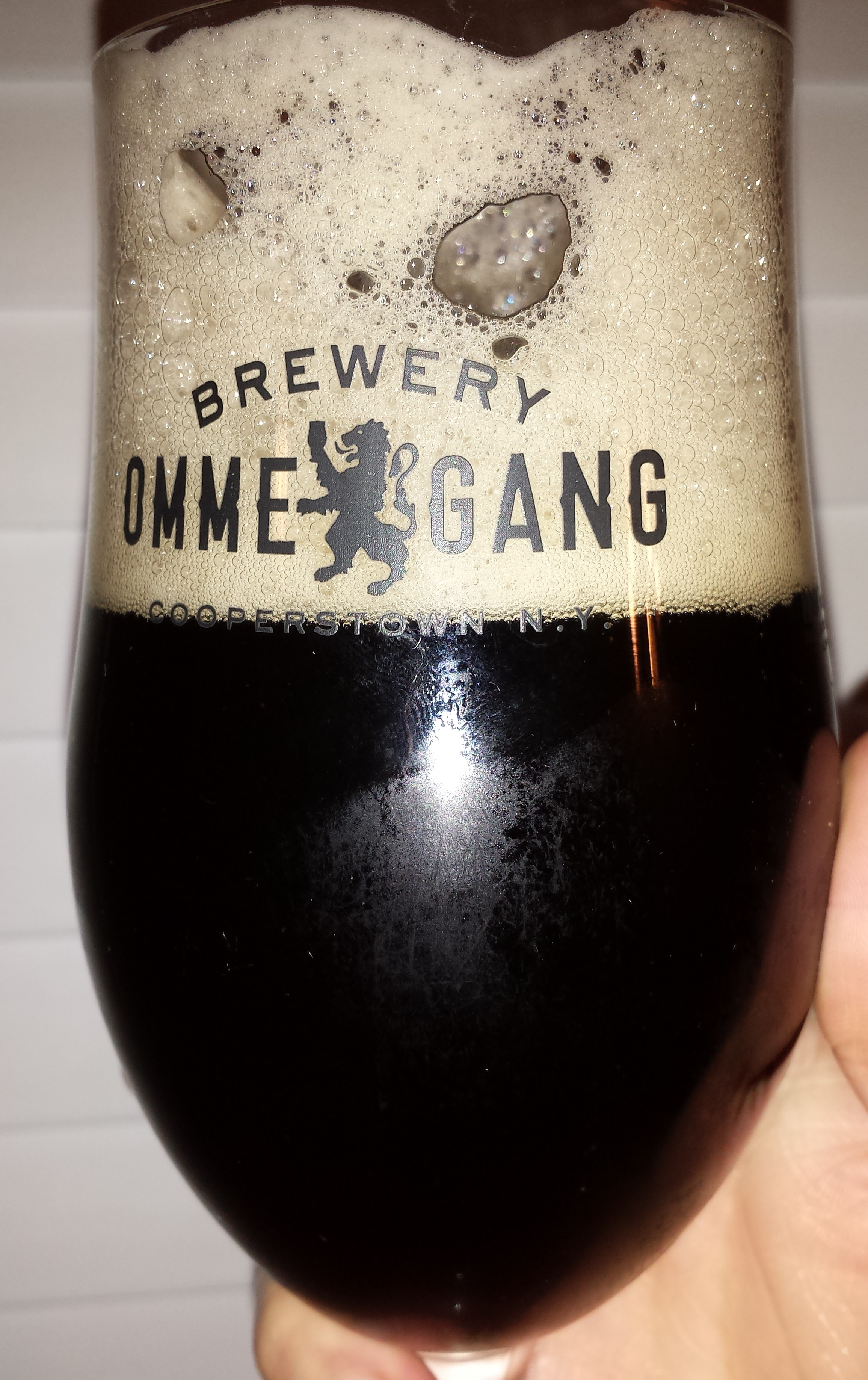
Ommegang Fire & Blood Red Ale
The color of this beer is absolutely striking. When I hear “red ale” I’m usually imagining some middle-of-the-road amber kind of beer. This one was deep, dark red. Beautiful ruby highlights – impossible to see in the picture above, unfortunately – beckoned me to smell and taste it. This was an exercise in delayed gratification, because the rocky head was so thick and persistent I had to wait several minutes before it subsided enough to drink. So I contented myself with smelling it, taking in the tart lemon freshness and barely detectable hint of chili pepper.
I hate to say it, but I found Fire & Blood drinkable and yet unremarkable. The flavors promised on the label and website – spicy chili, “assertive” hops, dark fruit – just didn’t manifest for me. The chili pepper was detectable only when I looked hard for it. The hop presence was faint and the dark fruit notes were muted by the extreme dryness of the beer.
Not that disappointment came as a surprise. I love everything I’ve ever had with the Ommegang label on it except for the three GoT beers they’ve released. The first – Iron Throne Blonde Ale, released in March 2013 – was decent enough but sort of ruined for me by excessive hype. Take the Black Stout, released last fall, was interesting with its star anise and licorice, but fell short of my expectations. I’m glad Ommegang is making these beers, because anything that promotes awareness of craft beer is good. But I keep hoping that one day they’ll brew one that delivers as intense and memorable an experience as the show itself.
So what’s a Zyme Lord to drink when watching the rest of the new season? Not to worry! I’ve got my own GoT-themed beer on tap: Wit Walker Wight Ale (recipe here).

Wit Walker Wight Ale
This beer that I made primarily to have something sessionable on hand for parties has turned out to be one of my own main pours these days. It’s an enticing cloudy straw color (again the photo above does it little justice) with a thick fizzy white head that dissipates quickly. There’s a faintly footy Belgiany aroma coupled with a hint of clove and spice. When it hits the palate, the blood orange comes out in full force – not overpowering the beer, but providing a backdrop of bitter citrus and zest that bounces effervescently on the tongue. I’ll be glad to finish a keg (or two?) of this beer as the season progresses.
It isn’t often that I face off one of my homebrews with a commercial beer. But when I do, it’s encouraging that my own beer can come out the winner. Don’t get me wrong, I love Ommegang and will continue to support their efforts to bringing beer awareness to GoT fans and vice versa. When the fourth GoT beer comes out this fall, I’ll buy a bomber or two. I’m just that big of a geek – for beer and for the show. But as a backup, it’ll be nice to have my own GoT-themed beer on tap so I can drink the beer I want, when I want. After all, that’s what homebrewing is about.
Insert something witty here
Let’s start today at the BJCP Style Guidelines. Scroll through the list of styles. What do you see? Sure, it’s a manual, a valuable tool for any brewer. But for the beer lover, it’s also one part journal and one part little black book, with mental check marks next to the styles you’ve tasted and/or brewed … while unfamiliar styles call to you siren-like, the anticipation of conquests you haven’t yet made. Just like flipping through the pages of an old journal, you’re bound to have some regrets, some “what was I thinking?” moments (style 1A. Lite American Lager, anyone?). But also like a journal, the later entries leave you feeling a lot less embarrassed than the earlier ones, and certainly by the time you get to the English Pale Ales (starting with 8A. Standard/Ordinary Bitter) you’re starting to be proud of what you’ve accomplished.
Then halfway through, you see it: that entry that makes you question your judgment all over again, sitting drab and dull like a cat turd in the gold mine of your zymurgical adventures. The reminder of the giant noob you once were. And you ask yourself again, “What in the world was I thinking?”
I speak, of course, of 16A. Witbier.
Whether you call them wits, wittes, Belgian whites, or even bières blanches, chances are that you or someone you know has laughed derisively at this light, easy-drinking style in the recent past. And I’m not sure why that is. Maybe because so many commercial examples are so-called “crafty” offerings from industrial lager producers padding out their product portfolios with under-attenuated, over-flavored wits to provide a clawhold onto the elusive craft beer market and a talon in the door of the non-beer-drinker. Or maybe because witbiers are something we see as behind us, the non-threatening gateway beers we drank before graduating to today’s Imperial Everythings, and IPAs with IBUs approaching the GDP of Luxembourg. Witbiers are familiar, and after all we’ve been through … boring.
But it doesn’t have to be that way. With a little creativity, witbiers are a useful addition to the recipe book. They’re very forgiving of temperature fluctuations during fermentation (i.e., great for beginners), and are especially handy when you need a batch of beer to go from grain to glass in a couple of weeks (i.e., great for anyone strapped for time).
The traditional wit recipe is roughly equal parts continental Pilsner malt and unmalted/flaked wheat, with oats on top of that at around 5-10% of the grain bill. A multi-step mash is usually performed with a beta-glucan rest at 110°F (or a protein rest at 120°F) and a saccharification rest around 154°F. The multi-step mash breaks down proteins that make the flaked grains gummy, avoiding the frustration of a stuck mash (replacing it, in my opinion, with the frustration of missing multiple step temperatures in my converted cooler mash tun … but more on that in a moment). In the boil, a small early addition of noble hops for bittering is typical, with coriander and orange peel (often Curaçao bitter orange, also known as laraha) added near the end.
My variation was developed in response to the need for an easy brewday and my desire for a bit more flavor than is offered by most commercial witbiers. First, the grain:
- 4.25 lbs Belgian Pilsner malt
- 4.25 lbs white wheat malt
- 1 lb flaked oats
- 0.25 lbs (4 oz) Munich malt
The substitution of malted white wheat for flaked wheat eliminates the need to do a multi-step mash, but just to be safe – since I still had about 10% flaked oats – I included 8 oz of rice hulls to keep the lauter flowing freely and did a single infusion mash at 151°F. The Munich was included to bring a little color and a touch of malty flavor.
I boiled for 100 minutes – longer than my usual 90, but just by accident. I added 0.55 oz of 8.2% AA American Santiam hops at the 60-minute mark. Santiam is a hop I hadn’t used before, but being related to German Tettnanger and Hallertauer Mittelfrüh (and thus more noble than American “Tettnang” hops which are actually descended from Fuggles) it seemed a worthy candidate. I got floral and peppery notes from it.
But the end of the boil was where things really got interesting. With 1 minute left in the boil, I added:
- 0.2 oz dried bitter orange peel (left over from a previous batch)
- 1 oz fresh blood orange zest (about 4 oranges’ worth)
- 12 g crushed coriander
- 3 g crushed grains of paradise
The original gravity was 1.053, technically a point past the upper end of the style, but I’m not complaining. I pitched a starter of White Labs WLP400 Belgian Wit Ale Yeast, an obvious choice for the style – but underpitched slightly by using a 900 mL starter. This should lead the yeast to produce more clove phenols to counterpoint the fresh zest and peppery spices. I started the fermentation at 68°F, but gradually heated the chamber up to 72°F by the third day, which should also accentuate the phenols. If it seems like I’m hedging my bets on phenol production, I am. This is my third wit, and the other two didn’t have nearly the fermentation flavor I was looking for.
I keg it two weeks from brewday, and I’ll be serving it just in time for the beginning of March and my ultimate reason for brewing this: a month of Game of Thrones viewings to prepare for the new season starting in April. It’s the reason I named this brew Wit Walker White Ale, and I think it’ll be a perfect beer to have on tap for Game of Thrones catch-up. It’s light enough to go with a variety of snacks. It’s sessiony enough to keep drinking through hours of viewings without getting drowsy or losing the plot in a beery stupor. And yes, it’s accessible enough to share with all my friends, even those who aren’t on the hardcore brew bandwagon yet. And by loading it up with flavors I like, I can guarantee myself something I can still be proud to drink along with everyone else … something so familiar, but completely new.
Homebrew Tips for New Dads: Commemorating the event, a great excuse to drink!
Well, I’m back. – Samwise Gamgee
I haven’t written for this blog in nearly two months, as I’ve gradually adjusted to the ups and downs of being a father to my first child. Learning how to change, bathe, and sing Queen songs (including a special diaper-time version of “Bohemian Rhapsody” with peepee-related lyrics) to my newborn son Lucian was only the beginning. I also learned to deal with: an increased share of the housework to help Momma, an upheaval of my sleep schedule, a return to my day job, and the happy stress of many wonderful visits from friends and family anxious to meet the little dude in the blue onesie.
With all of that going on it was hard to find time to write, which was fine because I wasn’t doing all that much to write about. If your blog is about homebrewing, when you ain’t homebrewing you ain’t got much to say.
Did you catch that? Practically no homebrewing for two months. The horror! Almost as horrific as the fact that “bottle washing” means something entirely new to me now that I have a baby (interestingly, I don’t dread washing baby bottles like I did beer bottles – no labels).
Even though I haven’t done much brewing, I have partaken liberally of the fruits of my homebrewing labor. Thanks to some careful planning before the birth, I’ve managed to keep the pipeline flowing during my hiatus. But preparing for these brewless weeks wasn’t just about making sure I had enough booze to get through the newborn period. Far from it. You see, I’m a commemorator.
The things we create – a beverage, a story, a carpentry project, even the name we give to a child – form a record of our past. Each creation is a snapshot of who we were when we created it, a representational image of our brain at the moment of creation. Those snapshots exist long after the “me” responsible for the creation has changed forever – years after, if we’re lucky – and are like little running shoes for the feet of our memories. That’s one of the reasons why I believe every human being should create … something.
Of course, if what you create is consumable food products like beers and meads, there’s a shelf life to consider, so they won’t last forever. Sure, the right brews (imperial stouts, barleywines, meads, fruit wines) can be cellared for years if designed and handled properly, but at some point you’ll open and empty the last bottle. They’re not quite as permanent as other creations can be. But the unique thing about brewing to commemorate important life events is that the enjoyment of those creations (i.e., the drinking of the beer after it’s fermented/aged) creates its own memories that are worth holding onto in their turn.
The day we brought Lucian home from the hospital, Lisa and I shared a bomber of Le Petit Plésiosaure Saison, a Summit-hopped saison loosely adapted from Brooklyn Sorachi Ace that I brewed in February. The name (French for “the Little Plesiosaurus”) is an homage to an adorable cartoon poster of the Loch Ness Monster we have hanging in Lucian’s room. We gave bottles of the saison out as favors to friends who came to our baby shower and asked them not to open it until we announced the birth, and we did the same.

C’est bon ça!
I’m thrilled to report that this saison exceeded my expectations and also wowed my friends, not all of them beer geeks: a refreshing, dry, aromatic and spicy saison perfect for late spring/early summer that hides its 8% ABV under layers of citrus, chamomile and subtle phenolics. We’ve made it through nearly all of the bottles we had left over, and that’s okay. This beer was intended for drinking fresh in hot weather, for refreshing breaks from the hard work of keepin’ this baby happy. When I have my last taste of it later this summer, I’ll pause to celebrate the end of the first phase of Lucian’s life and the beginning of the next. In fact, his 3-month birthday sounds like a great time to finish off the batch. Challenge accepted.
The other commemorative brew I’m enjoying between sessions of therapeutic baby bouncing is Lucian’s Landing Ginger Metheglin, a ginger mead I made in October with the goal of bottling it right before the baby was born (but Lucian landed early, so I didn’t bottle it until after). I aged it from October to April, by which time all of the fresh ginger root aromatics in the must had evaporated – only a pleasant ginger tang on the palate remained. To replace the lost aromatics, I steeped 3.5 oz of fresh ginger root in 8 oz of boiled water to make a ginger tea and added that to the carboy along with 4 oz of crystallized ginger in a muslin hop sack. After 4 weeks, I bottled it and had labels printed with my own design evoking the inspiration for my son’s name, a second-century work of early science fiction satire called True Story (often translated as True History) by Lucian of Samosata.

Protip: Even when buried beneath housework and baby care chores, always find time for Photoshop.
We plan to drink some fresh and save some bottles for special occasions (first Christmas, birthday, etc.), so the snazzy bottles were a must. Most recently we opened a bottle on Sunday, Lucian’s 2-month birthday, and found that mead paired quite well thematically with a marathon viewing of Game of Thrones Season 3 before the finale Sunday night. Pale golden and nearly crystal clear, it has just enough ginger to tickle the nose and palate before the unmistakable earthen notes of honey come in, then recede giving way to a fruity, ginger ale-like finish. I’m proud of it.

Deceptively elegant at 13.7% ABV.
I like to think that someday Lucian will appreciate things like the fact that his dad made a special mead in honor of his birth, even though he couldn’t enjoy it himself (though maybe one day, who knows …). There’s no way of knowing now, of course, but I suppose it doesn’t matter. I’ll keep doing it for myself. Being a father is hard work, and I’m sure it’s only going to get harder. Though it’s already proving to be well worth all the effort I put into it, finding time to remember “me” amid the multitude of self-sacrificing tasks to be completed has been an important step in retaining my sanity. And that’s who me is (erm, I am): A homebrewer. A commemorator. A big frickin’ sap.
My more perceptive readers may have noticed that above I mentioned “practically no homebrewing”. Don’t tell anyone, but I did manage to squeeze in one brewday before April – the month of my son’s birth – was over. That was yet another commemorative brew, but one I won’t be drinking for a long time. I’ll tell you all about it in an upcoming post. The only hint I’ll offer before then is: Ribbit.
This Sunday, remember to wish a Happy Father’s Day to your dad or a dad you know (or yourself if the gift-wrapped dress socks fit) … and to my fellow new dads out there, just starting out on this difficult but rewarding journey: have a homebrew with me. We deserve it.
 myBrewHome