
Homebrew Tips for New Dads: Commemorating the event, a great excuse to drink!
Well, I’m back. – Samwise Gamgee
I haven’t written for this blog in nearly two months, as I’ve gradually adjusted to the ups and downs of being a father to my first child. Learning how to change, bathe, and sing Queen songs (including a special diaper-time version of “Bohemian Rhapsody” with peepee-related lyrics) to my newborn son Lucian was only the beginning. I also learned to deal with: an increased share of the housework to help Momma, an upheaval of my sleep schedule, a return to my day job, and the happy stress of many wonderful visits from friends and family anxious to meet the little dude in the blue onesie.
With all of that going on it was hard to find time to write, which was fine because I wasn’t doing all that much to write about. If your blog is about homebrewing, when you ain’t homebrewing you ain’t got much to say.
Did you catch that? Practically no homebrewing for two months. The horror! Almost as horrific as the fact that “bottle washing” means something entirely new to me now that I have a baby (interestingly, I don’t dread washing baby bottles like I did beer bottles – no labels).
Even though I haven’t done much brewing, I have partaken liberally of the fruits of my homebrewing labor. Thanks to some careful planning before the birth, I’ve managed to keep the pipeline flowing during my hiatus. But preparing for these brewless weeks wasn’t just about making sure I had enough booze to get through the newborn period. Far from it. You see, I’m a commemorator.
The things we create – a beverage, a story, a carpentry project, even the name we give to a child – form a record of our past. Each creation is a snapshot of who we were when we created it, a representational image of our brain at the moment of creation. Those snapshots exist long after the “me” responsible for the creation has changed forever – years after, if we’re lucky – and are like little running shoes for the feet of our memories. That’s one of the reasons why I believe every human being should create … something.
Of course, if what you create is consumable food products like beers and meads, there’s a shelf life to consider, so they won’t last forever. Sure, the right brews (imperial stouts, barleywines, meads, fruit wines) can be cellared for years if designed and handled properly, but at some point you’ll open and empty the last bottle. They’re not quite as permanent as other creations can be. But the unique thing about brewing to commemorate important life events is that the enjoyment of those creations (i.e., the drinking of the beer after it’s fermented/aged) creates its own memories that are worth holding onto in their turn.
The day we brought Lucian home from the hospital, Lisa and I shared a bomber of Le Petit Plésiosaure Saison, a Summit-hopped saison loosely adapted from Brooklyn Sorachi Ace that I brewed in February. The name (French for “the Little Plesiosaurus”) is an homage to an adorable cartoon poster of the Loch Ness Monster we have hanging in Lucian’s room. We gave bottles of the saison out as favors to friends who came to our baby shower and asked them not to open it until we announced the birth, and we did the same.

C’est bon ça!
I’m thrilled to report that this saison exceeded my expectations and also wowed my friends, not all of them beer geeks: a refreshing, dry, aromatic and spicy saison perfect for late spring/early summer that hides its 8% ABV under layers of citrus, chamomile and subtle phenolics. We’ve made it through nearly all of the bottles we had left over, and that’s okay. This beer was intended for drinking fresh in hot weather, for refreshing breaks from the hard work of keepin’ this baby happy. When I have my last taste of it later this summer, I’ll pause to celebrate the end of the first phase of Lucian’s life and the beginning of the next. In fact, his 3-month birthday sounds like a great time to finish off the batch. Challenge accepted.
The other commemorative brew I’m enjoying between sessions of therapeutic baby bouncing is Lucian’s Landing Ginger Metheglin, a ginger mead I made in October with the goal of bottling it right before the baby was born (but Lucian landed early, so I didn’t bottle it until after). I aged it from October to April, by which time all of the fresh ginger root aromatics in the must had evaporated – only a pleasant ginger tang on the palate remained. To replace the lost aromatics, I steeped 3.5 oz of fresh ginger root in 8 oz of boiled water to make a ginger tea and added that to the carboy along with 4 oz of crystallized ginger in a muslin hop sack. After 4 weeks, I bottled it and had labels printed with my own design evoking the inspiration for my son’s name, a second-century work of early science fiction satire called True Story (often translated as True History) by Lucian of Samosata.

Protip: Even when buried beneath housework and baby care chores, always find time for Photoshop.
We plan to drink some fresh and save some bottles for special occasions (first Christmas, birthday, etc.), so the snazzy bottles were a must. Most recently we opened a bottle on Sunday, Lucian’s 2-month birthday, and found that mead paired quite well thematically with a marathon viewing of Game of Thrones Season 3 before the finale Sunday night. Pale golden and nearly crystal clear, it has just enough ginger to tickle the nose and palate before the unmistakable earthen notes of honey come in, then recede giving way to a fruity, ginger ale-like finish. I’m proud of it.

Deceptively elegant at 13.7% ABV.
I like to think that someday Lucian will appreciate things like the fact that his dad made a special mead in honor of his birth, even though he couldn’t enjoy it himself (though maybe one day, who knows …). There’s no way of knowing now, of course, but I suppose it doesn’t matter. I’ll keep doing it for myself. Being a father is hard work, and I’m sure it’s only going to get harder. Though it’s already proving to be well worth all the effort I put into it, finding time to remember “me” amid the multitude of self-sacrificing tasks to be completed has been an important step in retaining my sanity. And that’s who me is (erm, I am): A homebrewer. A commemorator. A big frickin’ sap.
My more perceptive readers may have noticed that above I mentioned “practically no homebrewing”. Don’t tell anyone, but I did manage to squeeze in one brewday before April – the month of my son’s birth – was over. That was yet another commemorative brew, but one I won’t be drinking for a long time. I’ll tell you all about it in an upcoming post. The only hint I’ll offer before then is: Ribbit.
This Sunday, remember to wish a Happy Father’s Day to your dad or a dad you know (or yourself if the gift-wrapped dress socks fit) … and to my fellow new dads out there, just starting out on this difficult but rewarding journey: have a homebrew with me. We deserve it.
Here’s one for the English majors
Last night when reading Mitch Steele’s book IPA: Brewing Techniques, Recipes and the Evolution of India Pale Ale, I came across this excerpt from a poem by British poet A. E. Housman which Steele used as a chapter epigraph. I recognized two lines, which will be familiar to many of my readers:
Say, for what were hop-yards meant,
Or why was Burton built on Trent?
Oh many a peer of England brews
Livelier liquor than the Muse,
And malt does more than Milton can
To justify God’s ways to man.
Ale, man, ale’s the stuff to drink
For fellows whom it hurts to think.
Spot the familiar lines? I’ll explain just in case. The quote “Malt does more than Milton can / To justify God’s ways to man” is referenced frequently in beer culture. It appears on T-shirts and in books, and is quoted endlessly on websites dealing with homebrewing and craft beer.
It’s one of those quotes we use to validate our passion, to reclaim some respect in a world that doesn’t always understand our love of beer and occasionally confuses us with the common alcoholic. With such quotes, we seek to remind the world that many drinkers are also great thinkers: from poets (Housman) to politicians (another famous quote is uncertainly attributed to Benjamin Franklin) to philosophers (ditto, Plato).
The Housman quote has always caught my eye because of the reference to John Milton’s Paradise Lost, which Milton wrote to – in his own words – “justify the ways of God to men”, something Housman appears to claim beer can do even better. I’m not Milton’s biggest fan, but I’ve read and enjoyed Paradise Lost and was always impressed that Housman seemed to echo one of my beliefs: that a good beer is a work of art as inspiring and enlightening as the world’s great stories. But I never read the rest of Housman’s poem until today.
So imagine my surprise when I read the last two lines above: “Ale, man, ale’s the stuff to drink / For fellows whom it hurts to think.”
Wait, what? Did Housman just say that ale is for guys who can’t think?
I was shocked and confused. I felt unfairly ridiculed and indignant. Was Housman calling beer drinkers morons? Was the malt/Milton quip actually intended as a mordant satire of the self-professed mental acuity of beer drinkers Housman saw as deluded, stupid oafs? Worse still, had beer lovers around the world been bandying this quote around proudly but out of context, little realizing that if Housman were still alive he’d be laughing at us behind his awe-inspiring mustache?
Beer guys aren’t smart? Preposterous! I mean, we all know someone who fits the Hank Hill profile: a canned-lager guzzler of simple tastes, few words and fewer thoughts. But that’s just a guy who drinks beer. A beer guy is a different breed of cat entirely. Beer guys are typically nerds of a unique variety: walking encyclopedias of zythological wisdom, holding databases worth of information in their heads about beer styles, hop profiles, and personal tasting notes collected over years of self-study. Many of the smartest and most educated people I know are beer guys, and are also brilliant in other unrelated professional/creative fields. And that’s not even counting the many scientifically-minded beer writers I don’t know personally, but who have amazed me with complex descriptions of brewing chemistry and biology in terms far beyond the comprehension of my degree in English literature and classical studies.
Which brings me back to Housman, and the fact that if there’s one beer-related skill I learned in college (let’s qualify that with in class) it’s how to analyze a poem about beer. If I wanted to understand what Housman was trying to say, I needed to read the poem in its entirety. It’s entitled “Terence, This Is Stupid Stuff” and the complete text of it is here. It’s from a collection of poems entitled A Shropshire Lad, and I’ll spare you the chore of getting through a full analysis of the poem. I’ve written enough of those for one life.
The gist of it is that some drinking buddies complain to their poet friend that the poems he recites are depressing, and they’d rather have him sing a dancing song to cheer them up. The poet replies that if they want cheer, they need look no further than the beer in their cups. But he cautions his friends that the joy gained by drinking is false and temporary, and once the buzz is past, the harsh realities of life remain. Poetry, he says, should be somber, to inure oneself against these harsh realities.
The poet doesn’t have anything against beer or the people who drink it; in fact, he’s a lover of it himself. He calls it “livelier than the Muse”, and better than Milton at showing humanity a fleeting glimpse of the divine. The “fellows whom it hurts to think” are all of us – beer guys, wine guys, even guys who don’t drink. He’s not saying we’re stupid and it hurts our brains to think, but that we are human and it hurts our souls to think about the world’s imperfections.
And so my short-lived indignation on behalf of my fellow beer nerds proved unnecessary. Far from making fun of us, Housman offers a poignant, if somewhat sobering, message on the role of alcohol and art in our lives. All things considered, it’s a pro-beer message, though with a warning that beer offers only a temporary distraction from reality (but what else can we ask for from the sensory pleasures of food, drink or entertainment?).
But in context, the quote isn’t quite the joyous celebration of beer’s awesome power that I thought it was, and I bet I’m not the only one surprised. It’s a valuable lesson in the importance of learning the context of anyone’s words before we go around quoting them.
Zyme Lord, Episode I: The phantom menace of extract-and-sugar kits
Several days ago I celebrated my 37th birthday, which was also the fourth anniversary of the day I became a homebrewer.
The day I became a homebrewer was not the day I brewed my first beer. That day was long ago in the remote fog of memory we call the 1990’s. It was the year I turned 21, and I got a 2-gallon Mr. Beer starter kit for Christmas. It came with a can of prehopped malt extract and called for a pound of table sugar. There was no boil and I think Fleischmann’s baking yeast was involved. At bottling (a week later!) I spooned loose sugar into each bottle for priming as directed.
The beers tasted like cider vinegar. Carbonation varied wildly from bottle to bottle. At the time, I assumed bad taste and inconsistency were inevitable. After all, I made beer at home, dude! I laughed at the comments and pinched faces of the friends drinking with me and enjoyed the buzz. Remember, I was 21.
And despite the results, I had fallen in love with the idea of brewing my own beer.
I was also trying to finish college, and didn’t find time to brew again. When I left home for grad school, Mr. Beer traveled with me. But it stayed in the box, and for years I kept it in the closet of one apartment after another until one day I finally just threw it out, vowing to brew again “someday”.
Four years ago, I got another starter kit on my birthday: the Coopers Micro-Brew Kit. In some ways it was like Mr. Beer grown up. The fermenter was bigger (30 liters/7.9 gallons). It came with proper brewing yeast and sugar drops for consistent priming. But the extract was still canned and prehopped, it still incorporated simple sugar (dextrose boxed with the kit) and recommended no boil. The beer also came out cidery, not how I wanted.
But I also got several books about brewing that birthday. Charlie Papazian’s The Complete Joy of Homebrewing and John Palmer’s How to Brew piqued my interest immediately and I read them from cover to cover. My homebrew wasn’t great, but I was reading about how great homebrew could be. I soon understood why extract-and-sugar kits yielded cidery beers. I realized what my own mistakes were. I looked forward to the next batch and considered what I would do better.
I had become a living embodiment of learning, ambition and self-challenge in the pursuit of better beer. I had become a homebrewer.
I brewed four Coopers batches before I ever touched grain or hops. Then I started working with extract, steeping grains and hop pellets. Then partial mashes for a year, and my first mead and cider. Less than two years after I got my Coopers kit, I brewed my first all-grain beer.
Now when I drink a pint of beer made from scratch from my own recipe, I’m often amazed how far I’ve come. And from what humble beginnings.
Extract-and-sugar systems like Coopers or Mr. Beer (which was purchased by Coopers in April 2012) are looked down on by many homebrewers. Some of that contempt is deserved. These systems oversimplify brewing to a fault: by limiting exposure to real ingredients and brewing processes, they take a lot of risk out of brewing, but at the cost of greatness. It’s almost impossible to fail to make beer with them, but equally impossible to make very good beer with them as sold. It’s disheartening to think of how many “homebrew curious” people must walk away from the hobby forever after tasting one batch of Coopers or Mr. Beer and assuming that’s as good as it gets.
There are also those who deride the kits for taking all the brewing out of “brewing”, and compare them to powdered drink mixes or boxed cake mix. Okay, maybe. You can’t just pour tomato sauce out of a jar onto microwaved pasta and say you made spaghetti from scratch (at least not in the Marchese family). You get more out of brewing when you put more of yourself into it, sure, but everyone has to start somewhere. With extract-and-sugar kits, you learn the basics of sanitation, fermentation, and carbonation: three essential skills a new brewer has to master, and for which there is simply no workaround in the home setting.
So extract-and-sugar is “brewing” more so than buying a six-pack is, just like jarred spaghetti sauce is “cooking” more so than going to a restaurant is. To say Coopers/Mr. Beer is “not brewing” implies that there is such a thing a “real homebrewing”, which I find a bit pompous.
Is it any wonder that some people are intimidated by our hobby? Walking into a homebrew shop for the first time can be terrifying for the uninitiated: shelf after shelf of mysterious products, bro-chatter filling the air with arcane jargon, and opinionated staff members with eccentric facial hair. My wife Lisa once ranked the homebrew shop as equal with the neighborhood comic book store as an intimidating bastion of male geekdom (and she lists beer and comics among the things she geeks on).
And there’s the cost. Extract-and-sugar kits offer a reasonably priced entry point into a hobby that can be expensive to break into, with a minimum of specialized equipment and ingredients so that if you don’t get bitten by the bug, you haven’t blown the baby’s college fund on shit you’ll never use again. These days, there are other inexpensive options available such as the Brooklyn Brew Shop 1-gallon all-grain kits that can be found at many non-specialty stores. Those kits didn’t exist when I started brewing, so I don’t know anything about how good they are. I’ll admit they seem cool.
But all-grain brewing introduces a lot of variables. I wouldn’t be surprised to hear that Brooklyn Brew Shop kits produce better beer than extract-and-sugar kits in a best-case scenario. But if something goes wrong, there’s a lot to troubleshoot. Why not master a few basic techniques first and then learn additional techniques one at a time?
Ultimately, there are many paths to the same goal of making the beer you like in the way you enjoy making it. The point I’m making is just that there’s no shame in the simple extract-and-sugar kits. With a little knowledge, like I had, they can be the start down a road to bigger challenges and better beer. And that, after all, is why we do it.
Brewing like a Bronze Ager
In the latest podcast episode of Basic Brewing Radio (“Bronze Age Brewing”, aired January 3, 2013) host James Spencer interviewed Ian Hill of the Heritage and Archaeological Research Practice based in the UK, about an ancient “microbrewery” structure discovered by University of Manchester archaeologists at the Bronze Age settlement of Kissonerga-Skalia, near the modern city of Paphos in Cyprus. A link to the story on the Telegraph’s website is below.
Bronze age ‘microbrewery’ discovered in Cyprus
The structure is dated to around 1600 BCE, and included an oven the archaeologists believe was used as a malting kiln, mortars for manual grain crushing, a hearth and clay pots. And you thought your drill-powered malt mill and 60,000-BTU propane burner constituted a bare-bones brewing system …
The conclusion that the structure was a malthouse/brewery came mostly through process of elimination, as Hill explains in the podcast. Some barley was found nearby along with fig seeds, which suggests a barley-based beer, perhaps with some smoked malt flavor as an accidental result of the kiln being contained in such a small space – a theory supported by smoky residue on the walls of the structure. The figs may have been a flavor additive, or may have been added to the wort to start fermentation via the introduction of wild yeast living on the figs’ skin.
Hill went on to explain how in August of 2012, he and some others on his team reconstructed the structure offsite to try malting some grain using the Kissonerga-Skalia setup, then brewed some beer with the grain they malted.
They made several batches with different parameters. Mash thicknesses varied, but the thinnest was 7 liters per kilogram of grain, which works out to 3.36 qts/lb, a thin mash but well within the range of no-sparge “Brew in a Bag” techniques. They doughed in at 70°C (158°F) and kept the mash temperature above 65°C (149°F): pretty typical mash. Although the Bronze Age beer probably was not boiled, Hill’s team boiled theirs to sanitize it. They did not add any hops.
They pitched one batch with crushed figs to emulate the wild fermentation technique speculated for the ancient beer. A second batch was pitched with grapes (also a source of wild yeast) instead of figs. A third batch was fruit-free and pitched with brewer’s yeast as a control. I won’t spoil the results – the podcast is short and fun, and completely worth listening to.
Idea time. I’d like to take the plunge into making an “ancient” beer of my own. I’m a history lover – the older the better – and like the idea of getting in touch with my ancient brewer ancestors by trying out their ingredients and techniques. Patrick McGovern’s book Uncorking the Past: The Quest for Wine, Beer, and Other Alcoholic Beverages is an inspiring read, and I love the work he’s done with Dogfish Head on beers like Midas Touch and Chateau Jiahu. But until now I haven’t had the motivation to get off the fence and dive in with an ancient recipe of my own.
Until now. The figs are speaking to something deep in my soul. Maybe it’s because at Christmas, someone in the family raided the canister of my aunt’s famous Italian fig cookies before I could, and I’ve been craving them ever since. And my recent introduction to historical brewing – Colonial Progress Ale – ended up tasting pretty damn good and has gotten great reviews from friends. I’m feeling ambitious.
So I’m going to brew a Kissonerga-Skalia beer with some smoked malt. I don’t think I’ve got the figs to do an all-wild fermentation, but I would like to try cultivating dregs from a bottle of Midas Touch. And I will use some fig somewhere in the brew for flavor and additional sugar. It sounds like a good spring beer, so that gives me between now and early February to put together a recipe.
In the meantime, I’ll remember a quote from Ian Hill in the podcast that stuck with me: “Archaeologists love their beer, so it’s not a bad thing to find.” Indeed.
Vote for Progress … hops
Saturday was Learn to Homebrew Day in the USA, and today is Election Day. To honor both events, I did what any patriotic and pedantic zyme lord would. I made beer.
I called it Colonial Progress Ale, and it’s something between an English bitter and an English brown ale. “Colonial” comes from the fermentables, adapted from a recipe I envisioned for a colonial-style ale during a trip to Philadelphia earlier this year. I ended up with:
- 6.5 lbs American 2-row
- 1 lb Victory malt
- 8 oz Flaked wheat
- 8 oz Flaked oats
- 1 lb Molasses
Each of these ingredients was chosen for a reason, starting with American 2-row malt as the base. Wheat is common in colonial ale recipes, including one attributed to Thomas Jefferson. Victory and oats I had no historic precedent for, but I added them for body in the finished beer, along with some bready/biscuity flavor (Victory) and silky smoothness (oats) to accentuate the English-inspired malt profile. I mashed at 153°F for medium fermentability, counting on the highly fermentable molasses to dry the beer out.
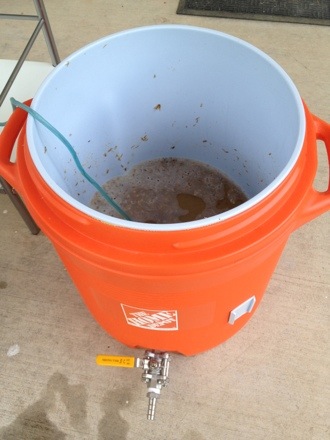
The mash begins.
Ohhh, molasses. A common ingredient in beer in early colonial Philadelphia (according to a quote from William Penn), I can eat the stuff right out of the jar. But I was nervous about using it after reading John Palmer’s tasting notes ranging from “rumlike” and “sweet” (woohoo!) to “harsh” and “bitter” (ergh). But further research online suggested that harsher flavors were associated with fermenting mineral-rich blackstrap molasses, not the regular unsulphured kind. I went with regular, and added them at the beginning of the boil with high hopes.
The “Progress” part came from the hops: one ounce of 6.6% AA Progress at the 60-minute mark for bittering, and another quarter ounce at 15 minutes for flavor. Progress is a UK varietal related to Fuggle hops, a good choice for English-style ales.
But that wasn’t all I added to the boil. Hops were available to some colonial brewers, but apparently not all that prevalent, so other bittering herbs were common. My original plan was to use horehound, but I realized the medicinal flavor might overpower a low-gravity ale. I thought of rosemary, but was talked out of it by the sages (ha, ha) at Austin Homebrew Supply. I landed on:
- .25 oz Juniper berries (crushed in mortar)
- .5 grams Sweet Gale (dried)
I added the herbs in the last minute of the boil and let them steep during cooling and whirlpool. I may add more later during conditioning.
The wort had an OG of 1.046, a true session ale for the upcoming winter (insert witty apropos Valley Forge reference; I can’t think of one). I pitched the slurry from a 2-liter starter of WLP008 East Coast Ale Yeast – reportedly the Sam Adams house strain – in keeping with the colonial theme. I set the fermentation chamber to an ambient 65-68°F, a little warmer than typical to coax some vintage ester flavor from this low-flocculating yeast.

Fermentation underway after 24 hours.
By this time tomorrow, the future of the United States will be written for the next four years. But regardless of whether my guy wins or not, I’ll have something to look forward to: a beverage in the tradition of the first beers brewed on American soil. Beer has always been a part of American culture, even before there was a United States, and from #1 on down to #44 many presidents have been homebrew aficionados: George Washington, Thomas Jefferson and James Madison were homebrewers and Barack Obama bought a homebrew kit for the White House with his own money. And beer remains one of the few things people can agree on regardless of personal politics.
Don’t forget to vote today, no matter who you’re supporting. Red and blue be damned. We can all party together in the colors of the SRM scale.
A Vigorous Starter
My name is Shawn, and I’m a homebrewer. I’m also a home meadmaker and home ciderer. In other words, I make my own alcoholic beverages.
There are those who prefer the term zymurgist, since it covers the making of all types of fermented beverages. I admit I like the sound of the word, which comes from one of my favorite Greek roots: zyme, a noun meaning the stuff we now know as yeast. But according to the dictionary definitions I’ve read, a zymurgist is a scientist who studies the chemistry of fermentation, not just a dude cooking up hooch in his backyard. I’m certainly not a scientist; and aside from a burning passion for a good sci-fi story (I make those too) and a screaming man-crush on Neil deGrasse Tyson, I don’t think of myself as having a scientific mind. Rational? Yes. Logical? I hope so. But scientific? By Ninkasi, I fear not. So I tend to avoid describing myself as a zymurgist.
But I’m not just about cooking up hooch in my backyard, either. The first time I explain that I’m a homebrewer to someone I’ve just met, I often get asked a question like, “I bet you make some pretty strong stuff, huh?” with the same sly wink that Snuffy Smith used to get from neighbors lauding the potency of his corn squeezin’s. The person asking is usually surprised to learn that the answer is No. The strongest beer I’ve ever made was about 8% alcohol by volume (twice the strength of Bud Light, but there are countless commercial craft beers in the 10% range, and many that are even higher). The strongest mead I’ve made was 14%, not uncommon for a wine. For me, homebrewing is not about getting hammered. In fact, it’s rare for me to drink one or more alcoholic beverages every day in a single week.
For me, homebrewing is about making something that I can share with my friends, that makes us relaxed and sociable and happy. It’s about history, about being part of a tradition of preparing fermented beverages that goes back at least 9,000 years. Many ancient civilizations, from the Sumerians down to the Romans, had deities of brewing and alcohol. The individuals who prepared these sacred beverages were shamans, respected elders; because they alone held the secrets by which grain and honey and grapes could be transmuted into an elixir that was healthy (in moderation) and brought people together in friendship, that led thinkers to new ideas and awakened the creativity of artists.
That’s why I’ve jokingly started calling myself a zyme lord. Sure, it’s bombastic and silly (Doctor Who fans will get the joke). But it also sounds ancient. Noble. And it alludes to the power that a brewer has in a society: the power to bring people together, to create a work of art that many people can come together to appreciate through shared experience, but each be affected in a profoundly different way. Brewing is a kind of storytelling, in the language of grain and hops, honey and fruit, water and yeast.
In this blog, I’ll write about what I’m brewing and what I’m drinking. I’ll share recipes. I’ll also write about how brewing intersects with my other interests: fiction, film, food, and others. I hope you enjoy reading it, and if my stories help you find your way to new ideas and awaken your creativity, then that’s the most a zyme lord can hope for. Prosit!
 myBrewHome
