
A Toast To … Space-age Polymers
O vessel clear, with name inscribed
From which my brew I oft imbibed;
From me too soon your life was took
When clumsily, the table I shook.I miss your sides, I miss your rim,
I miss the lace upon your brim,
I miss the feel of my glass complete
And filled with lager, stout or wheat.Perhaps, someday, I will replace
Your perfect sides, your perfect base;
But for today, I mourn the loss –
Into the bin, your shards I toss.– Me, “Ode to a Broken Glass”
I wrote that for a fellow member of the HomeBrewTalk.com online community a few years ago when he dropped and broke his favorite beer glass. Since then, I’ve recited it under my breath many times while disposing of the shattered remnants of my own glassware. See, I’m a bit of a klutz. Even sober I have inadvertently sent many innocent pint glasses crashing down to the tile floor of my kitchen (and hydrometers, but that’s a story for another day).
So when I was browsing the shelves at Austin Homebrew Supply recently, looking for last-minute impulse purchases I can’t live without, this caught my eye:

I’m sick of “good head” jokes too, so let’s just call it a day.
It’s called a Silipint. Although this version is obviously an Austin Homebrew exclusive, a quick dip into the Google pool shows that Silipints are available at tons of online retailers for around $10 each. As the name suggests, it’s a non-breakable silicone pint glass. After the salesperson helping me threw one to the store floor … hard … to demonstrate its durability, I bought two.
I’m sure some of you are laughing it off already. There’s a lot of debate these days about the “best glass” to serve beer in, and the Silipint might seem to have two strikes against it. It’s in the shape of an ordinary straight-sided shaker pint, which has gotten a lot of criticism from the “best glass” gurus. Not only is the Silipint is molded in that controversial shape, it’s also made from an unorthodox material that feels a little weird between your lips.
I’m not about to jump into the “best glass” debate, because many others out there are doing much better research on it than me – and to be honest, I don’t really care that much. I keep a variety of glasses, and I have preferred shapes for a few beer styles, but shaker pints are the foot soldiers of my glassware collection, and almost everything I pour from my kegerator goes into one.
But no matter the shape, glass breaks. Especially when I take it out of the house. So what’s a guy to drink from on a Sunday afternoon in the backyard, hovering over the grill or the brew kettle? Or when he brings a growler of homebrew to a picnic or a favorite BYOB barbecue joint?
Until now, the choice has been clear: red Solo cups. And I hate red Solo cups. And that goddamned song.
For all the spectrum of snobbery one can imagine in response to a drinking vessel that feels like a sex toy, I found that it actually drinks pretty well. Yes, the silicone does feel weird in your mouth, but it has some fortunate side effects in addition to durability. The rough texture is easy to hold onto (the container would survive being dropped, but we don’t want to waste beer, do we?). And during a brewing session on a Texas-hot summer day, the Silipint kept my Berliner Weisse cold enough to nurse for over an hour while I bounced between brewing tasks, longer than glass would have done.
The Silipint is now my vessel of choice to take with me when I bring homebrew out of the home. So I’m raising my glass today to toast the Silipint and the space-age silicone polymers that made it possible.
In other news, this week I ordered parts to build a portable draft system with a 20-ounce paintball CO2 tank. With that and my Silipint, all I’ll need is something to keep it cool and I’ll be able to bring a whole keg of draft homebrew with me wherever I go. The project will be finished a little late for the summer, but autumn in Texas still offers lots of chances for outdoor imbibing.
Tailgating? Not really my scene. But when I take my son for his first trick-or-treat this Halloween, I’d love to be the guy rolling around an ice-cold keg and offering tastes of pumpkin ale to the neighbors. Who wouldn’t?
Getting Medieval with Ginger Mead
Anyone reading this blog regularly will notice that for the past few months I haven’t really been brewing. I’ve been out of the house a lot, so my homebrew stock hasn’t depleted. Brewing would just net me a backlog of new beer waiting to get stale, not to mention the challenges of brewing outdoors in the Texas summer heat. But now that fall is here, I’ve returned to brewing with a ginger mead from a new recipe. Because ginger is a spice, ginger mead qualifies as a metheglin.
The history/fantasy geek in me loves mead, and it’s hard to find in stores. Most commercial examples are too sweet, better suited to mulling and heating; and my desire to make good easy-drinking mead was a big part of my initial interest in homebrewing. And here’s the big secret: it’s really easy. Meadmaking offers some new challenges for a beer brewer, but the brew day itself is fast and straightforward, especially compared to all-grain brewing. My mead brew day takes 2-3 hours; beer brewing takes me 8 hours from setup to cleanup. There’s no missing mash temperatures. No stuck sparges. No boilovers. No boiling at all – the aroma compounds in honey are volatile and boil off quickly, and honey’s natural antimicrobial properties make sanitizing the must (the pre-fermentation mixture of honey and water) unnecessary.
Preparing a 5-gallon mead must is as simple as heating 2-3 gallons of water on the stovetop, just enough to dissolve the honey (around 110°F), and mixing that with top-off water in the fermenter. I used the 7.5-gallon aluminum pot that usually serves as my hot liquor tank:
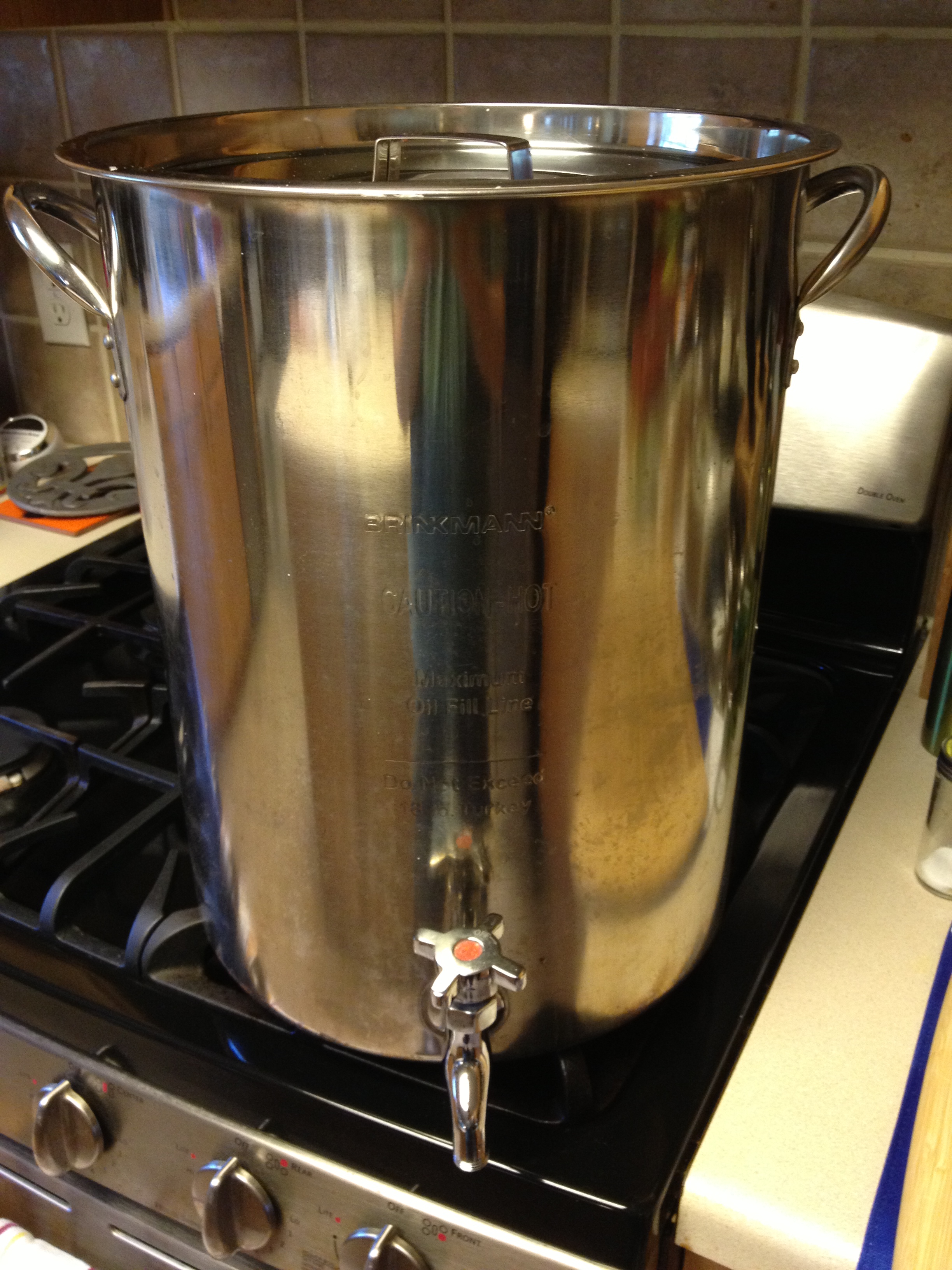
In tonight’s performance, “Kettle” will be played by “HLT”.
I used bottled spring water – for no other reason except that I wanted to pre-chill the top-off water, and Target had it on sale. I’ve made great mead with filtered tap water in the past. I heated 2.5 gallons to 120°F while Lisa peeled and diced fresh ginger root.

Chopping action shot!
- 10 lbs Kirkland Signature Clover Honey (Costco store brand)
- 4 lbs Round Rock Honey (local premium wildflower honey)

Los Fermentables.

… and a sore right arm.
I racked this to my fermenter and topped it off to 5.25 gallons with refrigerated spring water. The must temperature equalized at about 80°F with an OG of 1.101. I’m targeting 1.005 FG for medium-dry residual sugar and an ABV of roughly 13%.
Meanwhile, I rehydrated 10 grams (2 dry packets) of Lallemand Lalvin K1-V1116 wine yeast in 2/3 cup of cooled boiled water with 12.5 grams Lallemand Go-Ferm rehydration nutrient. Unlike barley malt, honey is very low in nutrients yeast need to thrive, so adding nutrients to the must is … well, a must. I follow the staggered nutrient addition schedule recommended by a user named hightest on the board HomeBrewTalk.com, which calls for 4.5 grams each of diammonium phosphate (DAP) and Lallemand Fermaid-K nutrient at pitching, with additional nutrient additions later during fermentation (there’s tons of great information from this guy here – as invaluable as Ken Schramm’s The Compleat Meadmaker, which I’ve read cover to cover). I mixed the DAP and Fermaid-K into the must with a healthy beating from my drill-mounted aeration whip, pitched the yeast slurry, and shoved it into the fermentation chiller.
All this week, I’ll be aerating the must twice daily with the whip and adding additional yeast nutrients as necessary. Once primary fermentation is complete, I’ll rack to a carboy and age it for at least six months before bottling. I expect to have to add more ginger again for some additional spice after all that aging, which I’ll add directly to the carboy. If it finishes too dry, I’ll stabilize it and add some of the leftover Round Rock Honey.
Meadmaking is extremely rewarding, and a great step outside the box for any brewer. Even extract beer brewers can make mead easily with a minimum of additional equipment, unlike jumping from extract to all-grain beer brewing. And with so few meads available commercially, it’s a great way to share with friends this ancient libation so rich in history, and yet so mysterious to many.
A Toast To … Art for Brewing’s Sake
As Central Texas is plagued by thunderstorms, I'm stuck in the house enjoying the last of a bottle of Mikkeller It's Alive! Belgian Wild Ale. And I'm raising my glass virtually to Dustin Sullivan, a fellow member of the online homebrewing forum HomeBrewTalk.com, and the creator of this awesome pictorial on how to make a yeast starter.

I love brewing. I love comic art. And I love anything that's educational in a novel and interesting way. This pictorial is all three, and I'm thrilled to have stumbled onto it. I wish everything in brewing could have been explained to me so simply when I was starting out. Sure, learning as you go is 50% of the fun of brewing (another 25% is drinking the results, and the last 25% is being able to impress your friends by dropping words like “saccharification” and “attenuate” into everyday conversation) … but I'm a knowledge addict, and I'm also pathologically risk averse. So I read everything I could get my hands on when I was starting my homebrew habit, so I'd have a good idea of each step of every process before I jumped in. Sometimes, it was hard to separate the good info from the bad: to separate the clear and “just-enough” from the over-explanatory, and to separate the simple sharing of helpful information from the vomiting of brewlore all over you by guys who just want to impress you with how much they know.
Now, I love John Palmer's How to Brew and Charlie Papazian's The Complete Joy of Homebrewing. They're phenomenal books, and essential for anyone entering the hobby. But if I'd had something as simple and clear as Dustin's yeast starter pictorial for my first extract brew, my first mash, my first rack to secondary, let alone my first yeast starter, I'd have lost a lot less sleep as a newbie.
Dustin also created a yeast calculator website called YeastCalc at yeastcalc.com. It's one of the most comprehensive pitching rate calculators I've seen online for liquid yeast. It tells you not only how big of a starter to make, but also allows you to dial in a target specific gravity for your starter, and tells you how much dry malt extract to use for that target. It even has options for calculating multiple step-up starters, for that 10-gallon barleywine you've been wanting to make. I'll be using this site next time I make a starter, and I recommend you do the same.
So I’d like to raise my beer glass to Dustin Sullivan, another homebrewer out there doing his part to make brewing a little easier and simpler for the rest of us: newbies and veterans alike. Thanks, Dustin. Prosit!
Also, anyone out there who isn't yet a member of HomeBrewTalk.com, check it out. There's heaps of information there. If you have questions, it's a great place to turn; if you have answers, we always welcome new insights. And it's the most helpful, responsive and engaged online community I've ever been a part of. If you join, look me up. My username is shawnbou and I'd love to hear from you.
 Posted with Blogsy
 myBrewHome