
Brew in a Bag: Bronze Age Fig Beer
I finally brought to life my Bronze Age Fig Beer, inspired by archaeological findings at Kissonerga-Skalia in Cyprus, in a small-batch brew day that had me flying by the seat of my pants from start to finish.
For small batches, I use the “Brew In a Bag” (BIAB) technique described in the October 2012 issue of Brew Your Own magazine, and also online here. The mash is done directly in the kettle with the grist contained in a nylon mesh bag. BIAB is great for the all-grain brewer looking to save time on brew day, because there’s no sparge. Lautering is as easy as lifting a bag of wet grains (which can admittedly be heavy, if like me, the only workout you get regularly is the ol’ 16-ounce curl). It’s also a great way for extract or partial mash brewers on a budget to explore all-grain brewing without expensive new equipment: just a brew kettle and the same mesh bag you may already be steeping grains in.
Most BIAB brews call for all the brewing liquor up front. The result is a very thin mash – 4 qts/lb in my case – but once the saccharification is done, the bag comes out and the wort can be brought to a boil immediately without sparging. Efficiency suffers, but this can be compensated for with a little extra grain. BIAB works for any batch size, provided the kettle is big enough for the grist and full volume of liquor, but I personally keep it to small batches. This batch was 6 quarts.
The Bronze Age brewer didn’t have a lot of specialty grains to choose from, so I kept my grain bill simple. The only specialty grain was German rauch malt, included to replicate the smoky flavor of malt kilned in a wood-burning oven in a small Bronze Age structure:
- 2 lbs 2-row malt
- 8 oz rauch malt
I mashed in with 10 quarts of water to stabilize the mash at 155 degrees and mashed for an hour, with the kettle wrapped in towels to retain heat. I still had to fire the burner a few times to keep the mash temperature high enough. If you do this, make sure to either take the bag out while the burner is on, or place a plate at the bottom of the kettle to dissipate the direct heat. Nylon mesh bags melt very easily.

Every man should learn how to roll and tuck his bag to keep it safely away from open flames.
Fresh figs are hard to find right now, so I bought dried figs in bulk from the local Whole Foods. I chopped 4 oz, leaving me with a sticky knife, and added them to the kettle to boil for 60 minutes to develop flavor and brown the sugars.
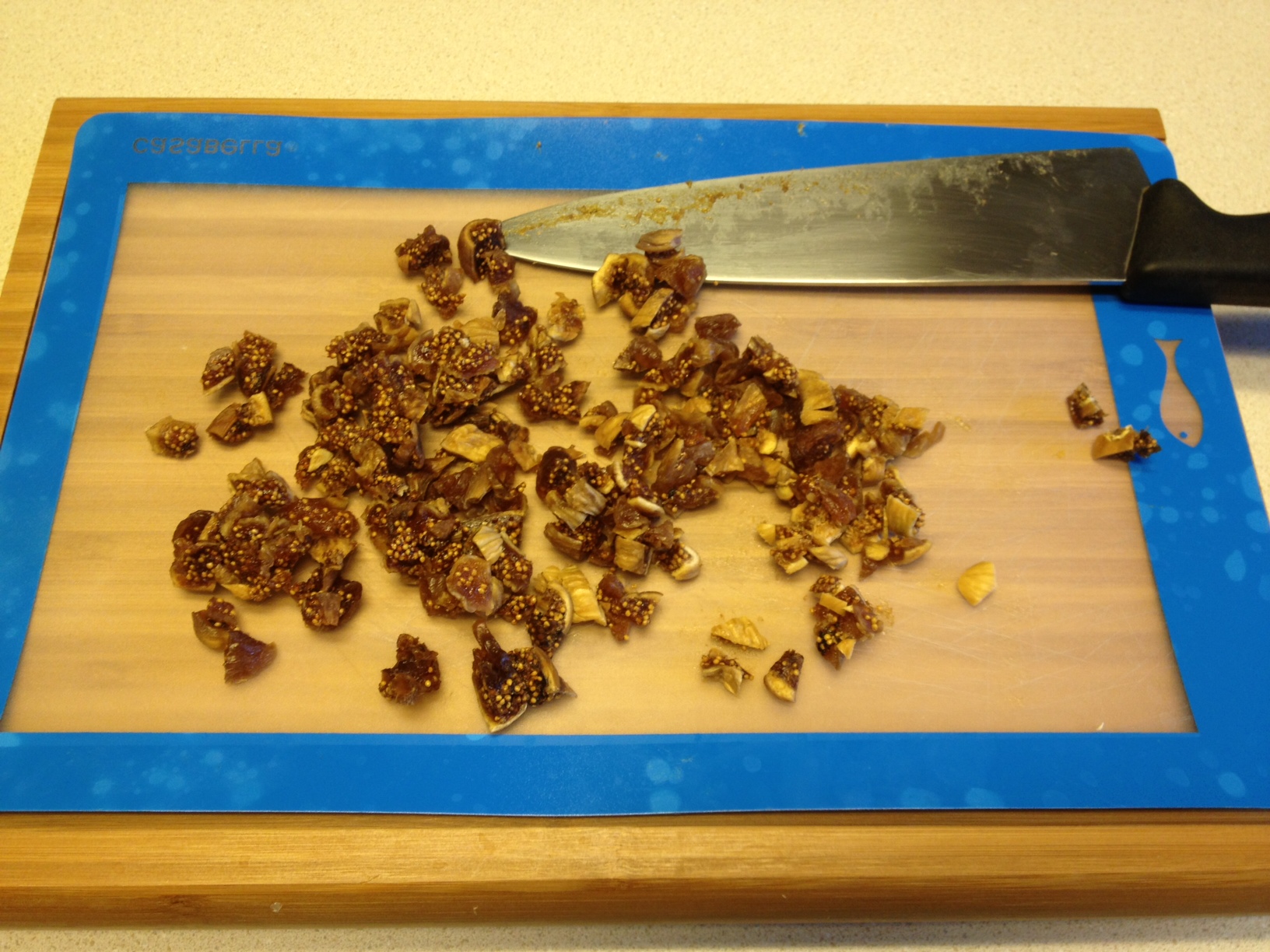
I meant to say really sticky.
Hops were not used in barley beer until the 11th century CE, so I didn’t use any. Instead, I delved into a fantastic book called The Flavor Bible for inspiration on bittering ingredients that might go well with fig. I settled on a quarter ounce of dried bitter orange peel (a traditional ingredient in Belgian witbiers, and available at most homebrew shops) and 7 sprigs of fresh thyme, and added these to the boil with 5 minutes left, along with another 1.5 oz of chopped figs.
Before boiling, the gravity was a measly 1.026, which would likely have boiled down to something in the 1.030-1.040 range. That’s fine for a session beer, but not for a rustic brew worthy of an ancient Cypriot warrior. To raise the potential alcohol, I added a pound of wildflower honey at flameout. According to Patrick McGovern’s Uncorking the Past (another fantastic book), many ancient brews were “grogs” made by mixing fermentable sugars – malt, grapes, honey, other fruits – so I was still channeling my Bronze Age forebears here, though this could technically qualify as a “braggot” by modern standards.

Straining out the chunky bits.
When all was said and done, with sugars from malt, figs, and honey, the wort at pitching time was 1.078, a fairly big brew. I pitched a 600 mL starter made from Dogfish Head Midas Touch dregs I cultivated from a bottle.

The offering, prepped and ready for sacrifice.
Would the ancient brew gods reward my efforts with the dulcet tones of a gurgling airlock? Find out in my next update.
Cultivating bottle dregs
UPDATE NOTE: This post describes a failed attempt at cultivating bottle dregs. If you’ve found this page looking for information on how to cultivate bottle dregs for pitching into beer wort, thank you for reading but please do not follow my process below. It didn’t work for me, as you can read in my follow-up here.
After deciding to brew a Bronze Age-inspired fig beer, I quickly went to work on the recipe in the hopes of brewing it on Monday (which I have off from my day job). It’ll be a 1-gallon experiment batch, with 2-row barley and rauch malt for that Bronze Age kiln-smoked flavor. Bitter orange peel will feature as a flavoring, and I haven’t decided yet whether it’ll have minimal hops or none. Honey and figs will round out the flavor and provide additional fermentable sugar. For yeast, I plan to cultivate a 2-step starter from the dregs in a bottle of Dogfish Head Midas Touch.
I’ve never cultivated a starter from bottle dregs before. Why now, and why Midas Touch? One usually hears about brewers cultivating dregs from sour beers like Orval to harvest the unique blend of Brett and bacteria strains that make those beers special, as described in this blog entry from TheMadFermentationist.com. But it should work with clean Saccharomyces as well.
I’m not sure what kind of yeast is used to ferment Midas Touch, though clone recipes online call for Trappist ale strains. I don’t even know if the yeast Dogfish Head bottles Midas Touch on is the same as the yeast that ferments it – many breweries use different yeasts for bottle conditioning. So my decision to use Midas Touch dregs was less about capturing a particular unique yeast than it was about superstition.

9 out of 10 prehistoric shamans agree: Consume your totem’s essence to gain its power.
Midas Touch is one of Dogfish Head’s “ancient ales” and is based on chemical analysis of bronze vessels found in Gordion in Central Turkey – roughly the same part of the world as Cyprus, where my fig beer has its inspirational roots. I thought the dregs might be a good luck charm for my first foray into ancient brewing: a little piece of the magic from Sam Calagione and Dr. Patrick McGovern, two of the high priests of modern ancient ale reproduction. But really, the main reason I did it was because it sounded like fun and I’ve never done it before.
I made a first-step starter wort of 200 milliliters to bring the bottle yeast back from the dead. When that ferments out, I’ll “step it up” to a second starter of 500 mL. For a full 5-gallon batch I’d continue stepping up to 2 liters, but for a 1-gallon batch, 500 mL should suffice.
I scaled down my usual starter process as well as I could, realizing it’s okay if some the math isn’t exact in a wild-shot experiment. I dissolved 15 grams of extra light dry malt extract in 200 mL of boiling water. Usually I use 1 gram per 10 milliliters, but I’m hoping the lower OG starter will give a little advantage to sleepy yeast.
I also added 3/32 of a teaspoon of yeast nutrient. While that sounds like a strange fraction to use, it’s simply one each of the “pinch” and “smidgen” measuring spoons (or 3 “smidgens”) available at specialty kitchen stores. Those little spoons aren’t all that useful on a day-to-day basis, but I keep them around just for tiny measurements like this. For the record, an exact scaling of my usual 1/2 teaspoon nutrient per liter of starter would have been 1/10 teaspoon.

It was almost too small to boil on the stovetop.
5 minutes of boiling reduced the starter volume more than expected, so after I cooled it and transferred to a sanitized pint glass, I topped off with pre-boiled water and chilled in the freezer to an acceptable pitching temperature of 84°F. I roused the yeast in the last half-inch of a bottle of Midas Touch (which I had already poured into a glass and was drinking) and pitched it.

Ready for the stir plate.
As of today, there’s no visible sign of fermentation in the starter, but there is a pleasant boozy smell coming from the glass. There’s no telling how few viable yeast cells were in that bottle, but even a few cells should reproduce given time.
We’ll see how it shakes out by Monday. I never do anything too crazy without a safety net, so I have a packet of Fermentis Safbrew T-58 – a spicy Belgian yeast strain with reported clove notes, which should go well with honey, fig and smoke – on hand just in case I don’t get a usable starter. But that’s Plan B.
Here’s hoping the Bronze Age beer gods smile on my undertaking.
A taste of local at the Texas Craft Brewers Festival
Fiesta Gardens in East Austin was the hoppiest place in town on October 6 as about two dozen breweries from all over Texas gathered for the annual Texas Craft Brewers Festival, sponsored by the Young Men’s Business League of Austin. Featuring over 115 beers, the event promised to be a carnival of discovery. I walked through the gates holding my tasting glass eagerly, like an explorer taking his first steps on a newly discovered shore with a trusty saber in hand.
The format was a familiar one: a booth from each brewery in attendance (arranged in alphabetical order, wow) offering pours of their most popular and/or most interesting beers. $20 bought admission, a 4 oz. plastic tasting glass and six tickets, with additional tickets available for purchase at two for $3. Most of the pours cost one ticket, with some of the rarer/higher-gravity offerings going for two.
I sprung for the $65 VIP pass. It didn’t come with any additional tickets (bummer), but I did get a T-shirt and imperial pint glass along with noon entry, two hours before everyone else. The early entry was worth it, because the place got nuts at 2:00 when the gates opened to general admission. VIP’s also got a “meet-and-greet” round robin tasting in the main pavilion from 1:00 to 2:00. Brewers and brewery representatives walked around the pavilion with pitchers, pouring samples and answering questions.
I love talking to brewers who have a real passion for brewing. The ones who are visibly energized by talking to kindred spirits. The ones whose eyes light up when asked why they chose one yeast strain over another, or who get excited when you taste something subtle in the beer that they were specifically trying for. They’re the stewards of our community, the true shamans of our tribal craft brew culture. I’d especially like to thank Jeff Stuffings of Jester King Craft Brewery, Diane Rogness of Rogness Brewing Company, Jud Mulherin of Circle Brewing Company and Grant Wood of Revolver Brewing Company for stopping for a few minutes on a busy day to talk to me – one of many admirers clamoring for their time – about their ingredients, their craft, and why they do what they do.
The beers themselves presented a fascinating snapshot of where Texas craft brew is today. Several things became apparent over the course of the day:
- Sour beer no longer a thing? The event website boasted “at least four sours”. That’s a much smaller number than I would have predicted a year ago, when sours were seemingly the next big wave in craft brewing. But now it seems Texas brewers are looking elsewhere for innovation. Real Ale Scots Gone Wild and Austin Beerworks Einhorn Berliner Weisse were on tap along with some sours from Jester King, but I didn’t see anything on the menu that I hadn’t tried before. I made a beeline to the Jester King booth for what I thought was a new sour – the Viking-inspired Gotlandsdricka – and got a surprise. Jeff Stuffings informed me his Gotlandsdricka was intended to be a modern interpretation, not a historically accurate recreation of the ancient ale, and was clean-fermented with just Saccharomyces cerevisiae. I’m a sucker for anything Nordic, and I liked it a lot, but I’m still curious to taste the sour version they may release in a few months.
- Flavorings are where it’s at. For a region so rich in German heritage, Texas brewers sure don’t know the meaning of Reinheitsgebot. Spices and fruits abounded. Rogness OST Porter with coffee and coconut and Yogi Amber with chai spice, Thirsty Planet ChiGoatle Amber with peppers, Revolver Blood & Honey Wheat with blood orange zest and spices, and Jester King Gotlandsdricka with sweet gale and juniper all made impressions on me. Even Reinheitsgebot champions Circle Brewing have jumped into the flavor fray with Smokin’ Beech, a refreshing Rauchbier with a bacony character from malt beechwood-smoked according to a traditional Bamberg process that Jud Mulherin described to me in reverent detail.
- Tea is the new coffee. Coffee porters and stouts remain popular, but Texas brewers are starting to notice coffee’s hot stepsister from across the ocean, with very different takes on the concept. Live Oak poured an Oaktoberfest infused with lapsang souchong China black tea, lending a vegetal smokiness tailored for slow sipping. Jester King poured their kombucha farmhouse ale Buddha’s Brew. Rogness Yogi Amber doesn’t actually have tea in it, but recreates the experience of chai tea in an amber beer with chai spices and unfermentable sugars. Diane Rogness called Yogi “her baby”, and she should be proud of it. I enjoyed drinking it and have thought about it a lot since Saturday.
- Dallas-Fort Worth is growing. Lakewood Brewing and Revolver Brewing are two names from the Metroplex that seem to have made their Austin debut at the event, alongside DFW stalwarts Deep Ellum and Southern Star. I didn’t get a chance to try Lakewood (sorry!) but Revolver’s Blood & Honey Wheat is a surprisingly complex lawnmower beer with blood orange zest and savory spices. Head brewer Grant Wood invited me to guess which spices he used. I guessed incorrectly, and when I pressed him for the correct answer, he said smiling, “We’ve gotta have some secrets.” Touché.
Finally, the day brought great news to the mead lover in me. I had a chance to speak to Eric Lowe of Meridian Hive Meadery, a new Austin company getting their brewhouse (meadhouse?) assembled currently, and who will hopefully be releasing their first meads in early 2013. There’s a mead gap in Austin, and I welcome them with open arms and a thirsty palate.
Photos of the event are below (including one of your friend and humble narrator in a yellow shirt), courtesy of Roy Moore and Control Images. Thanks to the YMBL and all who made the event what it was.


 myBrewHome