
Getting Medieval with Ginger Mead
Anyone reading this blog regularly will notice that for the past few months I haven’t really been brewing. I’ve been out of the house a lot, so my homebrew stock hasn’t depleted. Brewing would just net me a backlog of new beer waiting to get stale, not to mention the challenges of brewing outdoors in the Texas summer heat. But now that fall is here, I’ve returned to brewing with a ginger mead from a new recipe. Because ginger is a spice, ginger mead qualifies as a metheglin.
The history/fantasy geek in me loves mead, and it’s hard to find in stores. Most commercial examples are too sweet, better suited to mulling and heating; and my desire to make good easy-drinking mead was a big part of my initial interest in homebrewing. And here’s the big secret: it’s really easy. Meadmaking offers some new challenges for a beer brewer, but the brew day itself is fast and straightforward, especially compared to all-grain brewing. My mead brew day takes 2-3 hours; beer brewing takes me 8 hours from setup to cleanup. There’s no missing mash temperatures. No stuck sparges. No boilovers. No boiling at all – the aroma compounds in honey are volatile and boil off quickly, and honey’s natural antimicrobial properties make sanitizing the must (the pre-fermentation mixture of honey and water) unnecessary.
Preparing a 5-gallon mead must is as simple as heating 2-3 gallons of water on the stovetop, just enough to dissolve the honey (around 110°F), and mixing that with top-off water in the fermenter. I used the 7.5-gallon aluminum pot that usually serves as my hot liquor tank:
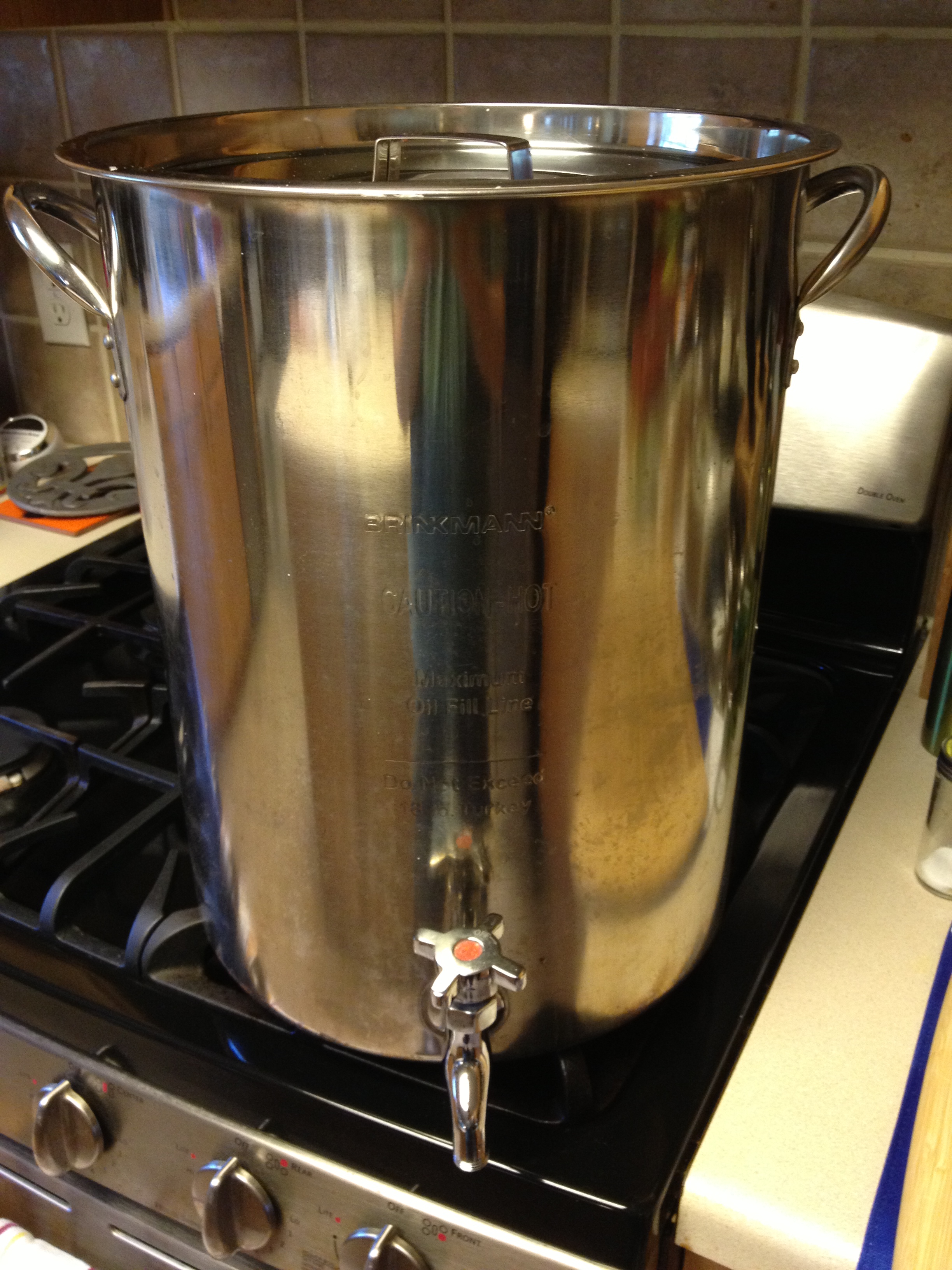
In tonight’s performance, “Kettle” will be played by “HLT”.
I used bottled spring water – for no other reason except that I wanted to pre-chill the top-off water, and Target had it on sale. I’ve made great mead with filtered tap water in the past. I heated 2.5 gallons to 120°F while Lisa peeled and diced fresh ginger root.

Chopping action shot!
- 10 lbs Kirkland Signature Clover Honey (Costco store brand)
- 4 lbs Round Rock Honey (local premium wildflower honey)

Los Fermentables.

… and a sore right arm.
I racked this to my fermenter and topped it off to 5.25 gallons with refrigerated spring water. The must temperature equalized at about 80°F with an OG of 1.101. I’m targeting 1.005 FG for medium-dry residual sugar and an ABV of roughly 13%.
Meanwhile, I rehydrated 10 grams (2 dry packets) of Lallemand Lalvin K1-V1116 wine yeast in 2/3 cup of cooled boiled water with 12.5 grams Lallemand Go-Ferm rehydration nutrient. Unlike barley malt, honey is very low in nutrients yeast need to thrive, so adding nutrients to the must is … well, a must. I follow the staggered nutrient addition schedule recommended by a user named hightest on the board HomeBrewTalk.com, which calls for 4.5 grams each of diammonium phosphate (DAP) and Lallemand Fermaid-K nutrient at pitching, with additional nutrient additions later during fermentation (there’s tons of great information from this guy here – as invaluable as Ken Schramm’s The Compleat Meadmaker, which I’ve read cover to cover). I mixed the DAP and Fermaid-K into the must with a healthy beating from my drill-mounted aeration whip, pitched the yeast slurry, and shoved it into the fermentation chiller.
All this week, I’ll be aerating the must twice daily with the whip and adding additional yeast nutrients as necessary. Once primary fermentation is complete, I’ll rack to a carboy and age it for at least six months before bottling. I expect to have to add more ginger again for some additional spice after all that aging, which I’ll add directly to the carboy. If it finishes too dry, I’ll stabilize it and add some of the leftover Round Rock Honey.
Meadmaking is extremely rewarding, and a great step outside the box for any brewer. Even extract beer brewers can make mead easily with a minimum of additional equipment, unlike jumping from extract to all-grain beer brewing. And with so few meads available commercially, it’s a great way to share with friends this ancient libation so rich in history, and yet so mysterious to many.
 myBrewHome