
From the Cellar: December, bomber by bomber
I have an ever-growing collection of 22 oz and 750 ml bottles of beer cellaring in the Harry Potter closet. I save them for interesting meal pairings or other special occasions (which includes “another Sunday”). So December – a time of parties, good meals, multiple Christmas celebrations and the new year – is a perfect time to catch up on the cellar back stock. By which I mean drink them, of course.
It’s also when a lot of breweries release special beers, so I’ve found a few to fill the empty spaces in my cellar as I drink them up. Here’s a quick review of some recent bombers I’ve tasted and bought, and a preview of what I’m uncapping next.
This past Saturday, I opened a Stone Enjoy By 12.21.12 IPA. The occasion? Nothing more than resting up after seeing The Hobbit twice on Friday, and a December evening warm enough to put some filet mignons on the backyard grill. Steak and IPA aren’t two things I pair often, especially not when the steak is seasoned boldly (I used some coffee-chipotle rub left over from Thanksgiving), but time was running out on this time bomb of a bomber. The spicy beef and spicy beer matched better than I expected. The beer was light in color, with less melanoidin flavor than I usually want from an IPA, but I didn’t mind the hops overtaking the light malt profile. It was fresh, grassy, floral and spicy. Like a morning stroll through an English garden in spring. With a steak.
Then on Sunday, my wife Lisa and I had an early “Christmas” dinner: leg of lamb with garlic, lemon and herbs, which I paired with a bottle of Boulevard Collaboration No. 3 – Stingo that I’ve had for several months. Not knowing anything about “stingo” – a strong English style – except what was on the label, I expected deep malt and spice with a hint of sour tartness. I thought it would be a natural pairing for lamb with a little tangy mint sauce, but I was disappointed. There was some malt roastiness and a tang on the finish, but nothing in between. Not enough malt backbone, not enough depth, and not enough sourness to be pleasant. I had a lot of trouble finishing it, and that’s the first time I can say that about a Boulevard beer. Realizing it had been in storage for a while, I checked the date on the label, and it wasn’t out of date. Just not my thing, I guess.
I also bought a few new beers for my collection: a Stone 12.12.12 Vertical Epic Ale, a Brooklyn Black Ops, and a Samuel Adams Thirteenth Hour. I predict at least 2 of those won’t live to see spring.
Speaking of not living to see spring, this Friday night (December 21) I’ll open a bottle of Dogfish Head Theobroma in honor of the winter solstice and the end of the Mayan calendar. Since “theobroma” (a.k.a. cacao) is the food of the gods, this should be an excellent way to gain favor with Bolon Yokte K’uh, the Mayan god of war and creation who might be coming to destroy us all. If he is not amused and punishes me for my insolence – or if, more likely, he forgets to show up and the world continues to turn – at least I’ll be enjoying one of my favorite beers.
Saturday morning, assuming we’re alive and not already on the Dark Rift road to the Mayan underworld Xibalba, we drive to New Orleans to spend Christmas with our families there. I’m bringing a couple of bottles of Samuel Adams Norse Legend Sahti for Christmas Day. I haven’t tried it yet, but it should be something interesting to introduce to non-beer geeks in the family. The label might even open up some geeky discussion about Norse mythology, which I recommend highly as an excellent conversation topic, especially over grandmother’s Christmas lasagna.
Then there’s a bottle of Samichlaus Bier Helles which won’t see any action until New Year’s Eve. January 1 is Lisa’s birthday, and this year she can’t drink to celebrate thanks to our bouncing, kicking bun in the oven. So we’re having a small celebration at home starting on New Year’s Eve. Samichlaus, a rare Helles bock brewed only once each year by Brauerei Schloss Eggenberg in Austria, will be a fitting send-off to 2012: a very special beer for a very good year.
Vote for Progress … hops
Saturday was Learn to Homebrew Day in the USA, and today is Election Day. To honor both events, I did what any patriotic and pedantic zyme lord would. I made beer.
I called it Colonial Progress Ale, and it’s something between an English bitter and an English brown ale. “Colonial” comes from the fermentables, adapted from a recipe I envisioned for a colonial-style ale during a trip to Philadelphia earlier this year. I ended up with:
- 6.5 lbs American 2-row
- 1 lb Victory malt
- 8 oz Flaked wheat
- 8 oz Flaked oats
- 1 lb Molasses
Each of these ingredients was chosen for a reason, starting with American 2-row malt as the base. Wheat is common in colonial ale recipes, including one attributed to Thomas Jefferson. Victory and oats I had no historic precedent for, but I added them for body in the finished beer, along with some bready/biscuity flavor (Victory) and silky smoothness (oats) to accentuate the English-inspired malt profile. I mashed at 153°F for medium fermentability, counting on the highly fermentable molasses to dry the beer out.
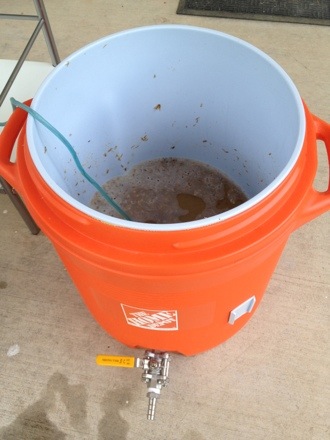
The mash begins.
Ohhh, molasses. A common ingredient in beer in early colonial Philadelphia (according to a quote from William Penn), I can eat the stuff right out of the jar. But I was nervous about using it after reading John Palmer’s tasting notes ranging from “rumlike” and “sweet” (woohoo!) to “harsh” and “bitter” (ergh). But further research online suggested that harsher flavors were associated with fermenting mineral-rich blackstrap molasses, not the regular unsulphured kind. I went with regular, and added them at the beginning of the boil with high hopes.
The “Progress” part came from the hops: one ounce of 6.6% AA Progress at the 60-minute mark for bittering, and another quarter ounce at 15 minutes for flavor. Progress is a UK varietal related to Fuggle hops, a good choice for English-style ales.
But that wasn’t all I added to the boil. Hops were available to some colonial brewers, but apparently not all that prevalent, so other bittering herbs were common. My original plan was to use horehound, but I realized the medicinal flavor might overpower a low-gravity ale. I thought of rosemary, but was talked out of it by the sages (ha, ha) at Austin Homebrew Supply. I landed on:
- .25 oz Juniper berries (crushed in mortar)
- .5 grams Sweet Gale (dried)
I added the herbs in the last minute of the boil and let them steep during cooling and whirlpool. I may add more later during conditioning.
The wort had an OG of 1.046, a true session ale for the upcoming winter (insert witty apropos Valley Forge reference; I can’t think of one). I pitched the slurry from a 2-liter starter of WLP008 East Coast Ale Yeast – reportedly the Sam Adams house strain – in keeping with the colonial theme. I set the fermentation chamber to an ambient 65-68°F, a little warmer than typical to coax some vintage ester flavor from this low-flocculating yeast.

Fermentation underway after 24 hours.
By this time tomorrow, the future of the United States will be written for the next four years. But regardless of whether my guy wins or not, I’ll have something to look forward to: a beverage in the tradition of the first beers brewed on American soil. Beer has always been a part of American culture, even before there was a United States, and from #1 on down to #44 many presidents have been homebrew aficionados: George Washington, Thomas Jefferson and James Madison were homebrewers and Barack Obama bought a homebrew kit for the White House with his own money. And beer remains one of the few things people can agree on regardless of personal politics.
Don’t forget to vote today, no matter who you’re supporting. Red and blue be damned. We can all party together in the colors of the SRM scale.
 myBrewHome