
The Buddha and the King
On a beautiful, cool Saturday afternoon wedged between days of thunderstorms, Jester King Craft Brewery released their new Buddha’s Brew ale during their weekly open house. Beer hipsters (and garden variety hipsters) descended on the brewery for a turnout that scuttlebutt suggests was the biggest the brewery has ever seen on a “non-event” Saturday.
The new ale is a collaboration between Jester King and Austin kombucha company Buddha’s Brew. It’s Jester King’s first beer fermented entirely in oak. The wheat ale wort was pitched with bacteria and fermented in the barrel, then aged for nine months before blending it with Buddha’s Brew Classic Flavor Kombucha. Buddha’s Brew was also on location Saturday giving out free kombucha by the sample and cup. I’ve been a fan of their kombucha for years, so I was excited about the collaboration.
I haven’t been to Jester King in several months, so I was surprised to find a new system in place for the beer tasting. In the old system, $10 bought you a tulip glass and three full pours of whatever you wanted. Now, for $10 you get a card listing the day’s menu with a check box next to each of the 7 beers available:

One ticket to paradise, with a kombucha to go.
The bartenders poured 5.5 oz of whatever you ordered and marked the box next to it on the card. If you tried them all, it would equate to a little over two pints of beer and a keepsake glass for $10. So it’s not the steal it used to be, but it’s still a great value, especially if you can get there early enough to go back through the (very long) line 7 times during the 3-hour window they’re open. Even though this new system effectively raises the price per ounce over the previous system, it encourages beer flights instead of pounding pints as quickly as possible. The limited-release selections du jour are thus available to more attendees, and fewer frat boys are stumbling around drunk from too many Black Metals. I’m not sure if the new system was just for this event or if this is how they do it every week now, but I’m a fan of it in theory … if they can get the line moving a little faster.
I started with Buddha’s Brew, the hot new starlet on the set. It was straw-colored with little head and smelled like a Berliner Weisse: lactic, light and wheaty, though I was hoping for more fruitiness on the nose. It tasted like a Berliner Weisse too. Tart, refreshing and wheaty with some vinegar notes and a pleasant mouth-puckering tartness. My only complaint was that it was less complex than I expected. The kombucha didn’t add much flavor; no fruitiness, no earthiness. Nor any oakiness or vanilla from the barrel aging. It could have been any sour wheat ale, albeit a well-made one. Note that I would gladly drink it again if there weren’t more interesting beers available.


My third pour was Mad Meg, an organic bière de provision – a high-alcohol continental style intended for extended aging. At 9.6% ABV, it was a step up from my earlier tastings but smooth enough not to be a shock. It poured a handsome red-orange I attribute to Cara-Munich malt, but I enjoyed thinking of it as an “albino amber”. The aroma was mouth-watering: floral hops and a rich mandarin-like citrus with noticeable alcohol. The flavor didn’t disappoint, either, delivering piney hop bitterness at the start and boozy, bready malt on the finish with no alcohol burn. It was smooth and brilliantly balanced, easy to drink on a fall afternoon or warm enough for a cool night.
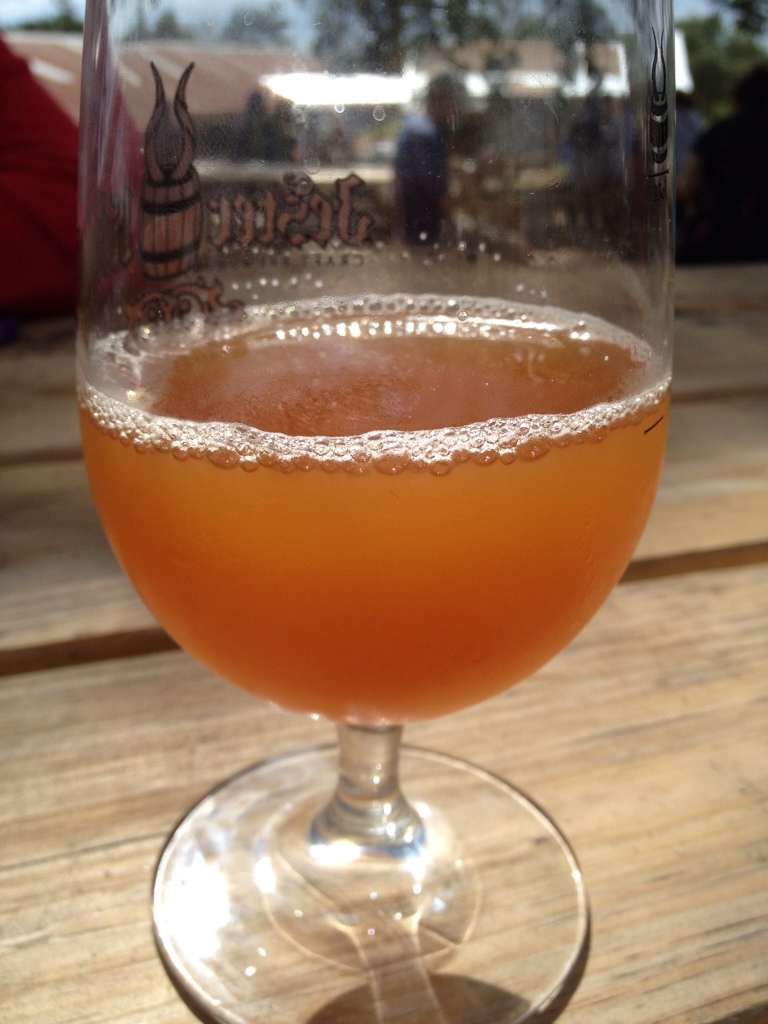
I made my way through the tastings leisurely and only got three in my 90 minutes there, but it was well worth the price of admission. Between beers I cleansed my palate with lots of free kombucha from the Buddha’s Brew tent (thanks!). Peach and Pineapple-Super Greens flavors were on tap and delicious.
I left happy (alcohol + probiotics, mmm mmm good!) and inspired. I’ve been thinking about homebrewing kombucha for a long time, and I might start soon using some Buddha’s Brew dregs to culture a starter SCOBY. Someday I actually hope to have draft kombucha in the kegerator for those non-beer occasions. I’m not sure I’ll ever use it in a beer myself, but who knows? And I toast Jester King for their innovation. After all, that’s what supporting local business is all about.
Weizen Up
Sorry, Internet, I've been holding out on you. Weiss Blau Weiss Bavarian Hefeweizen, my experiment in simplicity that I brewed in June, has been pouring for over a week now, and I've had several pints of it already; but I haven't yet written about it. It's high time I did, so you can enjoy it vicariously as much as I've been enjoying it … well … the regular way.
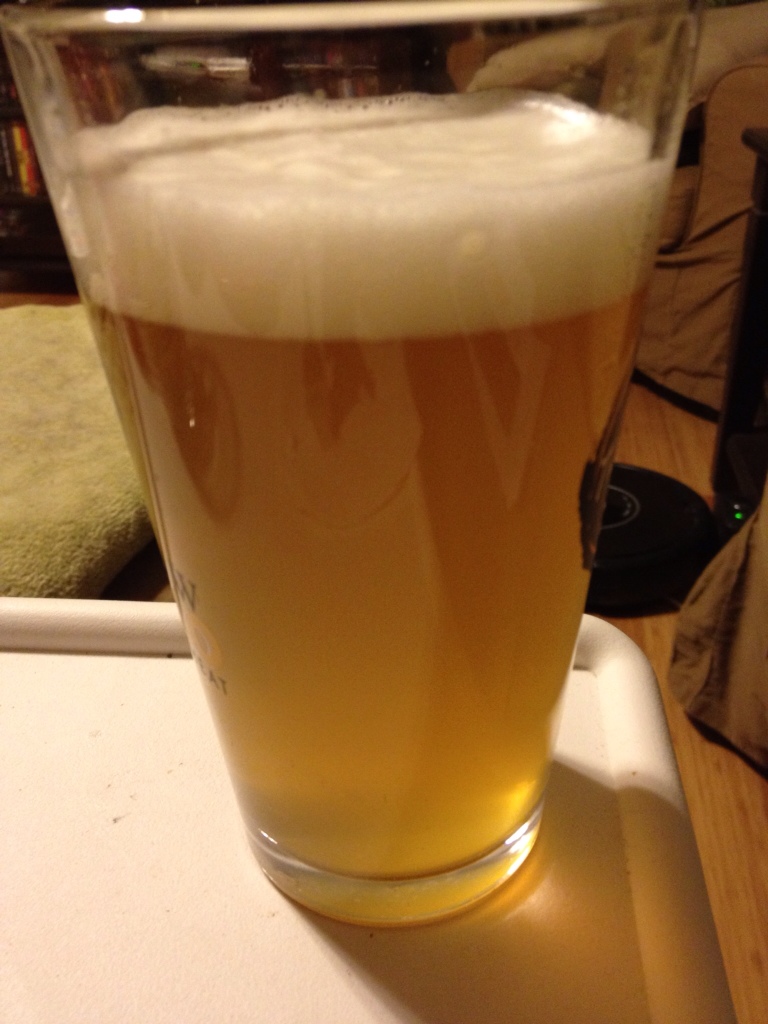
Shinin' like Rhine-gold.
It pours beautifully: a creamy golden color with a gleaming white head. It's cloudy, as a hefeweizen should be, and except for a little bit of floating sediment, it looks as good as any commercially brewed hefeweizen I've ever had. The sediment should clear up once I pour a few more pints off the keg. I did use Irish moss for this brew – as I do for most of my brews – but there are many who choose not to use kettle finings for hefeweizens, and it's possible this worked against me in that it precipitated more particles out to the bottom of the keg. But I'm sure it'll be fine in a few more pours.
The aroma is spectacular. Exactly what I wanted: lots of banana esters, a touch of the sweet, grainy aroma of crisp continental Pilsner malt, and the faintest whiff of clove spiciness. That's about it. No hops on the nose at all. Nothing confusing or muddling. You can tell instantly what ingredient created every single component of the olfactory signature of this beer.
The taste is good, too. It's light, of course, and perfect patio refreshment for my next summer brew session. The yeasty character doesn't lead in the flavor department the way I was hoping it would, not like it leads the aroma. I don't usually bother with that little slice of citrus that most brewheads outside of Bavaria are so fond of in their weizens, but I could see a lemon wedge adding something to this beer, just because it could use a bit more zing (sadly, I don't have any in the house). I don't blame the recipe for this little flaw, rather my fermentation temperature. Next time I make it, I'll ferment a couple of degrees higher for the first couple of days.
The mouthfeel is just right for a summer afternoon: refreshing, not too astringent. It goes down smooth and easy, and at 5.2% ABV is pretty session friendly.
So there you have it. Weiss Blau Weiss Bavarian Hefeweizen was an overall success, not despite its simple recipe but because of it. In fact, it seems to me that my efforts to introduce unnecessary complexity to the process – namely, using kettle finings and overchilling during fermentation – was the main thing that kept it from being (to me) a perfect beer. But that's okay; it's still plenty drinkable, and I'm sure I'll be emptying this keg pretty quickly … no complaints here, because I'd love to make it again. Can I make it even simpler next time? Probably not much so, but the lesson has been hammered home: one doesn't need a mile-long list of ingredients to make a damn good beer.
Of course, the Bavarians have been trying to tell us that for centuries.
Back to Basics with Bavarian Hefeweizen
As homebrewers, we often have a tendency to throw a bunch of different ingredients into recipes just because we can. Sometimes economy’s the reason, like using 5 grams of 8 different bittering hops because they’re in the freezer and about to expire. Other times, it’s just plain stubbornness, like the tendency of American homebrewers (myself included) to put crystal malt in everything. But it’s good to be reminded that sometimes, simplicity is best. After all, humans have been brewing for thousands of years, and the ancient Sumerians certainly didn’t have eight different kinds of debittered black malts to choose from.
My lesson in simplicity this week is a Bavarian Hefeweizen I brewed Sunday. I called it Weiss Blau Weiss. The name means “white-blue” and is an homage to the flag of Bavaria, a pattern of white and blue diamonds (called “lozenges” or sometimes “fusils” – your heraldry lesson for the day) seen at German-themed beer events all over the world.

You remember this, don’t you? You puked on it last Oktoberfest.
I brew mostly wheat beers in the summer, because they ferment better in the warm temperatures we face in Texas in the hottest part of the year. But most of my wheat homebrews in the past have been American-style wheats, fermented with White Labs WLP320 American Hefeweizen Ale Yeast. It’s a great clean-fermenting yeast, and I recommend it for any wheat ale with fruit, herbs or spices. But I’m bored with that clean flavor lately, and I’ve been enjoying commercial wheats with the kind of clove/banana esters that come from German hefeweizen yeast strains. So after a lot of deliberation (and with input from my soulmate and recipe consultant Lisa, who talked me down off the ledge of including some exotic spice such as mahlab in the boil) I decided to keep it simple with a traditional Bavarian hefeweizen – simple grain bill and simple hops, allowing the ester character of a German yeast strain to come through.
The grain bill was a 50/50 split of base malts – no specialty grains, no aromatics, no crystal. Just:
- 5.5 lbs German Pilsen malt
- 5.5 lbs White Wheat malt
I mashed at 152°F for an hour.
Noble hops are standard for this style, so I used:
- 0.5 oz Hallertauer (4.8% AA) for 60 min
- 0.5 oz Hallertauer Saphir (4.2% AA) for 60 min
- 0.1 oz Hallertauer (4.8% AA) for 15 min
- 0.1 oz Hallertauer Saphir (4.2% AA) for 15 min
Using two different Hallertauer varieties may seem unnecessarily complex in this so-called “simple” beer. But I really dig Saphir, and I had 0.6 oz in my freezer, which wasn’t enough. So I supplemented the Saphir with ordinary Hallertauer to get an ounce for bittering and a little extra for flavor, while using up my Saphir backstock (see? economy). In the end, I liked the symmetry of splitting the hop additions 50/50, same as the grain, so I ran with it.
The OG of the wort was 1.052. I pitched a smack pack of Wyeast 3068 Weihenstephan Weizen with no starter, hoping the low pitching rate will promote ester production. I’m also keeping the fermentation temperature between 68-72°F for the same reason. The word hefe in hefeweizen is German for “yeast”, and I want the yeast esters to take center stage.
On Monday, the beer was fermenting so vigorously I had to replace my airlock with a blowoff hose – always a proud moment for any brewer. Today, it’s still bubbling several times a minute. Assuming it’s done fermenting by this time next week, I plan to keg it immediately. Hefeweizens are great consumed fresh, and while I don’t think a longer conditioning period would hurt it, I don’t see it helping much … plus, I have an empty tap on the kegerator ready for a new beer!
It was hard, but I think keeping it simple will serve this beer well. While I love creativity in brewing, and there’s a strong desire to be original by throwing the kitchen sink into every recipe, sometimes one needs to dial it back and focus on the basics, the minimum needed to make a good beer in a classic style. And as with so many other things, part of being a good brewer is knowing what not to do, as much as knowing what to do.
 myBrewHome