
Fantastic Fest 2012 in review: beer, free beer, and a movie or two
Fantastic Fest 2012 is now a happy week-old memory. I saw 33 films from September 20-27 and emptied more than a few pint glasses. My highlights from the festival are below:
Day 1 – My Fest started with Tim Burton’s Frankenweenie in 3D. But that wasn’t until 6pm, so before the show, I had lunch at Bangers Sausage House & Beer Garden, where I enjoyed two barrel-aged Texas beers: Bourbon Barrel Alt-eration from Hops & Grain, and Real Ale Shipwrecked (aged in Jameson barrels for extra deliciousness) with an antelope and venison merguez sausage in honor of the reanimated pooch. Once I got to the Alamo Drafthouse Cinema for the movie, I found myself in the Shiner-sponsored theater, and enjoyed a free Shiner Bock. But my favorite film that day was Antiviral from Canadian director Brandon Cronenberg – son of film legend David Cronenberg (The Fly, Videodrome), and worthy of his father’s directorial legacy.
Day 2 – Two major highlights: The Conspiracy, also from Canada, which I watched with a couple of pale ales: an Austin Beerworks Fire Eagle IPA and a Shiner Wild Hare Pale Ale. Later that night, a friend and I got to the bottom of a pitcher of Real Ale Firemans #4 while watching Dead Sushi, the latest from Japanese director Noboru Iguchi. Iguchi’s shock/splatter/gross-out horror-comedies aren’t for everyone, but I find them great fun; and Dead Sushi is one of the better ones. Before the screening was a live in-theater eating competition between Iguchi, SFX guru Yoshihiro Nishimura and four audience members eating bull penis sushi, duck fetuses and ghost pepper tuna roll. Kudos to them; I couldn’t do it.
Day 3 – A great day. I sipped a Ranger Creek Small Batch #2 saison during Holy Motors by French director Leos Carax, a dense and symbolic film that begs rewatching. Next I saw the brutal yakuza revenge sequel Outrage Beyond by Japan’s Takeshi Kitano (a.k.a. Beat Takeshi), which went well with a Brooklyn East India Pale Ale. I watched an English-language remake of Pusher (the Danish original was the directorial debut of Drive and Bronson director Nicolas Winding Refn) with a Live Oak Oaktoberfest in hand, and I enjoyed another Firemans #4 at midnight during my most anticipated movie of the festival, the kung-fu-steampunk epic Tai Chi 0. All these movies made it into my top fifteen of the fest, and I’m still thinking about that Ranger Creek saison.
Day 4 – Started with my initial pick for best of the fest, Lee’s Adventure, a Chinese sci-fi film starring Jaycee Chan (son of Jackie) as a slacker-gamer with a disease that randomly slows and speeds his perception of time. China scored again in the evening with the aptly titled Vulgaria, a crude comedy about a Hong Kong softcore porn producer that kept me laughing out loud. At midnight, I saw the awesome British action-comedy Cockneys vs. Zombies, whose title pretty much says it all. I watched that with my favorite beer of the day, a Deschutes Obsidian Stout that was perfect for a midnight show.
Day 5 – The standout film was Black Out, a Dutch crime caper that played like classic Guy Ritchie. Day 5 is usually when I start to get bleary-eyed and need rest; unsurprisingly, I have no beer notes from this day. I recall drinking one or two Fire Eagle IPAs and at least one Hops & Grain Pale Dog Pale Ale.
Day 6 – My evening film was Vanishing Waves, a sci-fi thinker from Lithuania. There’s always at least one quiet, sterile and cerebral sci-fi film at the Fest every year, and whatever it is usually ends up in my top ten. This was no exception, and it inspired me to dig up and finish an incomplete short story I drafted last year (hooray for inspiration!). I watched it with a Thirsty Planet Buckethead IPA.
Day 7 – The penultimate night of the Fest brought me Hellfjord, by far the most fun I had all week. A new series from from a team of brilliant Norwegians (including writer Tommy Wirkola, director Patrik Syversen and writer-stars Zahid Ali and Stig Frode Henriksen) whose combined resume includes the zom-com Dead Snow and the geek comedy You Said What?, Hellfjord touted itself as Twin Peaks-meets-Hot Fuzz, and that’s pretty spot on. The complete first season screened – seven episodes – and I simply could not stop laughing during the entire three and a half hours. “Brilliant” doesn’t begin to describe this series. It was my definitive Best of the Fest. I’m counting the months until it may someday be released on American DVD, and if you have any sense of humor at all, you should look for it too. I also finished off another pitcher of Firemans #4 (with help) and had a spectacular barbecue chicken pizza with jalapenos before heading to the Hellfjord Norwegian Party at the Highball, where friends and I donned Viking helmets and drank Austin Beerworks Black Thunder Schwarzbier with samples of lutefisk and other pickled Nordic delicacies. And the mighty Thor smiled down upon us.
Day 8 – Somewhat anticlimactic after Day 7, but started with the poignant, entertaining Canadian drama I Declare War, about kids playing a game of war that skirts dangerously close to the real thing. After a couple of underwhelming afternoon screenings, I ended the day with a few complimentary Shiner Wild Hare Pale Ales at the Closing Night Party at the Austin American Legion hall.
So there you have it. Seven days have passed and I’m already looking forward to next year’s Fantastic Fest. There’s a reason we call it “geek Christmas” in my house. It’s a time to celebrate film, storytelling, inspiration, good friends, good food and good beer. And these are a few of my favorite things.
The Buddha and the King
On a beautiful, cool Saturday afternoon wedged between days of thunderstorms, Jester King Craft Brewery released their new Buddha’s Brew ale during their weekly open house. Beer hipsters (and garden variety hipsters) descended on the brewery for a turnout that scuttlebutt suggests was the biggest the brewery has ever seen on a “non-event” Saturday.
The new ale is a collaboration between Jester King and Austin kombucha company Buddha’s Brew. It’s Jester King’s first beer fermented entirely in oak. The wheat ale wort was pitched with bacteria and fermented in the barrel, then aged for nine months before blending it with Buddha’s Brew Classic Flavor Kombucha. Buddha’s Brew was also on location Saturday giving out free kombucha by the sample and cup. I’ve been a fan of their kombucha for years, so I was excited about the collaboration.
I haven’t been to Jester King in several months, so I was surprised to find a new system in place for the beer tasting. In the old system, $10 bought you a tulip glass and three full pours of whatever you wanted. Now, for $10 you get a card listing the day’s menu with a check box next to each of the 7 beers available:

One ticket to paradise, with a kombucha to go.
The bartenders poured 5.5 oz of whatever you ordered and marked the box next to it on the card. If you tried them all, it would equate to a little over two pints of beer and a keepsake glass for $10. So it’s not the steal it used to be, but it’s still a great value, especially if you can get there early enough to go back through the (very long) line 7 times during the 3-hour window they’re open. Even though this new system effectively raises the price per ounce over the previous system, it encourages beer flights instead of pounding pints as quickly as possible. The limited-release selections du jour are thus available to more attendees, and fewer frat boys are stumbling around drunk from too many Black Metals. I’m not sure if the new system was just for this event or if this is how they do it every week now, but I’m a fan of it in theory … if they can get the line moving a little faster.
I started with Buddha’s Brew, the hot new starlet on the set. It was straw-colored with little head and smelled like a Berliner Weisse: lactic, light and wheaty, though I was hoping for more fruitiness on the nose. It tasted like a Berliner Weisse too. Tart, refreshing and wheaty with some vinegar notes and a pleasant mouth-puckering tartness. My only complaint was that it was less complex than I expected. The kombucha didn’t add much flavor; no fruitiness, no earthiness. Nor any oakiness or vanilla from the barrel aging. It could have been any sour wheat ale, albeit a well-made one. Note that I would gladly drink it again if there weren’t more interesting beers available.


My third pour was Mad Meg, an organic bière de provision – a high-alcohol continental style intended for extended aging. At 9.6% ABV, it was a step up from my earlier tastings but smooth enough not to be a shock. It poured a handsome red-orange I attribute to Cara-Munich malt, but I enjoyed thinking of it as an “albino amber”. The aroma was mouth-watering: floral hops and a rich mandarin-like citrus with noticeable alcohol. The flavor didn’t disappoint, either, delivering piney hop bitterness at the start and boozy, bready malt on the finish with no alcohol burn. It was smooth and brilliantly balanced, easy to drink on a fall afternoon or warm enough for a cool night.
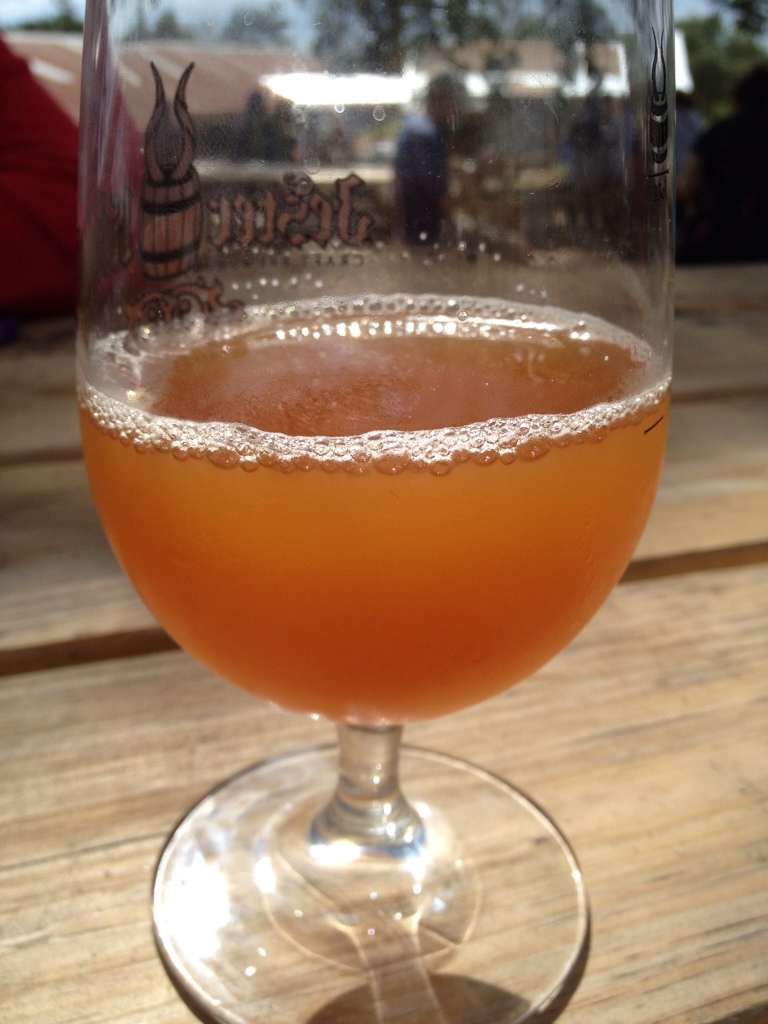
I made my way through the tastings leisurely and only got three in my 90 minutes there, but it was well worth the price of admission. Between beers I cleansed my palate with lots of free kombucha from the Buddha’s Brew tent (thanks!). Peach and Pineapple-Super Greens flavors were on tap and delicious.
I left happy (alcohol + probiotics, mmm mmm good!) and inspired. I’ve been thinking about homebrewing kombucha for a long time, and I might start soon using some Buddha’s Brew dregs to culture a starter SCOBY. Someday I actually hope to have draft kombucha in the kegerator for those non-beer occasions. I’m not sure I’ll ever use it in a beer myself, but who knows? And I toast Jester King for their innovation. After all, that’s what supporting local business is all about.
A vacation … from beer?
On Wednesday I leave for a 6-day, 5-night trip to Playa Mujeres, Mexico. There will be sun, sand and crystal blue water, and all the food and drinks I can shove down my gullet. Now that’s a vacation!
The resort offers an array of alcoholic and non-alcoholic beverages, from freshly made juices to smoothies, sodas, wines, spirits (including Cuban rum and a plethora of premium tequilas), and of course, your usual assortment of international industrially brewed beers, all included in the price of the room. One thing I don’t think they have is a wide selection (translation: any) of craft beers to choose from. Yeah, yeah … I know you’re really feeling sorry for me now.
But what’s a Zyme Lord to do in the court of King Corona? Where cerveza means something light and fizzy served in a clear bottle with a crusty lime wedge stuffed into it?
It’s not that I’m a beer snob; I just don’t like most Mexican beers, certainly not when there are other (cost-equal) options. I enjoy most spirits. Tequila actually has been my “go-to” spirit for a few months now. I’ve had many reposados and good silver tequilas on the rocks lately, because I find the Texas summer too hot for whiskey.
But that’s the problem. I’ve been drinking tequila all summer, and I’ve had some good ones. Isn’t vacation supposed to be a break from the norm? Isn’t there something else I should be looking for?
I’d love to say I’d liberate myself from the dogmatic prison of my resort and explore the real Mexico. Go deep into the countryside, find some old dude living in a shack who makes the best moonshine mezcal around. Even more so, I’d love to journey into Central Mexico and find an honest-to-goodness pulqueria to try pulque, an undistilled fermented maguey beverage I’ve read a lot about. But the truth is, I’m just not that adventurous … with my life, that is; not my tastebuds. So unless I can get canned pulque at the resort, I suspect I will return to the States once again without having tasted this mystique-filled Holy Grail of hooches.
And I doubt canned pulque would be worth it anyway. Probably best to just stick with what I know. And what I know is this: except for a Bohemia or two with a seafood taco lunch, I’ll probably go without beer until I get back.
But hey, six days without beer on a Mexican beach with great food and a Kindle full of classic science fiction novels is pretty much better than any other six days without beer. Right?
So off we go. And as Pink Floyd said, “Pass the tequila, Manuel.”
A Toast To … Single-Serving Friends
The film Fight Club (and I assume the Chuck Palahniuk novel, which I haven’t read yet) introduced the concept of the “single-serving friend”. They’re the people you meet briefly – on a plane, or at a crowded bar in an unfamiliar town – and start talking. You enjoy each other’s company for a few hours, then go your separate ways, never to meet again. In Fight Club, it’s a humorously cynical observation: casual partners for pointless conversation. An illusion of companionship to get you through a few hours of another day on your inexorable way to the grave. A brief distraction, nothing more.
Coming home from a trip to Miami for my day job, I had a 2-hour layover in Atlanta. I stepped off the plane hungry, but mostly thirsty, and beelined to the SweetWater Draft House & Grill (thanks to GateGuru on iPhone for the tip) for some hopefully good beer, and whatever meal they could provide.
The place was small and packed. The line for available seats moved quickly, but by the time I got to the front, no one was about to get up anytime soon. A voice said, “He can sit here if he wants,” to a hostess. As she walked over to relay the message, I realized the voice was referring to me. Why the hell not? I thought, and took him up on the offer.
Before I committed myself to the unorthodox arrangement, I eyed my unexpected dinner companion with the kind of guarded scrutiny that comes from having been in airports too long. He was my age, looked harmless, so I thanked him and sat down. He ordered a pint of 420 Extra Pale Ale and another for me on his tab, then introduced himself as Larry and told me where he was from. He too was on his way home from a business trip, and about to start the last leg of a grueling journey involving multiple connections.
I mentioned where I lived. “Austin! Keepin’ it weird!” he hooted. “What kind of music do you like?” It’s assumed worldwide that all Austinites are music fans (and it seems to be true). I named some of my favorites, and then asked Larry his.
“Gangsta rap,” he said. I nodded and told him how as a teenager I discovered what was left of a tape of N.W.A.’s seminal Straight Outta Compton next to an apartment complex dumpster, and how from that day on it’s been one of my favorite albums. Larry high-fived me enthusiastically across the table. We exchanged some profanity-laden lyrics that frightened the table next to us.
From N.W.A. we moved to Parliament-Funkadelic. Then hoppy ales. We talked about whatever either of us mentioned that excited the other. Larry told stories about the origins of idioms and customs – like toasting before drinking – with the zeal of an elder passing sacred knowledge to his tribe. They might have been good-natured bullshit, but in that moment it didn’t matter; I applauded each one. At some point, he complimented me on my quick wit. But mostly he talked about how much he loved his wife, and how much he was looking forward to holding his baby when he got home. I shared something equally vulnerable and private.
When his plane was boarding, Larry got up. We shook hands and wished each other safe trips. He left. A few minutes later so did I, and boarded my plane going in an opposite direction. Then it occurred to me that I had been speaking with a complete stranger in a way more honest and unguarded than I often do with my real friends, at least on a daily basis.
What was it that loosened our tongues, convinced us to let our guard down so completely? The beer? Doubtful. Two pints in an hour is hardly enough to get me going. No, I think it was the fact of speaking to someone I’d never see again that gave me a sense of liberating anonymity. But it was unlike the shadowy anonymity of the Internet, where faceless alphanumeric handles respond to candor by shitting all over people they’ll never have to look in the eye. This was anonymity with a face, with eyes that glistened and a mouth that curled up or down as the conversation turned: indelible markers of the reality of the human being across the table. It was radiant, like an element that burns too quickly to be viable as a long-term fuel.
We didn’t exchange numbers. We didn’t friend each other on Facebook. I did get a few laughs for the flight home, a fun story to share, and maybe some personality traits that will work their way into some character I write in the future.
But I also got a reminder of the fact that every other person in that airport, whether racing from gate to gate or standing in line for an overpriced beverage, is a real human being. They have names and stories to tell. They have spouses and children waiting for them somewhere. They have favorite songs playing behind those headphones fused to their ears, and they might be the same as yours.
So maybe the key is to appreciate single-serving friends for what they are: short distractions, yes. But distractions that can be enjoyed and remembered, and learned from. Does that make them much different from the books and movies we bury our faces in at the airport, trying desperately not to talk to strangers?
Tapping the All-Galena Pale Ale
Today I kegged the all-Galena hopped American Pale Ale I brewed on the Fourth of July. That’s 7 weeks ago, a long time even by my standards. Due mostly to my day job, I haven’t had friends over nearly enough this summer, so I didn’t have a free tap until now. The Galena APA has been sitting in the primary in the Harry Potter closet all this time.
On the spectrum of anxiety over long rests on the yeast cake, I’m in the middle. I’m not one of those homebrewers who racks off the primary after a week, and I don’t usually secondary at all. But anything longer than 4-5 weeks and I start to get a little antsy. My inner critic kicks in and I begin scolding myself for letting my busy schedule and personal inertia destroy an innocent homebrew by allowing it to age past the terminus of perfection and into the sinister, uncouth dark age of spoilage. Then I get OCD about it. I sniff my hydrometer samples for the telltale “rotting meat” and “shrimp” aromas supposedly typical of autolysis. Once my fears are quelled, I leave it for a few more days, still fearing that the next time I take a sample, it will be too late.
Yes, I could just rack to a carboy after 4 weeks, but that would risk oxidation, which I consider a much more real and terrifying bogeyman than autolysis. I won’t rack unless I intend to age for a long time.
So I’ve been wary for a couple of weeks. But when I took the last sample before kegging, the beer didn’t smell like my Uncle Brian’s backyard during one of his legendary shrimp boils, so that was a good sign. It doesn’t taste like excrement either – huzzah, bullet dodged again.
But more interesting than this tiny conquest over beer-death (hey, I take the victories where I can get ’em) was the result of the dry hopping.
I added a half-ounce of Galena pellets (12.8% AA) a week ago. I always dry hop APAs and IPAs, but especially wanted to do so this time on account of the hop aroma lost during the long rest. Galena isn’t commonly used for aroma or dry hopping from what I can tell, but reports on the Interwebs had me expecting dark fruit aroma from the dry hops.
Those reports weren’t exaggerated. There’s a definite cherry/berry aroma here. It’s deceiving for a pale ale, as it doesn’t exhibit any of the notes we typically associate with “hop-forward” beers: not floral, nor herbal, nor citrusy. But it’s enticing. Coupled with the bready malt notes of the Munich in the mash, the beer ends up smelling a little bit like cherry pie, more so like a tart blackberry cobbler.
That isn’t coming through in the flavor, but I haven’t tasted it properly (i.e., carbonated and chilled) just yet. That first pint will be one for my personal record book, I’m sure. And I’m already thinking about other ways to use Galena as a late-addition hop: as a component in a late-hopped Belgian dubbel, paired with some Special B malt; or in a dry farmhouse wheat with a little bit of rye or mahlab – yeah, I’m still jonesing to use mahlab.
This could be the start of something unorthodox and awesome. You and me, Galena, we’re goin’ places.
Tips for Retailers and Homebrewers alike
Close on the heels of the recent battle with my kegerator over the pressure of my kegs (which I’m happy to report has been stable at 8 PSI since my last post), I saw an article shared on Facebook dealing with storing and dispensing draft beer. The article, written by Julia Herz and published on craftbeer.com back in January, is here:
“Frosted Glassware Is Not Cool: Temperature Tips for Craft Beer Retailers” by Julia Herz
Ostensibly a “cheat sheet” for craft beer retailers to teach them to properly store, dispense and serve craft beer consistent with the demands of an ever-more-knowledgeable clientele of brew enthusiasts, it’s still great information for a homebrewer to have. Especially one who’s kegging and serving their homebrew on draft.
It’s also timely advice for a lot of Central Texas taprooms, now that we’re in the hottest month of the summer. Many bars here are used to serving tall frothy helpings of pee-colored American lager in frozen mugs to guys coming in off the hot asphalt and looking for something cold, wet and flavorless to slake their thirst … not knowing better, many of them assume colder is better and serve craft beer in frozen mugs too.
No.
Frozen glasses are never right for craft beer. Never. Seriously. They numb the tongue and desensitize the tastebuds. Next time you’re at a pub and you order a glass of some rare new offering from Belgium or California or Rehoboth Beach at $9 for 12 ounces, and your bartender brings it to you in a frozen glass: send it back.
I don’t care how hot it is outside. You paid premium for that beer. You deserve to taste it. And you should tell them so. Otherwise, how are they ever gonna learn?
The one thing in this article I don’t fully agree with is the assertion that all bottled and kegged beers should be kept refrigerated. For bars and pubs, maybe. They need to turn out the freshest product possible. But taken out of context and at face value, this “rule” can be interpreted too broadly.
Case in point: high-end bombers sold in groceries and liquor stores. Many beers sold in 750 ml bombers benefit from long-term storage before drinking. Brett ferments and wild ales, barrel-aged and oaked stouts/porters, barley wines, and Belgian abbey-style ales all develop interesting flavor characteristics when cellared correctly (read: cool – but not cold – and dark) for several months or more. The natural microbe and oxygen reactions that develop these flavors don’t happen at refrigerator temperatures.
But too many stores selling bombers are keeping them refrigerated, presumably in an attempt to keep these high-ticket items fresher (and sellable) longer. The problem for those of us who want to age them is that unpasteurized beers don’t respond well to going from room temp, to fridge temp, to cellar temp. It won’t turn them instantly to cat piss, but it’s not recommended. A bomber that’s been refrigerated at the store has effectively had its long-term aging potential reduced – even if you slowly raise the temperature and cellar it, it’s not going to have the shelf stability it would have had otherwise. I won’t buy refrigerated bombers unless I plan to drink them soon, and I’ve been politely informing the staff at a high-end grocery store in my neighborhood of this for several weeks. I’m sure I’m not the only one fighting this fight, and I’d hate to see this cheat sheet work against our efforts if misinterpreted.
But aside from this small split in our ideologies, I think it’s full of great information, and I hope you will too. Read, learn and enjoy. Prosit.
My ongoing gas problem
My name is Shawn, and I have a problem with gas.
Specifically, the carbon dioxide tank in my 3-tap homebrew kegerator. About two weeks ago, I noticed that my beers were getting a little overcarbonated. My regulator, it turned out, was set to a very high 14 PSI. I try to keep it at 10 PSI, which produces an acceptable level of carbonation for most beers; not ideal for all, but it’s good enough and a simple round number.
But when my precious beers were suddenly pouring out as 80% head, I knew something was amiss. So I got on my knees, pulled a keg out of the kegerator to get to the 5-pound CO2 tank at its home on the compressor hump, relieved pressure at the tank valve and turned the regulator screw a tiny bit counterclockwise to lower the pressure. It doesn’t take much to get big results: a few degrees of torque on a quarter-inch bolt can result in a difference of 3-4 PSI, and sometimes it takes a day before it stabilizes.
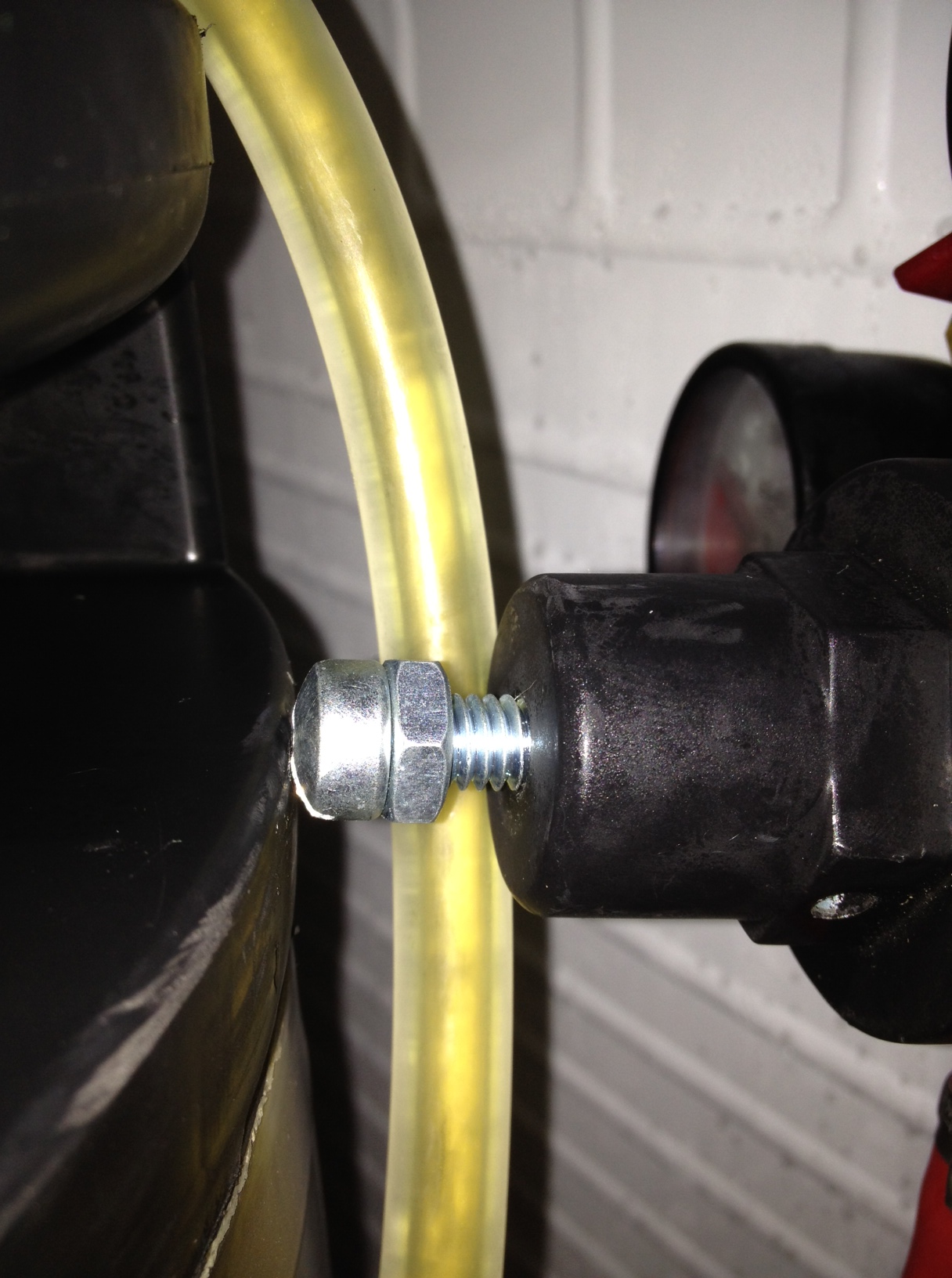
The little bastard causing all the trouble.
But it seemed like it was going to work, for a few days. Then, by coincidence, the tank ran out of gas (I suspected a leak, but thankfully found none). Unfortunately, it was a Monday and I live too far from Austin Homebrew Supply to go there on a weeknight, so I had to wait 5 days before I could get it refilled. Once done, I happily hooked up the newly filled tank and set the pressure to 8 PSI in the hopes that the pressure differential would bleed out some of the extra carbonation in the beer and equalize at the level I’m looking for.
And bleed it did. I poured a pint of Weiss Blau Weiss a few days later, and it was straight-up flat. The regulator was surprisingly at 3 PSI. I was in full WTF mode by this point, until I realized that I set the pressure before I opened all the valves in my gas manifold. 8 PSI with one valve open to one keg dissipated after I opened the other two valves.
Now I think it’s back to normal. We’ll see in a couple of days. And someday I’ll invest in longer beer lines for the system. Longer beer lines mean more distance for the beer to travel from keg to glass, which means it doesn’t come out so fast and so foamy even when the pressure’s a little high. That’s the next logical step, but I’m hoping to put that project off for a less-busy weekend.
Was there a point to this story? No, mostly I’m just venting. But it’s a solid cautionary tale for any homebrewer out there still slaving over a bottling bucket, manually filling and capping 11 bottles for every gallon of homebrew and thinking, “Once I get my kegging system, all my problems are going to be solved!” I once thought that, too.
Nope. Sorry. There will always be problems. Something can always go wrong. Especially when your hobby’s primary equipment options are mostly Frankensteined together by DIYers from common appliances, picnic gear and plumbing fittings. Problems are a given. You just have to roll with them.
But that’s part of the fun. Anybody can go to the store and buy great beer by the case. What makes homebrewers invest the time and the money in all the constant tinkering? Ingenuity. Creativity. And a morbid, wretched drive to find problems that need solving. It’s the same reason I build my own desktop computers from scratch instead of buying them off the shelf. It’s the same reason I’ve been researching and outlining my novel for an obsessively long eight months, poking holes in my own ideas before I write the first page. Like many men, I may shout and curse and bang my fist when a frustrating problem rears its head, but secretly, I love it when a problem arises, because it’s another chance to prove how smart I am by solving it.
So here’s hoping this problem is solved … for now. A pint is calling my name, so I’ll test it soon. But I’ve got hours to kill before bedtime, and who knows what might be waiting for me in there?
One Drink Minimum: Real Ale Beer Dinner at Easy Tiger (part 2 of 2)
Now that the hop-fueled insanity of IPA Day 2012 is over, back to my two-part review of last week's Real Ale Beer Dinner at Easy Tiger Bake Shop & Beer Garden. See here for Part 1.
We left off at …
Fourth Course: Scots Gone Wild Sour Real Heavy with venison liver mousse, black pepper cherry jam, arugula, country levain – The first three courses were all paired with beers made from the same Lost Gold IPA wort. The first new wort in the lineup was a single-barrel wild fermented Scotch ale. It was good, with floral and dark berry notes on the nose and a murky chocolatey red-brown color. It was tart and astringent, very refreshing and great for summer, and paired well with the very rich venison liver mousse. I love venison, though I'm not a fan of organ meat, and a quick glance around the room told me I wasn't the only one outside of my comfort zone. But with a little faith in the chef, I tucked in with an open mind, and I'm glad I did. A bite of the liver mousse spread on the levain bread with a chaser of the sour Scotch ale was fantastic, but the portion was big. I finished mine, but I saw a lot of unemptied plates.

Beer 4: Scots Gone Wild Sour Real Heavy
Fifth Course: Highlander Barrel-Aged Real Heavy with bone marrow, blood sausage, herb salad, fougasse – Before this next dish came out, the servers brought out an enormous pretzel-like bread (the fougasse, I believe). It was delicious, but there was no way the two of us at our table could fit more than a few bites in. The beer, also made from the Real Heavy wort above but aged in red wine barrels, was my least favorite of the night. It had little aroma and a bitter, medicinal flavor. After so much good beer and good food, it was a minor letdown. As for the food, this was my first time eating bone marrow, and it wasn't bad, but I preferred the blood sausage. The herb salad was very sparsely dressed, well-balanced to the strong, earthy flavors of the protein on the plate.

Beer 5: Highlander Barrel-Aged Real Heavy
Sixth Course: Vol. 15 Bourbon Barrel-Aged Russian Imperial Stout with bitter orange bread pudding, caramelized honey, figs, walnuts – Yep, you read right: Easy Tiger worked bread into the dessert as well (bravo, maestros). By this point, I was stuffed, but I finished this tasty and surprisingly light bread pudding. The beer hit all the notes one expects from a RIS, though my (perhaps desensitized) taste buds didn't taste much barrel character in the stout. And the stout may have gone better with a chocolate cake than with such a light bread pudding. After everything else, I couldn't finish the beer, and I wasn't the only one. I hate to waste, but there's only so much one can consume in an evening.

Beer 6: Vol. 15 Bourbon Barrel-Aged Russian Imperial Stout
So there you have it: a delicious dinner and a great beer flight. Easy Tiger and Real Ale truly went all out with each of their contributions and made a good team. The plating portions and the beer pours were impressive, and a great deal for $55 a head. On the other hand, smaller portions would likely have kept the appetites in the room going longer. Maybe even long enough for the less adventurous folks in the room to embrace those organ meats on the later plates.
But hey, Easy Tiger is learning as they go … and I recognize that “The portions were too big at my six-course gourmet microbrew dinner!” is totally a first-world complaint. So I'm not complaining at all. It's just an observation, and maybe will raise some awareness that could eliminate waste in the future.
As for Real Ale, I'd say they showed Austin that this now-old-standby in the local beer community still has some surprises up its sleeve. But they are bigger than the upstarts; and bigger, for a commercial brewery, means bigger risk. Smaller breweries can brew a small experimental batch and eat the cost of having to dump it if necessary, but a brewery the size of Real Ale takes a huge financial hit if they make a 60-barrel batch of something that turns out undrinkable. The trick of fermenting 3 different worts 6 different ways seems a good way for a brewery that size to experiment: if one of the beers turns out bad, there's still barrels and barrels of another beer they made from that wort they can still sell. Is that as exciting as the reckless abandon of a smaller brewery? Well, no … but it still can turn out a bunch of damn good beers, as Real Ale proved.
So thanks to Easy Tiger and Real Ale for a great night that left me happily stuffed and happily buzzed. I'm looking forward to the next one. Prosit.
 myBrewHome