
An homage to UK pubs (and a classic monster movie)
I vote we go back to the Slaughtered Lamb. – Jack Goodman, An American Werewolf in London
Homebrew inspiration can come from strange places. My favorite homebrews are the ones that were inspired not just by an imagined set of flavors, but by places I’ve visited, stories I’ve read, movies I’ve watched, etc. I love using the language of malt, hops, and yeast to tell a story about something more than beer. The trick, though, is that brewing is not an abstract art. A good concept might make for a great conversation starter, but no matter how high-concept a brew is, if it doesn’t taste good I don’t want to be stuck with five gallons of it (I graduated from a Catholic university in New Orleans, but that doesn’t make it a good idea to brew a crawfish & Bananas Foster porter with Trappist ale yeast for the alumni picnic). Finding the right balance between concept and taste is the ultimate goal.
In spring 2011, Lisa and I visited the United Kingdom for three weeks and spent a lot of time in pubs. We drank real ales from so many regional breweries whose names I can’t remember (except for Brains – #1 among zombies in South Wales) served at cellar temperature, often from beer engines – though at one awesome hole-in-the-wall in a one-road hamlet in Scotland I think I remember drinking beer dispensed from a cardboard box. The taste and aroma of real British ale, even the sight of the interior of a British pub, are vivid and powerful memories for me.
In summer 2012, I saw John Landis’ 1981 film An American Werewolf in London for the first time and my nostalgia was kindled by an early scene in the film at a fictitious Yorkshire pub called the “Slaughtered Lamb”. So I brewed a special bitter with English malts and American hops that I named Kessler’s Rampage Special Bitter in homage to the film’s main character and titular werewolf. Not long after I kegged it my sister-in-law and her husband, a native Sussaxon*, came to visit for a week and emptied the keg while I wasn’t looking. I took that as a compliment, and decided to brew it again this summer.
The 2013 version was 94% (8 lbs) Fawcett’s Optic malt, reportedly the base used by Fuller’s and other UK breweries. 4 oz each of Crystal 40 and Crystal 150 rounded out the grain bill. Last year I used Crystal 120 instead of Crystal 150, but otherwise the malt profile was the same in both versions and pretty typical of the style. The mash was one hour at 155°F.
The hops were my chance to freestyle. American homebrewers can be pretty predictable in their hop selections for English pale ales – occasionally someone might get bold and use a little Fuggles, but generally it’s either East Kent Goldings, East Kent Goldings, or another … what’s it called? oh yeah, East Kent Goldings. I suppose that’s what judges look for in competition, but the lack of originality disappoints me. American pale ales and English pale ales are cousin styles, and I see no reason why American hops can’t play a role in a damn fine English bitter if the right ones are chosen – i.e., probably not the 4 C’s (though I suspect someone has done it well).
In 2012, I used exclusively American hops in keeping with the inspiration (you can see both recipes here). For 2013, I deviated with one English hop in the mix:
- 0.5 oz Warrior (15% AA) at 60 minutes
- 0.5 oz Progress (6.6% AA) at 15 minutes
- 0.4 oz Willamette (4% AA) at 5 minutes
Although Progress is English and Willamette is American, both are Fuggle derivatives, so I thought they would pair nicely together despite being a slight variation on the original inspiration. Consider it an homage to Jenny Agutter’s character Alex in the film, the English love interest of the American David Kessler (yes, I can rationalize anything with my artsy symbolic bullshit).
I pitched Safale S-04 into the wort with an OG of 1.046. True to the old adage that “English yeast do it faster,” the fermentation bottomed out at 1.010 less than 48 hours later, leaving me with an ABV of 4.7%, palpable but still sessionable. I kegged it after 4 weeks, and after 2 weeks under refrigeration it’s just starting to get good enough to drink.
I don’t have any of last year’s batch left over to do a true vertical tasting, but I’m a little disappointed in this year’s model. I’m not sure the Progress hops were a good addition (sorry, Jenny). I’ve used them in more robust English-style beers like porters and stouts to great effect, but with so little malt character to hide behind, I’m getting a strong tropical fruit flavor though it is mellowing with time in the keg. The other fault is less diacetyl than I like in this style, though it may be hiding under all those Progress hops and may become more obvious as the hop flavor mellows.
So the beer’s not perfect. But considering I half expected the skies to open up, swarms of locusts and some ancient BJCP curse to fall upon me when I put hops other than East Kent Goldings in a special bitter, I think I’m still coming out ahead. I don’t get the feeling of being an American lost in Britain in this version, but my second Transatlantic ale experiment is good enough to brew again. And again. Until I get it right.
*Sussaxon: a native of East or West Sussex. My brother-in-law assures me this although this term is technically accurate, no one uses it. We both like it because it makes us think of the people of Sussex as mud-splattered, armor-clad Saxons performing great acts of manly savagery like raiding cottages across the southern coast of Great Britain. They’re not.
Vote for Progress … hops
Saturday was Learn to Homebrew Day in the USA, and today is Election Day. To honor both events, I did what any patriotic and pedantic zyme lord would. I made beer.
I called it Colonial Progress Ale, and it’s something between an English bitter and an English brown ale. “Colonial” comes from the fermentables, adapted from a recipe I envisioned for a colonial-style ale during a trip to Philadelphia earlier this year. I ended up with:
- 6.5 lbs American 2-row
- 1 lb Victory malt
- 8 oz Flaked wheat
- 8 oz Flaked oats
- 1 lb Molasses
Each of these ingredients was chosen for a reason, starting with American 2-row malt as the base. Wheat is common in colonial ale recipes, including one attributed to Thomas Jefferson. Victory and oats I had no historic precedent for, but I added them for body in the finished beer, along with some bready/biscuity flavor (Victory) and silky smoothness (oats) to accentuate the English-inspired malt profile. I mashed at 153°F for medium fermentability, counting on the highly fermentable molasses to dry the beer out.
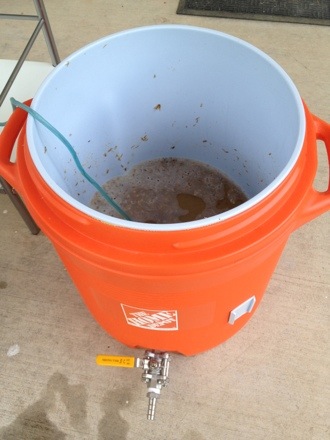
The mash begins.
Ohhh, molasses. A common ingredient in beer in early colonial Philadelphia (according to a quote from William Penn), I can eat the stuff right out of the jar. But I was nervous about using it after reading John Palmer’s tasting notes ranging from “rumlike” and “sweet” (woohoo!) to “harsh” and “bitter” (ergh). But further research online suggested that harsher flavors were associated with fermenting mineral-rich blackstrap molasses, not the regular unsulphured kind. I went with regular, and added them at the beginning of the boil with high hopes.
The “Progress” part came from the hops: one ounce of 6.6% AA Progress at the 60-minute mark for bittering, and another quarter ounce at 15 minutes for flavor. Progress is a UK varietal related to Fuggle hops, a good choice for English-style ales.
But that wasn’t all I added to the boil. Hops were available to some colonial brewers, but apparently not all that prevalent, so other bittering herbs were common. My original plan was to use horehound, but I realized the medicinal flavor might overpower a low-gravity ale. I thought of rosemary, but was talked out of it by the sages (ha, ha) at Austin Homebrew Supply. I landed on:
- .25 oz Juniper berries (crushed in mortar)
- .5 grams Sweet Gale (dried)
I added the herbs in the last minute of the boil and let them steep during cooling and whirlpool. I may add more later during conditioning.
The wort had an OG of 1.046, a true session ale for the upcoming winter (insert witty apropos Valley Forge reference; I can’t think of one). I pitched the slurry from a 2-liter starter of WLP008 East Coast Ale Yeast – reportedly the Sam Adams house strain – in keeping with the colonial theme. I set the fermentation chamber to an ambient 65-68°F, a little warmer than typical to coax some vintage ester flavor from this low-flocculating yeast.

Fermentation underway after 24 hours.
By this time tomorrow, the future of the United States will be written for the next four years. But regardless of whether my guy wins or not, I’ll have something to look forward to: a beverage in the tradition of the first beers brewed on American soil. Beer has always been a part of American culture, even before there was a United States, and from #1 on down to #44 many presidents have been homebrew aficionados: George Washington, Thomas Jefferson and James Madison were homebrewers and Barack Obama bought a homebrew kit for the White House with his own money. And beer remains one of the few things people can agree on regardless of personal politics.
Don’t forget to vote today, no matter who you’re supporting. Red and blue be damned. We can all party together in the colors of the SRM scale.
Strike up the Sousa march …
This Fourth of July, I celebrated my right to make beer. Regular readers may recall that a few months ago, I posted a recipe for an American Colonial Ale inspired by a recent trip to Philadelphia. The perfect beer to brew on the Fourth of July! But silly me, I forgot all about it until after I left Austin Homebrew Supply with my ingredients for a different beer. So I’ll have to brew the colonial ale another time. Oops …
Instead, I brewed a single-hop Galena American Pale Ale, the second in my “Misty Mountain Hop” series of single-hop brews (the first was a Citra APA). This was a new grain bill entirely of my own devising, and if the beer comes out well, I’ll probably make it my standard grain bill for all APAs from now on:
- 9 lbs 2-row malt
- 1.5 lbs Munich malt
- 8 oz Crystal 40L
- 8 oz Crystal 75L
The wort looked and smelled delicious coming out of the mash tun, a sort of tangerine-copper color with an aroma like toasted artisan bread. I’ve got high hopes.

Vorlauf action shot!
The hop additions were all Galena, of course. This common bittering hop doesn’t seem to be used often for late hop additions, but I’ve read reviews of a few beers with late Galena hops that had descriptors like “dark fruit” and “tart berry”. Sounds awesome to me. I used:
- .85 oz at 60 minutes
- .5 oz at 15 minutes
- .5 oz at 5 minutes
- .5 oz at flameout
All of my Galena hop pellets were rated 12.8% AA. I’ll probably add another half ounce of dry hops before kegging for added aroma. My OG came in at 1.055, pretty much smack in the middle of the BJCP range for American Pale Ales. I pitched 15 grams of rehydrated Safale US-05 yeast.
But my real declaration of independence this brew session was from my old swamp cooler. After long deliberation (and somehow, writing about the idea a couple of weeks ago made it seem more feasible – thanks, Internet!) I finally bit the bullet and got myself a true temperature-controlled fermentation chamber: a Kenmore 5.1 cubic foot chest freezer with a Johnson Digital Temperature Controller dialed in to a range of 65-68°F.

Crazy. Sexy. Cool.
The Galena APA has been in there for a few days, and I’m still working out the kinks. Last night after I was out of the house all day, it had somehow got down to 60°F, though it was back up within minutes after I cracked the freezer lid for a while. But I can already say that this is one of the best purchases I have made in support of my homebrew habit. Ever. No more checking the closet every hour to monitor the temperature. No more keeping dozens of frozen water bottles on hand, waiting to be used in the swamp cooler, spending their idle time rolling around my garage freezer and making it harder to find more important stuff (like, you know, food). Perhaps most importantly, no more risks of infection from the stagnant water in the swamp cooler, which always bothered me. I just let it do its thing, check it once or twice a day, and it’s always been in the range I want … except for last night, but it’s never gotten higher than 68°F.
And now I am at liberty to brew what I want to brew, any time of year. I can lager in August. With a few modifications, I can make warm-fermented fruity Belgians in February.
Freedom. I dig it. Don’t we all?
A Crescent City Concoction, part 2
On Monday I finally kegged my Crescent Moon Café au Lait Stout after 4 weeks in the fermenter. I also finally added the eponymous coffee to the beer, crossing the line from a plain old milk stout (albeit one made by my own from-scratch recipe) into something truly unique.
The coffee and chicory was cold brewed on Lisa’s Toddy system: combining a pound of ground coffee with 9 cups of cold water, and letting it steep overnight, we brewed about 40 oz of concentrated coffee extract. Theoretically, this coffee extract is stronger than regular brewed coffee, but when we mixed a little bit of the extract with a sample of the beer at the planned ratio of 16-24 oz of coffee and chicory per 5 gallons of milk stout, there just wasn’t nearly enough coffee flavor. So we ramped it up, added more and more coffee until we got to a point where we were happy. The ratio we landed on was 64(!) oz of extract in the 5 gallon batch of beer. That’s a lot more than any coffee/beer recipe I’ve ever seen, but I let my tastebuds do the deciding. And I did want a bold coffee flavor.
The extract was added directly to the keg, and the beer was racked on top of that. This displaced a half gallon of the beer, so we ended up with .5 gallons of coffee extract to 4.5 gallons of beer, or a ratio of 1 part coffee to 9 parts stout. What I sampled really did taste like café au lait, so I’m pleased. Now it’s carbonating in the kegerator, and will be ready to drink in a few days.
This beer has made me feel like being a newbie homebrewer all over again: The anxious counting of day after day while I wait for the beer to be ready. The adventurous experimentation. The excitement over the unknown. If these phrases sound like ways to describe a brand new romance, it’s no accident. I’m in love with homebrewing, and this stout has reminded me why I fell in love with it in the first place. I want more of this thrill.
With June nearly upon us, I’ll look to a wheat beer for my next brew, as they’re much more forgiving to make in the heat of a Central Texas summer, even in my air-conditioned home. I’ve talked about a blood orange or other citrus wheat for a while now. I could resurrect one of my wheats from previous summers – lemongrass, ginger, or agave – but the wanderlust of experimentation is consuming me, and I think I’m itching for something new.
Read my original post about the recipe and brew day for the café au lait stout here.
A Crescent City Concoction
For a long time now I’ve been in love with milk stouts, and have wanted to brew one. Lisa has also been asking for a coffee stout, specifically one using New Orleans-style coffee and chicory (we’re both New Orleanians by birth), to slake her thirst for java. In a flash of inspiration, I decided to combine the coffee/chicory stout and milk stout into one brew: a “café au lait” stout. You know, just like Café du Monde on Decatur Street would serve if they had a liquor license.
A sweet stout is a great beer style to honor my hometown. Like New Orleans, sweet stout is dark and mysterious, but full of character. It may be intimidating to the uninitiated, even harsh at first; but it’s warm and inviting when you know what to expect. And you discover something new about it with each new taste. That’s all very poetic, I know, but it’s a lot to explain when filling a glass. So adding the ingredients of a real French Market café au lait was exactly what I needed to bring my lofty symbolic interpretation of the city back down to earth.
I named the brew Crescent Moon Café au Lait Stout in honor of New Orleans’ nickname “the Crescent City” and a current obsession I have with all things lunar. I’d like to give a quick toast here to the HomeBrewTalk.com community, and the great people at Austin Homebrew Supply, for helping me finalize the recipe. The grain bill:
- 9 lbs 2-row malt
- 1.5 lb Coffee Malt
- .75 lb Roasted Barley
- .5 lb Crystal 90L
I chose specialty grains with coffee-like flavor profiles to accentuate the coffee in the finished product. I’d never used coffee malt (which despite the name is just barley malt – it has no actual coffee in it) before, but it was advertised as being kilned to 130-170L with a smell and taste like coffee, and it didn’t disappoint. Roasted barley, too, is known for its coffee characteristics, so I opted for it instead of black patent malt to get a little more flavor. The medium-dark crystal malt was added to round out the malt profile of the beer and leave some respectable body.
I started the mash at 153°F, and it dropped to 152°F by the end of the 60-minute mash.
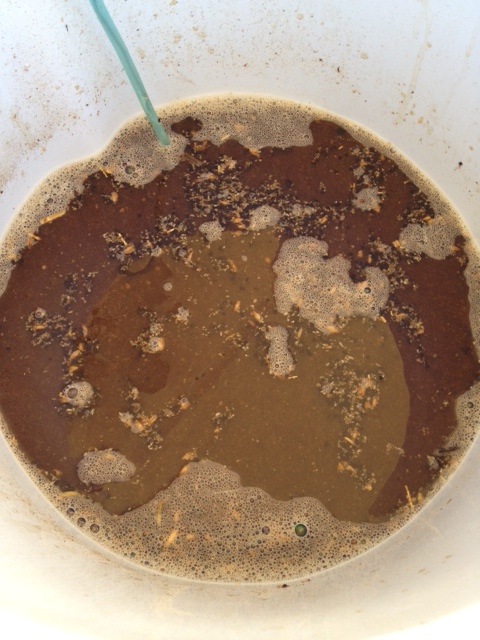
Gore from severed starch molecules splatters the walls of my mash tun like a scene from Dexter.
I did two batch sparges and ran 7.75 gallons of 1.032 wort into the kettle. For my last several brews, I have been forced to run off extra wort and boil it down for 90 minutes to hit my target OG. Someday I’ll figure out why that’s the case, but for now I don’t mind the longer boils. It gives me time to catch up on reading and Words With Friends.
I took a sort of bare-minimum approach to the hops, as I really wasn’t interested in a lot of hop character. I want the aroma and bitterness of the coffee and chicory to come through. So I added just .75 oz of 12.4% AA Nugget hop pellets to the boil with 60 minutes left to go, and no late hop additions. I added 1 lb of lactose (the ingredient that makes a milk stout a milk stout) later in the boil, with 20 minutes left.
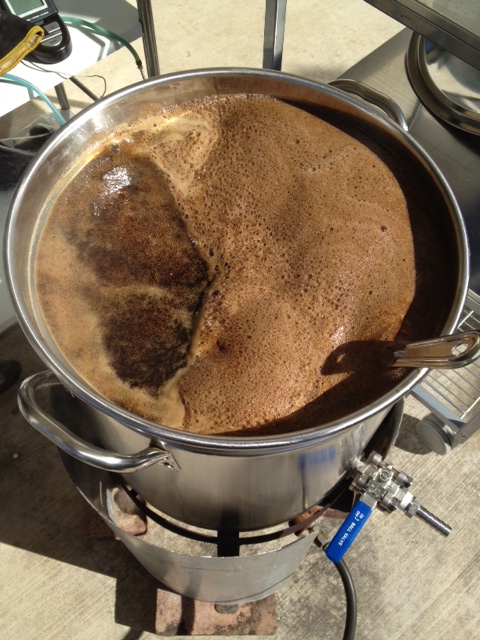
It's not just pretty to look at. The backyard smelled like a Starbucks.
Notice that I haven’t actually added the coffee and chicory yet. So far, this café au lait stout is just a milk stout begging for a wake-up, but it’s amazing how much it already smells like coffee, thanks to the malts I used. At kegging time, we’ll cold brew between 16-24 oz of coffee and chicory and rack the beer onto that. Cold brewed coffee is recommended because of its smoothness, and it’s really the only way we drink coffee and chicory in this house anyway.
The OG of the wort was 1.064, and I pitched 14 grams of rehydrated Fermentis Safale S-04 yeast. After years of using liquid yeast and rarely using the same strain twice, I’ve recently started using more dry yeast, and this simple English ale strain is rapidly becoming my go-to strain. That’s partly because I’ve been making a lot of British styles, and partly because my busy schedule hasn’t left me with much time to properly prepare liquid yeast for pitching (making a starter, etc.). But I couldn’t have settled down with a finer microbe, because S-04 works fast and flocculates like a rock star, leaving some fruity esters behind but mostly a very clean beer. I brewed this beer on Saturday, and as of yesterday, the kraeusen was already starting to fall.

Moments after pitching the yeast. They may be stooges, but they keep my fermentations cool.
I’m really excited about this brew. So much so that I couldn’t wait to make it, even though my timing means that I’m going to have a thick, malty stout on tap during the brutal Texas summer. But a friend said to me recently, “Any season is the right season for stout,” and I couldn’t agree more. Especially when my respite from the heat will be a tall, delicious pint of the Big Easy.
So, who’s bringing the beignets?
Philadelphia, and Thoughts on Colonial Brewing
My “day job” (i.e., the one that pays me) sent me to Philadelphia this week. Today I was lucky enough to get a chance to venture out of the cozy suburb where my employer has its offices and into the exciting bustle of one of the oldest cities on the continent. I saw the Liberty Bell and Independence Hall, had a cheesesteak that blew my damn mind, and drove in a circle past the Philadelphia Museum of Art (the famous steps from Rocky).
Philadelphia has had a profound effect on me. The city appears to have been designed with the intent of sending a message to visitors: “Hey, you know that place between Canada and Mexico that the entire world has been watching for centuries? The one with the Bill of Rights and the guns and the Coca-Cola? Yeah, the United States of America. We invented that place, bro.” Everything here is named after George Washington or Benjamin Franklin. The city logo is a bell with a crack in it. The shadiest-looking strip malls have words like independence and liberty in their names. And though it may not be the first thought on the mind of every modern Philadelphian, there is a feeling in the ground itself here that the spot you’re standing on is one where something important happened.
Now I’m back at my hotel, packed and ready to board a plane to return to Austin tomorrow. And because sitting alone in a hotel room drinking Yeungling Lager and listening to the Stone Roses would just be too pathetic, I’ve been inspired by my wanderings today to read about colonial brewing. And thinking it’s high time I do something of the sort.
Summer is around the corner, and a low-alcohol historic colonial brew may be just the thing for backyard refreshment in the Texas heat. And since come May it will be very hard to keep fermentation temperatures down in the swamp cooler in the Harry Potter closet, I can rationalize any esters in the brew as part of the “colonial charm”.
The gravity and bitterness should be similar to that of an English bitter, around 1.040 and 16 IBU. But I’ll get there with 6.5 lbs of American 2-row malt mashed at around 153-154°F. In the boil:
- 1 lb Molasses
- 0.5 oz Northern Brewer (~9% AA) for 60 minutes
- 1 oz Horehound for 5 minutes
I could replace the Northern Brewer with East Kent Goldings, an older and certainly more “English” hop, but that would push the recipe closer to an English bitter than I’d like. Ultimately, I don’t think it matters much because the hops are just for bittering. The flavor and aroma will come from the horehound, which I’m using as a thujone-free substitute for wormwood (an attested colonial ale ingredient). For yeast, White Labs WLP 008 East Coast Ale Yeast is the obvious choice.
Earlier this evening, I read a quote from William Penn himself: “Our Beer was mostly made of Molasses which well boyld, until it makes a very tolerable drink, but note they make Mault, and Mault Drink begins to be common, especially in the Ordinaries and the Houses of the more substantial People.” One can imagine the pride Penn must have felt at explaining to his reader how his city, once a town of molasses-quaffing hooligans, was changing into a place where “substantial” people were starting to prosper enough that they could afford to drink real malt beer. I like to think my brew will be one that Penn would be proud of, and a fitting tribute to how far his city (and the nation conceived here) have come since he landed on the bank of the Delaware in 1682: familiar but changed, refined but true to the spirit of improvisation out of necessity.
The plan is to make this my first brew for May, after this weekend’s New Orleans-inspired café au lait stout (details Saturday!). And if I find myself inspired by any other great American cities, who knows what will be next?
For more on Philadelphia brewing throughout history (including the colonial period) see this article by Rich Wagner from the Spring 1991 issue of Zymurgy.
 myBrewHome