
One Drink Minimum: Real Ale Beer Dinner at Easy Tiger (part 1 of 2)
Last week Lisa scored tickets to a beer dinner hosted by Real Ale Brewing Company at Easy Tiger Bake Shop & Beer Garden in downtown Austin.
Easy Tiger opened earlier this year on East Sixth Street, promising fresh baked-in-house breads, ample taps, and a menu that goes beyond pizza, all just down the street from the chickenpox of dive bars and music venues that dot the sidewalks of what the kids call “Dirty Sixth”. This was Easy Tiger’s first beer dinner, and it showed – mainly through oversized portions; a good problem, really – but the dishes were tasty and the pairings on the mark.
It would’ve been hard to imagine it when I first moved to Austin, but Real Ale is now the big kid on the block in Central Texas craft brew. With every new brewery that sets up shop in the region, Real Ale becomes more and more the elder statesman, and they’ve been accused of letting themselves go stale, of not pushing the envelope. (Aside from their flagship ale Firemans #4, most of their beers fall firmly in the American-British spectrum of bitter/pale ales: an APA, a rye APA, an IPA, etc. … but they do make a fantastic barleywine and some nice German seasonals.) The lineup for this beer dinner seemed carefully choreographed to prove that the old dog still has some tricks in it, and while I’m not sure I bought the routine 100%, the beers were well-made and I had a fantastic time.
Aperitif: Firemans #4 – Before the first dish came out, we started with a 6-oz pour of Real Ale’s ubiquitous flagship blonde ale. If you haven’t tasted this beer, you haven’t been to Austin. It really is everywhere, and it’s been the gateway to craft beer for frat boys and good ol’boys in this town for years (not to mention a few people I know). Call it boring; but you can’t argue with its quality, and they brought out the freshest batch I’ve ever tasted for this event. Crisp, clean taste, a nutty continental malt aroma, and a noticeable but not intimidating noble hop flavor make this a beer you can buy a case of for that stubborn Bud drinker in your family, even for your mom. And I have.
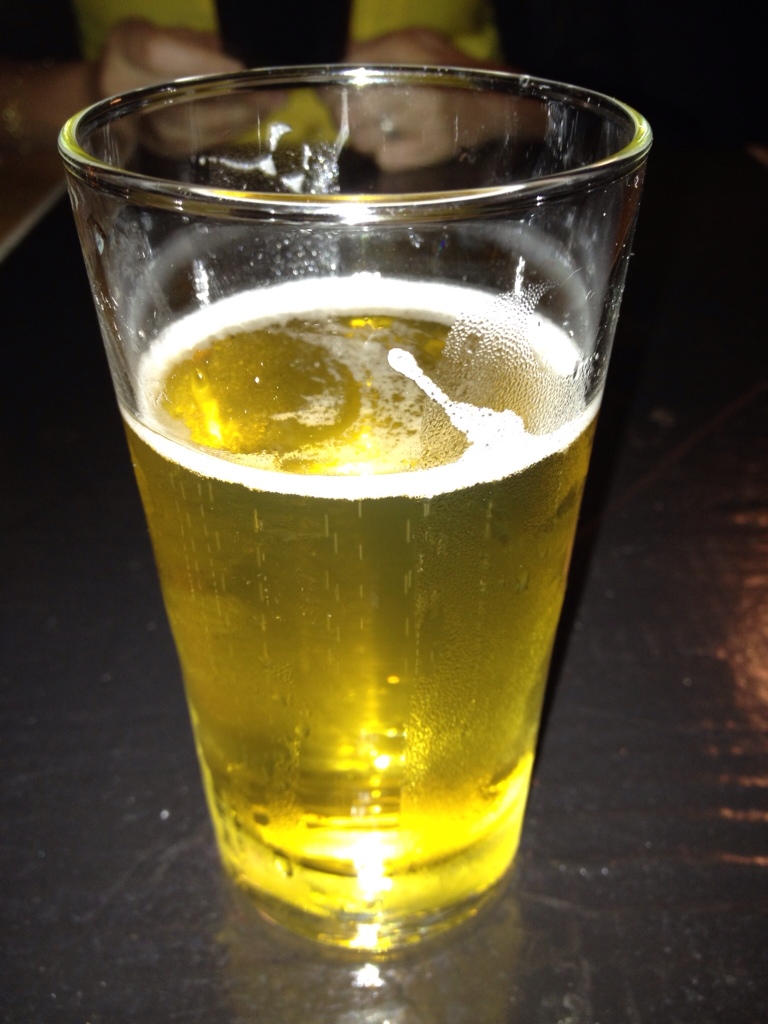
Beer 0: Firemans #4
Then the marquee lineup started: 6 dishes paired with 6 beers, about 6 ounces worth of each (cue Iron Maiden). The trick I mentioned earlier was that these 6 beers came from only 3 different “wort streams” – this was a new term to me, but basically means simply that 3 different worts were fermented under different conditions to produce 6 different beers.
First Course: Lost Gold IPA with mussels, smoked tomato, fennel, leaks baguette – Real Ale’s aptly named year-round IPA pours a deep golden color. The aroma abounds with grapefruit and floral notes. The flavor is a modest but noticeable blast of hops that doesn’t fail to refresh. It went astoundingly well with a smokey mussel stew served family-style with a whole baguette (for two). We scraped the bowl, and it was a big bowl. And all I can say about the bread is, “OMG, bread!” You can tell it’s what Easy Tiger does best.

Beer 1: Lost Gold IPA
Second Course: Empire Barrel-Aged Lost Gold IPA with duck sausage, corn pudding, watercress – The second beer made from the Lost Gold IPA wort was aged in red wine barrels that left a blanket of sour cherry fruit notes on the whole thing. The hop aroma faded with the aging, as expected, but the bitterness remained, and the beer poured enticingly murky. A hint of pungent funk from the barrel complemented the rich, earthy duck sausage. The corn pudding was light and fluffy; it complemented the sausage just fine but was easily overpowered by the beer. The disparate elements of the dish worked better separately than as a single bite.

Beer 2: Empire Barrel-Aged Lost Gold IPA
Third Course: Imperium Wild Lost Gold IPA with apricot-braised goat, local shell pea cake, mint gremolata – The third version of Lost Gold was aged in similar barrels to Empire, but wild fermentation was induced for a funkier flavor. Floral notes took center stage on this one, and it was very dry, balancing very well with another rich protein dish. The apricot balanced both the gaminess of the goat and the funkiness of the beer. By now, I was really excited about what the night had in store. I was eating great food and enjoying the results of an experiment on how one wort could become three very different beers.

Beer 3: Imperium Wild Lost Gold IPA
Check back in a few days when I post my reviews on the last three pairings of the evening, and my overall impressions. It was a delightful and insightful night.
A Toast To … Art for Brewing’s Sake
As Central Texas is plagued by thunderstorms, I'm stuck in the house enjoying the last of a bottle of Mikkeller It's Alive! Belgian Wild Ale. And I'm raising my glass virtually to Dustin Sullivan, a fellow member of the online homebrewing forum HomeBrewTalk.com, and the creator of this awesome pictorial on how to make a yeast starter.

I love brewing. I love comic art. And I love anything that's educational in a novel and interesting way. This pictorial is all three, and I'm thrilled to have stumbled onto it. I wish everything in brewing could have been explained to me so simply when I was starting out. Sure, learning as you go is 50% of the fun of brewing (another 25% is drinking the results, and the last 25% is being able to impress your friends by dropping words like “saccharification” and “attenuate” into everyday conversation) … but I'm a knowledge addict, and I'm also pathologically risk averse. So I read everything I could get my hands on when I was starting my homebrew habit, so I'd have a good idea of each step of every process before I jumped in. Sometimes, it was hard to separate the good info from the bad: to separate the clear and “just-enough” from the over-explanatory, and to separate the simple sharing of helpful information from the vomiting of brewlore all over you by guys who just want to impress you with how much they know.
Now, I love John Palmer's How to Brew and Charlie Papazian's The Complete Joy of Homebrewing. They're phenomenal books, and essential for anyone entering the hobby. But if I'd had something as simple and clear as Dustin's yeast starter pictorial for my first extract brew, my first mash, my first rack to secondary, let alone my first yeast starter, I'd have lost a lot less sleep as a newbie.
Dustin also created a yeast calculator website called YeastCalc at yeastcalc.com. It's one of the most comprehensive pitching rate calculators I've seen online for liquid yeast. It tells you not only how big of a starter to make, but also allows you to dial in a target specific gravity for your starter, and tells you how much dry malt extract to use for that target. It even has options for calculating multiple step-up starters, for that 10-gallon barleywine you've been wanting to make. I'll be using this site next time I make a starter, and I recommend you do the same.
So I’d like to raise my beer glass to Dustin Sullivan, another homebrewer out there doing his part to make brewing a little easier and simpler for the rest of us: newbies and veterans alike. Thanks, Dustin. Prosit!
Also, anyone out there who isn't yet a member of HomeBrewTalk.com, check it out. There's heaps of information there. If you have questions, it's a great place to turn; if you have answers, we always welcome new insights. And it's the most helpful, responsive and engaged online community I've ever been a part of. If you join, look me up. My username is shawnbou and I'd love to hear from you.
 Posted with Blogsy
Rogue Ales: Losing their relevance?
I’ve got nothing against Rogue Ales. I actually owe them a lot. Living on the West Coast in the early aughts, their beers inspired me long before I was a homebrewer. That smirking libertine on the bomber label, enticing me with interesting names like “Dead Guy Ale” and unique ingredients like hazelnut and soba … these things helped awaken me to the possibilities of what beer could be. I don’t drink Rogue often anymore, but that’s mainly because I drink so much Texas beer. (Coincidentally, I bought a bomber of their Chatoe Rogue Single Malt Ale this week. I wasn’t crazy about it, but I think it was mishandled in shipping. Two bottles in a row were gushers.)
But when I saw this story about a new beer in the works called New Crustacean, fermented with yeast harvested from the beard of Rogue Brewmaster John Maier, I had a pretty strong reaction. There isn’t one part of me that sees this as a good idea. (Hat tip to Heather Null for sending me the story.)
I’m all for experimentation, as long as good flavor is the ultimate goal. Brewing is not an abstract art; the point is to make beer that people will drink. Not that Rogue can’t make a perfectly drinkable beer with beard yeast, but just because something is drinkable doesn’t mean anyone will drink it. So I feel like this beer, at this time, is the wrong idea.
The ick factor doesn’t bother me. I realize they’re not throwing a sprig of John Maier’s hair into every batch. This is yeast propagation we’re talking about here. With the help of White Labs – a name in the brewing community that I trust implicitly – they’re isolating the yeast using science that I can’t begin to understand, and reproducing the strain under sterile conditions. So I’m not worried about the fact that “OMG beard yeast beer sounds gross!” and if anyone reading this is worrying about that, please don’t.
And I’m not worried about some mysterious X-factor in those microbes, either. We’re talking about a guy who’s worked in a brewery every day since 1989; there’s probably more beer yeast in that beard than there is in the air ducts at Rogue. He may even have hop bines in there for all I know. In fact, I’d be willing to put money on that beard yeast being at least 90% genetically equivalent to Rogue’s proprietary house beer strain, Pacman. Besides, we’re always told that nothing can live in beer that’s harmful to humans, and I’m pretty sure the biologists at White Labs know the difference between a viable strain of Saccharomyces cerevisiae and the Ebola virus. So whatever it is, it ain’t gonna kill us.
What bothers me is the message this sends to the non-craft-beer-drinking world. This is obviously a niche product. Few people are going to want to drink beer made with yeast from some dude’s beard, no matter how safe or sanitary it really is. I’m not just talking about the masses out there with their cans of industrial lager. Even craft beer lovers are going to be split on this idea. What Rogue is really telling the world with this gesture is that they’re catering to the extremists: the hardcore beer geeks with their T-shirts from nanobreweries you’ve never heard of, who brag about driving all the way to Russian River to get this year’s Pliny the Elder before it hits stores, all the while laughing over the rims of their pints at the craft beer neophyte at the end of the bar sipping on a 60-Minute IPA. The ones who always have to be more cutting edge than you about their beer habit and would slurp tripel from every goatee, vandyke and ZZ Top in Oregon to prove it. At best, Rogue’s beard beer is a stunt; at worst, it’s an exclusionary tactic executed with pomposity and self-aware irony.
Is that their right? Sure, but all brewers, commercial or hobbyist, are ambassadors of our craft. Anything that brings new beer lovers into the fold helps our craft along. And anything that alienates potential newcomers, or that portrays beer fans as snobs and weirdos, is bad for breweries’ business, and makes it harder for homebrewers to get friends on board. Why risk all that, why do it to the industry and the community, just for a publicity stunt and some bragging rights that no one really wants?
At the end of the day, they can do what they choose, and I can choose not to support it. But it does make me wonder at Rogue’s relevance in the modern craft beer industry if they have to grasp at stunts like this to keep moving. Maybe years ago, they were an unstoppable innovative force, but they’re not the only rogues on the block anymore: now we have Dogfish Head, Jolly Pumpkin, Mikkeller, and others who wow us every season with their originality and marketability … and don’t have to be, as that fabled beer peddler Moe Szyslak once said on The Simpsons about post-modern art, “weird for the sake of weird”.
 myBrewHome