
A taste of local at the Texas Craft Brewers Festival
Fiesta Gardens in East Austin was the hoppiest place in town on October 6 as about two dozen breweries from all over Texas gathered for the annual Texas Craft Brewers Festival, sponsored by the Young Men’s Business League of Austin. Featuring over 115 beers, the event promised to be a carnival of discovery. I walked through the gates holding my tasting glass eagerly, like an explorer taking his first steps on a newly discovered shore with a trusty saber in hand.
The format was a familiar one: a booth from each brewery in attendance (arranged in alphabetical order, wow) offering pours of their most popular and/or most interesting beers. $20 bought admission, a 4 oz. plastic tasting glass and six tickets, with additional tickets available for purchase at two for $3. Most of the pours cost one ticket, with some of the rarer/higher-gravity offerings going for two.
I sprung for the $65 VIP pass. It didn’t come with any additional tickets (bummer), but I did get a T-shirt and imperial pint glass along with noon entry, two hours before everyone else. The early entry was worth it, because the place got nuts at 2:00 when the gates opened to general admission. VIP’s also got a “meet-and-greet” round robin tasting in the main pavilion from 1:00 to 2:00. Brewers and brewery representatives walked around the pavilion with pitchers, pouring samples and answering questions.
I love talking to brewers who have a real passion for brewing. The ones who are visibly energized by talking to kindred spirits. The ones whose eyes light up when asked why they chose one yeast strain over another, or who get excited when you taste something subtle in the beer that they were specifically trying for. They’re the stewards of our community, the true shamans of our tribal craft brew culture. I’d especially like to thank Jeff Stuffings of Jester King Craft Brewery, Diane Rogness of Rogness Brewing Company, Jud Mulherin of Circle Brewing Company and Grant Wood of Revolver Brewing Company for stopping for a few minutes on a busy day to talk to me – one of many admirers clamoring for their time – about their ingredients, their craft, and why they do what they do.
The beers themselves presented a fascinating snapshot of where Texas craft brew is today. Several things became apparent over the course of the day:
- Sour beer no longer a thing? The event website boasted “at least four sours”. That’s a much smaller number than I would have predicted a year ago, when sours were seemingly the next big wave in craft brewing. But now it seems Texas brewers are looking elsewhere for innovation. Real Ale Scots Gone Wild and Austin Beerworks Einhorn Berliner Weisse were on tap along with some sours from Jester King, but I didn’t see anything on the menu that I hadn’t tried before. I made a beeline to the Jester King booth for what I thought was a new sour – the Viking-inspired Gotlandsdricka – and got a surprise. Jeff Stuffings informed me his Gotlandsdricka was intended to be a modern interpretation, not a historically accurate recreation of the ancient ale, and was clean-fermented with just Saccharomyces cerevisiae. I’m a sucker for anything Nordic, and I liked it a lot, but I’m still curious to taste the sour version they may release in a few months.
- Flavorings are where it’s at. For a region so rich in German heritage, Texas brewers sure don’t know the meaning of Reinheitsgebot. Spices and fruits abounded. Rogness OST Porter with coffee and coconut and Yogi Amber with chai spice, Thirsty Planet ChiGoatle Amber with peppers, Revolver Blood & Honey Wheat with blood orange zest and spices, and Jester King Gotlandsdricka with sweet gale and juniper all made impressions on me. Even Reinheitsgebot champions Circle Brewing have jumped into the flavor fray with Smokin’ Beech, a refreshing Rauchbier with a bacony character from malt beechwood-smoked according to a traditional Bamberg process that Jud Mulherin described to me in reverent detail.
- Tea is the new coffee. Coffee porters and stouts remain popular, but Texas brewers are starting to notice coffee’s hot stepsister from across the ocean, with very different takes on the concept. Live Oak poured an Oaktoberfest infused with lapsang souchong China black tea, lending a vegetal smokiness tailored for slow sipping. Jester King poured their kombucha farmhouse ale Buddha’s Brew. Rogness Yogi Amber doesn’t actually have tea in it, but recreates the experience of chai tea in an amber beer with chai spices and unfermentable sugars. Diane Rogness called Yogi “her baby”, and she should be proud of it. I enjoyed drinking it and have thought about it a lot since Saturday.
- Dallas-Fort Worth is growing. Lakewood Brewing and Revolver Brewing are two names from the Metroplex that seem to have made their Austin debut at the event, alongside DFW stalwarts Deep Ellum and Southern Star. I didn’t get a chance to try Lakewood (sorry!) but Revolver’s Blood & Honey Wheat is a surprisingly complex lawnmower beer with blood orange zest and savory spices. Head brewer Grant Wood invited me to guess which spices he used. I guessed incorrectly, and when I pressed him for the correct answer, he said smiling, “We’ve gotta have some secrets.” Touché.
Finally, the day brought great news to the mead lover in me. I had a chance to speak to Eric Lowe of Meridian Hive Meadery, a new Austin company getting their brewhouse (meadhouse?) assembled currently, and who will hopefully be releasing their first meads in early 2013. There’s a mead gap in Austin, and I welcome them with open arms and a thirsty palate.
Photos of the event are below (including one of your friend and humble narrator in a yellow shirt), courtesy of Roy Moore and Control Images. Thanks to the YMBL and all who made the event what it was.


Fantastic Fest 2012 in review: beer, free beer, and a movie or two
Fantastic Fest 2012 is now a happy week-old memory. I saw 33 films from September 20-27 and emptied more than a few pint glasses. My highlights from the festival are below:
Day 1 – My Fest started with Tim Burton’s Frankenweenie in 3D. But that wasn’t until 6pm, so before the show, I had lunch at Bangers Sausage House & Beer Garden, where I enjoyed two barrel-aged Texas beers: Bourbon Barrel Alt-eration from Hops & Grain, and Real Ale Shipwrecked (aged in Jameson barrels for extra deliciousness) with an antelope and venison merguez sausage in honor of the reanimated pooch. Once I got to the Alamo Drafthouse Cinema for the movie, I found myself in the Shiner-sponsored theater, and enjoyed a free Shiner Bock. But my favorite film that day was Antiviral from Canadian director Brandon Cronenberg – son of film legend David Cronenberg (The Fly, Videodrome), and worthy of his father’s directorial legacy.
Day 2 – Two major highlights: The Conspiracy, also from Canada, which I watched with a couple of pale ales: an Austin Beerworks Fire Eagle IPA and a Shiner Wild Hare Pale Ale. Later that night, a friend and I got to the bottom of a pitcher of Real Ale Firemans #4 while watching Dead Sushi, the latest from Japanese director Noboru Iguchi. Iguchi’s shock/splatter/gross-out horror-comedies aren’t for everyone, but I find them great fun; and Dead Sushi is one of the better ones. Before the screening was a live in-theater eating competition between Iguchi, SFX guru Yoshihiro Nishimura and four audience members eating bull penis sushi, duck fetuses and ghost pepper tuna roll. Kudos to them; I couldn’t do it.
Day 3 – A great day. I sipped a Ranger Creek Small Batch #2 saison during Holy Motors by French director Leos Carax, a dense and symbolic film that begs rewatching. Next I saw the brutal yakuza revenge sequel Outrage Beyond by Japan’s Takeshi Kitano (a.k.a. Beat Takeshi), which went well with a Brooklyn East India Pale Ale. I watched an English-language remake of Pusher (the Danish original was the directorial debut of Drive and Bronson director Nicolas Winding Refn) with a Live Oak Oaktoberfest in hand, and I enjoyed another Firemans #4 at midnight during my most anticipated movie of the festival, the kung-fu-steampunk epic Tai Chi 0. All these movies made it into my top fifteen of the fest, and I’m still thinking about that Ranger Creek saison.
Day 4 – Started with my initial pick for best of the fest, Lee’s Adventure, a Chinese sci-fi film starring Jaycee Chan (son of Jackie) as a slacker-gamer with a disease that randomly slows and speeds his perception of time. China scored again in the evening with the aptly titled Vulgaria, a crude comedy about a Hong Kong softcore porn producer that kept me laughing out loud. At midnight, I saw the awesome British action-comedy Cockneys vs. Zombies, whose title pretty much says it all. I watched that with my favorite beer of the day, a Deschutes Obsidian Stout that was perfect for a midnight show.
Day 5 – The standout film was Black Out, a Dutch crime caper that played like classic Guy Ritchie. Day 5 is usually when I start to get bleary-eyed and need rest; unsurprisingly, I have no beer notes from this day. I recall drinking one or two Fire Eagle IPAs and at least one Hops & Grain Pale Dog Pale Ale.
Day 6 – My evening film was Vanishing Waves, a sci-fi thinker from Lithuania. There’s always at least one quiet, sterile and cerebral sci-fi film at the Fest every year, and whatever it is usually ends up in my top ten. This was no exception, and it inspired me to dig up and finish an incomplete short story I drafted last year (hooray for inspiration!). I watched it with a Thirsty Planet Buckethead IPA.
Day 7 – The penultimate night of the Fest brought me Hellfjord, by far the most fun I had all week. A new series from from a team of brilliant Norwegians (including writer Tommy Wirkola, director Patrik Syversen and writer-stars Zahid Ali and Stig Frode Henriksen) whose combined resume includes the zom-com Dead Snow and the geek comedy You Said What?, Hellfjord touted itself as Twin Peaks-meets-Hot Fuzz, and that’s pretty spot on. The complete first season screened – seven episodes – and I simply could not stop laughing during the entire three and a half hours. “Brilliant” doesn’t begin to describe this series. It was my definitive Best of the Fest. I’m counting the months until it may someday be released on American DVD, and if you have any sense of humor at all, you should look for it too. I also finished off another pitcher of Firemans #4 (with help) and had a spectacular barbecue chicken pizza with jalapenos before heading to the Hellfjord Norwegian Party at the Highball, where friends and I donned Viking helmets and drank Austin Beerworks Black Thunder Schwarzbier with samples of lutefisk and other pickled Nordic delicacies. And the mighty Thor smiled down upon us.
Day 8 – Somewhat anticlimactic after Day 7, but started with the poignant, entertaining Canadian drama I Declare War, about kids playing a game of war that skirts dangerously close to the real thing. After a couple of underwhelming afternoon screenings, I ended the day with a few complimentary Shiner Wild Hare Pale Ales at the Closing Night Party at the Austin American Legion hall.
So there you have it. Seven days have passed and I’m already looking forward to next year’s Fantastic Fest. There’s a reason we call it “geek Christmas” in my house. It’s a time to celebrate film, storytelling, inspiration, good friends, good food and good beer. And these are a few of my favorite things.
The Buddha and the King
On a beautiful, cool Saturday afternoon wedged between days of thunderstorms, Jester King Craft Brewery released their new Buddha’s Brew ale during their weekly open house. Beer hipsters (and garden variety hipsters) descended on the brewery for a turnout that scuttlebutt suggests was the biggest the brewery has ever seen on a “non-event” Saturday.
The new ale is a collaboration between Jester King and Austin kombucha company Buddha’s Brew. It’s Jester King’s first beer fermented entirely in oak. The wheat ale wort was pitched with bacteria and fermented in the barrel, then aged for nine months before blending it with Buddha’s Brew Classic Flavor Kombucha. Buddha’s Brew was also on location Saturday giving out free kombucha by the sample and cup. I’ve been a fan of their kombucha for years, so I was excited about the collaboration.
I haven’t been to Jester King in several months, so I was surprised to find a new system in place for the beer tasting. In the old system, $10 bought you a tulip glass and three full pours of whatever you wanted. Now, for $10 you get a card listing the day’s menu with a check box next to each of the 7 beers available:

One ticket to paradise, with a kombucha to go.
The bartenders poured 5.5 oz of whatever you ordered and marked the box next to it on the card. If you tried them all, it would equate to a little over two pints of beer and a keepsake glass for $10. So it’s not the steal it used to be, but it’s still a great value, especially if you can get there early enough to go back through the (very long) line 7 times during the 3-hour window they’re open. Even though this new system effectively raises the price per ounce over the previous system, it encourages beer flights instead of pounding pints as quickly as possible. The limited-release selections du jour are thus available to more attendees, and fewer frat boys are stumbling around drunk from too many Black Metals. I’m not sure if the new system was just for this event or if this is how they do it every week now, but I’m a fan of it in theory … if they can get the line moving a little faster.
I started with Buddha’s Brew, the hot new starlet on the set. It was straw-colored with little head and smelled like a Berliner Weisse: lactic, light and wheaty, though I was hoping for more fruitiness on the nose. It tasted like a Berliner Weisse too. Tart, refreshing and wheaty with some vinegar notes and a pleasant mouth-puckering tartness. My only complaint was that it was less complex than I expected. The kombucha didn’t add much flavor; no fruitiness, no earthiness. Nor any oakiness or vanilla from the barrel aging. It could have been any sour wheat ale, albeit a well-made one. Note that I would gladly drink it again if there weren’t more interesting beers available.


My third pour was Mad Meg, an organic bière de provision – a high-alcohol continental style intended for extended aging. At 9.6% ABV, it was a step up from my earlier tastings but smooth enough not to be a shock. It poured a handsome red-orange I attribute to Cara-Munich malt, but I enjoyed thinking of it as an “albino amber”. The aroma was mouth-watering: floral hops and a rich mandarin-like citrus with noticeable alcohol. The flavor didn’t disappoint, either, delivering piney hop bitterness at the start and boozy, bready malt on the finish with no alcohol burn. It was smooth and brilliantly balanced, easy to drink on a fall afternoon or warm enough for a cool night.
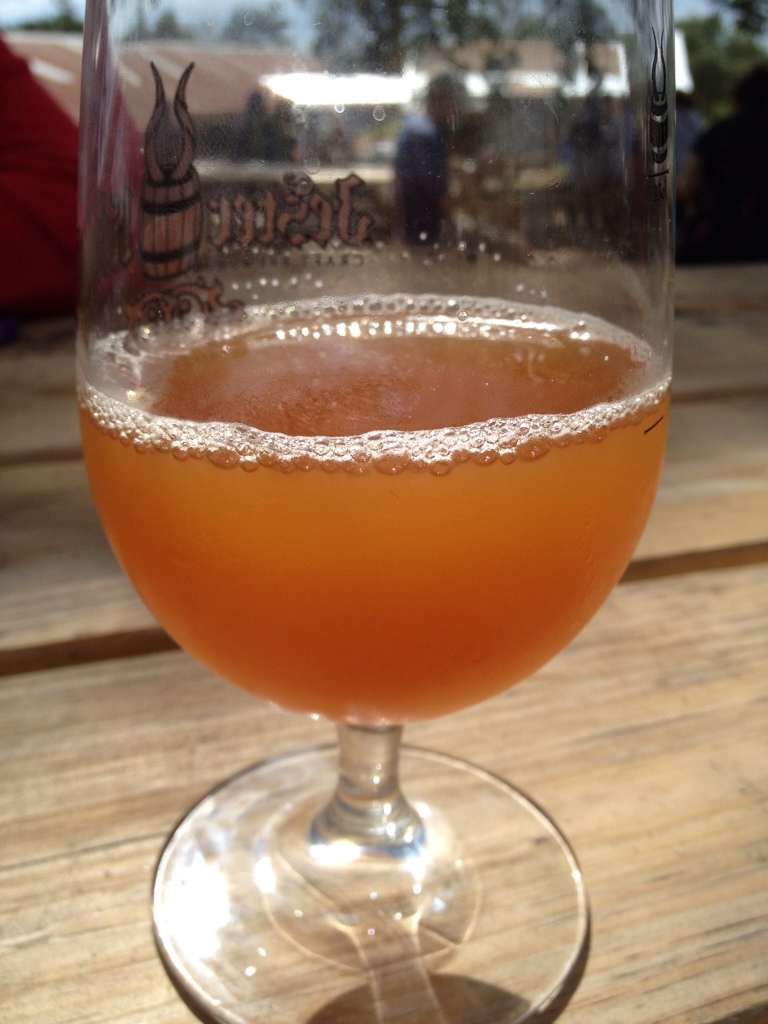
I made my way through the tastings leisurely and only got three in my 90 minutes there, but it was well worth the price of admission. Between beers I cleansed my palate with lots of free kombucha from the Buddha’s Brew tent (thanks!). Peach and Pineapple-Super Greens flavors were on tap and delicious.
I left happy (alcohol + probiotics, mmm mmm good!) and inspired. I’ve been thinking about homebrewing kombucha for a long time, and I might start soon using some Buddha’s Brew dregs to culture a starter SCOBY. Someday I actually hope to have draft kombucha in the kegerator for those non-beer occasions. I’m not sure I’ll ever use it in a beer myself, but who knows? And I toast Jester King for their innovation. After all, that’s what supporting local business is all about.
Tapping the All-Galena Pale Ale
Today I kegged the all-Galena hopped American Pale Ale I brewed on the Fourth of July. That’s 7 weeks ago, a long time even by my standards. Due mostly to my day job, I haven’t had friends over nearly enough this summer, so I didn’t have a free tap until now. The Galena APA has been sitting in the primary in the Harry Potter closet all this time.
On the spectrum of anxiety over long rests on the yeast cake, I’m in the middle. I’m not one of those homebrewers who racks off the primary after a week, and I don’t usually secondary at all. But anything longer than 4-5 weeks and I start to get a little antsy. My inner critic kicks in and I begin scolding myself for letting my busy schedule and personal inertia destroy an innocent homebrew by allowing it to age past the terminus of perfection and into the sinister, uncouth dark age of spoilage. Then I get OCD about it. I sniff my hydrometer samples for the telltale “rotting meat” and “shrimp” aromas supposedly typical of autolysis. Once my fears are quelled, I leave it for a few more days, still fearing that the next time I take a sample, it will be too late.
Yes, I could just rack to a carboy after 4 weeks, but that would risk oxidation, which I consider a much more real and terrifying bogeyman than autolysis. I won’t rack unless I intend to age for a long time.
So I’ve been wary for a couple of weeks. But when I took the last sample before kegging, the beer didn’t smell like my Uncle Brian’s backyard during one of his legendary shrimp boils, so that was a good sign. It doesn’t taste like excrement either – huzzah, bullet dodged again.
But more interesting than this tiny conquest over beer-death (hey, I take the victories where I can get ’em) was the result of the dry hopping.
I added a half-ounce of Galena pellets (12.8% AA) a week ago. I always dry hop APAs and IPAs, but especially wanted to do so this time on account of the hop aroma lost during the long rest. Galena isn’t commonly used for aroma or dry hopping from what I can tell, but reports on the Interwebs had me expecting dark fruit aroma from the dry hops.
Those reports weren’t exaggerated. There’s a definite cherry/berry aroma here. It’s deceiving for a pale ale, as it doesn’t exhibit any of the notes we typically associate with “hop-forward” beers: not floral, nor herbal, nor citrusy. But it’s enticing. Coupled with the bready malt notes of the Munich in the mash, the beer ends up smelling a little bit like cherry pie, more so like a tart blackberry cobbler.
That isn’t coming through in the flavor, but I haven’t tasted it properly (i.e., carbonated and chilled) just yet. That first pint will be one for my personal record book, I’m sure. And I’m already thinking about other ways to use Galena as a late-addition hop: as a component in a late-hopped Belgian dubbel, paired with some Special B malt; or in a dry farmhouse wheat with a little bit of rye or mahlab – yeah, I’m still jonesing to use mahlab.
This could be the start of something unorthodox and awesome. You and me, Galena, we’re goin’ places.
Tips for Retailers and Homebrewers alike
Close on the heels of the recent battle with my kegerator over the pressure of my kegs (which I’m happy to report has been stable at 8 PSI since my last post), I saw an article shared on Facebook dealing with storing and dispensing draft beer. The article, written by Julia Herz and published on craftbeer.com back in January, is here:
“Frosted Glassware Is Not Cool: Temperature Tips for Craft Beer Retailers” by Julia Herz
Ostensibly a “cheat sheet” for craft beer retailers to teach them to properly store, dispense and serve craft beer consistent with the demands of an ever-more-knowledgeable clientele of brew enthusiasts, it’s still great information for a homebrewer to have. Especially one who’s kegging and serving their homebrew on draft.
It’s also timely advice for a lot of Central Texas taprooms, now that we’re in the hottest month of the summer. Many bars here are used to serving tall frothy helpings of pee-colored American lager in frozen mugs to guys coming in off the hot asphalt and looking for something cold, wet and flavorless to slake their thirst … not knowing better, many of them assume colder is better and serve craft beer in frozen mugs too.
No.
Frozen glasses are never right for craft beer. Never. Seriously. They numb the tongue and desensitize the tastebuds. Next time you’re at a pub and you order a glass of some rare new offering from Belgium or California or Rehoboth Beach at $9 for 12 ounces, and your bartender brings it to you in a frozen glass: send it back.
I don’t care how hot it is outside. You paid premium for that beer. You deserve to taste it. And you should tell them so. Otherwise, how are they ever gonna learn?
The one thing in this article I don’t fully agree with is the assertion that all bottled and kegged beers should be kept refrigerated. For bars and pubs, maybe. They need to turn out the freshest product possible. But taken out of context and at face value, this “rule” can be interpreted too broadly.
Case in point: high-end bombers sold in groceries and liquor stores. Many beers sold in 750 ml bombers benefit from long-term storage before drinking. Brett ferments and wild ales, barrel-aged and oaked stouts/porters, barley wines, and Belgian abbey-style ales all develop interesting flavor characteristics when cellared correctly (read: cool – but not cold – and dark) for several months or more. The natural microbe and oxygen reactions that develop these flavors don’t happen at refrigerator temperatures.
But too many stores selling bombers are keeping them refrigerated, presumably in an attempt to keep these high-ticket items fresher (and sellable) longer. The problem for those of us who want to age them is that unpasteurized beers don’t respond well to going from room temp, to fridge temp, to cellar temp. It won’t turn them instantly to cat piss, but it’s not recommended. A bomber that’s been refrigerated at the store has effectively had its long-term aging potential reduced – even if you slowly raise the temperature and cellar it, it’s not going to have the shelf stability it would have had otherwise. I won’t buy refrigerated bombers unless I plan to drink them soon, and I’ve been politely informing the staff at a high-end grocery store in my neighborhood of this for several weeks. I’m sure I’m not the only one fighting this fight, and I’d hate to see this cheat sheet work against our efforts if misinterpreted.
But aside from this small split in our ideologies, I think it’s full of great information, and I hope you will too. Read, learn and enjoy. Prosit.
One Drink Minimum: Real Ale Beer Dinner at Easy Tiger (part 2 of 2)
Now that the hop-fueled insanity of IPA Day 2012 is over, back to my two-part review of last week's Real Ale Beer Dinner at Easy Tiger Bake Shop & Beer Garden. See here for Part 1.
We left off at …
Fourth Course: Scots Gone Wild Sour Real Heavy with venison liver mousse, black pepper cherry jam, arugula, country levain – The first three courses were all paired with beers made from the same Lost Gold IPA wort. The first new wort in the lineup was a single-barrel wild fermented Scotch ale. It was good, with floral and dark berry notes on the nose and a murky chocolatey red-brown color. It was tart and astringent, very refreshing and great for summer, and paired well with the very rich venison liver mousse. I love venison, though I'm not a fan of organ meat, and a quick glance around the room told me I wasn't the only one outside of my comfort zone. But with a little faith in the chef, I tucked in with an open mind, and I'm glad I did. A bite of the liver mousse spread on the levain bread with a chaser of the sour Scotch ale was fantastic, but the portion was big. I finished mine, but I saw a lot of unemptied plates.

Beer 4: Scots Gone Wild Sour Real Heavy
Fifth Course: Highlander Barrel-Aged Real Heavy with bone marrow, blood sausage, herb salad, fougasse – Before this next dish came out, the servers brought out an enormous pretzel-like bread (the fougasse, I believe). It was delicious, but there was no way the two of us at our table could fit more than a few bites in. The beer, also made from the Real Heavy wort above but aged in red wine barrels, was my least favorite of the night. It had little aroma and a bitter, medicinal flavor. After so much good beer and good food, it was a minor letdown. As for the food, this was my first time eating bone marrow, and it wasn't bad, but I preferred the blood sausage. The herb salad was very sparsely dressed, well-balanced to the strong, earthy flavors of the protein on the plate.

Beer 5: Highlander Barrel-Aged Real Heavy
Sixth Course: Vol. 15 Bourbon Barrel-Aged Russian Imperial Stout with bitter orange bread pudding, caramelized honey, figs, walnuts – Yep, you read right: Easy Tiger worked bread into the dessert as well (bravo, maestros). By this point, I was stuffed, but I finished this tasty and surprisingly light bread pudding. The beer hit all the notes one expects from a RIS, though my (perhaps desensitized) taste buds didn't taste much barrel character in the stout. And the stout may have gone better with a chocolate cake than with such a light bread pudding. After everything else, I couldn't finish the beer, and I wasn't the only one. I hate to waste, but there's only so much one can consume in an evening.

Beer 6: Vol. 15 Bourbon Barrel-Aged Russian Imperial Stout
So there you have it: a delicious dinner and a great beer flight. Easy Tiger and Real Ale truly went all out with each of their contributions and made a good team. The plating portions and the beer pours were impressive, and a great deal for $55 a head. On the other hand, smaller portions would likely have kept the appetites in the room going longer. Maybe even long enough for the less adventurous folks in the room to embrace those organ meats on the later plates.
But hey, Easy Tiger is learning as they go … and I recognize that “The portions were too big at my six-course gourmet microbrew dinner!” is totally a first-world complaint. So I'm not complaining at all. It's just an observation, and maybe will raise some awareness that could eliminate waste in the future.
As for Real Ale, I'd say they showed Austin that this now-old-standby in the local beer community still has some surprises up its sleeve. But they are bigger than the upstarts; and bigger, for a commercial brewery, means bigger risk. Smaller breweries can brew a small experimental batch and eat the cost of having to dump it if necessary, but a brewery the size of Real Ale takes a huge financial hit if they make a 60-barrel batch of something that turns out undrinkable. The trick of fermenting 3 different worts 6 different ways seems a good way for a brewery that size to experiment: if one of the beers turns out bad, there's still barrels and barrels of another beer they made from that wort they can still sell. Is that as exciting as the reckless abandon of a smaller brewery? Well, no … but it still can turn out a bunch of damn good beers, as Real Ale proved.
So thanks to Easy Tiger and Real Ale for a great night that left me happily stuffed and happily buzzed. I'm looking forward to the next one. Prosit.
A Toast To … The Second Annual #IPADay
Happy #IPADay 2012! Notice I didn’t say “hoppy”. I can be an awful punster sometimes, but not that awful.
I’ll post the second half of my review of the Real Ale Beer Dinner at Easy Tiger soon. But first, a break to celebrate the second annual IPA Day!

IPA Day started last year as a tribute to this celebrated style. From the IPADay.org website:
Founded in 2011 by beer evangelists and social media personalities Ashley Routson and Ryan Ross, IPA Day is a universal movement created to unite the voices of craft beer enthusiasts, bloggers, and brewers worldwide, using social media as the common arena for connecting the conversation together.
IPA Day is not the brainchild of a corporate marketing machine, nor is it meant to serve any particular beer brand. IPA Day is opportunity for all breweries, bloggers, businesses and consumers to connect and share their love of craft beer. It is an opportunity for the entire craft beer culture to combine forces and advocate craft beer through increased education and global awareness.
India Pale Ale has become one of the surest things in craft brew today. Once an English style, it’s taken the U.S.A. by storm in recent decades as American brewers have taken the concept across the pond and transformed it into something we can now call our own. And having had a few traditional English IPAs last year in England, I can assure you, what we call IPA in the States is a very different animal. Not necessarily better, but different.
I’ll be honest, the first time I tried an IPA I wasn’t a fan. But once I had a few proper examples, it didn’t take me too long to convert. What’s not to love? The smooth, sweet firmness of a solid malt backbone? The fresh, citrusy/floral aroma and flavor of good hops? The refreshing, clean fermentation profile?
Sure, IPA has its roots in nineteenth-century British imperialism (click here for the story if you don’t know it) … but you know what else has its roots in British imperialism? Earl Grey tea. And Freddie Mercury. Who doesn’t love Freddie Mercury? The British Empire doesn’t seem so bad now, does it?
I’ll be celebrating IPA Day with a bomber of Deschutes Hop Henge Experimental IPA and a homemade sprouted-bean curry (and a surprise Guild Wars 2 stress test, but that’s unrelated … except that I’ll be drinking IPA while I play it).
If you’re in Austin and looking for something IPAish to do today, the ladies at Bitch Beer have a running list of local IPA events here.
And if you don’t usually drink IPAs, or you don’t think you like them, why not give them another shot today?
Don’t forget to share your IPA celebrations via social media with the hashtag #IPADay. Cheers.
One Drink Minimum: Real Ale Beer Dinner at Easy Tiger (part 1 of 2)
Last week Lisa scored tickets to a beer dinner hosted by Real Ale Brewing Company at Easy Tiger Bake Shop & Beer Garden in downtown Austin.
Easy Tiger opened earlier this year on East Sixth Street, promising fresh baked-in-house breads, ample taps, and a menu that goes beyond pizza, all just down the street from the chickenpox of dive bars and music venues that dot the sidewalks of what the kids call “Dirty Sixth”. This was Easy Tiger’s first beer dinner, and it showed – mainly through oversized portions; a good problem, really – but the dishes were tasty and the pairings on the mark.
It would’ve been hard to imagine it when I first moved to Austin, but Real Ale is now the big kid on the block in Central Texas craft brew. With every new brewery that sets up shop in the region, Real Ale becomes more and more the elder statesman, and they’ve been accused of letting themselves go stale, of not pushing the envelope. (Aside from their flagship ale Firemans #4, most of their beers fall firmly in the American-British spectrum of bitter/pale ales: an APA, a rye APA, an IPA, etc. … but they do make a fantastic barleywine and some nice German seasonals.) The lineup for this beer dinner seemed carefully choreographed to prove that the old dog still has some tricks in it, and while I’m not sure I bought the routine 100%, the beers were well-made and I had a fantastic time.
Aperitif: Firemans #4 – Before the first dish came out, we started with a 6-oz pour of Real Ale’s ubiquitous flagship blonde ale. If you haven’t tasted this beer, you haven’t been to Austin. It really is everywhere, and it’s been the gateway to craft beer for frat boys and good ol’boys in this town for years (not to mention a few people I know). Call it boring; but you can’t argue with its quality, and they brought out the freshest batch I’ve ever tasted for this event. Crisp, clean taste, a nutty continental malt aroma, and a noticeable but not intimidating noble hop flavor make this a beer you can buy a case of for that stubborn Bud drinker in your family, even for your mom. And I have.
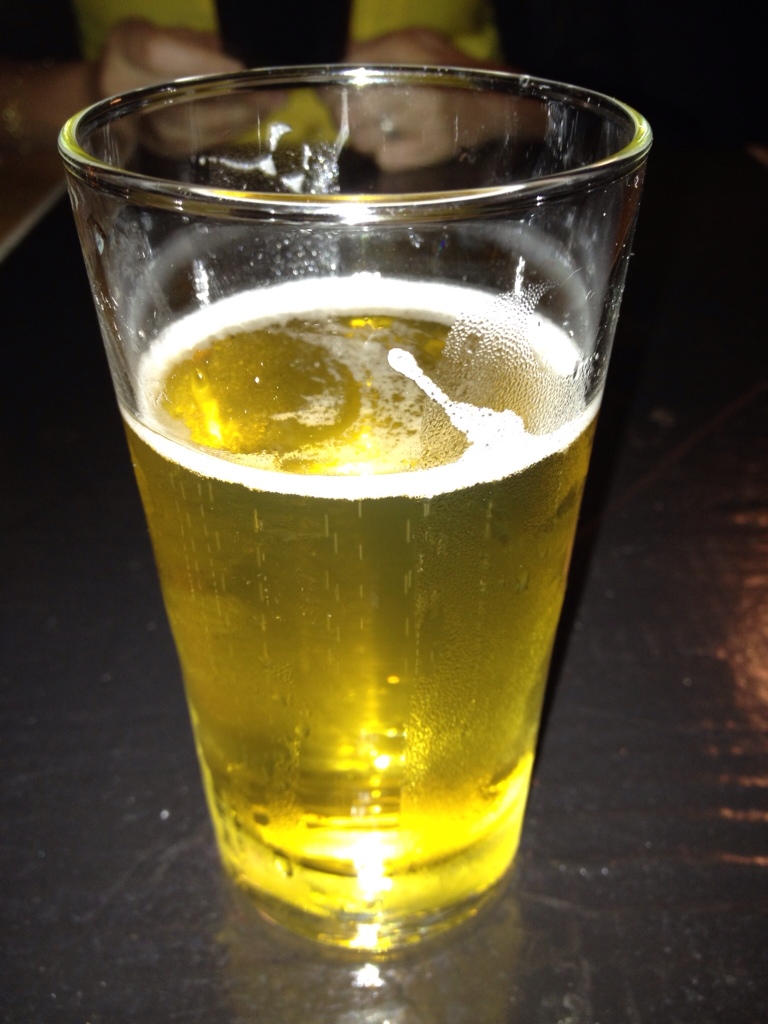
Beer 0: Firemans #4
Then the marquee lineup started: 6 dishes paired with 6 beers, about 6 ounces worth of each (cue Iron Maiden). The trick I mentioned earlier was that these 6 beers came from only 3 different “wort streams” – this was a new term to me, but basically means simply that 3 different worts were fermented under different conditions to produce 6 different beers.
First Course: Lost Gold IPA with mussels, smoked tomato, fennel, leaks baguette – Real Ale’s aptly named year-round IPA pours a deep golden color. The aroma abounds with grapefruit and floral notes. The flavor is a modest but noticeable blast of hops that doesn’t fail to refresh. It went astoundingly well with a smokey mussel stew served family-style with a whole baguette (for two). We scraped the bowl, and it was a big bowl. And all I can say about the bread is, “OMG, bread!” You can tell it’s what Easy Tiger does best.

Beer 1: Lost Gold IPA
Second Course: Empire Barrel-Aged Lost Gold IPA with duck sausage, corn pudding, watercress – The second beer made from the Lost Gold IPA wort was aged in red wine barrels that left a blanket of sour cherry fruit notes on the whole thing. The hop aroma faded with the aging, as expected, but the bitterness remained, and the beer poured enticingly murky. A hint of pungent funk from the barrel complemented the rich, earthy duck sausage. The corn pudding was light and fluffy; it complemented the sausage just fine but was easily overpowered by the beer. The disparate elements of the dish worked better separately than as a single bite.

Beer 2: Empire Barrel-Aged Lost Gold IPA
Third Course: Imperium Wild Lost Gold IPA with apricot-braised goat, local shell pea cake, mint gremolata – The third version of Lost Gold was aged in similar barrels to Empire, but wild fermentation was induced for a funkier flavor. Floral notes took center stage on this one, and it was very dry, balancing very well with another rich protein dish. The apricot balanced both the gaminess of the goat and the funkiness of the beer. By now, I was really excited about what the night had in store. I was eating great food and enjoying the results of an experiment on how one wort could become three very different beers.

Beer 3: Imperium Wild Lost Gold IPA
Check back in a few days when I post my reviews on the last three pairings of the evening, and my overall impressions. It was a delightful and insightful night.
Weizen Up
Sorry, Internet, I've been holding out on you. Weiss Blau Weiss Bavarian Hefeweizen, my experiment in simplicity that I brewed in June, has been pouring for over a week now, and I've had several pints of it already; but I haven't yet written about it. It's high time I did, so you can enjoy it vicariously as much as I've been enjoying it … well … the regular way.
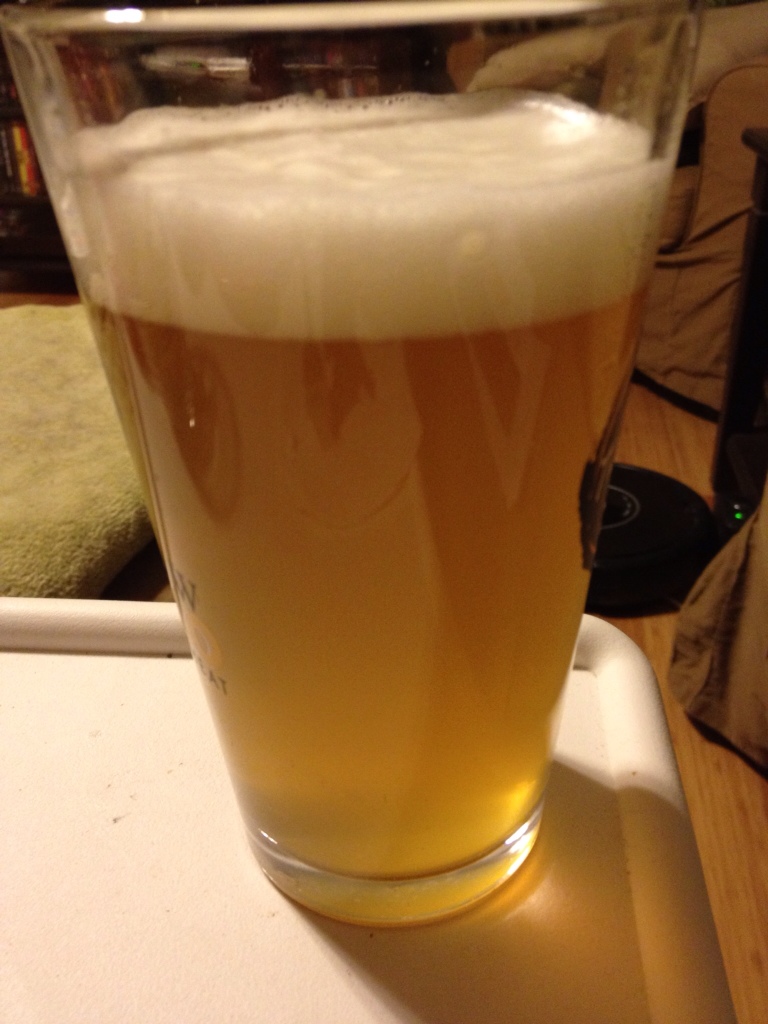
Shinin' like Rhine-gold.
It pours beautifully: a creamy golden color with a gleaming white head. It's cloudy, as a hefeweizen should be, and except for a little bit of floating sediment, it looks as good as any commercially brewed hefeweizen I've ever had. The sediment should clear up once I pour a few more pints off the keg. I did use Irish moss for this brew – as I do for most of my brews – but there are many who choose not to use kettle finings for hefeweizens, and it's possible this worked against me in that it precipitated more particles out to the bottom of the keg. But I'm sure it'll be fine in a few more pours.
The aroma is spectacular. Exactly what I wanted: lots of banana esters, a touch of the sweet, grainy aroma of crisp continental Pilsner malt, and the faintest whiff of clove spiciness. That's about it. No hops on the nose at all. Nothing confusing or muddling. You can tell instantly what ingredient created every single component of the olfactory signature of this beer.
The taste is good, too. It's light, of course, and perfect patio refreshment for my next summer brew session. The yeasty character doesn't lead in the flavor department the way I was hoping it would, not like it leads the aroma. I don't usually bother with that little slice of citrus that most brewheads outside of Bavaria are so fond of in their weizens, but I could see a lemon wedge adding something to this beer, just because it could use a bit more zing (sadly, I don't have any in the house). I don't blame the recipe for this little flaw, rather my fermentation temperature. Next time I make it, I'll ferment a couple of degrees higher for the first couple of days.
The mouthfeel is just right for a summer afternoon: refreshing, not too astringent. It goes down smooth and easy, and at 5.2% ABV is pretty session friendly.
So there you have it. Weiss Blau Weiss Bavarian Hefeweizen was an overall success, not despite its simple recipe but because of it. In fact, it seems to me that my efforts to introduce unnecessary complexity to the process – namely, using kettle finings and overchilling during fermentation – was the main thing that kept it from being (to me) a perfect beer. But that's okay; it's still plenty drinkable, and I'm sure I'll be emptying this keg pretty quickly … no complaints here, because I'd love to make it again. Can I make it even simpler next time? Probably not much so, but the lesson has been hammered home: one doesn't need a mile-long list of ingredients to make a damn good beer.
Of course, the Bavarians have been trying to tell us that for centuries.
A Toast To … Art for Brewing’s Sake
As Central Texas is plagued by thunderstorms, I'm stuck in the house enjoying the last of a bottle of Mikkeller It's Alive! Belgian Wild Ale. And I'm raising my glass virtually to Dustin Sullivan, a fellow member of the online homebrewing forum HomeBrewTalk.com, and the creator of this awesome pictorial on how to make a yeast starter.

I love brewing. I love comic art. And I love anything that's educational in a novel and interesting way. This pictorial is all three, and I'm thrilled to have stumbled onto it. I wish everything in brewing could have been explained to me so simply when I was starting out. Sure, learning as you go is 50% of the fun of brewing (another 25% is drinking the results, and the last 25% is being able to impress your friends by dropping words like “saccharification” and “attenuate” into everyday conversation) … but I'm a knowledge addict, and I'm also pathologically risk averse. So I read everything I could get my hands on when I was starting my homebrew habit, so I'd have a good idea of each step of every process before I jumped in. Sometimes, it was hard to separate the good info from the bad: to separate the clear and “just-enough” from the over-explanatory, and to separate the simple sharing of helpful information from the vomiting of brewlore all over you by guys who just want to impress you with how much they know.
Now, I love John Palmer's How to Brew and Charlie Papazian's The Complete Joy of Homebrewing. They're phenomenal books, and essential for anyone entering the hobby. But if I'd had something as simple and clear as Dustin's yeast starter pictorial for my first extract brew, my first mash, my first rack to secondary, let alone my first yeast starter, I'd have lost a lot less sleep as a newbie.
Dustin also created a yeast calculator website called YeastCalc at yeastcalc.com. It's one of the most comprehensive pitching rate calculators I've seen online for liquid yeast. It tells you not only how big of a starter to make, but also allows you to dial in a target specific gravity for your starter, and tells you how much dry malt extract to use for that target. It even has options for calculating multiple step-up starters, for that 10-gallon barleywine you've been wanting to make. I'll be using this site next time I make a starter, and I recommend you do the same.
So I’d like to raise my beer glass to Dustin Sullivan, another homebrewer out there doing his part to make brewing a little easier and simpler for the rest of us: newbies and veterans alike. Thanks, Dustin. Prosit!
Also, anyone out there who isn't yet a member of HomeBrewTalk.com, check it out. There's heaps of information there. If you have questions, it's a great place to turn; if you have answers, we always welcome new insights. And it's the most helpful, responsive and engaged online community I've ever been a part of. If you join, look me up. My username is shawnbou and I'd love to hear from you.
 Posted with Blogsy
 myBrewHome