
On-Tap Recap: Beers for the aging former headbanger
I was a metal kid in the late 80’s. Although I liked the music, it was the album art that drew me in. Iron Maiden, Dio, Ozzy, any album with demons or creepy magical glyphs on the cover was fair game for my tape collection when I was about twelve. See, back in the late 80’s before Viggo Mortensen and Peter Dinklage, it was hard out there for fantasy geeks. We didn’t strut proudly down the street shaking our D&D dice in their little bag, shouting about how geeky we were to passersby. Just being seen with a paperback of The Lord of the Rings was enough to get your ass kicked. But wearing a T-shirt or pin with album art from a metal band was, if not exactly “cool”, at least likely to scare people away so they’d leave you alone. It was a subtle way to get your geek on while people around you just assumed you were into something more socially acceptable than fantasy, like consuming heavy drugs or worshipping Satan.
The parental shock value of the album art was a factor as well. As an honor-roll student in the suburbs of a southern American city, there were few ways I could terrify my parents more than by hanging a life-size poster of Iron Maiden’s mascot Eddie the Head next to my bed, where it hung for almost ten years. My wife – who has been with me since we were teenagers – still has fond memories of that poster, recalling our first evenings as a couple (studying, always studying) under the leering visage of Eddie in his Somewhere in Time cyborg form. And they say teenage boys know nothing of romance.
Today is the twentieth anniversary of my first date with that wonderful woman I married, so I’m celebrating the past by recapping two beers that I think the twelve-year-old me who bought that poster would be proud of.
Eddie himself stars in my first tasting, snarling at me in 19th-century dragoon uniform from the label of a pint-sized bottle of Trooper by Robinsons Brewery, named for – and featuring the art from the 1983 single release of – the Iron Maiden song “The Trooper”.

Billed by Robinsons as a hand-crafted real ale “developed” by Maiden frontman Bruce Dickinson with “true depth of character”, it sounded about right for my taste. It poured a deep orange-gold with a thicker head than I expected, with the brassy, crackery aroma I love in an English ale. The taste was fine, a little astringent and earthy with a hint of slick, oily mouthfeel like one gets with oats in the grain bill, though I don’t know if there were any in this one. I don’t know about “true depth of character” but it was a pleasant enough pint at a sessiony 4.7% ABV. A friend of mine who is both a homebrewer and an Iron Maiden obsessive described the beer as “not as good as you want it to be”, and that was true. It’s a gimmick, plain and simple, and I bought into it; the beer was pleasant but not as remarkable as the song it’s named for. I could drink it again, but would rather drink my own English-style homebrew … though I will save the bottle.
Drawn in a style reminiscent of a seventeenth-century woodcut, a three-headed demon towers over a burning sea of tortured mortals beneath a ring of runes and glyphs on the label of Blakkr Imperial Black Ale, a collaborative brew between the self-proclaimed “unholy trinity” of Three Floyds Brewing in Indiana, Surly Brewing in Minnesota, and Real Ale Brewing in Central Texas, brought together by their “love of brewing and love of metal”. The black double IPA is available in 4-packs of – what else? – metal cans. Twelve-year-old me would totally have worn a pin of this label on his jean jacket.
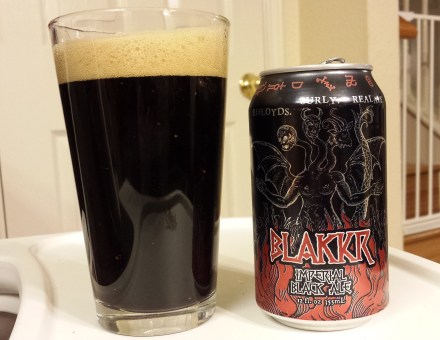
How’s the beer? Well, it’s black. With a thick beige head and a citrus aroma that leans towards bitter orange and lime. But it’s surprisingly drinkable for an imperial brew with an ABV of 9%. I don’t find it syrupy at all. There’s a crisp bitterness on the front end from traditional American pale ale hops, though as I empty the glass and my palate becomes fatigued, I notice the hops less and the roastiness of black malts comes to the foreground, like a dessert of dark chocolate cake after a pungent salad. But for all that, the beer isn’t that memorable. It’s tasty, and I would drink it again (good thing since I have three more) but I’m not sure that it lives up to the awesomeness of the label art.
Which means we have a trend here. Wicked art that satisfies your inner twelve-year-old and tie-ins with your favorite metal band are neat, but only get you so far in craft beer. Both beers could have been worse, but could have been better. I’ve learned I’ll buy a beer once on a gimmick, but I won’t rush out and buy it again. And it seems that you can’t judge a beer by its label.
A taste of local at the Texas Craft Brewers Festival
Fiesta Gardens in East Austin was the hoppiest place in town on October 6 as about two dozen breweries from all over Texas gathered for the annual Texas Craft Brewers Festival, sponsored by the Young Men’s Business League of Austin. Featuring over 115 beers, the event promised to be a carnival of discovery. I walked through the gates holding my tasting glass eagerly, like an explorer taking his first steps on a newly discovered shore with a trusty saber in hand.
The format was a familiar one: a booth from each brewery in attendance (arranged in alphabetical order, wow) offering pours of their most popular and/or most interesting beers. $20 bought admission, a 4 oz. plastic tasting glass and six tickets, with additional tickets available for purchase at two for $3. Most of the pours cost one ticket, with some of the rarer/higher-gravity offerings going for two.
I sprung for the $65 VIP pass. It didn’t come with any additional tickets (bummer), but I did get a T-shirt and imperial pint glass along with noon entry, two hours before everyone else. The early entry was worth it, because the place got nuts at 2:00 when the gates opened to general admission. VIP’s also got a “meet-and-greet” round robin tasting in the main pavilion from 1:00 to 2:00. Brewers and brewery representatives walked around the pavilion with pitchers, pouring samples and answering questions.
I love talking to brewers who have a real passion for brewing. The ones who are visibly energized by talking to kindred spirits. The ones whose eyes light up when asked why they chose one yeast strain over another, or who get excited when you taste something subtle in the beer that they were specifically trying for. They’re the stewards of our community, the true shamans of our tribal craft brew culture. I’d especially like to thank Jeff Stuffings of Jester King Craft Brewery, Diane Rogness of Rogness Brewing Company, Jud Mulherin of Circle Brewing Company and Grant Wood of Revolver Brewing Company for stopping for a few minutes on a busy day to talk to me – one of many admirers clamoring for their time – about their ingredients, their craft, and why they do what they do.
The beers themselves presented a fascinating snapshot of where Texas craft brew is today. Several things became apparent over the course of the day:
- Sour beer no longer a thing? The event website boasted “at least four sours”. That’s a much smaller number than I would have predicted a year ago, when sours were seemingly the next big wave in craft brewing. But now it seems Texas brewers are looking elsewhere for innovation. Real Ale Scots Gone Wild and Austin Beerworks Einhorn Berliner Weisse were on tap along with some sours from Jester King, but I didn’t see anything on the menu that I hadn’t tried before. I made a beeline to the Jester King booth for what I thought was a new sour – the Viking-inspired Gotlandsdricka – and got a surprise. Jeff Stuffings informed me his Gotlandsdricka was intended to be a modern interpretation, not a historically accurate recreation of the ancient ale, and was clean-fermented with just Saccharomyces cerevisiae. I’m a sucker for anything Nordic, and I liked it a lot, but I’m still curious to taste the sour version they may release in a few months.
- Flavorings are where it’s at. For a region so rich in German heritage, Texas brewers sure don’t know the meaning of Reinheitsgebot. Spices and fruits abounded. Rogness OST Porter with coffee and coconut and Yogi Amber with chai spice, Thirsty Planet ChiGoatle Amber with peppers, Revolver Blood & Honey Wheat with blood orange zest and spices, and Jester King Gotlandsdricka with sweet gale and juniper all made impressions on me. Even Reinheitsgebot champions Circle Brewing have jumped into the flavor fray with Smokin’ Beech, a refreshing Rauchbier with a bacony character from malt beechwood-smoked according to a traditional Bamberg process that Jud Mulherin described to me in reverent detail.
- Tea is the new coffee. Coffee porters and stouts remain popular, but Texas brewers are starting to notice coffee’s hot stepsister from across the ocean, with very different takes on the concept. Live Oak poured an Oaktoberfest infused with lapsang souchong China black tea, lending a vegetal smokiness tailored for slow sipping. Jester King poured their kombucha farmhouse ale Buddha’s Brew. Rogness Yogi Amber doesn’t actually have tea in it, but recreates the experience of chai tea in an amber beer with chai spices and unfermentable sugars. Diane Rogness called Yogi “her baby”, and she should be proud of it. I enjoyed drinking it and have thought about it a lot since Saturday.
- Dallas-Fort Worth is growing. Lakewood Brewing and Revolver Brewing are two names from the Metroplex that seem to have made their Austin debut at the event, alongside DFW stalwarts Deep Ellum and Southern Star. I didn’t get a chance to try Lakewood (sorry!) but Revolver’s Blood & Honey Wheat is a surprisingly complex lawnmower beer with blood orange zest and savory spices. Head brewer Grant Wood invited me to guess which spices he used. I guessed incorrectly, and when I pressed him for the correct answer, he said smiling, “We’ve gotta have some secrets.” Touché.
Finally, the day brought great news to the mead lover in me. I had a chance to speak to Eric Lowe of Meridian Hive Meadery, a new Austin company getting their brewhouse (meadhouse?) assembled currently, and who will hopefully be releasing their first meads in early 2013. There’s a mead gap in Austin, and I welcome them with open arms and a thirsty palate.
Photos of the event are below (including one of your friend and humble narrator in a yellow shirt), courtesy of Roy Moore and Control Images. Thanks to the YMBL and all who made the event what it was.


Fantastic Fest 2012 in review: beer, free beer, and a movie or two
Fantastic Fest 2012 is now a happy week-old memory. I saw 33 films from September 20-27 and emptied more than a few pint glasses. My highlights from the festival are below:
Day 1 – My Fest started with Tim Burton’s Frankenweenie in 3D. But that wasn’t until 6pm, so before the show, I had lunch at Bangers Sausage House & Beer Garden, where I enjoyed two barrel-aged Texas beers: Bourbon Barrel Alt-eration from Hops & Grain, and Real Ale Shipwrecked (aged in Jameson barrels for extra deliciousness) with an antelope and venison merguez sausage in honor of the reanimated pooch. Once I got to the Alamo Drafthouse Cinema for the movie, I found myself in the Shiner-sponsored theater, and enjoyed a free Shiner Bock. But my favorite film that day was Antiviral from Canadian director Brandon Cronenberg – son of film legend David Cronenberg (The Fly, Videodrome), and worthy of his father’s directorial legacy.
Day 2 – Two major highlights: The Conspiracy, also from Canada, which I watched with a couple of pale ales: an Austin Beerworks Fire Eagle IPA and a Shiner Wild Hare Pale Ale. Later that night, a friend and I got to the bottom of a pitcher of Real Ale Firemans #4 while watching Dead Sushi, the latest from Japanese director Noboru Iguchi. Iguchi’s shock/splatter/gross-out horror-comedies aren’t for everyone, but I find them great fun; and Dead Sushi is one of the better ones. Before the screening was a live in-theater eating competition between Iguchi, SFX guru Yoshihiro Nishimura and four audience members eating bull penis sushi, duck fetuses and ghost pepper tuna roll. Kudos to them; I couldn’t do it.
Day 3 – A great day. I sipped a Ranger Creek Small Batch #2 saison during Holy Motors by French director Leos Carax, a dense and symbolic film that begs rewatching. Next I saw the brutal yakuza revenge sequel Outrage Beyond by Japan’s Takeshi Kitano (a.k.a. Beat Takeshi), which went well with a Brooklyn East India Pale Ale. I watched an English-language remake of Pusher (the Danish original was the directorial debut of Drive and Bronson director Nicolas Winding Refn) with a Live Oak Oaktoberfest in hand, and I enjoyed another Firemans #4 at midnight during my most anticipated movie of the festival, the kung-fu-steampunk epic Tai Chi 0. All these movies made it into my top fifteen of the fest, and I’m still thinking about that Ranger Creek saison.
Day 4 – Started with my initial pick for best of the fest, Lee’s Adventure, a Chinese sci-fi film starring Jaycee Chan (son of Jackie) as a slacker-gamer with a disease that randomly slows and speeds his perception of time. China scored again in the evening with the aptly titled Vulgaria, a crude comedy about a Hong Kong softcore porn producer that kept me laughing out loud. At midnight, I saw the awesome British action-comedy Cockneys vs. Zombies, whose title pretty much says it all. I watched that with my favorite beer of the day, a Deschutes Obsidian Stout that was perfect for a midnight show.
Day 5 – The standout film was Black Out, a Dutch crime caper that played like classic Guy Ritchie. Day 5 is usually when I start to get bleary-eyed and need rest; unsurprisingly, I have no beer notes from this day. I recall drinking one or two Fire Eagle IPAs and at least one Hops & Grain Pale Dog Pale Ale.
Day 6 – My evening film was Vanishing Waves, a sci-fi thinker from Lithuania. There’s always at least one quiet, sterile and cerebral sci-fi film at the Fest every year, and whatever it is usually ends up in my top ten. This was no exception, and it inspired me to dig up and finish an incomplete short story I drafted last year (hooray for inspiration!). I watched it with a Thirsty Planet Buckethead IPA.
Day 7 – The penultimate night of the Fest brought me Hellfjord, by far the most fun I had all week. A new series from from a team of brilliant Norwegians (including writer Tommy Wirkola, director Patrik Syversen and writer-stars Zahid Ali and Stig Frode Henriksen) whose combined resume includes the zom-com Dead Snow and the geek comedy You Said What?, Hellfjord touted itself as Twin Peaks-meets-Hot Fuzz, and that’s pretty spot on. The complete first season screened – seven episodes – and I simply could not stop laughing during the entire three and a half hours. “Brilliant” doesn’t begin to describe this series. It was my definitive Best of the Fest. I’m counting the months until it may someday be released on American DVD, and if you have any sense of humor at all, you should look for it too. I also finished off another pitcher of Firemans #4 (with help) and had a spectacular barbecue chicken pizza with jalapenos before heading to the Hellfjord Norwegian Party at the Highball, where friends and I donned Viking helmets and drank Austin Beerworks Black Thunder Schwarzbier with samples of lutefisk and other pickled Nordic delicacies. And the mighty Thor smiled down upon us.
Day 8 – Somewhat anticlimactic after Day 7, but started with the poignant, entertaining Canadian drama I Declare War, about kids playing a game of war that skirts dangerously close to the real thing. After a couple of underwhelming afternoon screenings, I ended the day with a few complimentary Shiner Wild Hare Pale Ales at the Closing Night Party at the Austin American Legion hall.
So there you have it. Seven days have passed and I’m already looking forward to next year’s Fantastic Fest. There’s a reason we call it “geek Christmas” in my house. It’s a time to celebrate film, storytelling, inspiration, good friends, good food and good beer. And these are a few of my favorite things.
One Drink Minimum: Real Ale Beer Dinner at Easy Tiger (part 2 of 2)
Now that the hop-fueled insanity of IPA Day 2012 is over, back to my two-part review of last week's Real Ale Beer Dinner at Easy Tiger Bake Shop & Beer Garden. See here for Part 1.
We left off at …
Fourth Course: Scots Gone Wild Sour Real Heavy with venison liver mousse, black pepper cherry jam, arugula, country levain – The first three courses were all paired with beers made from the same Lost Gold IPA wort. The first new wort in the lineup was a single-barrel wild fermented Scotch ale. It was good, with floral and dark berry notes on the nose and a murky chocolatey red-brown color. It was tart and astringent, very refreshing and great for summer, and paired well with the very rich venison liver mousse. I love venison, though I'm not a fan of organ meat, and a quick glance around the room told me I wasn't the only one outside of my comfort zone. But with a little faith in the chef, I tucked in with an open mind, and I'm glad I did. A bite of the liver mousse spread on the levain bread with a chaser of the sour Scotch ale was fantastic, but the portion was big. I finished mine, but I saw a lot of unemptied plates.

Beer 4: Scots Gone Wild Sour Real Heavy
Fifth Course: Highlander Barrel-Aged Real Heavy with bone marrow, blood sausage, herb salad, fougasse – Before this next dish came out, the servers brought out an enormous pretzel-like bread (the fougasse, I believe). It was delicious, but there was no way the two of us at our table could fit more than a few bites in. The beer, also made from the Real Heavy wort above but aged in red wine barrels, was my least favorite of the night. It had little aroma and a bitter, medicinal flavor. After so much good beer and good food, it was a minor letdown. As for the food, this was my first time eating bone marrow, and it wasn't bad, but I preferred the blood sausage. The herb salad was very sparsely dressed, well-balanced to the strong, earthy flavors of the protein on the plate.

Beer 5: Highlander Barrel-Aged Real Heavy
Sixth Course: Vol. 15 Bourbon Barrel-Aged Russian Imperial Stout with bitter orange bread pudding, caramelized honey, figs, walnuts – Yep, you read right: Easy Tiger worked bread into the dessert as well (bravo, maestros). By this point, I was stuffed, but I finished this tasty and surprisingly light bread pudding. The beer hit all the notes one expects from a RIS, though my (perhaps desensitized) taste buds didn't taste much barrel character in the stout. And the stout may have gone better with a chocolate cake than with such a light bread pudding. After everything else, I couldn't finish the beer, and I wasn't the only one. I hate to waste, but there's only so much one can consume in an evening.

Beer 6: Vol. 15 Bourbon Barrel-Aged Russian Imperial Stout
So there you have it: a delicious dinner and a great beer flight. Easy Tiger and Real Ale truly went all out with each of their contributions and made a good team. The plating portions and the beer pours were impressive, and a great deal for $55 a head. On the other hand, smaller portions would likely have kept the appetites in the room going longer. Maybe even long enough for the less adventurous folks in the room to embrace those organ meats on the later plates.
But hey, Easy Tiger is learning as they go … and I recognize that “The portions were too big at my six-course gourmet microbrew dinner!” is totally a first-world complaint. So I'm not complaining at all. It's just an observation, and maybe will raise some awareness that could eliminate waste in the future.
As for Real Ale, I'd say they showed Austin that this now-old-standby in the local beer community still has some surprises up its sleeve. But they are bigger than the upstarts; and bigger, for a commercial brewery, means bigger risk. Smaller breweries can brew a small experimental batch and eat the cost of having to dump it if necessary, but a brewery the size of Real Ale takes a huge financial hit if they make a 60-barrel batch of something that turns out undrinkable. The trick of fermenting 3 different worts 6 different ways seems a good way for a brewery that size to experiment: if one of the beers turns out bad, there's still barrels and barrels of another beer they made from that wort they can still sell. Is that as exciting as the reckless abandon of a smaller brewery? Well, no … but it still can turn out a bunch of damn good beers, as Real Ale proved.
So thanks to Easy Tiger and Real Ale for a great night that left me happily stuffed and happily buzzed. I'm looking forward to the next one. Prosit.
One Drink Minimum: Real Ale Beer Dinner at Easy Tiger (part 1 of 2)
Last week Lisa scored tickets to a beer dinner hosted by Real Ale Brewing Company at Easy Tiger Bake Shop & Beer Garden in downtown Austin.
Easy Tiger opened earlier this year on East Sixth Street, promising fresh baked-in-house breads, ample taps, and a menu that goes beyond pizza, all just down the street from the chickenpox of dive bars and music venues that dot the sidewalks of what the kids call “Dirty Sixth”. This was Easy Tiger’s first beer dinner, and it showed – mainly through oversized portions; a good problem, really – but the dishes were tasty and the pairings on the mark.
It would’ve been hard to imagine it when I first moved to Austin, but Real Ale is now the big kid on the block in Central Texas craft brew. With every new brewery that sets up shop in the region, Real Ale becomes more and more the elder statesman, and they’ve been accused of letting themselves go stale, of not pushing the envelope. (Aside from their flagship ale Firemans #4, most of their beers fall firmly in the American-British spectrum of bitter/pale ales: an APA, a rye APA, an IPA, etc. … but they do make a fantastic barleywine and some nice German seasonals.) The lineup for this beer dinner seemed carefully choreographed to prove that the old dog still has some tricks in it, and while I’m not sure I bought the routine 100%, the beers were well-made and I had a fantastic time.
Aperitif: Firemans #4 – Before the first dish came out, we started with a 6-oz pour of Real Ale’s ubiquitous flagship blonde ale. If you haven’t tasted this beer, you haven’t been to Austin. It really is everywhere, and it’s been the gateway to craft beer for frat boys and good ol’boys in this town for years (not to mention a few people I know). Call it boring; but you can’t argue with its quality, and they brought out the freshest batch I’ve ever tasted for this event. Crisp, clean taste, a nutty continental malt aroma, and a noticeable but not intimidating noble hop flavor make this a beer you can buy a case of for that stubborn Bud drinker in your family, even for your mom. And I have.
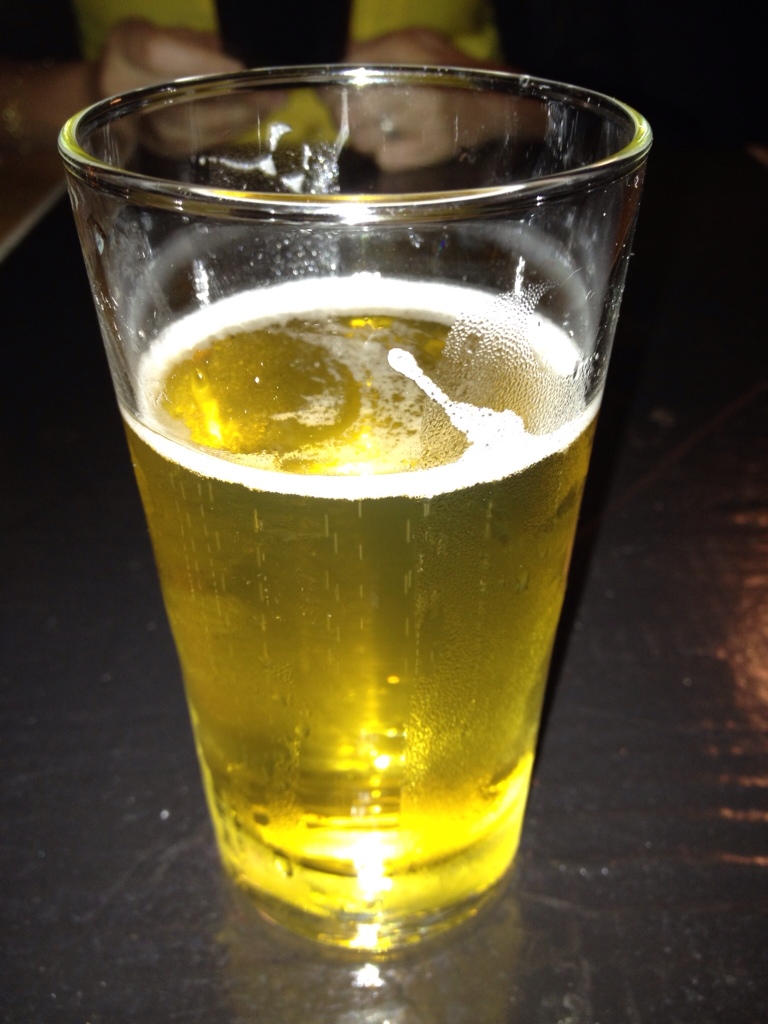
Beer 0: Firemans #4
Then the marquee lineup started: 6 dishes paired with 6 beers, about 6 ounces worth of each (cue Iron Maiden). The trick I mentioned earlier was that these 6 beers came from only 3 different “wort streams” – this was a new term to me, but basically means simply that 3 different worts were fermented under different conditions to produce 6 different beers.
First Course: Lost Gold IPA with mussels, smoked tomato, fennel, leaks baguette – Real Ale’s aptly named year-round IPA pours a deep golden color. The aroma abounds with grapefruit and floral notes. The flavor is a modest but noticeable blast of hops that doesn’t fail to refresh. It went astoundingly well with a smokey mussel stew served family-style with a whole baguette (for two). We scraped the bowl, and it was a big bowl. And all I can say about the bread is, “OMG, bread!” You can tell it’s what Easy Tiger does best.

Beer 1: Lost Gold IPA
Second Course: Empire Barrel-Aged Lost Gold IPA with duck sausage, corn pudding, watercress – The second beer made from the Lost Gold IPA wort was aged in red wine barrels that left a blanket of sour cherry fruit notes on the whole thing. The hop aroma faded with the aging, as expected, but the bitterness remained, and the beer poured enticingly murky. A hint of pungent funk from the barrel complemented the rich, earthy duck sausage. The corn pudding was light and fluffy; it complemented the sausage just fine but was easily overpowered by the beer. The disparate elements of the dish worked better separately than as a single bite.

Beer 2: Empire Barrel-Aged Lost Gold IPA
Third Course: Imperium Wild Lost Gold IPA with apricot-braised goat, local shell pea cake, mint gremolata – The third version of Lost Gold was aged in similar barrels to Empire, but wild fermentation was induced for a funkier flavor. Floral notes took center stage on this one, and it was very dry, balancing very well with another rich protein dish. The apricot balanced both the gaminess of the goat and the funkiness of the beer. By now, I was really excited about what the night had in store. I was eating great food and enjoying the results of an experiment on how one wort could become three very different beers.

Beer 3: Imperium Wild Lost Gold IPA
Check back in a few days when I post my reviews on the last three pairings of the evening, and my overall impressions. It was a delightful and insightful night.
 myBrewHome