
Gluten Tag
The May/June 2012 issue of Zymurgy magazine includes an article entitled “Secrets of Gluten-Free Brewing”, by BellaOnline beer and brewing editor, Carolyn Smagalski. In it, she gives tips to homebrewers on ingredients for true gluten-free beers, and reports on gluten-free offerings from a number of commercial breweries including Strange Brewing Company in Denver and Dock Street Brewery in Philadelphia. Even Dogfish Head’s Sam Calagione, ever the zymurgic Rick O’Connell, has adventurously entered the gluten-free ring with Tweason’ale, a champagne-like beer with sorghum, buckwheat honey, molasses, and strawberries.
It’s a great article, and interesting because I’ve always been curious about gluten-free brewing. First of all, I must stress that I am not a physician, nor am I an expert on gluten, gluten-free brewing, or food allergies and I cannot attest to the safety of any ingredient mentioned in this article. Please check with your physician before brewing or drinking a beer made with any ingredient mentioned here.
I don’t suffer from celiac disease, wheat allergies or any other kind of gluten intolerance. But I have friends who do, and I know it must be hard. What if my doctor ever told me I couldn’t drink beer anymore? What would I do? I could always put more energy into cider and mead, but beer is really my passion as a zyme lord. So my empathy glands pulsate to make good beer my gluten-free friends can drink, even though none have asked.
(Let’s ignore the question of “What if my doctor ever told me I couldn’t drink any alcohol anymore?” … but the answer, sadly, is: “Fetch the razor blades while I run the bathwater,” because to quote the immortal Buddy Holly, that’ll be the day when I die.)
Because gluten is present in most common grains, the key to gluten-free brewing is finding alternative sources of fermentable sugar. Barley, wheat, rye, oats and even spelt are off the table. But sorghum, buckwheat, corn, rice, millet, and quinoa are recommended alternatives. These grains may not yield as much sugar as brewers are used to, so it’s common to add other fermentables as well, such as honey or corn syrup. Hops are gluten-free, but yeast should be carefully selected, since most of them are grown in traditional barley wort (Lallemand’s Danstar beer yeast and Lalvin wine yeast product lines are listed by Smagalski as gluten-free, being grown in potato starch).
While sorghum has been used in gluten-free beers for years now, it’s notorious for being kinda … well, awful. I’ve never had one, but I’ve also never heard of anyone drinking a sorghum beer by choice. But other grains Smagalski listed were inspirations to me. I eat quinoa about twice a week, and would love to try it in beer. I don’t know much about buckwheat, but have been thinking about buckwheat honey in a mead: why not a gluten-free braggot of buckwheat and buckwheat honey?
There’s also a recipe for a chestnut beer in the article. Apparently chestnut starch can be converted to sugar, but must be “mashed” for 12 hours with added amylase enzyme powder – they don’t have enough diastatic power on their own. 12 hours is a long mash to start a brew day, but this might be a worth while experiment. Even without a specific need in my household for gluten-free beer, I smell a possible holiday brew in the cards. “Chestnuts Steeping in an Open Mash Tun Holiday Ale”? It’s catchy.
Anyone out there brewing gluten-free beers? I’d love to hear from you, as this is something I really want to explore. Who’s up for an adventure?
The Jester just got bester
As of this past Tuesday, Jester King Craft Brewery in Austin is now certified organic by the USDA, according to this press release on their website.
To quote the release:
The first of our beers to carry certified organic labeling will be this year’s version of Drink’in the Sunbelt Hoppy Wheat Beer, followed by our next batches of Mad Meg Farmhouse Provision Ale and Boxer’s Revenge Barrel-Aged Wild Ale. Le Petit Prince Farmhouse Table Beer, Noble King Hoppy Farmhouse Ale, Wytchmaker Farmhouse Rye IPA, Das Wunderkind! Sour Saison, and Bonnie the Rare Berliner Weisse also received full organic certification and will be labeled as such once we run through our current stock of labels. Black Metal Farmhouse Imperial Stout, which is over 70% organic, but uses a small amount of non-organic specialty malt, has been certified “Made with Organic Ingredients” and will carry the Texas Department of Agriculture seal, the next time labels are printed.
Although I may be more organic than some, I’m not really hung up on the organic lifestyle and organic foods. Sure, I belong to a local organic CSA called Johnson’s Backyard Garden. I don’t eat at major fast food chains (or any major restaurant chain at all if I can avoid it, which I usually can – thanks, Austin!). I try not to buy packaged foods with a lot of ingredients I can’t pronounce, but that’s a long way from organic. When it comes to my own brewing, I don’t add a lot of funky chemicals if I can help it – brewing water salts and acids to keep my mash pH down are generally the extent; I don’t spend the extra dough for organic malts and hops. In other words, whether food or drink, I keep it simple for anything I can control, and I don’t sweat the other stuff too much.
But who wouldn’t want to know that the ingredients that go into the beer they drink is of the best quality possible? Whether that means organic, or locally sourced, or whatever your personal hobbyhorse is, the fact that they bother at all means that they have a commitment to quality ingredients: that they care what they put into the beer they sell. That they’re not just here for the craft beer fad, and that they want to establish (and strengthen) their identity in the ever-more-crowded local Austin beer scene.
And that is great news, and a reminder of why I love the folks at Jester King so much. As far as I’m concerned, one of the best breweries in town just got better. I like to think that each of the best local breweries in Central Texas has a knack for something (see recent post here for my thoughts on the awesome power of Live Oak Brewing to replicate classic German styles). I always thought Jester King’s knack was simply to bring European-style farmhouse ales to a market otherwise lacking in them. But now Jester King appears to be doing more: with this gesture, they’ve demonstrated they want to be a leader in quality and innovation in all ways (including taking on the Texas Alcoholic Beverage Commission late last year over some silly beer labeling and distribution laws) in the Austin craft beer community. If there’s a battle commencing between great beer and mediocre beer, Jester King appears to want to be in the vanguard … they may not have been the first, but they seem determined to jump into the lead.
So prosit to Jester King! I’m glad they’re here.
A Crescent City Concoction, part 2
On Monday I finally kegged my Crescent Moon Café au Lait Stout after 4 weeks in the fermenter. I also finally added the eponymous coffee to the beer, crossing the line from a plain old milk stout (albeit one made by my own from-scratch recipe) into something truly unique.
The coffee and chicory was cold brewed on Lisa’s Toddy system: combining a pound of ground coffee with 9 cups of cold water, and letting it steep overnight, we brewed about 40 oz of concentrated coffee extract. Theoretically, this coffee extract is stronger than regular brewed coffee, but when we mixed a little bit of the extract with a sample of the beer at the planned ratio of 16-24 oz of coffee and chicory per 5 gallons of milk stout, there just wasn’t nearly enough coffee flavor. So we ramped it up, added more and more coffee until we got to a point where we were happy. The ratio we landed on was 64(!) oz of extract in the 5 gallon batch of beer. That’s a lot more than any coffee/beer recipe I’ve ever seen, but I let my tastebuds do the deciding. And I did want a bold coffee flavor.
The extract was added directly to the keg, and the beer was racked on top of that. This displaced a half gallon of the beer, so we ended up with .5 gallons of coffee extract to 4.5 gallons of beer, or a ratio of 1 part coffee to 9 parts stout. What I sampled really did taste like café au lait, so I’m pleased. Now it’s carbonating in the kegerator, and will be ready to drink in a few days.
This beer has made me feel like being a newbie homebrewer all over again: The anxious counting of day after day while I wait for the beer to be ready. The adventurous experimentation. The excitement over the unknown. If these phrases sound like ways to describe a brand new romance, it’s no accident. I’m in love with homebrewing, and this stout has reminded me why I fell in love with it in the first place. I want more of this thrill.
With June nearly upon us, I’ll look to a wheat beer for my next brew, as they’re much more forgiving to make in the heat of a Central Texas summer, even in my air-conditioned home. I’ve talked about a blood orange or other citrus wheat for a while now. I could resurrect one of my wheats from previous summers – lemongrass, ginger, or agave – but the wanderlust of experimentation is consuming me, and I think I’m itching for something new.
Read my original post about the recipe and brew day for the café au lait stout here.
From the Cellar: Showdown! Commercial vs. Homebrewed Smoked Porter
For this edition of From the Cellar, I opened a bomber of Ranger Creek Mesquite Smoked Porter (6.4% ABV) and pitted it head-to-head against my own homebrewed porter currently on tap: Smokey in a Plain Wrapper Rauch Porter (6.0% ABV).
Smoked porter or rauch porter is one of those style variations that seems to be springing up in all sorts of places spontaneously. Granted, Stone has had their version on the market for over 15 years now, so it’s possible we all got the same great idea from them. But it is a great idea. The astringency and bite of smoked malt plays well against the sweet and malty backdrop of a porter malt bill, giving complexity without having to resort to a ton of hops in the boil. It gives a flavor akin to stout without the sharp roasted barley notes that are so common (though not necessarily required) in a stout. So yeah, I’m a fan; and I was dying to know how one of my own brews stacked up against a commercial offering from one of my favorite up-and-comers in the Central Texas craft beer scene.
I poured a blind tasting of both beers and tried them side by side. I didn’t know which was which until after I had written down all of my notes. Picking a clear winner was tough, so I just judged each on its merits and avoided trying to score them (though I did have a personal favorite).

Beer A
Beer A was nearly black with chocolate brown notes, and tiny bubbles with not a lot of head retention. The nose had some slight but noticeable fruity esters over dark chocolate and coffee. The aroma of smoke was present, but not obvious.

Beer B
Beer B had a much more persistent head and was completely black with bigger and rockier bubbles. There was a distinct woodsy scent and a smell not entirely unlike good Texas barbecue. But the beer had a boozy smell, like it was barrel-aged, which would be a surprise. The thick head and carbonation would suggest that if it was aged, it wasn’t aged for any considerable length of time.
As for the flavor, I generally preferred Beer A even though Beer B was arguably a better crafted brew and a better example of a rauch porter. Beer A was full of dark chocolate and vanilla flavor, with a slight amount of esters and very little smoke. But it was refreshing and easy to drink, and ultimately really satisfying. Beer B was cleaner fermented, but the smoke really, really dominated the flavor … to the point of being almost too much for me. There was some leather and wood in Beer B, but really it was all about the smoke. It was drier than Beer A, but less refreshing because of the harsh, aggressive character I found the smoke imparted.
Within seconds of tasting, I knew which one was mine. Smokey in a Plain Wrapper has been on tap in my kegerator for a couple of months, so I know it pretty well and could pretty much tell it was Beer A. The Ranger Creek Mesquite Smoked Porter was Beer B.
So while the results weren’t shocking, they were very informative. My homebrew was more estery and with less smoke flavor (thus arguably less true to the essence of a rauch porter) than a commercial equivalent. But I would rather drink my homebrew, even when I didn’t know it was my homebrew, simply because it was more refreshing. Am I just getting used to the unique flavor produced in my brewing setup, or am I just subconsciously making beers I like? Or was it simply the fact that I wasn’t crazy about the mesquite smoke in the Ranger Creek beer, and another rauch porter from another brewery (with another kind of smoke) would have fared better? It’s hard to say. It could have been just familiarity with Smokey that made me like it more.
Regardless, it’s great to know that I like my beers not only because I made them, but that they also stack up well against commercial brews. I have no idea how I’d do against the commercial brew before a panel of judges, but as long as I like it and want to drink it (and share it with others) that’s good enough for me. Prosit!
One Drink Minimum: I see your Schwarz is as big as mine
Friday night was the inaugural screening of the Summer of ’82 film series at the Alamo Drafthouse Cinema Ritz location: John Milius’ Conan the Barbarian. Yeah, that’s right. That one, with Ahnold. With James Earl Jones as the snake god and Mako as the crazy wizard, and the lamentation of the women and all that. Oh, yeah.
I’ve been stoked about the Summer of ’82 series since I first saw a teaser for it, and the badge I scored is one of my prize possessions for the next few months. To kick the series off with Conan was an absolute blast. The (apparently brand new) 35mm print was astoundingly beautiful, and despite having seen it again and again, I felt like I was watching the film for the first time. Arnold Schwarzenegger owned that role (sorry, Jason Momoa, I’d ride in your khalasar, but you didn’t teach me what was best in life) and the film is much more intelligent than most people give it credit for. It’s a wonderful clash of the classic and the new: Conan is more or less your standard orphan-turned-legendary-hero, Siegfried meets Spartacus. But Milius knows his Joseph Campbell, and he tells a story that hits all the conventional heroic journey notes while still staying profoundly modern, with a screenplay so sparse in dialogue it’s almost high art, a post-Jonestown message about kids and cults that still resonates 30 years later, and a powerful female lead character who is a warrior first and a love interest second. I rooted for those characters like I’ve never rooted before, and James Earl Jones was so terrifying as Thulsa Doom on the big screen (those eyes!) that I only laughed a little bit when he told Conan he was his father.
To go with the Schwarzeneggerian splendor unfolding on the silver screen, I ordered a pint of Live Oak Brewing Company’s seasonal Schwarzbier. When asked what sets Live Oak apart in the exponentially expanding Austin beer scene, what comes to mind first is that they do a better job of replicating traditional German styles than anyone else around. Their HefeWeizen is a true hefe, full of banana and clove flavors, not the bland hazy wheat beers now rolling off the production line of every regional brewery. Their Pilz is a real-deal Bohemian pilsner, with crisp Czech malt and refreshing Saaz hops that fill every sip with flavor. These aren’t even styles I’m all that fond of, but I love that Live Oak does them well. I knew their take on the traditional German black lager known as a schwarzbier would be no exception.
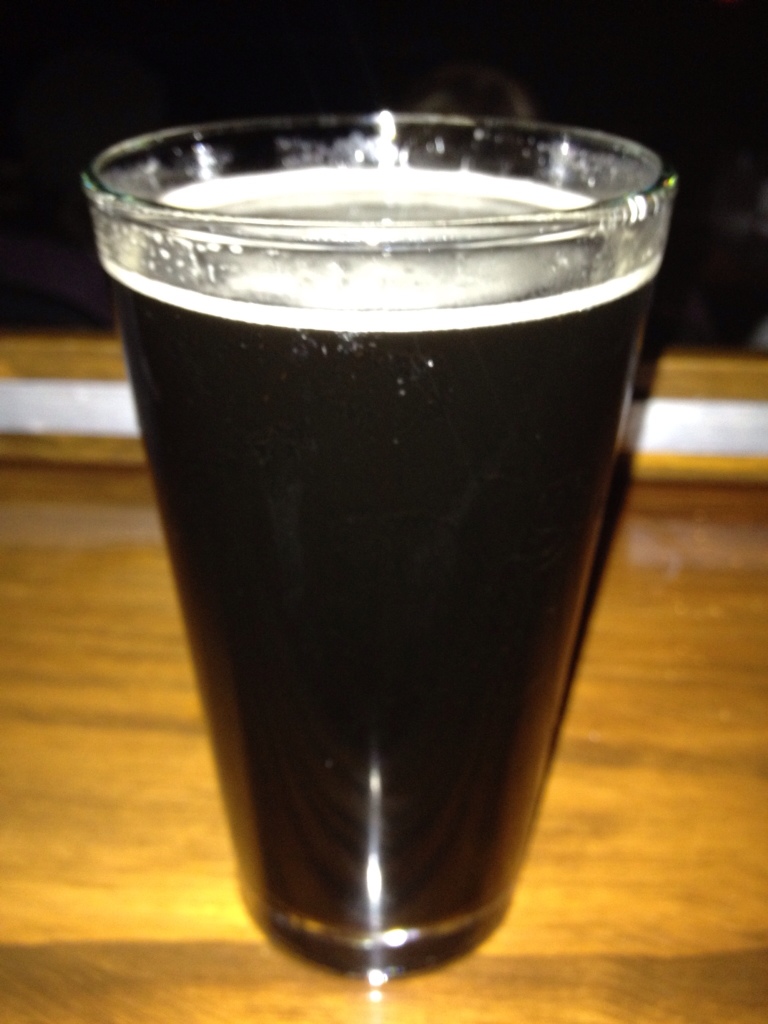
“Now they will know why they are afraid of the dark…”
The color was the deepest black, opaque. It seemed darker than most schwarzbiers and black lagers I’ve had, but that could have been the dim light of the movie theater. There wasn’t much aroma, but what I could pick up from it was dark chocolate and caramel, with the slightest hint of banana esters. Same with the flavor, which was subtle and refreshing, though chocolatey and with a little noble hop bite tapering off into a faint mocha java aftertaste. I found the mouthfeel a little thin for my taste, but I find that with black lagers a lot; I tend to be more of an ale guy, really, and perhaps my palate is still too calibrated for stout to really appreciate the thinner, more refreshing and crisp nature of a schwarzbier. But for all that, I enjoyed it. Once again Live Oak proved that they know German beer, and play with convention as well as any brewery in Central Texas.
The next screening in the Summer of ’82 series is Mad Max 2 (a.k.a. The Road Warrior). Since that show is not at an Alamo Drafthouse location, I’ve no idea yet whether there will be a beer available there that will pair as nicely and thematically with that film as this one did. If anyone can get their hands on some banged-up, greasy, post-apocalyptic cans of VB from the land of Oz, I won’t say no.
One Drink Minimum: Blues at Red’s and some Pink
Things have been pretty busy for the last week between the day job and writing, but on Thursday evening I was able to take a little break from it all. The occasion was a performance by former Pink Floyd frontman Roger Waters at the Frank Erwin Center in Austin, performing the group’s legendary album The Wall in its entirety. Before the show, I stopped at Red’s Porch in south Austin to enjoy “half pint night”, where the featured beer was Oskar Blues Deviant Dale’s IPA.

This was a spectacular beer. The color is a bright, vibrant orange that I suspect comes from the addition of Victory or dark Munich malt to the grain bill – my money’s on Munich, but as of writing this I haven’t had a chance to confirm it online. The aroma exudes grapefruit and pine, and is the freshest hop presence I can remember smelling in a beer. Late hop additions? Definitely, though I haven’t looked into which ones (and I’ll admit I’m not quite able to tell them all apart by smell and taste just yet). But when the glass was put down, it smelled like someone was holding a bag of fresh hops under my nose. I wanted to dive in.
Once it hit my palate, what surprised me most was its incredible smoothness. They call it an Imperial IPA, but at 8% ABV it’s right at the bottom of what I’d consider the appropriate alcohol range for the style. To be honest, it doesn’t even taste that strong. But as I kept drinking, it also became apparent that the beer is nearly perfectly balanced: its 85 IBUs are perfectly countered by a lotof malt sweetness, but without being cloying. For a hop bomb, there’s no resiny or medicinal quality that I can taste. The mouthfeel was just right, refreshing but not too dry. This is a brewery that knows how to make an IPA, and I’d drink it all day long. Luckily, between Lisa and I, we drank four of the half-pint glasses, and have a nice set to remind us of the experience.
Lest anyone be concerned that the concert was an afterthought after such a sublime dinner-and-drink experience, rest assured that it was not. I’m a raving, drooling Pink Floyd fan, and every time I’ve seen Roger Waters live (four times now, twice with this production of The Wall) he puts on a great show. He has an uncanny ability to connect intimately with a crowd of thousands – even in a university basketball stadium, and even when performing half of his show from behind a wall of cardboard bricks – no small feat for a rocker who was once notorious for his feelings of alienation from his bandmates and animosity for his fans (which inspired the album in 1979). But to paraphrase his song “One Of My Turns”, he has grown older, much less colder, and seems to be having a lot of fun. Or at least as much as is tasteful, given the very socially conscious themes and images of the show. He jumps around. He dresses in costumes. He pantomimes the lyrics. And he thanks his audience over and over again for letting him do it at his age. Reading between the lines of his comments to the audience, it’s obvious that Waters sees his touring now as a kind of therapy: no longer feeling isolated as he did when he wrote the album, he’s reinterpreted the story to shine a spotlight on those who feel isolated all over the world due to political and social injustices. To call it a concert is to do it a disservice: it’s a work of performance art and a heartfelt call to action to make the world a better place. It’s bombastic but honest, grandiose but personal.
A perfect balance of sweet and bitter in an unexpectedly subdued Imperial IPA, and a balancing act from a performer letting go of his darkest memories by reliving them. I’m wondering if that’s not a coincidence; if in fact that kind of balance is present in everything great. In any case, it was a fantastic intermission in an otherwise exhausting week.
I hope to be back on track with more posts later this week. Until then, prosit.
Old Faithful: The Saga of JR 11/27
I hate to jinx myself by saying it, but I’ve been pretty lucky as a brewer. Since I started brewing three years ago, I’ve been happy with almost every beer I’ve made. Even my first few all-extract batches were pleasing enough; granted, I had no idea how much better my beers could be. But I learned from every mistake and obsessed over details, and consequently, I can honestly say that almost every beer I’ve made has been better than the one before it.
Except for one.
It was November 2010, and I was partial mash brewing for nearly the last time (I switched to all-grain brewing in January 2011). The recipe was a juniper rye ale kit from Austin Homebrew Supply, and I had chosen it as my holiday beer for that year. I conducted the stovetop mini-mash with zeal, anticipating the adoring looks I’d get from family and friends as I proudly poured gleaming bronze ale into their eager glasses. I inhaled deeply as I crushed the juniper berries in a mortar and pestle, imagining what that piney, herbaceous scent would add to the aromas of Christmas dinners filling the air in the homes of my loved ones.
The brew session went spectacularly, as did fermentation. I bottled on November 27, christened the batch number JR 11/27, and poured the first taste eleven days before Christmas. It was okay – in need of some aging, but promising.

Sleeping beast.
But when the holiday arrived, disaster struck. The first bottle I opened foamed over. Yes, we smelled juniper, but were distracted by the geyser of beer spilling out all over my hands and the floor. I tried another, and another, with the same results. I realized with horror that JR 11/27 was one of those beers homebrewers dread making: a “gusher”, overcarbonated in the bottle by an unknown infection.
Once the fizz settled enough to pour, all the yeast sediment had been kicked up from the bottom of the bottle and poured out into the glass in huge chunks. Particles hung in suspension in the glass, pale against the dark amber beer, looking thick and jellylike. I tried pouring through sieves, coffee filters, even paper towels; all that did was break the sediment up into tinier particles that made it look like a glass of some odious brown first aid gel.
People drank it, politely, but no one asked for more. I couldn’t blame them. It was nasty looking and didn’t taste like anything. Presumably the infection that caused the gusher fermented the beer too thin, taking out all the body and flavor. But I didn’t give up on it. In the weeks to come, I chilled and drank bottle after bottle, stubbornly rejecting the obvious like some crippled but libidinous salmon struggling upstream towards spawntopia. It never improved.
A few months later, with twelve bottles left, I decided to accept JR 11/27’s fate. But, unable to bring myself to dump the remaining bottles down the drain, I hid them in the back of the Harry Potter closet and forgot about them. Perhaps time really did heal all things, and someday they’d be worth drinking.
This weekend, about a year later, I chilled one and tasted it. I quickly noticed what hadn’t changed.

Cue a thousand homebrewers out there saying, "Yeah, I could've told you that."
After two minutes of gushing, I was able to pour the remaining eight ounces into a glass. The color was a deep, dark copper, but chunky with suspended sediment and still very unattractive.

... but strangely photogenic.
The head dissipated quickly after pouring. The aroma was quite pleasant: tart, cider vinegar and dark fruit (raisin, black cherry, currant) with a hint of Grape Nuts. The vinegar notes suggest that an acetobacter infection was the cause of my gusher. There’s no discernible juniper aroma.
The flavor is better than it was a year ago, but exceedingly dry. It starts out rich and vinous, but quickly fades into a harsh, vinegary zing. If I concentrate after swallowing, I can almost detect an earthy mustiness lingering on my palate. Mouthfeel is practically nonexistent: it’s thin, but not refreshing.
Overall, JR 11/27 has gotten to a point where it’s drinkable, but barely. I certainly won’t serve it to any but my most adventurous friends (and maybe only with a blindfold). But if time hasn’t healed the beer itself, it’s changed my reaction to it. With sour beers being en vogue in craft brewing, this beer with its wild acetobacter isn’t quite the debacle today that it seemed like last year. I won’t reach for it next time I’m thirsty, but I’ll drink another to see how it changes.
I’ll also take a cue from those brewing sour beers, and try blending JR 11/27 with something else. On its own, it’s harsh. But blended with something maltier and more full-bodied, it may bring some complexity to an otherwise boring beer. I can think of a few bottles I have on hand that might benefit from its more “unique” characteristics.
So it seems I’ve learned something that will make me a better brewer, and surprisingly, a better writer. I didn’t get what I wanted out of one of my creations; and yes, that sucks. But with time and an open mind, I reacquainted myself with it on its own terms, and thought of a way to make it work. No one wants to scrap something they’ve created, be it a beer, a book or a batch of brownies. So appreciating one’s creation for what it is – not what it was supposed to be – is a valuable lesson for any creative person.
Of course I’ll do what’s necessary to avoid the unexpected in the future, like being even more careful about sanitation. But when the unexpected occurs, it’s good to remember that something interesting may come out of it – and that there may be something worth saving, even in our disappointments.
A Crescent City Concoction
For a long time now I’ve been in love with milk stouts, and have wanted to brew one. Lisa has also been asking for a coffee stout, specifically one using New Orleans-style coffee and chicory (we’re both New Orleanians by birth), to slake her thirst for java. In a flash of inspiration, I decided to combine the coffee/chicory stout and milk stout into one brew: a “café au lait” stout. You know, just like Café du Monde on Decatur Street would serve if they had a liquor license.
A sweet stout is a great beer style to honor my hometown. Like New Orleans, sweet stout is dark and mysterious, but full of character. It may be intimidating to the uninitiated, even harsh at first; but it’s warm and inviting when you know what to expect. And you discover something new about it with each new taste. That’s all very poetic, I know, but it’s a lot to explain when filling a glass. So adding the ingredients of a real French Market café au lait was exactly what I needed to bring my lofty symbolic interpretation of the city back down to earth.
I named the brew Crescent Moon Café au Lait Stout in honor of New Orleans’ nickname “the Crescent City” and a current obsession I have with all things lunar. I’d like to give a quick toast here to the HomeBrewTalk.com community, and the great people at Austin Homebrew Supply, for helping me finalize the recipe. The grain bill:
- 9 lbs 2-row malt
- 1.5 lb Coffee Malt
- .75 lb Roasted Barley
- .5 lb Crystal 90L
I chose specialty grains with coffee-like flavor profiles to accentuate the coffee in the finished product. I’d never used coffee malt (which despite the name is just barley malt – it has no actual coffee in it) before, but it was advertised as being kilned to 130-170L with a smell and taste like coffee, and it didn’t disappoint. Roasted barley, too, is known for its coffee characteristics, so I opted for it instead of black patent malt to get a little more flavor. The medium-dark crystal malt was added to round out the malt profile of the beer and leave some respectable body.
I started the mash at 153°F, and it dropped to 152°F by the end of the 60-minute mash.
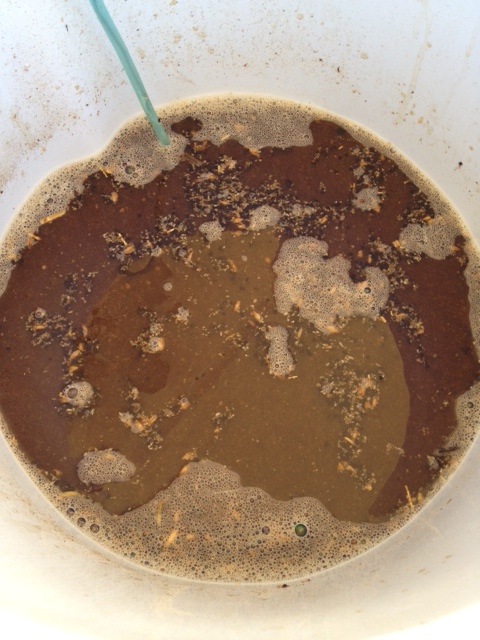
Gore from severed starch molecules splatters the walls of my mash tun like a scene from Dexter.
I did two batch sparges and ran 7.75 gallons of 1.032 wort into the kettle. For my last several brews, I have been forced to run off extra wort and boil it down for 90 minutes to hit my target OG. Someday I’ll figure out why that’s the case, but for now I don’t mind the longer boils. It gives me time to catch up on reading and Words With Friends.
I took a sort of bare-minimum approach to the hops, as I really wasn’t interested in a lot of hop character. I want the aroma and bitterness of the coffee and chicory to come through. So I added just .75 oz of 12.4% AA Nugget hop pellets to the boil with 60 minutes left to go, and no late hop additions. I added 1 lb of lactose (the ingredient that makes a milk stout a milk stout) later in the boil, with 20 minutes left.
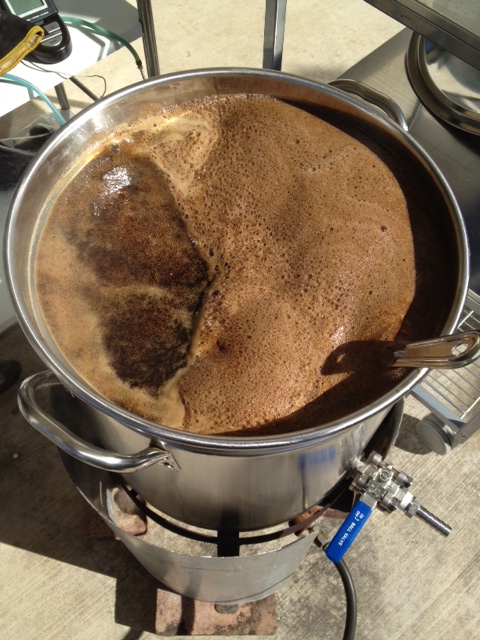
It's not just pretty to look at. The backyard smelled like a Starbucks.
Notice that I haven’t actually added the coffee and chicory yet. So far, this café au lait stout is just a milk stout begging for a wake-up, but it’s amazing how much it already smells like coffee, thanks to the malts I used. At kegging time, we’ll cold brew between 16-24 oz of coffee and chicory and rack the beer onto that. Cold brewed coffee is recommended because of its smoothness, and it’s really the only way we drink coffee and chicory in this house anyway.
The OG of the wort was 1.064, and I pitched 14 grams of rehydrated Fermentis Safale S-04 yeast. After years of using liquid yeast and rarely using the same strain twice, I’ve recently started using more dry yeast, and this simple English ale strain is rapidly becoming my go-to strain. That’s partly because I’ve been making a lot of British styles, and partly because my busy schedule hasn’t left me with much time to properly prepare liquid yeast for pitching (making a starter, etc.). But I couldn’t have settled down with a finer microbe, because S-04 works fast and flocculates like a rock star, leaving some fruity esters behind but mostly a very clean beer. I brewed this beer on Saturday, and as of yesterday, the kraeusen was already starting to fall.

Moments after pitching the yeast. They may be stooges, but they keep my fermentations cool.
I’m really excited about this brew. So much so that I couldn’t wait to make it, even though my timing means that I’m going to have a thick, malty stout on tap during the brutal Texas summer. But a friend said to me recently, “Any season is the right season for stout,” and I couldn’t agree more. Especially when my respite from the heat will be a tall, delicious pint of the Big Easy.
So, who’s bringing the beignets?
Old Favorites and New at the 2012 Off-Centered Film Fest
This weekend saw the annual return of Dogfish Head Brewery’s Sam Calagione to Austin for the fifth anniversary of the Off-Centered Film Fest, a three-day celebration of craft beer and film in partnership with the Alamo Drafthouse Cinema. This year’s programming was all western-themed, and I attended two of the four events: Thursday’s Blazing Saddles Quote-Along Beer Party Rolling Roadshow, and Friday’s Once Upon a Time in the West Dogfish Head Beer Feast.
On Thursday, attendees gathered at Republic Square Park downtown to watch Mel Brooks’ classic western spoof Blazing Saddles outdoors on a giant portable screen. Cap guns were handed out and free beans were provided by the bowlful. The audience was encouraged (nay, compelled) to shout their favorite lines as they were spoken on screen. Most importantly, though, over a dozen area breweries (and Dogfish Head) set up booths and iced down the jockey boxes to let us sample some of the rarest brews the Central Texas craft beer scene has to offer (complete list here). The pours were $3 each, and not huge; but proceeds benefited the Texas Craft Brewers Guild and frankly, most of the beers were in the 8-12% ABV range, so no one complained. I tasted seven, and five stood out as being truly fantastic:
- Jester King Craft Brewery/Mikkeller Beer Geek Rodeo
- South Austin Brewing Saison D’Austin
- Ranger Creek Brewing & Distilling Strawberry Milk Stout
- Thirsty Planet Brewing Jittery Monk Smoked Coffee Dubbel
- Real Ale Brewing WT3F Mysterium Verum
As for the movie, well, it’s Blazing frickin’ Saddles. To say that I’m a fan is like saying Bismarck is a herring. It’s like saying William J. LePetomane has questionable acumen as a governor. It’s one of the most often quoted movies in this house, and ranks just behind the original Star Wars trilogy and just ahead of the Lord of the Rings trilogy for the number of times we’ve purchased it (once on VHS, twice on DVD, and twice on Blu-Ray). To see it again on the big screen while quoting along, shooting caps at the screen, and sampling exciting new local beers was a fun twist on an old favorite, and a heady rush. (That’s Hedley!)
The new experience and the old were reversed on Friday, when I went to the Alamo Drafthouse on South Lamar to see a film I hadn’t seen before while drinking some familiar (but spectacular) beers. The film was Sergio Leone’s classic spaghetti western Once Upon a Time in the West, and was accompanied by a six-course Italian meal prepared by Alamo Executive Chef John Bullington and a paired flight of eight Dogfish Head beers selected by Sam Calagione (full menu here). The food was absolutely delicious, as I’ve come to expect from Alamo feasts. And although I had tasted most of the beers before – or at least previous years’ versions of them – many of Delaware-based Dogfish Head’s top-shelf offerings are hard to come by in Texas, so I always welcome a chance to drink them again.
Ta Henket is a recent favorite of mine in Dogfish Head’s catalog, and I hope it sticks around. Bitches Brew is a thing of beauty, and I was thrilled to get my hand on only my third glass of it since it came out in 2010. But my favorite beers of the night were two I hadn’t tried before: the 2010 Olde School Barley Wine, and a barrel-aged 2010 Burton Baton. Burton Baton is a perennial seasonal offering, but this version of it had a funky Brett-like character that surprised and really impressed me. I asked Sam during the Q&A session whether they had intentionally exposed the beer to any wild bugs during fermentation; no, he said, but he noticed and liked the wild character as well, and pointed out that these kinds of unpredictable results are common when barrel aging due to microbes residing in the porous wood. Intentional or not, I’d love to see more of this kind of thing from Dogfish Head, and will drive my happy ass all the way to Delaware if I have to.
Meanwhile, the Olde School Barley Wine was my favorite pairing of the night, with cured duck breast, fig and gorgonzola on a pinenut crisp with balsamic vinaigrette. My favorite dish on its own was the lamb meatballs and gnocchi served with a delicious but not quite as perfectly paired 2011 Immort Ale.
The Leone film was incredible, and I learned why friends have been telling me to watch it. It’s joined the short list of films I’ve seen that are very near perfect. From the beautiful composition to the sparse but perfectly sufficient dialogue to the haunting score by Ennio Morricone, not to mention excellent performances by Charles Bronson, Claudia Cardinale, Jason Robards and a chilling Henry Fonda, Once Upon a Time in the West is an absolute must-see for anyone who loves, or wants to learn to love, the western genre.
Although I missed out on the Fest’s other two events, I enjoyed the ones I made it to and look forward to next year. Here’s hoping that Dogfish Head and the Alamo Drafthouse continue their collaboration. It’s a great time for anyone who loves good beer, great food, or awesome films … and for someone like me who loves all three, it’s yet another reason to be glad to be in Austin.
A Toast To … De-Pixelated and Blue Goggles Films
Tomorrow I’ll be back to posting about beer, with news of the 2012 Off-Centered Film Fest sponsored by the Alamo Drafthouse Cinema and Dogfish Head Brewery. But I’d like to take a moment now to celebrate something I’m excited about that’s not beer-related.
For a few years, I’ve been lucky enough to know the talented people at Blue Goggles Films, and to work with them on the production of several of their acclaimed web shorts. Today they announced a new partnership with GameTrailers.com to feature their shorts monthly in a new series called De-Pixelated:
These guys know games, and they also know how to tell a great story. I was thrilled to be involved in the production of the premiere episode, and I can’t wait to see what comes next.
So I’d like to raise my beer glass to writer/director Ben Moody and producer Rachel Moody, co-founders of Blue Goggles Films, and to the premiere of De-Pixelated. Watch the first episode Tuesday, April 24 on GameTrailers.com.
Prosit!
 myBrewHome