
The Buddha and the King
On a beautiful, cool Saturday afternoon wedged between days of thunderstorms, Jester King Craft Brewery released their new Buddha’s Brew ale during their weekly open house. Beer hipsters (and garden variety hipsters) descended on the brewery for a turnout that scuttlebutt suggests was the biggest the brewery has ever seen on a “non-event” Saturday.
The new ale is a collaboration between Jester King and Austin kombucha company Buddha’s Brew. It’s Jester King’s first beer fermented entirely in oak. The wheat ale wort was pitched with bacteria and fermented in the barrel, then aged for nine months before blending it with Buddha’s Brew Classic Flavor Kombucha. Buddha’s Brew was also on location Saturday giving out free kombucha by the sample and cup. I’ve been a fan of their kombucha for years, so I was excited about the collaboration.
I haven’t been to Jester King in several months, so I was surprised to find a new system in place for the beer tasting. In the old system, $10 bought you a tulip glass and three full pours of whatever you wanted. Now, for $10 you get a card listing the day’s menu with a check box next to each of the 7 beers available:

One ticket to paradise, with a kombucha to go.
The bartenders poured 5.5 oz of whatever you ordered and marked the box next to it on the card. If you tried them all, it would equate to a little over two pints of beer and a keepsake glass for $10. So it’s not the steal it used to be, but it’s still a great value, especially if you can get there early enough to go back through the (very long) line 7 times during the 3-hour window they’re open. Even though this new system effectively raises the price per ounce over the previous system, it encourages beer flights instead of pounding pints as quickly as possible. The limited-release selections du jour are thus available to more attendees, and fewer frat boys are stumbling around drunk from too many Black Metals. I’m not sure if the new system was just for this event or if this is how they do it every week now, but I’m a fan of it in theory … if they can get the line moving a little faster.
I started with Buddha’s Brew, the hot new starlet on the set. It was straw-colored with little head and smelled like a Berliner Weisse: lactic, light and wheaty, though I was hoping for more fruitiness on the nose. It tasted like a Berliner Weisse too. Tart, refreshing and wheaty with some vinegar notes and a pleasant mouth-puckering tartness. My only complaint was that it was less complex than I expected. The kombucha didn’t add much flavor; no fruitiness, no earthiness. Nor any oakiness or vanilla from the barrel aging. It could have been any sour wheat ale, albeit a well-made one. Note that I would gladly drink it again if there weren’t more interesting beers available.


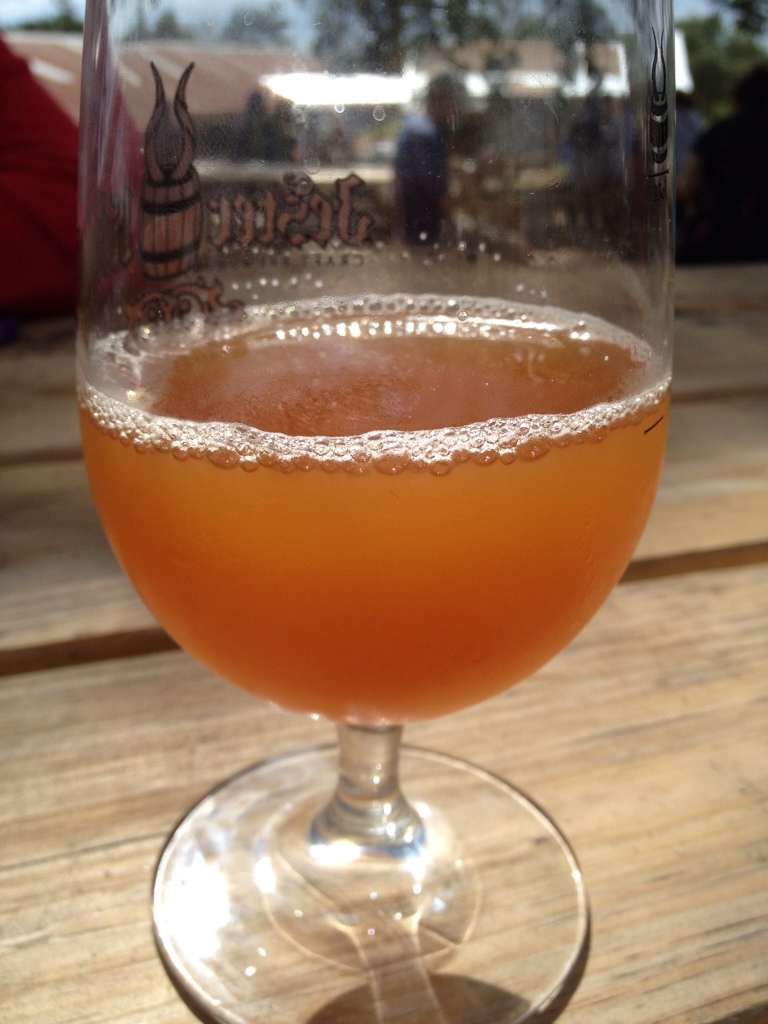
My third pour was Mad Meg, an organic bière de provision – a high-alcohol continental style intended for extended aging. At 9.6% ABV, it was a step up from my earlier tastings but smooth enough not to be a shock. It poured a handsome red-orange I attribute to Cara-Munich malt, but I enjoyed thinking of it as an “albino amber”. The aroma was mouth-watering: floral hops and a rich mandarin-like citrus with noticeable alcohol. The flavor didn’t disappoint, either, delivering piney hop bitterness at the start and boozy, bready malt on the finish with no alcohol burn. It was smooth and brilliantly balanced, easy to drink on a fall afternoon or warm enough for a cool night.
I made my way through the tastings leisurely and only got three in my 90 minutes there, but it was well worth the price of admission. Between beers I cleansed my palate with lots of free kombucha from the Buddha’s Brew tent (thanks!). Peach and Pineapple-Super Greens flavors were on tap and delicious.
I left happy (alcohol + probiotics, mmm mmm good!) and inspired. I’ve been thinking about homebrewing kombucha for a long time, and I might start soon using some Buddha’s Brew dregs to culture a starter SCOBY. Someday I actually hope to have draft kombucha in the kegerator for those non-beer occasions. I’m not sure I’ll ever use it in a beer myself, but who knows? And I toast Jester King for their innovation. After all, that’s what supporting local business is all about.
Tips for Retailers and Homebrewers alike
Close on the heels of the recent battle with my kegerator over the pressure of my kegs (which I’m happy to report has been stable at 8 PSI since my last post), I saw an article shared on Facebook dealing with storing and dispensing draft beer. The article, written by Julia Herz and published on craftbeer.com back in January, is here:
“Frosted Glassware Is Not Cool: Temperature Tips for Craft Beer Retailers” by Julia Herz
Ostensibly a “cheat sheet” for craft beer retailers to teach them to properly store, dispense and serve craft beer consistent with the demands of an ever-more-knowledgeable clientele of brew enthusiasts, it’s still great information for a homebrewer to have. Especially one who’s kegging and serving their homebrew on draft.
It’s also timely advice for a lot of Central Texas taprooms, now that we’re in the hottest month of the summer. Many bars here are used to serving tall frothy helpings of pee-colored American lager in frozen mugs to guys coming in off the hot asphalt and looking for something cold, wet and flavorless to slake their thirst … not knowing better, many of them assume colder is better and serve craft beer in frozen mugs too.
No.
Frozen glasses are never right for craft beer. Never. Seriously. They numb the tongue and desensitize the tastebuds. Next time you’re at a pub and you order a glass of some rare new offering from Belgium or California or Rehoboth Beach at $9 for 12 ounces, and your bartender brings it to you in a frozen glass: send it back.
I don’t care how hot it is outside. You paid premium for that beer. You deserve to taste it. And you should tell them so. Otherwise, how are they ever gonna learn?
The one thing in this article I don’t fully agree with is the assertion that all bottled and kegged beers should be kept refrigerated. For bars and pubs, maybe. They need to turn out the freshest product possible. But taken out of context and at face value, this “rule” can be interpreted too broadly.
Case in point: high-end bombers sold in groceries and liquor stores. Many beers sold in 750 ml bombers benefit from long-term storage before drinking. Brett ferments and wild ales, barrel-aged and oaked stouts/porters, barley wines, and Belgian abbey-style ales all develop interesting flavor characteristics when cellared correctly (read: cool – but not cold – and dark) for several months or more. The natural microbe and oxygen reactions that develop these flavors don’t happen at refrigerator temperatures.
But too many stores selling bombers are keeping them refrigerated, presumably in an attempt to keep these high-ticket items fresher (and sellable) longer. The problem for those of us who want to age them is that unpasteurized beers don’t respond well to going from room temp, to fridge temp, to cellar temp. It won’t turn them instantly to cat piss, but it’s not recommended. A bomber that’s been refrigerated at the store has effectively had its long-term aging potential reduced – even if you slowly raise the temperature and cellar it, it’s not going to have the shelf stability it would have had otherwise. I won’t buy refrigerated bombers unless I plan to drink them soon, and I’ve been politely informing the staff at a high-end grocery store in my neighborhood of this for several weeks. I’m sure I’m not the only one fighting this fight, and I’d hate to see this cheat sheet work against our efforts if misinterpreted.
But aside from this small split in our ideologies, I think it’s full of great information, and I hope you will too. Read, learn and enjoy. Prosit.
My ongoing gas problem
My name is Shawn, and I have a problem with gas.
Specifically, the carbon dioxide tank in my 3-tap homebrew kegerator. About two weeks ago, I noticed that my beers were getting a little overcarbonated. My regulator, it turned out, was set to a very high 14 PSI. I try to keep it at 10 PSI, which produces an acceptable level of carbonation for most beers; not ideal for all, but it’s good enough and a simple round number.
But when my precious beers were suddenly pouring out as 80% head, I knew something was amiss. So I got on my knees, pulled a keg out of the kegerator to get to the 5-pound CO2 tank at its home on the compressor hump, relieved pressure at the tank valve and turned the regulator screw a tiny bit counterclockwise to lower the pressure. It doesn’t take much to get big results: a few degrees of torque on a quarter-inch bolt can result in a difference of 3-4 PSI, and sometimes it takes a day before it stabilizes.
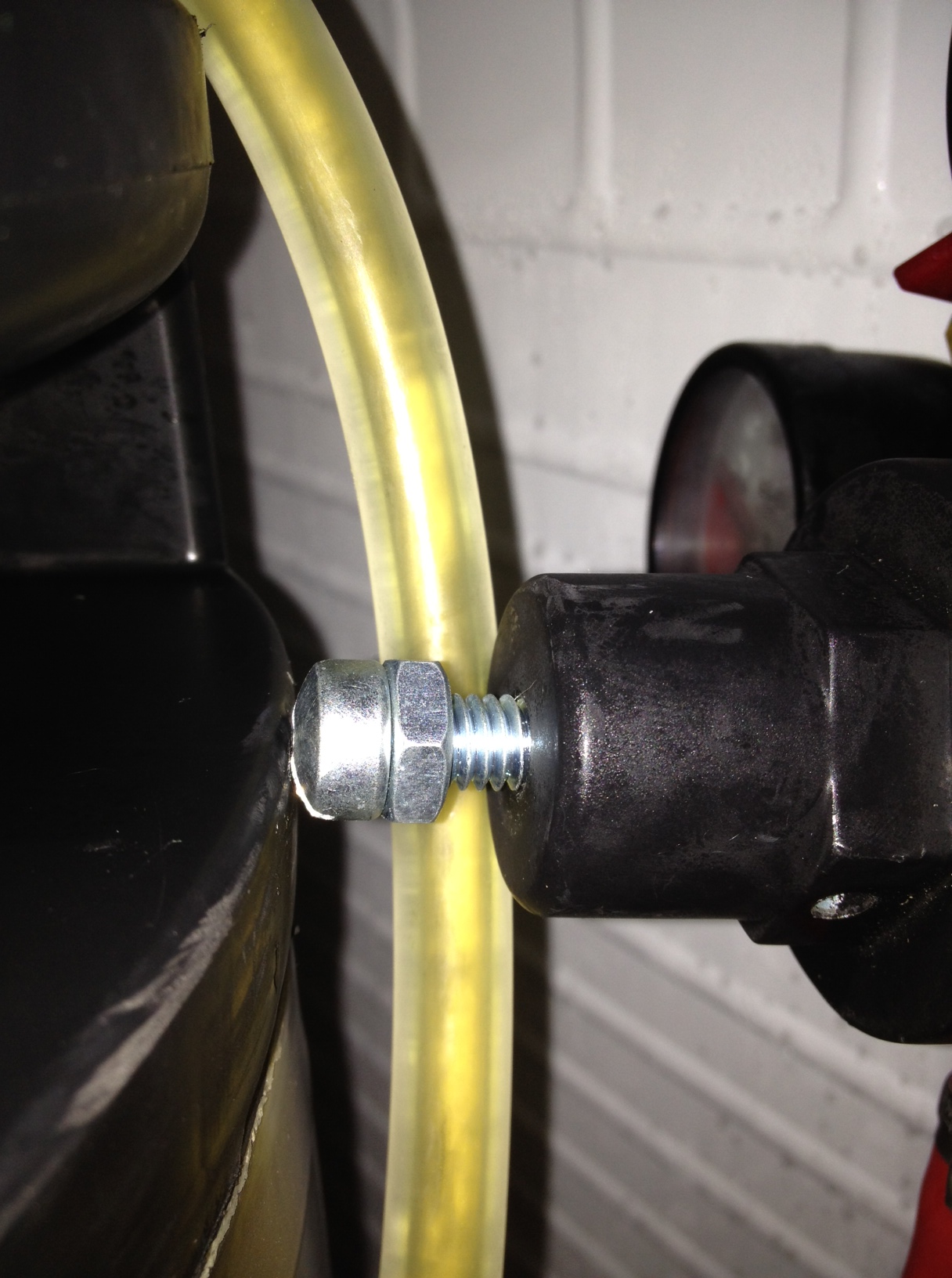
The little bastard causing all the trouble.
But it seemed like it was going to work, for a few days. Then, by coincidence, the tank ran out of gas (I suspected a leak, but thankfully found none). Unfortunately, it was a Monday and I live too far from Austin Homebrew Supply to go there on a weeknight, so I had to wait 5 days before I could get it refilled. Once done, I happily hooked up the newly filled tank and set the pressure to 8 PSI in the hopes that the pressure differential would bleed out some of the extra carbonation in the beer and equalize at the level I’m looking for.
And bleed it did. I poured a pint of Weiss Blau Weiss a few days later, and it was straight-up flat. The regulator was surprisingly at 3 PSI. I was in full WTF mode by this point, until I realized that I set the pressure before I opened all the valves in my gas manifold. 8 PSI with one valve open to one keg dissipated after I opened the other two valves.
Now I think it’s back to normal. We’ll see in a couple of days. And someday I’ll invest in longer beer lines for the system. Longer beer lines mean more distance for the beer to travel from keg to glass, which means it doesn’t come out so fast and so foamy even when the pressure’s a little high. That’s the next logical step, but I’m hoping to put that project off for a less-busy weekend.
Was there a point to this story? No, mostly I’m just venting. But it’s a solid cautionary tale for any homebrewer out there still slaving over a bottling bucket, manually filling and capping 11 bottles for every gallon of homebrew and thinking, “Once I get my kegging system, all my problems are going to be solved!” I once thought that, too.
Nope. Sorry. There will always be problems. Something can always go wrong. Especially when your hobby’s primary equipment options are mostly Frankensteined together by DIYers from common appliances, picnic gear and plumbing fittings. Problems are a given. You just have to roll with them.
But that’s part of the fun. Anybody can go to the store and buy great beer by the case. What makes homebrewers invest the time and the money in all the constant tinkering? Ingenuity. Creativity. And a morbid, wretched drive to find problems that need solving. It’s the same reason I build my own desktop computers from scratch instead of buying them off the shelf. It’s the same reason I’ve been researching and outlining my novel for an obsessively long eight months, poking holes in my own ideas before I write the first page. Like many men, I may shout and curse and bang my fist when a frustrating problem rears its head, but secretly, I love it when a problem arises, because it’s another chance to prove how smart I am by solving it.
So here’s hoping this problem is solved … for now. A pint is calling my name, so I’ll test it soon. But I’ve got hours to kill before bedtime, and who knows what might be waiting for me in there?
One Drink Minimum: Real Ale Beer Dinner at Easy Tiger (part 2 of 2)
Now that the hop-fueled insanity of IPA Day 2012 is over, back to my two-part review of last week's Real Ale Beer Dinner at Easy Tiger Bake Shop & Beer Garden. See here for Part 1.
We left off at …
Fourth Course: Scots Gone Wild Sour Real Heavy with venison liver mousse, black pepper cherry jam, arugula, country levain – The first three courses were all paired with beers made from the same Lost Gold IPA wort. The first new wort in the lineup was a single-barrel wild fermented Scotch ale. It was good, with floral and dark berry notes on the nose and a murky chocolatey red-brown color. It was tart and astringent, very refreshing and great for summer, and paired well with the very rich venison liver mousse. I love venison, though I'm not a fan of organ meat, and a quick glance around the room told me I wasn't the only one outside of my comfort zone. But with a little faith in the chef, I tucked in with an open mind, and I'm glad I did. A bite of the liver mousse spread on the levain bread with a chaser of the sour Scotch ale was fantastic, but the portion was big. I finished mine, but I saw a lot of unemptied plates.

Beer 4: Scots Gone Wild Sour Real Heavy
Fifth Course: Highlander Barrel-Aged Real Heavy with bone marrow, blood sausage, herb salad, fougasse – Before this next dish came out, the servers brought out an enormous pretzel-like bread (the fougasse, I believe). It was delicious, but there was no way the two of us at our table could fit more than a few bites in. The beer, also made from the Real Heavy wort above but aged in red wine barrels, was my least favorite of the night. It had little aroma and a bitter, medicinal flavor. After so much good beer and good food, it was a minor letdown. As for the food, this was my first time eating bone marrow, and it wasn't bad, but I preferred the blood sausage. The herb salad was very sparsely dressed, well-balanced to the strong, earthy flavors of the protein on the plate.

Beer 5: Highlander Barrel-Aged Real Heavy
Sixth Course: Vol. 15 Bourbon Barrel-Aged Russian Imperial Stout with bitter orange bread pudding, caramelized honey, figs, walnuts – Yep, you read right: Easy Tiger worked bread into the dessert as well (bravo, maestros). By this point, I was stuffed, but I finished this tasty and surprisingly light bread pudding. The beer hit all the notes one expects from a RIS, though my (perhaps desensitized) taste buds didn't taste much barrel character in the stout. And the stout may have gone better with a chocolate cake than with such a light bread pudding. After everything else, I couldn't finish the beer, and I wasn't the only one. I hate to waste, but there's only so much one can consume in an evening.

Beer 6: Vol. 15 Bourbon Barrel-Aged Russian Imperial Stout
So there you have it: a delicious dinner and a great beer flight. Easy Tiger and Real Ale truly went all out with each of their contributions and made a good team. The plating portions and the beer pours were impressive, and a great deal for $55 a head. On the other hand, smaller portions would likely have kept the appetites in the room going longer. Maybe even long enough for the less adventurous folks in the room to embrace those organ meats on the later plates.
But hey, Easy Tiger is learning as they go … and I recognize that “The portions were too big at my six-course gourmet microbrew dinner!” is totally a first-world complaint. So I'm not complaining at all. It's just an observation, and maybe will raise some awareness that could eliminate waste in the future.
As for Real Ale, I'd say they showed Austin that this now-old-standby in the local beer community still has some surprises up its sleeve. But they are bigger than the upstarts; and bigger, for a commercial brewery, means bigger risk. Smaller breweries can brew a small experimental batch and eat the cost of having to dump it if necessary, but a brewery the size of Real Ale takes a huge financial hit if they make a 60-barrel batch of something that turns out undrinkable. The trick of fermenting 3 different worts 6 different ways seems a good way for a brewery that size to experiment: if one of the beers turns out bad, there's still barrels and barrels of another beer they made from that wort they can still sell. Is that as exciting as the reckless abandon of a smaller brewery? Well, no … but it still can turn out a bunch of damn good beers, as Real Ale proved.
So thanks to Easy Tiger and Real Ale for a great night that left me happily stuffed and happily buzzed. I'm looking forward to the next one. Prosit.
A Toast To … The Second Annual #IPADay
Happy #IPADay 2012! Notice I didn’t say “hoppy”. I can be an awful punster sometimes, but not that awful.
I’ll post the second half of my review of the Real Ale Beer Dinner at Easy Tiger soon. But first, a break to celebrate the second annual IPA Day!

IPA Day started last year as a tribute to this celebrated style. From the IPADay.org website:
Founded in 2011 by beer evangelists and social media personalities Ashley Routson and Ryan Ross, IPA Day is a universal movement created to unite the voices of craft beer enthusiasts, bloggers, and brewers worldwide, using social media as the common arena for connecting the conversation together.
IPA Day is not the brainchild of a corporate marketing machine, nor is it meant to serve any particular beer brand. IPA Day is opportunity for all breweries, bloggers, businesses and consumers to connect and share their love of craft beer. It is an opportunity for the entire craft beer culture to combine forces and advocate craft beer through increased education and global awareness.
India Pale Ale has become one of the surest things in craft brew today. Once an English style, it’s taken the U.S.A. by storm in recent decades as American brewers have taken the concept across the pond and transformed it into something we can now call our own. And having had a few traditional English IPAs last year in England, I can assure you, what we call IPA in the States is a very different animal. Not necessarily better, but different.
I’ll be honest, the first time I tried an IPA I wasn’t a fan. But once I had a few proper examples, it didn’t take me too long to convert. What’s not to love? The smooth, sweet firmness of a solid malt backbone? The fresh, citrusy/floral aroma and flavor of good hops? The refreshing, clean fermentation profile?
Sure, IPA has its roots in nineteenth-century British imperialism (click here for the story if you don’t know it) … but you know what else has its roots in British imperialism? Earl Grey tea. And Freddie Mercury. Who doesn’t love Freddie Mercury? The British Empire doesn’t seem so bad now, does it?
I’ll be celebrating IPA Day with a bomber of Deschutes Hop Henge Experimental IPA and a homemade sprouted-bean curry (and a surprise Guild Wars 2 stress test, but that’s unrelated … except that I’ll be drinking IPA while I play it).
If you’re in Austin and looking for something IPAish to do today, the ladies at Bitch Beer have a running list of local IPA events here.
And if you don’t usually drink IPAs, or you don’t think you like them, why not give them another shot today?
Don’t forget to share your IPA celebrations via social media with the hashtag #IPADay. Cheers.
One Drink Minimum: Real Ale Beer Dinner at Easy Tiger (part 1 of 2)
Last week Lisa scored tickets to a beer dinner hosted by Real Ale Brewing Company at Easy Tiger Bake Shop & Beer Garden in downtown Austin.
Easy Tiger opened earlier this year on East Sixth Street, promising fresh baked-in-house breads, ample taps, and a menu that goes beyond pizza, all just down the street from the chickenpox of dive bars and music venues that dot the sidewalks of what the kids call “Dirty Sixth”. This was Easy Tiger’s first beer dinner, and it showed – mainly through oversized portions; a good problem, really – but the dishes were tasty and the pairings on the mark.
It would’ve been hard to imagine it when I first moved to Austin, but Real Ale is now the big kid on the block in Central Texas craft brew. With every new brewery that sets up shop in the region, Real Ale becomes more and more the elder statesman, and they’ve been accused of letting themselves go stale, of not pushing the envelope. (Aside from their flagship ale Firemans #4, most of their beers fall firmly in the American-British spectrum of bitter/pale ales: an APA, a rye APA, an IPA, etc. … but they do make a fantastic barleywine and some nice German seasonals.) The lineup for this beer dinner seemed carefully choreographed to prove that the old dog still has some tricks in it, and while I’m not sure I bought the routine 100%, the beers were well-made and I had a fantastic time.
Aperitif: Firemans #4 – Before the first dish came out, we started with a 6-oz pour of Real Ale’s ubiquitous flagship blonde ale. If you haven’t tasted this beer, you haven’t been to Austin. It really is everywhere, and it’s been the gateway to craft beer for frat boys and good ol’boys in this town for years (not to mention a few people I know). Call it boring; but you can’t argue with its quality, and they brought out the freshest batch I’ve ever tasted for this event. Crisp, clean taste, a nutty continental malt aroma, and a noticeable but not intimidating noble hop flavor make this a beer you can buy a case of for that stubborn Bud drinker in your family, even for your mom. And I have.
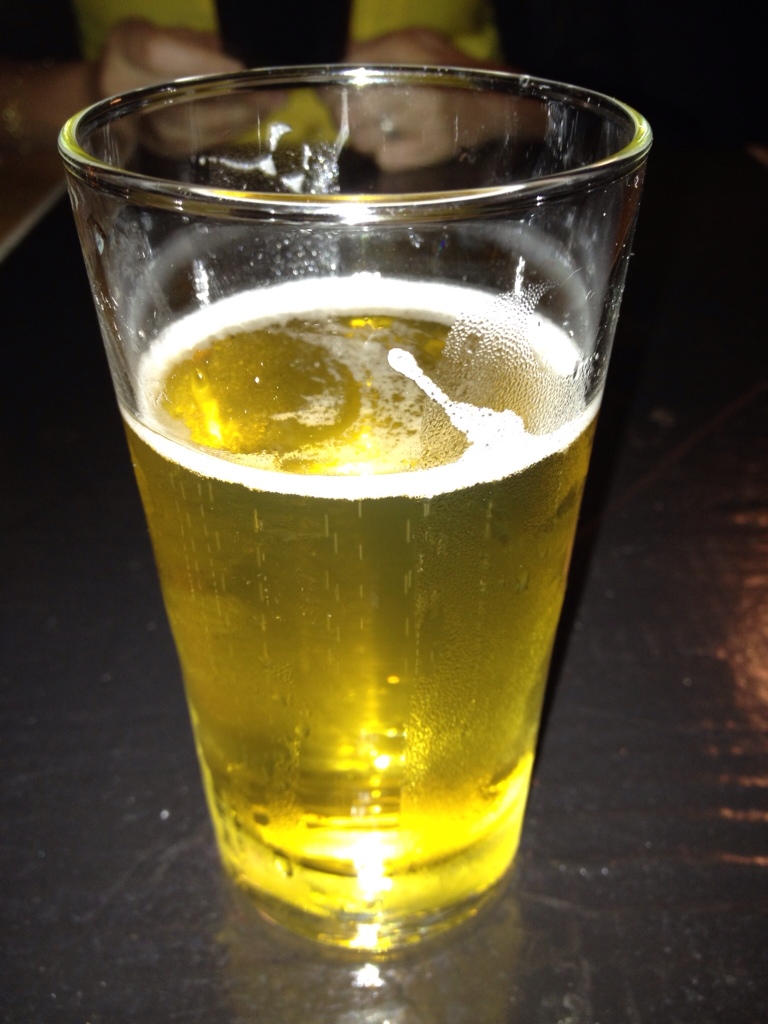
Beer 0: Firemans #4
Then the marquee lineup started: 6 dishes paired with 6 beers, about 6 ounces worth of each (cue Iron Maiden). The trick I mentioned earlier was that these 6 beers came from only 3 different “wort streams” – this was a new term to me, but basically means simply that 3 different worts were fermented under different conditions to produce 6 different beers.
First Course: Lost Gold IPA with mussels, smoked tomato, fennel, leaks baguette – Real Ale’s aptly named year-round IPA pours a deep golden color. The aroma abounds with grapefruit and floral notes. The flavor is a modest but noticeable blast of hops that doesn’t fail to refresh. It went astoundingly well with a smokey mussel stew served family-style with a whole baguette (for two). We scraped the bowl, and it was a big bowl. And all I can say about the bread is, “OMG, bread!” You can tell it’s what Easy Tiger does best.

Beer 1: Lost Gold IPA
Second Course: Empire Barrel-Aged Lost Gold IPA with duck sausage, corn pudding, watercress – The second beer made from the Lost Gold IPA wort was aged in red wine barrels that left a blanket of sour cherry fruit notes on the whole thing. The hop aroma faded with the aging, as expected, but the bitterness remained, and the beer poured enticingly murky. A hint of pungent funk from the barrel complemented the rich, earthy duck sausage. The corn pudding was light and fluffy; it complemented the sausage just fine but was easily overpowered by the beer. The disparate elements of the dish worked better separately than as a single bite.

Beer 2: Empire Barrel-Aged Lost Gold IPA
Third Course: Imperium Wild Lost Gold IPA with apricot-braised goat, local shell pea cake, mint gremolata – The third version of Lost Gold was aged in similar barrels to Empire, but wild fermentation was induced for a funkier flavor. Floral notes took center stage on this one, and it was very dry, balancing very well with another rich protein dish. The apricot balanced both the gaminess of the goat and the funkiness of the beer. By now, I was really excited about what the night had in store. I was eating great food and enjoying the results of an experiment on how one wort could become three very different beers.

Beer 3: Imperium Wild Lost Gold IPA
Check back in a few days when I post my reviews on the last three pairings of the evening, and my overall impressions. It was a delightful and insightful night.
A Toast To … Art for Brewing’s Sake
As Central Texas is plagued by thunderstorms, I'm stuck in the house enjoying the last of a bottle of Mikkeller It's Alive! Belgian Wild Ale. And I'm raising my glass virtually to Dustin Sullivan, a fellow member of the online homebrewing forum HomeBrewTalk.com, and the creator of this awesome pictorial on how to make a yeast starter.

I love brewing. I love comic art. And I love anything that's educational in a novel and interesting way. This pictorial is all three, and I'm thrilled to have stumbled onto it. I wish everything in brewing could have been explained to me so simply when I was starting out. Sure, learning as you go is 50% of the fun of brewing (another 25% is drinking the results, and the last 25% is being able to impress your friends by dropping words like “saccharification” and “attenuate” into everyday conversation) … but I'm a knowledge addict, and I'm also pathologically risk averse. So I read everything I could get my hands on when I was starting my homebrew habit, so I'd have a good idea of each step of every process before I jumped in. Sometimes, it was hard to separate the good info from the bad: to separate the clear and “just-enough” from the over-explanatory, and to separate the simple sharing of helpful information from the vomiting of brewlore all over you by guys who just want to impress you with how much they know.
Now, I love John Palmer's How to Brew and Charlie Papazian's The Complete Joy of Homebrewing. They're phenomenal books, and essential for anyone entering the hobby. But if I'd had something as simple and clear as Dustin's yeast starter pictorial for my first extract brew, my first mash, my first rack to secondary, let alone my first yeast starter, I'd have lost a lot less sleep as a newbie.
Dustin also created a yeast calculator website called YeastCalc at yeastcalc.com. It's one of the most comprehensive pitching rate calculators I've seen online for liquid yeast. It tells you not only how big of a starter to make, but also allows you to dial in a target specific gravity for your starter, and tells you how much dry malt extract to use for that target. It even has options for calculating multiple step-up starters, for that 10-gallon barleywine you've been wanting to make. I'll be using this site next time I make a starter, and I recommend you do the same.
So I’d like to raise my beer glass to Dustin Sullivan, another homebrewer out there doing his part to make brewing a little easier and simpler for the rest of us: newbies and veterans alike. Thanks, Dustin. Prosit!
Also, anyone out there who isn't yet a member of HomeBrewTalk.com, check it out. There's heaps of information there. If you have questions, it's a great place to turn; if you have answers, we always welcome new insights. And it's the most helpful, responsive and engaged online community I've ever been a part of. If you join, look me up. My username is shawnbou and I'd love to hear from you.
 Posted with Blogsy
Strike up the Sousa march …
This Fourth of July, I celebrated my right to make beer. Regular readers may recall that a few months ago, I posted a recipe for an American Colonial Ale inspired by a recent trip to Philadelphia. The perfect beer to brew on the Fourth of July! But silly me, I forgot all about it until after I left Austin Homebrew Supply with my ingredients for a different beer. So I’ll have to brew the colonial ale another time. Oops …
Instead, I brewed a single-hop Galena American Pale Ale, the second in my “Misty Mountain Hop” series of single-hop brews (the first was a Citra APA). This was a new grain bill entirely of my own devising, and if the beer comes out well, I’ll probably make it my standard grain bill for all APAs from now on:
- 9 lbs 2-row malt
- 1.5 lbs Munich malt
- 8 oz Crystal 40L
- 8 oz Crystal 75L
The wort looked and smelled delicious coming out of the mash tun, a sort of tangerine-copper color with an aroma like toasted artisan bread. I’ve got high hopes.

Vorlauf action shot!
The hop additions were all Galena, of course. This common bittering hop doesn’t seem to be used often for late hop additions, but I’ve read reviews of a few beers with late Galena hops that had descriptors like “dark fruit” and “tart berry”. Sounds awesome to me. I used:
- .85 oz at 60 minutes
- .5 oz at 15 minutes
- .5 oz at 5 minutes
- .5 oz at flameout
All of my Galena hop pellets were rated 12.8% AA. I’ll probably add another half ounce of dry hops before kegging for added aroma. My OG came in at 1.055, pretty much smack in the middle of the BJCP range for American Pale Ales. I pitched 15 grams of rehydrated Safale US-05 yeast.
But my real declaration of independence this brew session was from my old swamp cooler. After long deliberation (and somehow, writing about the idea a couple of weeks ago made it seem more feasible – thanks, Internet!) I finally bit the bullet and got myself a true temperature-controlled fermentation chamber: a Kenmore 5.1 cubic foot chest freezer with a Johnson Digital Temperature Controller dialed in to a range of 65-68°F.

Crazy. Sexy. Cool.
The Galena APA has been in there for a few days, and I’m still working out the kinks. Last night after I was out of the house all day, it had somehow got down to 60°F, though it was back up within minutes after I cracked the freezer lid for a while. But I can already say that this is one of the best purchases I have made in support of my homebrew habit. Ever. No more checking the closet every hour to monitor the temperature. No more keeping dozens of frozen water bottles on hand, waiting to be used in the swamp cooler, spending their idle time rolling around my garage freezer and making it harder to find more important stuff (like, you know, food). Perhaps most importantly, no more risks of infection from the stagnant water in the swamp cooler, which always bothered me. I just let it do its thing, check it once or twice a day, and it’s always been in the range I want … except for last night, but it’s never gotten higher than 68°F.
And now I am at liberty to brew what I want to brew, any time of year. I can lager in August. With a few modifications, I can make warm-fermented fruity Belgians in February.
Freedom. I dig it. Don’t we all?
Rogue Ales: Losing their relevance?
I’ve got nothing against Rogue Ales. I actually owe them a lot. Living on the West Coast in the early aughts, their beers inspired me long before I was a homebrewer. That smirking libertine on the bomber label, enticing me with interesting names like “Dead Guy Ale” and unique ingredients like hazelnut and soba … these things helped awaken me to the possibilities of what beer could be. I don’t drink Rogue often anymore, but that’s mainly because I drink so much Texas beer. (Coincidentally, I bought a bomber of their Chatoe Rogue Single Malt Ale this week. I wasn’t crazy about it, but I think it was mishandled in shipping. Two bottles in a row were gushers.)
But when I saw this story about a new beer in the works called New Crustacean, fermented with yeast harvested from the beard of Rogue Brewmaster John Maier, I had a pretty strong reaction. There isn’t one part of me that sees this as a good idea. (Hat tip to Heather Null for sending me the story.)
I’m all for experimentation, as long as good flavor is the ultimate goal. Brewing is not an abstract art; the point is to make beer that people will drink. Not that Rogue can’t make a perfectly drinkable beer with beard yeast, but just because something is drinkable doesn’t mean anyone will drink it. So I feel like this beer, at this time, is the wrong idea.
The ick factor doesn’t bother me. I realize they’re not throwing a sprig of John Maier’s hair into every batch. This is yeast propagation we’re talking about here. With the help of White Labs – a name in the brewing community that I trust implicitly – they’re isolating the yeast using science that I can’t begin to understand, and reproducing the strain under sterile conditions. So I’m not worried about the fact that “OMG beard yeast beer sounds gross!” and if anyone reading this is worrying about that, please don’t.
And I’m not worried about some mysterious X-factor in those microbes, either. We’re talking about a guy who’s worked in a brewery every day since 1989; there’s probably more beer yeast in that beard than there is in the air ducts at Rogue. He may even have hop bines in there for all I know. In fact, I’d be willing to put money on that beard yeast being at least 90% genetically equivalent to Rogue’s proprietary house beer strain, Pacman. Besides, we’re always told that nothing can live in beer that’s harmful to humans, and I’m pretty sure the biologists at White Labs know the difference between a viable strain of Saccharomyces cerevisiae and the Ebola virus. So whatever it is, it ain’t gonna kill us.
What bothers me is the message this sends to the non-craft-beer-drinking world. This is obviously a niche product. Few people are going to want to drink beer made with yeast from some dude’s beard, no matter how safe or sanitary it really is. I’m not just talking about the masses out there with their cans of industrial lager. Even craft beer lovers are going to be split on this idea. What Rogue is really telling the world with this gesture is that they’re catering to the extremists: the hardcore beer geeks with their T-shirts from nanobreweries you’ve never heard of, who brag about driving all the way to Russian River to get this year’s Pliny the Elder before it hits stores, all the while laughing over the rims of their pints at the craft beer neophyte at the end of the bar sipping on a 60-Minute IPA. The ones who always have to be more cutting edge than you about their beer habit and would slurp tripel from every goatee, vandyke and ZZ Top in Oregon to prove it. At best, Rogue’s beard beer is a stunt; at worst, it’s an exclusionary tactic executed with pomposity and self-aware irony.
Is that their right? Sure, but all brewers, commercial or hobbyist, are ambassadors of our craft. Anything that brings new beer lovers into the fold helps our craft along. And anything that alienates potential newcomers, or that portrays beer fans as snobs and weirdos, is bad for breweries’ business, and makes it harder for homebrewers to get friends on board. Why risk all that, why do it to the industry and the community, just for a publicity stunt and some bragging rights that no one really wants?
At the end of the day, they can do what they choose, and I can choose not to support it. But it does make me wonder at Rogue’s relevance in the modern craft beer industry if they have to grasp at stunts like this to keep moving. Maybe years ago, they were an unstoppable innovative force, but they’re not the only rogues on the block anymore: now we have Dogfish Head, Jolly Pumpkin, Mikkeller, and others who wow us every season with their originality and marketability … and don’t have to be, as that fabled beer peddler Moe Szyslak once said on The Simpsons about post-modern art, “weird for the sake of weird”.
Trying to keep my cool
With the summer solstice behind us and 3-digit temperatures facing Central Texas, I’ve been giving lots of thought to fermentation temperature control. Fermentation temperature is the most important variable a brewer can control during fermentation, and has a huge impact on flavor. Ales should be kept between 65-72°F during active fermentation, and ideally between 66-68°F for most yeast strains. Too hot and you start to get banana, clove, and bubblegum flavors from esters produced by the yeast (hotter than 80°F and you get fusel alcohols, which give that acrid “firewater” taste associated with cheap spirits). Too cold and ale yeast start go dormant, so fermentation may not complete – although lager yeasts ferment best between 45-55°F.
Here in Texas, “too cold” has never been a problem – with sympathy for my friends in Minnesota and Canada – but “too hot” frequently is. So I use a “swamp cooler” to keep my fermentations cool. This is where you place the fermenter in a big tub filled with cold water, and keep the water cold by periodically swapping out frozen ice packs. I also cover the fermenter with a T-shirt to wick cold water up the sides – some brewers even add a fan to the system. Whatever specific variation you go with, it’s a great way to keep fermentation cool on a budget: for the price of a $7 plastic tub at Target, a decent-sized collection of ice packs (or frozen water bottles), an old shirt and that broken fan in your garage that stopped oscillating in 1998, you can easily keep your fermenter 10°F colder than the room it’s in. My Weiss Blau Weiss Bavarian Hefeweizen didn’t get above 73° all last week, despite ambient temperatures in the house of up to 80°. And the only reason it got that high was because I wanted it to.
But this method has its drawbacks. For one, temperatures fluctuate quickly, and you need to be able to swap out ice packs every few hours. I work from home, so I can do this; but I can’t imagine making this work with a job outside the house. And overnight, the temperature usually goes up 5-7° by morning (sorry, beer: I love you, but not enough to wake up every 2 hours during the night for you) and it takes time to bring it back down.
It’s also messy. Keeping a few gallons of stagnant water in a dark closet for 7-10 days isn’t always a pretty sight. Sometimes, the T-shirt develops mildew and needs to be changed out – unpleasant at best, and a contamination risk at worst (though not a huge one if the fermenter is closed and the airlock filled). And when primary fermentation is done … well, let’s just say that if you’ve ever lifted a plastic bucket containing 5 gallons of liquid wrapped in sopping wet cotton out of a larger plastic bucket, you know how much fun it isn’t.
So I think I’m ready to graduate to a chest freezer with a Johnson temperature controller. It’ll be cleaner, easier, and will give me new power as a brewer. No longer will I be tied down brewing wheat beers during the sweltering Texas summer – I can make crisp APAs and blonde ales, knowing I’ll be able to keep the fermentation cool enough to get a good clean flavor. I’ll also finally be able to make some decent Belgian-style ales, which require gradually ramping up the temperature with better precision than I can get in my swamp cooler. Someday, if I get really crazy, I may even try my hand at making a lager.
I just need to find a freezer that’s big enough for my 8-gallon fermenter but small enough to fit through the door of the Harry Potter closet. It’ll cost a bit of money, but it’s an investment in better beer and more versatility. And really, isn’t that what being a homebrewer is all about?
 myBrewHome