
Strike up the Sousa march …
This Fourth of July, I celebrated my right to make beer. Regular readers may recall that a few months ago, I posted a recipe for an American Colonial Ale inspired by a recent trip to Philadelphia. The perfect beer to brew on the Fourth of July! But silly me, I forgot all about it until after I left Austin Homebrew Supply with my ingredients for a different beer. So I’ll have to brew the colonial ale another time. Oops …
Instead, I brewed a single-hop Galena American Pale Ale, the second in my “Misty Mountain Hop” series of single-hop brews (the first was a Citra APA). This was a new grain bill entirely of my own devising, and if the beer comes out well, I’ll probably make it my standard grain bill for all APAs from now on:
- 9 lbs 2-row malt
- 1.5 lbs Munich malt
- 8 oz Crystal 40L
- 8 oz Crystal 75L
The wort looked and smelled delicious coming out of the mash tun, a sort of tangerine-copper color with an aroma like toasted artisan bread. I’ve got high hopes.

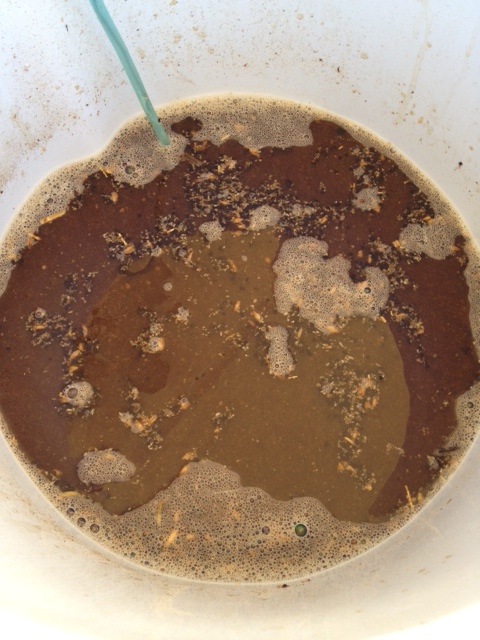
Vorlauf action shot!
The hop additions were all Galena, of course. This common bittering hop doesn’t seem to be used often for late hop additions, but I’ve read reviews of a few beers with late Galena hops that had descriptors like “dark fruit” and “tart berry”. Sounds awesome to me. I used:
- .85 oz at 60 minutes
- .5 oz at 15 minutes
- .5 oz at 5 minutes
- .5 oz at flameout
All of my Galena hop pellets were rated 12.8% AA. I’ll probably add another half ounce of dry hops before kegging for added aroma. My OG came in at 1.055, pretty much smack in the middle of the BJCP range for American Pale Ales. I pitched 15 grams of rehydrated Safale US-05 yeast.
But my real declaration of independence this brew session was from my old swamp cooler. After long deliberation (and somehow, writing about the idea a couple of weeks ago made it seem more feasible – thanks, Internet!) I finally bit the bullet and got myself a true temperature-controlled fermentation chamber: a Kenmore 5.1 cubic foot chest freezer with a Johnson Digital Temperature Controller dialed in to a range of 65-68°F.

Crazy. Sexy. Cool.
The Galena APA has been in there for a few days, and I’m still working out the kinks. Last night after I was out of the house all day, it had somehow got down to 60°F, though it was back up within minutes after I cracked the freezer lid for a while. But I can already say that this is one of the best purchases I have made in support of my homebrew habit. Ever. No more checking the closet every hour to monitor the temperature. No more keeping dozens of frozen water bottles on hand, waiting to be used in the swamp cooler, spending their idle time rolling around my garage freezer and making it harder to find more important stuff (like, you know, food). Perhaps most importantly, no more risks of infection from the stagnant water in the swamp cooler, which always bothered me. I just let it do its thing, check it once or twice a day, and it’s always been in the range I want … except for last night, but it’s never gotten higher than 68°F.
And now I am at liberty to brew what I want to brew, any time of year. I can lager in August. With a few modifications, I can make warm-fermented fruity Belgians in February.
Freedom. I dig it. Don’t we all?
Back to Basics with Bavarian Hefeweizen
As homebrewers, we often have a tendency to throw a bunch of different ingredients into recipes just because we can. Sometimes economy’s the reason, like using 5 grams of 8 different bittering hops because they’re in the freezer and about to expire. Other times, it’s just plain stubbornness, like the tendency of American homebrewers (myself included) to put crystal malt in everything. But it’s good to be reminded that sometimes, simplicity is best. After all, humans have been brewing for thousands of years, and the ancient Sumerians certainly didn’t have eight different kinds of debittered black malts to choose from.
My lesson in simplicity this week is a Bavarian Hefeweizen I brewed Sunday. I called it Weiss Blau Weiss. The name means “white-blue” and is an homage to the flag of Bavaria, a pattern of white and blue diamonds (called “lozenges” or sometimes “fusils” – your heraldry lesson for the day) seen at German-themed beer events all over the world.

You remember this, don’t you? You puked on it last Oktoberfest.
I brew mostly wheat beers in the summer, because they ferment better in the warm temperatures we face in Texas in the hottest part of the year. But most of my wheat homebrews in the past have been American-style wheats, fermented with White Labs WLP320 American Hefeweizen Ale Yeast. It’s a great clean-fermenting yeast, and I recommend it for any wheat ale with fruit, herbs or spices. But I’m bored with that clean flavor lately, and I’ve been enjoying commercial wheats with the kind of clove/banana esters that come from German hefeweizen yeast strains. So after a lot of deliberation (and with input from my soulmate and recipe consultant Lisa, who talked me down off the ledge of including some exotic spice such as mahlab in the boil) I decided to keep it simple with a traditional Bavarian hefeweizen – simple grain bill and simple hops, allowing the ester character of a German yeast strain to come through.
The grain bill was a 50/50 split of base malts – no specialty grains, no aromatics, no crystal. Just:
- 5.5 lbs German Pilsen malt
- 5.5 lbs White Wheat malt
I mashed at 152°F for an hour.
Noble hops are standard for this style, so I used:
- 0.5 oz Hallertauer (4.8% AA) for 60 min
- 0.5 oz Hallertauer Saphir (4.2% AA) for 60 min
- 0.1 oz Hallertauer (4.8% AA) for 15 min
- 0.1 oz Hallertauer Saphir (4.2% AA) for 15 min
Using two different Hallertauer varieties may seem unnecessarily complex in this so-called “simple” beer. But I really dig Saphir, and I had 0.6 oz in my freezer, which wasn’t enough. So I supplemented the Saphir with ordinary Hallertauer to get an ounce for bittering and a little extra for flavor, while using up my Saphir backstock (see? economy). In the end, I liked the symmetry of splitting the hop additions 50/50, same as the grain, so I ran with it.
The OG of the wort was 1.052. I pitched a smack pack of Wyeast 3068 Weihenstephan Weizen with no starter, hoping the low pitching rate will promote ester production. I’m also keeping the fermentation temperature between 68-72°F for the same reason. The word hefe in hefeweizen is German for “yeast”, and I want the yeast esters to take center stage.
On Monday, the beer was fermenting so vigorously I had to replace my airlock with a blowoff hose – always a proud moment for any brewer. Today, it’s still bubbling several times a minute. Assuming it’s done fermenting by this time next week, I plan to keg it immediately. Hefeweizens are great consumed fresh, and while I don’t think a longer conditioning period would hurt it, I don’t see it helping much … plus, I have an empty tap on the kegerator ready for a new beer!
It was hard, but I think keeping it simple will serve this beer well. While I love creativity in brewing, and there’s a strong desire to be original by throwing the kitchen sink into every recipe, sometimes one needs to dial it back and focus on the basics, the minimum needed to make a good beer in a classic style. And as with so many other things, part of being a good brewer is knowing what not to do, as much as knowing what to do.
A Crescent City Concoction, part 2
On Monday I finally kegged my Crescent Moon Café au Lait Stout after 4 weeks in the fermenter. I also finally added the eponymous coffee to the beer, crossing the line from a plain old milk stout (albeit one made by my own from-scratch recipe) into something truly unique.
The coffee and chicory was cold brewed on Lisa’s Toddy system: combining a pound of ground coffee with 9 cups of cold water, and letting it steep overnight, we brewed about 40 oz of concentrated coffee extract. Theoretically, this coffee extract is stronger than regular brewed coffee, but when we mixed a little bit of the extract with a sample of the beer at the planned ratio of 16-24 oz of coffee and chicory per 5 gallons of milk stout, there just wasn’t nearly enough coffee flavor. So we ramped it up, added more and more coffee until we got to a point where we were happy. The ratio we landed on was 64(!) oz of extract in the 5 gallon batch of beer. That’s a lot more than any coffee/beer recipe I’ve ever seen, but I let my tastebuds do the deciding. And I did want a bold coffee flavor.
The extract was added directly to the keg, and the beer was racked on top of that. This displaced a half gallon of the beer, so we ended up with .5 gallons of coffee extract to 4.5 gallons of beer, or a ratio of 1 part coffee to 9 parts stout. What I sampled really did taste like café au lait, so I’m pleased. Now it’s carbonating in the kegerator, and will be ready to drink in a few days.
This beer has made me feel like being a newbie homebrewer all over again: The anxious counting of day after day while I wait for the beer to be ready. The adventurous experimentation. The excitement over the unknown. If these phrases sound like ways to describe a brand new romance, it’s no accident. I’m in love with homebrewing, and this stout has reminded me why I fell in love with it in the first place. I want more of this thrill.
With June nearly upon us, I’ll look to a wheat beer for my next brew, as they’re much more forgiving to make in the heat of a Central Texas summer, even in my air-conditioned home. I’ve talked about a blood orange or other citrus wheat for a while now. I could resurrect one of my wheats from previous summers – lemongrass, ginger, or agave – but the wanderlust of experimentation is consuming me, and I think I’m itching for something new.
Read my original post about the recipe and brew day for the café au lait stout here.
A Crescent City Concoction
For a long time now I’ve been in love with milk stouts, and have wanted to brew one. Lisa has also been asking for a coffee stout, specifically one using New Orleans-style coffee and chicory (we’re both New Orleanians by birth), to slake her thirst for java. In a flash of inspiration, I decided to combine the coffee/chicory stout and milk stout into one brew: a “café au lait” stout. You know, just like Café du Monde on Decatur Street would serve if they had a liquor license.
A sweet stout is a great beer style to honor my hometown. Like New Orleans, sweet stout is dark and mysterious, but full of character. It may be intimidating to the uninitiated, even harsh at first; but it’s warm and inviting when you know what to expect. And you discover something new about it with each new taste. That’s all very poetic, I know, but it’s a lot to explain when filling a glass. So adding the ingredients of a real French Market café au lait was exactly what I needed to bring my lofty symbolic interpretation of the city back down to earth.
I named the brew Crescent Moon Café au Lait Stout in honor of New Orleans’ nickname “the Crescent City” and a current obsession I have with all things lunar. I’d like to give a quick toast here to the HomeBrewTalk.com community, and the great people at Austin Homebrew Supply, for helping me finalize the recipe. The grain bill:
- 9 lbs 2-row malt
- 1.5 lb Coffee Malt
- .75 lb Roasted Barley
- .5 lb Crystal 90L
I chose specialty grains with coffee-like flavor profiles to accentuate the coffee in the finished product. I’d never used coffee malt (which despite the name is just barley malt – it has no actual coffee in it) before, but it was advertised as being kilned to 130-170L with a smell and taste like coffee, and it didn’t disappoint. Roasted barley, too, is known for its coffee characteristics, so I opted for it instead of black patent malt to get a little more flavor. The medium-dark crystal malt was added to round out the malt profile of the beer and leave some respectable body.
I started the mash at 153°F, and it dropped to 152°F by the end of the 60-minute mash.
Gore from severed starch molecules splatters the walls of my mash tun like a scene from Dexter.
I did two batch sparges and ran 7.75 gallons of 1.032 wort into the kettle. For my last several brews, I have been forced to run off extra wort and boil it down for 90 minutes to hit my target OG. Someday I’ll figure out why that’s the case, but for now I don’t mind the longer boils. It gives me time to catch up on reading and Words With Friends.
I took a sort of bare-minimum approach to the hops, as I really wasn’t interested in a lot of hop character. I want the aroma and bitterness of the coffee and chicory to come through. So I added just .75 oz of 12.4% AA Nugget hop pellets to the boil with 60 minutes left to go, and no late hop additions. I added 1 lb of lactose (the ingredient that makes a milk stout a milk stout) later in the boil, with 20 minutes left.
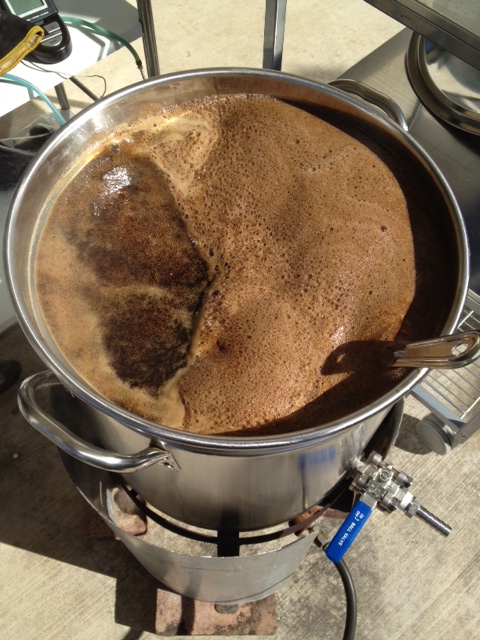
It's not just pretty to look at. The backyard smelled like a Starbucks.
Notice that I haven’t actually added the coffee and chicory yet. So far, this café au lait stout is just a milk stout begging for a wake-up, but it’s amazing how much it already smells like coffee, thanks to the malts I used. At kegging time, we’ll cold brew between 16-24 oz of coffee and chicory and rack the beer onto that. Cold brewed coffee is recommended because of its smoothness, and it’s really the only way we drink coffee and chicory in this house anyway.
The OG of the wort was 1.064, and I pitched 14 grams of rehydrated Fermentis Safale S-04 yeast. After years of using liquid yeast and rarely using the same strain twice, I’ve recently started using more dry yeast, and this simple English ale strain is rapidly becoming my go-to strain. That’s partly because I’ve been making a lot of British styles, and partly because my busy schedule hasn’t left me with much time to properly prepare liquid yeast for pitching (making a starter, etc.). But I couldn’t have settled down with a finer microbe, because S-04 works fast and flocculates like a rock star, leaving some fruity esters behind but mostly a very clean beer. I brewed this beer on Saturday, and as of yesterday, the kraeusen was already starting to fall.

Moments after pitching the yeast. They may be stooges, but they keep my fermentations cool.
I’m really excited about this brew. So much so that I couldn’t wait to make it, even though my timing means that I’m going to have a thick, malty stout on tap during the brutal Texas summer. But a friend said to me recently, “Any season is the right season for stout,” and I couldn’t agree more. Especially when my respite from the heat will be a tall, delicious pint of the Big Easy.
So, who’s bringing the beignets?
Bacillusferatu: the Undead Berliner Weisse
Part of the awesomeness of homebrewing is being able to drink a beer that you can’t buy. If you want to make a chocolate mint stout with a little bit of cardamom in it because it reminds you of your groom’s cake, you can. If you want to make a wheat ale inspired by the 13th-century Italian civil war between the Guelphs and the Ghibellines, you can (I might). And if you hear about an obscure beer that people are enjoying in another part of the world, instead of shaking your fist at the heavens and cursing the wretched stars for the circumstances of your birth, you can just make the beer yourself.
In February 2011, I saw a vial of White Labs WLP630 Berliner Weisse Blend at my local homebrew shop. I’d read a lot about Berliner Weisse, a refreshing, low-alcohol sour wheat beer fermented with ale yeast and Lactobacillus bacteria. It sounded delicious, and apparently is available everywhere in Northern Germany, even hot dog carts (frankfurterwagens in the vernacular, I believe) and brothels. But it’s hard to come by on this side of the Atlantic. I was stoked to find the necessary yeast blend – all I needed now were some common malts and hops. “At last! You will be mine!” I shouted, and cackled as I slipped the vial containing the precious mix of microbes into my shopping basket.
Then I got home and started reading about brewing sour beers, which I had never done before. The first rule of Sour Club is you need to be very careful to avoid cross-contamination: that is, you don’t want the bacteria in the sour beer to infect equipment you use to make traditional “clean” beers that ferment with just yeast, because they can turn all your “clean” beers sour. Plastic equipment is very susceptible to cross-contamination, because plastic surfaces get tiny scratches over time that harbor bacteria. I use almost exclusively plastic (I’m clumsy, and would so drop a glass carboy filled with 5 gallons of beer), so for me this basically meant that I needed a whole new set of brewing gear. I panicked. I didn’t have the money to invest in a second set of equipment just to make a beer I wasn’t even sure I’d like. So I stuck the vial in the fridge and forgot about it.
The yeast blend expired in May 2011, but I held onto it for weeks. Weeks became months. Soon it was February, and for all I knew, 99% of the yeast blend was probably dead. It was only then, having become a man with nothing to lose, that I found my courage.
I decided to make a 1-gallon batch of Berliner Weisse, my rationale being:
- A new set of small batch gear was cheaper than a new set of 5-gallon gear.
- If most of the yeast blend was dead, I’d have better luck with a smaller volume of wort.
- I wasn’t sure how much Berliner Weisse I’d need around the house anyway.
I brewed it on March 3. The recipe was based on “Saures Biergesicht” from Jamil Zainasheff and John Palmer’s Brewing Classic Styles, scaled for smaller volume but lower efficiency:
- 1 lb Bohemian Pilsner malt
- .75 lb White Wheat malt
I mashed at 149°F for 90 minutes in a pot on the stove; brew-in-a-bag, no sparge. I added .22 oz of Hallertau Saphir hops (4.2% AA) and boiled for 15 minutes. I transferred 5.5 quarts of wort with a gravity of 1.035 into a 2-gallon bucket I’d outfitted with a stopper and airlock. Then came the moment of truth: pitching the year-old yeast/lacto blend.
On account of the Teutonic heritage of the style and the unholy act of bringing microbes back from the dead, I named the brew “Bacillusferatu” after my second favorite German expressionist horror film (I plan to honor my favorite one soon with a pyment mead of buckwheat honey and Cab Sauv grape juice called “The Cabernet of Doctor Caligari”). But I never had much hope that my creation would live. Surely there was not enough magic left in that vial.
But man, was I wrong. It took a couple of days to get started, but it did. And it fermented wonderfully.
I racked Bacillusferatu into a small carboy 3 weeks later at gravity 1.006. Now it sleeps quietly, the bacteria continuing to ferment the beer and develop its characteristic tartness. In 6 months or so, it should be ready to emerge from its slumber and be unleashed upon the world …

"Is this your carboy? What a lovely neck."
I still have no idea how this beer will turn out. Right now it tastes good and funky, but with no tartness yet. But I have learned two important lessons from brewing it. #1 – As a homebrewer, I alone control my drinking destiny. #2 – Douglas Adams and Charlie Papazian were right. Don’t panic. Relax, don’t worry, have a homebrew. To which I’d add: Never be afraid to try something new.
 myBrewHome