
Beer Guy’s Burden
A friend reaches into his cooler at a BYOB party and pulls out two cans from Austin Beerworks: a Pearl Snap Pils and a Fire Eagle IPA. Knowing his preference, I hold my hand out for the IPA while he keeps the Pils. As our cans crack open in unison, he asks me, “Why don’t I like that one again?”
I think for a split second. “Because it’s got more hops, which makes it more bitter,” I say. “But it’s also sweeter and has more alcohol. It’s really just more everything.”
I’ve opened with a quip, and I’m considering going into more detail. But while I’m thinking about what to say next, everyone at the table laughs, and the conversation resumes. The moment has passed, and the chance to say more about what makes those beers different is gone.
Of the friends I hang out with regularly, I’m #1 or #2 in beer geekdom, and the only one currently homebrewing. That makes me the “beer guy” in the group. All my friends like craft beer, but most aren’t into it like I am. They come to me with their beer questions. I’ve been asked to order for my friends at bars and to suggest thematically appropriate beers for parties. It’s a role I’m honored to play, but it comes with responsibility.
I’d love for my friends to love beer as much as I do. If they knew it like I do, they’d love it like I do, right? I must tell them everything I know! Right?
But no. When asked a question, I have to be careful with my answer. I have to give just the right amount of information. To cover the basics in enough detail to keep their interest piqued, but not to get so bogged down in the minutiae that I lose them along the way.
At the BYOB party, if I answered my friend with an hour-long lecture on the difference between the noble hops in the Pils and American hops in the IPA, I can just about bet no one at that table would ever ask me a question about beer again. I know I’m a damned interesting guy, but even I don’t want to listen to me speaking for that long. If I scare my friend away from wanting to ask me about beer, then I’m doing it wrong. The mission is to nurture his curiosity, give him information so he can make a decision about when and where he’ll try that IPA on his on (if ever).
So I chose a simple, funny answer. A few facts and a tacit invitation to ask me more. He didn’t ask me more – not then, anyway, but maybe I had planted a seed.
I hope everyone reading this has at least one or two people they can seriously geek out about beer with. But even if you do, I know you’d love to get all the rest of your friends on board too. But they’re not all going to. Some may be on their way, and some of them will get there eventually. Not all, but some.
What can we do to help them along? Be there for them, but don’t push. Be their sherpa on the climb up the mountain. Give them the information and the encouragement they need. They’re your friends. You know them. You know what they need to hear. Answer their questions but don’t bore them or scare them away. Let them take baby steps. Craft beer is booming, and to the neophyte, the options are intimidating (don’t we all remember our first time?). Help them navigate those options with comfortable sojourns outside their comfort zone, and don’t go too wild too fast. Be gentle. They’re new to this.
Offer a schwarzbier to a friend who always reaches for Guinness. Offer a light beer drinker a Bohemian-style pilsner or even an APA. If they like that, give them an IPA (not an Imperial!). If your friend trusts you enough to take your recommendation, honor that by introducing them to something they’ll like, and thank you for later.
I see it as a sacred duty. But of course, I get a little too serious about stuff like this sometimes.
As for my friend, I talked with him again a couple of days later. He told me that after spending the previous afternoon downing Pearl Snaps, his tastebuds had gotten tired of it and so he went looking for something with a little more flavor. He reached for one of those IPAs left over from the BYOB, and enjoyed it so much he had a second one.
Mission accomplished. Phase one, at least.
A Toast To … Single-Serving Friends
The film Fight Club (and I assume the Chuck Palahniuk novel, which I haven’t read yet) introduced the concept of the “single-serving friend”. They’re the people you meet briefly – on a plane, or at a crowded bar in an unfamiliar town – and start talking. You enjoy each other’s company for a few hours, then go your separate ways, never to meet again. In Fight Club, it’s a humorously cynical observation: casual partners for pointless conversation. An illusion of companionship to get you through a few hours of another day on your inexorable way to the grave. A brief distraction, nothing more.
Coming home from a trip to Miami for my day job, I had a 2-hour layover in Atlanta. I stepped off the plane hungry, but mostly thirsty, and beelined to the SweetWater Draft House & Grill (thanks to GateGuru on iPhone for the tip) for some hopefully good beer, and whatever meal they could provide.
The place was small and packed. The line for available seats moved quickly, but by the time I got to the front, no one was about to get up anytime soon. A voice said, “He can sit here if he wants,” to a hostess. As she walked over to relay the message, I realized the voice was referring to me. Why the hell not? I thought, and took him up on the offer.
Before I committed myself to the unorthodox arrangement, I eyed my unexpected dinner companion with the kind of guarded scrutiny that comes from having been in airports too long. He was my age, looked harmless, so I thanked him and sat down. He ordered a pint of 420 Extra Pale Ale and another for me on his tab, then introduced himself as Larry and told me where he was from. He too was on his way home from a business trip, and about to start the last leg of a grueling journey involving multiple connections.
I mentioned where I lived. “Austin! Keepin’ it weird!” he hooted. “What kind of music do you like?” It’s assumed worldwide that all Austinites are music fans (and it seems to be true). I named some of my favorites, and then asked Larry his.
“Gangsta rap,” he said. I nodded and told him how as a teenager I discovered what was left of a tape of N.W.A.’s seminal Straight Outta Compton next to an apartment complex dumpster, and how from that day on it’s been one of my favorite albums. Larry high-fived me enthusiastically across the table. We exchanged some profanity-laden lyrics that frightened the table next to us.
From N.W.A. we moved to Parliament-Funkadelic. Then hoppy ales. We talked about whatever either of us mentioned that excited the other. Larry told stories about the origins of idioms and customs – like toasting before drinking – with the zeal of an elder passing sacred knowledge to his tribe. They might have been good-natured bullshit, but in that moment it didn’t matter; I applauded each one. At some point, he complimented me on my quick wit. But mostly he talked about how much he loved his wife, and how much he was looking forward to holding his baby when he got home. I shared something equally vulnerable and private.
When his plane was boarding, Larry got up. We shook hands and wished each other safe trips. He left. A few minutes later so did I, and boarded my plane going in an opposite direction. Then it occurred to me that I had been speaking with a complete stranger in a way more honest and unguarded than I often do with my real friends, at least on a daily basis.
What was it that loosened our tongues, convinced us to let our guard down so completely? The beer? Doubtful. Two pints in an hour is hardly enough to get me going. No, I think it was the fact of speaking to someone I’d never see again that gave me a sense of liberating anonymity. But it was unlike the shadowy anonymity of the Internet, where faceless alphanumeric handles respond to candor by shitting all over people they’ll never have to look in the eye. This was anonymity with a face, with eyes that glistened and a mouth that curled up or down as the conversation turned: indelible markers of the reality of the human being across the table. It was radiant, like an element that burns too quickly to be viable as a long-term fuel.
We didn’t exchange numbers. We didn’t friend each other on Facebook. I did get a few laughs for the flight home, a fun story to share, and maybe some personality traits that will work their way into some character I write in the future.
But I also got a reminder of the fact that every other person in that airport, whether racing from gate to gate or standing in line for an overpriced beverage, is a real human being. They have names and stories to tell. They have spouses and children waiting for them somewhere. They have favorite songs playing behind those headphones fused to their ears, and they might be the same as yours.
So maybe the key is to appreciate single-serving friends for what they are: short distractions, yes. But distractions that can be enjoyed and remembered, and learned from. Does that make them much different from the books and movies we bury our faces in at the airport, trying desperately not to talk to strangers?
My ongoing gas problem
My name is Shawn, and I have a problem with gas.
Specifically, the carbon dioxide tank in my 3-tap homebrew kegerator. About two weeks ago, I noticed that my beers were getting a little overcarbonated. My regulator, it turned out, was set to a very high 14 PSI. I try to keep it at 10 PSI, which produces an acceptable level of carbonation for most beers; not ideal for all, but it’s good enough and a simple round number.
But when my precious beers were suddenly pouring out as 80% head, I knew something was amiss. So I got on my knees, pulled a keg out of the kegerator to get to the 5-pound CO2 tank at its home on the compressor hump, relieved pressure at the tank valve and turned the regulator screw a tiny bit counterclockwise to lower the pressure. It doesn’t take much to get big results: a few degrees of torque on a quarter-inch bolt can result in a difference of 3-4 PSI, and sometimes it takes a day before it stabilizes.
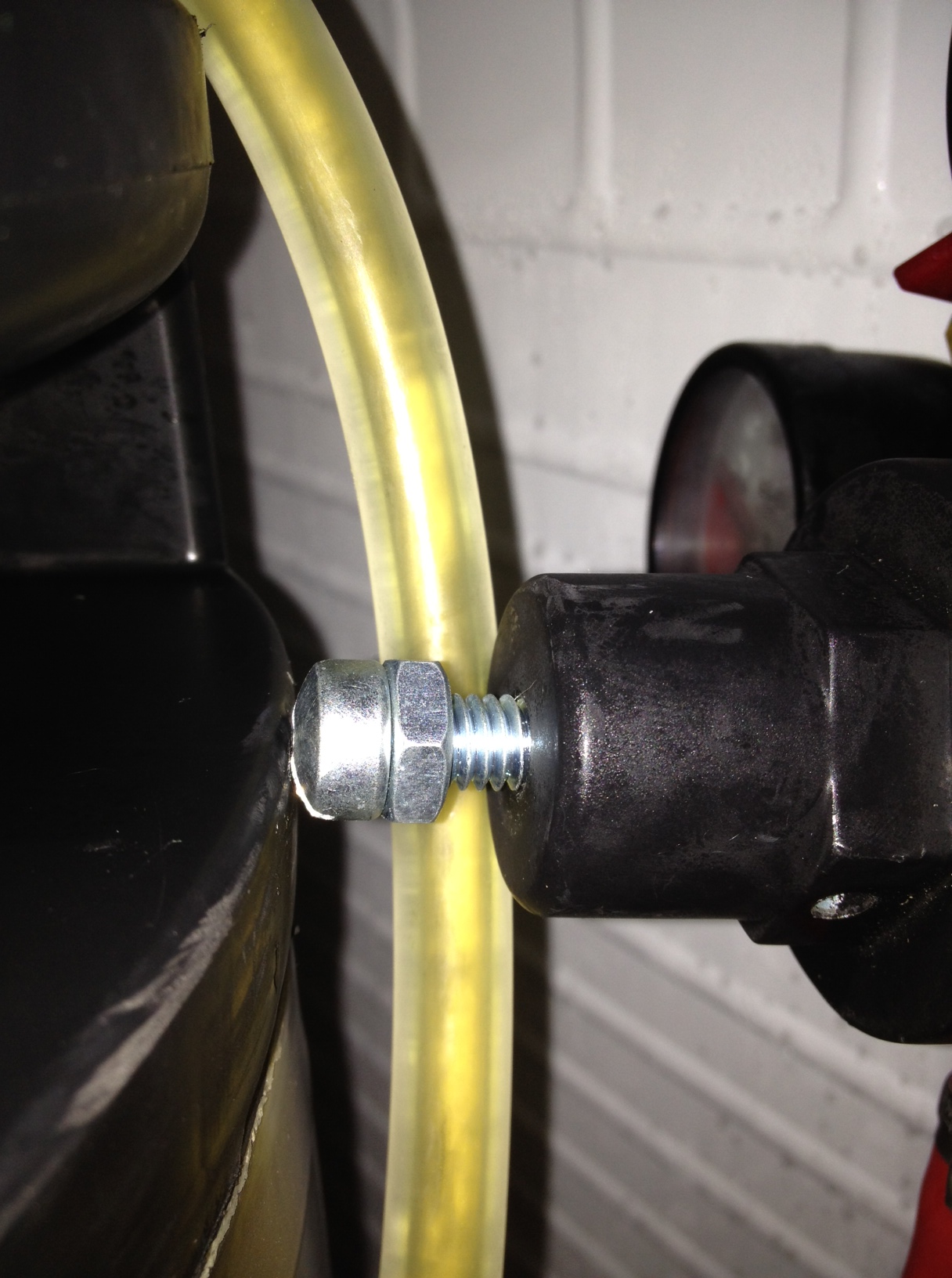
The little bastard causing all the trouble.
But it seemed like it was going to work, for a few days. Then, by coincidence, the tank ran out of gas (I suspected a leak, but thankfully found none). Unfortunately, it was a Monday and I live too far from Austin Homebrew Supply to go there on a weeknight, so I had to wait 5 days before I could get it refilled. Once done, I happily hooked up the newly filled tank and set the pressure to 8 PSI in the hopes that the pressure differential would bleed out some of the extra carbonation in the beer and equalize at the level I’m looking for.
And bleed it did. I poured a pint of Weiss Blau Weiss a few days later, and it was straight-up flat. The regulator was surprisingly at 3 PSI. I was in full WTF mode by this point, until I realized that I set the pressure before I opened all the valves in my gas manifold. 8 PSI with one valve open to one keg dissipated after I opened the other two valves.
Now I think it’s back to normal. We’ll see in a couple of days. And someday I’ll invest in longer beer lines for the system. Longer beer lines mean more distance for the beer to travel from keg to glass, which means it doesn’t come out so fast and so foamy even when the pressure’s a little high. That’s the next logical step, but I’m hoping to put that project off for a less-busy weekend.
Was there a point to this story? No, mostly I’m just venting. But it’s a solid cautionary tale for any homebrewer out there still slaving over a bottling bucket, manually filling and capping 11 bottles for every gallon of homebrew and thinking, “Once I get my kegging system, all my problems are going to be solved!” I once thought that, too.
Nope. Sorry. There will always be problems. Something can always go wrong. Especially when your hobby’s primary equipment options are mostly Frankensteined together by DIYers from common appliances, picnic gear and plumbing fittings. Problems are a given. You just have to roll with them.
But that’s part of the fun. Anybody can go to the store and buy great beer by the case. What makes homebrewers invest the time and the money in all the constant tinkering? Ingenuity. Creativity. And a morbid, wretched drive to find problems that need solving. It’s the same reason I build my own desktop computers from scratch instead of buying them off the shelf. It’s the same reason I’ve been researching and outlining my novel for an obsessively long eight months, poking holes in my own ideas before I write the first page. Like many men, I may shout and curse and bang my fist when a frustrating problem rears its head, but secretly, I love it when a problem arises, because it’s another chance to prove how smart I am by solving it.
So here’s hoping this problem is solved … for now. A pint is calling my name, so I’ll test it soon. But I’ve got hours to kill before bedtime, and who knows what might be waiting for me in there?
Weizen Up
Sorry, Internet, I've been holding out on you. Weiss Blau Weiss Bavarian Hefeweizen, my experiment in simplicity that I brewed in June, has been pouring for over a week now, and I've had several pints of it already; but I haven't yet written about it. It's high time I did, so you can enjoy it vicariously as much as I've been enjoying it … well … the regular way.
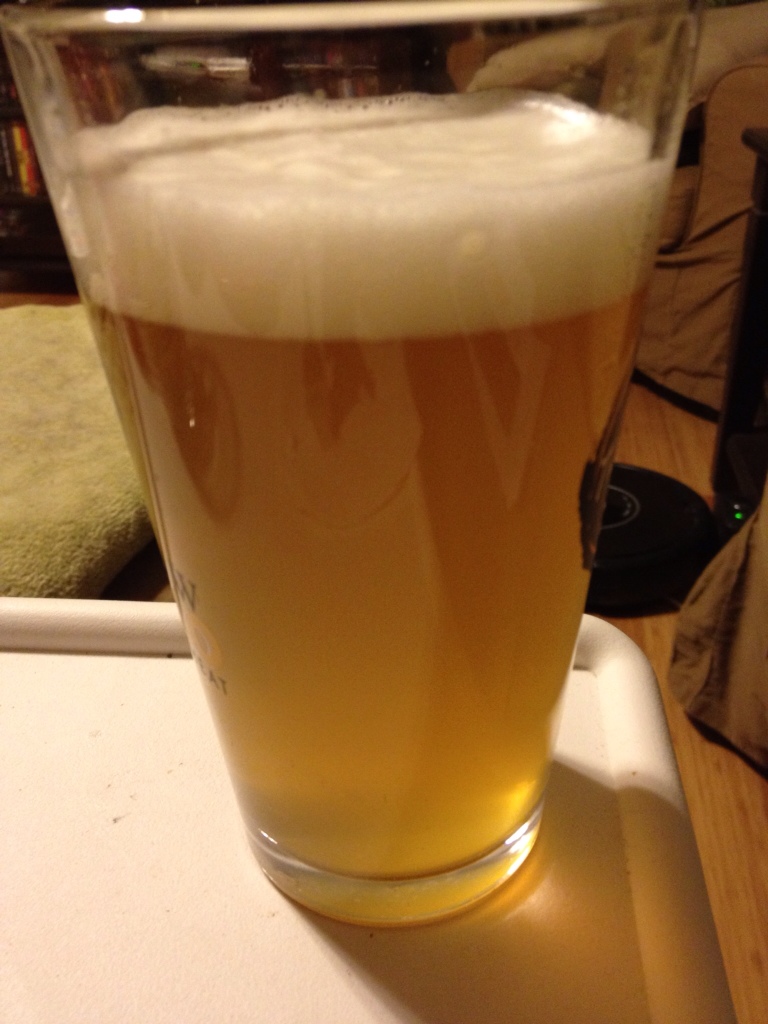
Shinin' like Rhine-gold.
It pours beautifully: a creamy golden color with a gleaming white head. It's cloudy, as a hefeweizen should be, and except for a little bit of floating sediment, it looks as good as any commercially brewed hefeweizen I've ever had. The sediment should clear up once I pour a few more pints off the keg. I did use Irish moss for this brew – as I do for most of my brews – but there are many who choose not to use kettle finings for hefeweizens, and it's possible this worked against me in that it precipitated more particles out to the bottom of the keg. But I'm sure it'll be fine in a few more pours.
The aroma is spectacular. Exactly what I wanted: lots of banana esters, a touch of the sweet, grainy aroma of crisp continental Pilsner malt, and the faintest whiff of clove spiciness. That's about it. No hops on the nose at all. Nothing confusing or muddling. You can tell instantly what ingredient created every single component of the olfactory signature of this beer.
The taste is good, too. It's light, of course, and perfect patio refreshment for my next summer brew session. The yeasty character doesn't lead in the flavor department the way I was hoping it would, not like it leads the aroma. I don't usually bother with that little slice of citrus that most brewheads outside of Bavaria are so fond of in their weizens, but I could see a lemon wedge adding something to this beer, just because it could use a bit more zing (sadly, I don't have any in the house). I don't blame the recipe for this little flaw, rather my fermentation temperature. Next time I make it, I'll ferment a couple of degrees higher for the first couple of days.
The mouthfeel is just right for a summer afternoon: refreshing, not too astringent. It goes down smooth and easy, and at 5.2% ABV is pretty session friendly.
So there you have it. Weiss Blau Weiss Bavarian Hefeweizen was an overall success, not despite its simple recipe but because of it. In fact, it seems to me that my efforts to introduce unnecessary complexity to the process – namely, using kettle finings and overchilling during fermentation – was the main thing that kept it from being (to me) a perfect beer. But that's okay; it's still plenty drinkable, and I'm sure I'll be emptying this keg pretty quickly … no complaints here, because I'd love to make it again. Can I make it even simpler next time? Probably not much so, but the lesson has been hammered home: one doesn't need a mile-long list of ingredients to make a damn good beer.
Of course, the Bavarians have been trying to tell us that for centuries.
Strike up the Sousa march …
This Fourth of July, I celebrated my right to make beer. Regular readers may recall that a few months ago, I posted a recipe for an American Colonial Ale inspired by a recent trip to Philadelphia. The perfect beer to brew on the Fourth of July! But silly me, I forgot all about it until after I left Austin Homebrew Supply with my ingredients for a different beer. So I’ll have to brew the colonial ale another time. Oops …
Instead, I brewed a single-hop Galena American Pale Ale, the second in my “Misty Mountain Hop” series of single-hop brews (the first was a Citra APA). This was a new grain bill entirely of my own devising, and if the beer comes out well, I’ll probably make it my standard grain bill for all APAs from now on:
- 9 lbs 2-row malt
- 1.5 lbs Munich malt
- 8 oz Crystal 40L
- 8 oz Crystal 75L
The wort looked and smelled delicious coming out of the mash tun, a sort of tangerine-copper color with an aroma like toasted artisan bread. I’ve got high hopes.

Vorlauf action shot!
The hop additions were all Galena, of course. This common bittering hop doesn’t seem to be used often for late hop additions, but I’ve read reviews of a few beers with late Galena hops that had descriptors like “dark fruit” and “tart berry”. Sounds awesome to me. I used:
- .85 oz at 60 minutes
- .5 oz at 15 minutes
- .5 oz at 5 minutes
- .5 oz at flameout
All of my Galena hop pellets were rated 12.8% AA. I’ll probably add another half ounce of dry hops before kegging for added aroma. My OG came in at 1.055, pretty much smack in the middle of the BJCP range for American Pale Ales. I pitched 15 grams of rehydrated Safale US-05 yeast.
But my real declaration of independence this brew session was from my old swamp cooler. After long deliberation (and somehow, writing about the idea a couple of weeks ago made it seem more feasible – thanks, Internet!) I finally bit the bullet and got myself a true temperature-controlled fermentation chamber: a Kenmore 5.1 cubic foot chest freezer with a Johnson Digital Temperature Controller dialed in to a range of 65-68°F.

Crazy. Sexy. Cool.
The Galena APA has been in there for a few days, and I’m still working out the kinks. Last night after I was out of the house all day, it had somehow got down to 60°F, though it was back up within minutes after I cracked the freezer lid for a while. But I can already say that this is one of the best purchases I have made in support of my homebrew habit. Ever. No more checking the closet every hour to monitor the temperature. No more keeping dozens of frozen water bottles on hand, waiting to be used in the swamp cooler, spending their idle time rolling around my garage freezer and making it harder to find more important stuff (like, you know, food). Perhaps most importantly, no more risks of infection from the stagnant water in the swamp cooler, which always bothered me. I just let it do its thing, check it once or twice a day, and it’s always been in the range I want … except for last night, but it’s never gotten higher than 68°F.
And now I am at liberty to brew what I want to brew, any time of year. I can lager in August. With a few modifications, I can make warm-fermented fruity Belgians in February.
Freedom. I dig it. Don’t we all?
One Drink Minimum: Blues at Red’s and some Pink
Things have been pretty busy for the last week between the day job and writing, but on Thursday evening I was able to take a little break from it all. The occasion was a performance by former Pink Floyd frontman Roger Waters at the Frank Erwin Center in Austin, performing the group’s legendary album The Wall in its entirety. Before the show, I stopped at Red’s Porch in south Austin to enjoy “half pint night”, where the featured beer was Oskar Blues Deviant Dale’s IPA.

This was a spectacular beer. The color is a bright, vibrant orange that I suspect comes from the addition of Victory or dark Munich malt to the grain bill – my money’s on Munich, but as of writing this I haven’t had a chance to confirm it online. The aroma exudes grapefruit and pine, and is the freshest hop presence I can remember smelling in a beer. Late hop additions? Definitely, though I haven’t looked into which ones (and I’ll admit I’m not quite able to tell them all apart by smell and taste just yet). But when the glass was put down, it smelled like someone was holding a bag of fresh hops under my nose. I wanted to dive in.
Once it hit my palate, what surprised me most was its incredible smoothness. They call it an Imperial IPA, but at 8% ABV it’s right at the bottom of what I’d consider the appropriate alcohol range for the style. To be honest, it doesn’t even taste that strong. But as I kept drinking, it also became apparent that the beer is nearly perfectly balanced: its 85 IBUs are perfectly countered by a lotof malt sweetness, but without being cloying. For a hop bomb, there’s no resiny or medicinal quality that I can taste. The mouthfeel was just right, refreshing but not too dry. This is a brewery that knows how to make an IPA, and I’d drink it all day long. Luckily, between Lisa and I, we drank four of the half-pint glasses, and have a nice set to remind us of the experience.
Lest anyone be concerned that the concert was an afterthought after such a sublime dinner-and-drink experience, rest assured that it was not. I’m a raving, drooling Pink Floyd fan, and every time I’ve seen Roger Waters live (four times now, twice with this production of The Wall) he puts on a great show. He has an uncanny ability to connect intimately with a crowd of thousands – even in a university basketball stadium, and even when performing half of his show from behind a wall of cardboard bricks – no small feat for a rocker who was once notorious for his feelings of alienation from his bandmates and animosity for his fans (which inspired the album in 1979). But to paraphrase his song “One Of My Turns”, he has grown older, much less colder, and seems to be having a lot of fun. Or at least as much as is tasteful, given the very socially conscious themes and images of the show. He jumps around. He dresses in costumes. He pantomimes the lyrics. And he thanks his audience over and over again for letting him do it at his age. Reading between the lines of his comments to the audience, it’s obvious that Waters sees his touring now as a kind of therapy: no longer feeling isolated as he did when he wrote the album, he’s reinterpreted the story to shine a spotlight on those who feel isolated all over the world due to political and social injustices. To call it a concert is to do it a disservice: it’s a work of performance art and a heartfelt call to action to make the world a better place. It’s bombastic but honest, grandiose but personal.
A perfect balance of sweet and bitter in an unexpectedly subdued Imperial IPA, and a balancing act from a performer letting go of his darkest memories by reliving them. I’m wondering if that’s not a coincidence; if in fact that kind of balance is present in everything great. In any case, it was a fantastic intermission in an otherwise exhausting week.
I hope to be back on track with more posts later this week. Until then, prosit.
A Vigorous Starter
My name is Shawn, and I’m a homebrewer. I’m also a home meadmaker and home ciderer. In other words, I make my own alcoholic beverages.
There are those who prefer the term zymurgist, since it covers the making of all types of fermented beverages. I admit I like the sound of the word, which comes from one of my favorite Greek roots: zyme, a noun meaning the stuff we now know as yeast. But according to the dictionary definitions I’ve read, a zymurgist is a scientist who studies the chemistry of fermentation, not just a dude cooking up hooch in his backyard. I’m certainly not a scientist; and aside from a burning passion for a good sci-fi story (I make those too) and a screaming man-crush on Neil deGrasse Tyson, I don’t think of myself as having a scientific mind. Rational? Yes. Logical? I hope so. But scientific? By Ninkasi, I fear not. So I tend to avoid describing myself as a zymurgist.
But I’m not just about cooking up hooch in my backyard, either. The first time I explain that I’m a homebrewer to someone I’ve just met, I often get asked a question like, “I bet you make some pretty strong stuff, huh?” with the same sly wink that Snuffy Smith used to get from neighbors lauding the potency of his corn squeezin’s. The person asking is usually surprised to learn that the answer is No. The strongest beer I’ve ever made was about 8% alcohol by volume (twice the strength of Bud Light, but there are countless commercial craft beers in the 10% range, and many that are even higher). The strongest mead I’ve made was 14%, not uncommon for a wine. For me, homebrewing is not about getting hammered. In fact, it’s rare for me to drink one or more alcoholic beverages every day in a single week.
For me, homebrewing is about making something that I can share with my friends, that makes us relaxed and sociable and happy. It’s about history, about being part of a tradition of preparing fermented beverages that goes back at least 9,000 years. Many ancient civilizations, from the Sumerians down to the Romans, had deities of brewing and alcohol. The individuals who prepared these sacred beverages were shamans, respected elders; because they alone held the secrets by which grain and honey and grapes could be transmuted into an elixir that was healthy (in moderation) and brought people together in friendship, that led thinkers to new ideas and awakened the creativity of artists.
That’s why I’ve jokingly started calling myself a zyme lord. Sure, it’s bombastic and silly (Doctor Who fans will get the joke). But it also sounds ancient. Noble. And it alludes to the power that a brewer has in a society: the power to bring people together, to create a work of art that many people can come together to appreciate through shared experience, but each be affected in a profoundly different way. Brewing is a kind of storytelling, in the language of grain and hops, honey and fruit, water and yeast.
In this blog, I’ll write about what I’m brewing and what I’m drinking. I’ll share recipes. I’ll also write about how brewing intersects with my other interests: fiction, film, food, and others. I hope you enjoy reading it, and if my stories help you find your way to new ideas and awaken your creativity, then that’s the most a zyme lord can hope for. Prosit!
 myBrewHome