
One Drink Minimum: Real Ale Beer Dinner at Easy Tiger (part 1 of 2)
Last week Lisa scored tickets to a beer dinner hosted by Real Ale Brewing Company at Easy Tiger Bake Shop & Beer Garden in downtown Austin.
Easy Tiger opened earlier this year on East Sixth Street, promising fresh baked-in-house breads, ample taps, and a menu that goes beyond pizza, all just down the street from the chickenpox of dive bars and music venues that dot the sidewalks of what the kids call “Dirty Sixth”. This was Easy Tiger’s first beer dinner, and it showed – mainly through oversized portions; a good problem, really – but the dishes were tasty and the pairings on the mark.
It would’ve been hard to imagine it when I first moved to Austin, but Real Ale is now the big kid on the block in Central Texas craft brew. With every new brewery that sets up shop in the region, Real Ale becomes more and more the elder statesman, and they’ve been accused of letting themselves go stale, of not pushing the envelope. (Aside from their flagship ale Firemans #4, most of their beers fall firmly in the American-British spectrum of bitter/pale ales: an APA, a rye APA, an IPA, etc. … but they do make a fantastic barleywine and some nice German seasonals.) The lineup for this beer dinner seemed carefully choreographed to prove that the old dog still has some tricks in it, and while I’m not sure I bought the routine 100%, the beers were well-made and I had a fantastic time.
Aperitif: Firemans #4 – Before the first dish came out, we started with a 6-oz pour of Real Ale’s ubiquitous flagship blonde ale. If you haven’t tasted this beer, you haven’t been to Austin. It really is everywhere, and it’s been the gateway to craft beer for frat boys and good ol’boys in this town for years (not to mention a few people I know). Call it boring; but you can’t argue with its quality, and they brought out the freshest batch I’ve ever tasted for this event. Crisp, clean taste, a nutty continental malt aroma, and a noticeable but not intimidating noble hop flavor make this a beer you can buy a case of for that stubborn Bud drinker in your family, even for your mom. And I have.

Beer 0: Firemans #4
Then the marquee lineup started: 6 dishes paired with 6 beers, about 6 ounces worth of each (cue Iron Maiden). The trick I mentioned earlier was that these 6 beers came from only 3 different “wort streams” – this was a new term to me, but basically means simply that 3 different worts were fermented under different conditions to produce 6 different beers.
First Course: Lost Gold IPA with mussels, smoked tomato, fennel, leaks baguette – Real Ale’s aptly named year-round IPA pours a deep golden color. The aroma abounds with grapefruit and floral notes. The flavor is a modest but noticeable blast of hops that doesn’t fail to refresh. It went astoundingly well with a smokey mussel stew served family-style with a whole baguette (for two). We scraped the bowl, and it was a big bowl. And all I can say about the bread is, “OMG, bread!” You can tell it’s what Easy Tiger does best.

Beer 1: Lost Gold IPA
Second Course: Empire Barrel-Aged Lost Gold IPA with duck sausage, corn pudding, watercress – The second beer made from the Lost Gold IPA wort was aged in red wine barrels that left a blanket of sour cherry fruit notes on the whole thing. The hop aroma faded with the aging, as expected, but the bitterness remained, and the beer poured enticingly murky. A hint of pungent funk from the barrel complemented the rich, earthy duck sausage. The corn pudding was light and fluffy; it complemented the sausage just fine but was easily overpowered by the beer. The disparate elements of the dish worked better separately than as a single bite.

Beer 2: Empire Barrel-Aged Lost Gold IPA
Third Course: Imperium Wild Lost Gold IPA with apricot-braised goat, local shell pea cake, mint gremolata – The third version of Lost Gold was aged in similar barrels to Empire, but wild fermentation was induced for a funkier flavor. Floral notes took center stage on this one, and it was very dry, balancing very well with another rich protein dish. The apricot balanced both the gaminess of the goat and the funkiness of the beer. By now, I was really excited about what the night had in store. I was eating great food and enjoying the results of an experiment on how one wort could become three very different beers.

Beer 3: Imperium Wild Lost Gold IPA
Check back in a few days when I post my reviews on the last three pairings of the evening, and my overall impressions. It was a delightful and insightful night.
Weizen Up
Sorry, Internet, I've been holding out on you. Weiss Blau Weiss Bavarian Hefeweizen, my experiment in simplicity that I brewed in June, has been pouring for over a week now, and I've had several pints of it already; but I haven't yet written about it. It's high time I did, so you can enjoy it vicariously as much as I've been enjoying it … well … the regular way.
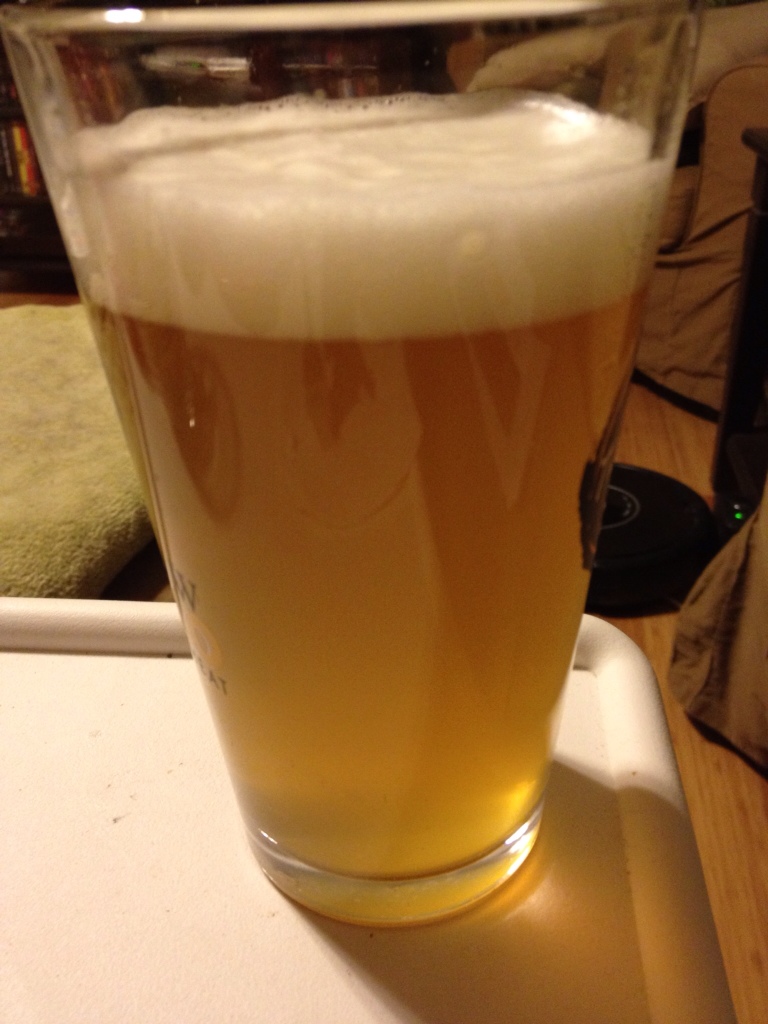
Shinin' like Rhine-gold.
It pours beautifully: a creamy golden color with a gleaming white head. It's cloudy, as a hefeweizen should be, and except for a little bit of floating sediment, it looks as good as any commercially brewed hefeweizen I've ever had. The sediment should clear up once I pour a few more pints off the keg. I did use Irish moss for this brew – as I do for most of my brews – but there are many who choose not to use kettle finings for hefeweizens, and it's possible this worked against me in that it precipitated more particles out to the bottom of the keg. But I'm sure it'll be fine in a few more pours.
The aroma is spectacular. Exactly what I wanted: lots of banana esters, a touch of the sweet, grainy aroma of crisp continental Pilsner malt, and the faintest whiff of clove spiciness. That's about it. No hops on the nose at all. Nothing confusing or muddling. You can tell instantly what ingredient created every single component of the olfactory signature of this beer.
The taste is good, too. It's light, of course, and perfect patio refreshment for my next summer brew session. The yeasty character doesn't lead in the flavor department the way I was hoping it would, not like it leads the aroma. I don't usually bother with that little slice of citrus that most brewheads outside of Bavaria are so fond of in their weizens, but I could see a lemon wedge adding something to this beer, just because it could use a bit more zing (sadly, I don't have any in the house). I don't blame the recipe for this little flaw, rather my fermentation temperature. Next time I make it, I'll ferment a couple of degrees higher for the first couple of days.
The mouthfeel is just right for a summer afternoon: refreshing, not too astringent. It goes down smooth and easy, and at 5.2% ABV is pretty session friendly.
So there you have it. Weiss Blau Weiss Bavarian Hefeweizen was an overall success, not despite its simple recipe but because of it. In fact, it seems to me that my efforts to introduce unnecessary complexity to the process – namely, using kettle finings and overchilling during fermentation – was the main thing that kept it from being (to me) a perfect beer. But that's okay; it's still plenty drinkable, and I'm sure I'll be emptying this keg pretty quickly … no complaints here, because I'd love to make it again. Can I make it even simpler next time? Probably not much so, but the lesson has been hammered home: one doesn't need a mile-long list of ingredients to make a damn good beer.
Of course, the Bavarians have been trying to tell us that for centuries.
Strike up the Sousa march …
This Fourth of July, I celebrated my right to make beer. Regular readers may recall that a few months ago, I posted a recipe for an American Colonial Ale inspired by a recent trip to Philadelphia. The perfect beer to brew on the Fourth of July! But silly me, I forgot all about it until after I left Austin Homebrew Supply with my ingredients for a different beer. So I’ll have to brew the colonial ale another time. Oops …
Instead, I brewed a single-hop Galena American Pale Ale, the second in my “Misty Mountain Hop” series of single-hop brews (the first was a Citra APA). This was a new grain bill entirely of my own devising, and if the beer comes out well, I’ll probably make it my standard grain bill for all APAs from now on:
- 9 lbs 2-row malt
- 1.5 lbs Munich malt
- 8 oz Crystal 40L
- 8 oz Crystal 75L
The wort looked and smelled delicious coming out of the mash tun, a sort of tangerine-copper color with an aroma like toasted artisan bread. I’ve got high hopes.

Vorlauf action shot!
The hop additions were all Galena, of course. This common bittering hop doesn’t seem to be used often for late hop additions, but I’ve read reviews of a few beers with late Galena hops that had descriptors like “dark fruit” and “tart berry”. Sounds awesome to me. I used:
- .85 oz at 60 minutes
- .5 oz at 15 minutes
- .5 oz at 5 minutes
- .5 oz at flameout
All of my Galena hop pellets were rated 12.8% AA. I’ll probably add another half ounce of dry hops before kegging for added aroma. My OG came in at 1.055, pretty much smack in the middle of the BJCP range for American Pale Ales. I pitched 15 grams of rehydrated Safale US-05 yeast.
But my real declaration of independence this brew session was from my old swamp cooler. After long deliberation (and somehow, writing about the idea a couple of weeks ago made it seem more feasible – thanks, Internet!) I finally bit the bullet and got myself a true temperature-controlled fermentation chamber: a Kenmore 5.1 cubic foot chest freezer with a Johnson Digital Temperature Controller dialed in to a range of 65-68°F.

Crazy. Sexy. Cool.
The Galena APA has been in there for a few days, and I’m still working out the kinks. Last night after I was out of the house all day, it had somehow got down to 60°F, though it was back up within minutes after I cracked the freezer lid for a while. But I can already say that this is one of the best purchases I have made in support of my homebrew habit. Ever. No more checking the closet every hour to monitor the temperature. No more keeping dozens of frozen water bottles on hand, waiting to be used in the swamp cooler, spending their idle time rolling around my garage freezer and making it harder to find more important stuff (like, you know, food). Perhaps most importantly, no more risks of infection from the stagnant water in the swamp cooler, which always bothered me. I just let it do its thing, check it once or twice a day, and it’s always been in the range I want … except for last night, but it’s never gotten higher than 68°F.
And now I am at liberty to brew what I want to brew, any time of year. I can lager in August. With a few modifications, I can make warm-fermented fruity Belgians in February.
Freedom. I dig it. Don’t we all?
Rogue Ales: Losing their relevance?
I’ve got nothing against Rogue Ales. I actually owe them a lot. Living on the West Coast in the early aughts, their beers inspired me long before I was a homebrewer. That smirking libertine on the bomber label, enticing me with interesting names like “Dead Guy Ale” and unique ingredients like hazelnut and soba … these things helped awaken me to the possibilities of what beer could be. I don’t drink Rogue often anymore, but that’s mainly because I drink so much Texas beer. (Coincidentally, I bought a bomber of their Chatoe Rogue Single Malt Ale this week. I wasn’t crazy about it, but I think it was mishandled in shipping. Two bottles in a row were gushers.)
But when I saw this story about a new beer in the works called New Crustacean, fermented with yeast harvested from the beard of Rogue Brewmaster John Maier, I had a pretty strong reaction. There isn’t one part of me that sees this as a good idea. (Hat tip to Heather Null for sending me the story.)
I’m all for experimentation, as long as good flavor is the ultimate goal. Brewing is not an abstract art; the point is to make beer that people will drink. Not that Rogue can’t make a perfectly drinkable beer with beard yeast, but just because something is drinkable doesn’t mean anyone will drink it. So I feel like this beer, at this time, is the wrong idea.
The ick factor doesn’t bother me. I realize they’re not throwing a sprig of John Maier’s hair into every batch. This is yeast propagation we’re talking about here. With the help of White Labs – a name in the brewing community that I trust implicitly – they’re isolating the yeast using science that I can’t begin to understand, and reproducing the strain under sterile conditions. So I’m not worried about the fact that “OMG beard yeast beer sounds gross!” and if anyone reading this is worrying about that, please don’t.
And I’m not worried about some mysterious X-factor in those microbes, either. We’re talking about a guy who’s worked in a brewery every day since 1989; there’s probably more beer yeast in that beard than there is in the air ducts at Rogue. He may even have hop bines in there for all I know. In fact, I’d be willing to put money on that beard yeast being at least 90% genetically equivalent to Rogue’s proprietary house beer strain, Pacman. Besides, we’re always told that nothing can live in beer that’s harmful to humans, and I’m pretty sure the biologists at White Labs know the difference between a viable strain of Saccharomyces cerevisiae and the Ebola virus. So whatever it is, it ain’t gonna kill us.
What bothers me is the message this sends to the non-craft-beer-drinking world. This is obviously a niche product. Few people are going to want to drink beer made with yeast from some dude’s beard, no matter how safe or sanitary it really is. I’m not just talking about the masses out there with their cans of industrial lager. Even craft beer lovers are going to be split on this idea. What Rogue is really telling the world with this gesture is that they’re catering to the extremists: the hardcore beer geeks with their T-shirts from nanobreweries you’ve never heard of, who brag about driving all the way to Russian River to get this year’s Pliny the Elder before it hits stores, all the while laughing over the rims of their pints at the craft beer neophyte at the end of the bar sipping on a 60-Minute IPA. The ones who always have to be more cutting edge than you about their beer habit and would slurp tripel from every goatee, vandyke and ZZ Top in Oregon to prove it. At best, Rogue’s beard beer is a stunt; at worst, it’s an exclusionary tactic executed with pomposity and self-aware irony.
Is that their right? Sure, but all brewers, commercial or hobbyist, are ambassadors of our craft. Anything that brings new beer lovers into the fold helps our craft along. And anything that alienates potential newcomers, or that portrays beer fans as snobs and weirdos, is bad for breweries’ business, and makes it harder for homebrewers to get friends on board. Why risk all that, why do it to the industry and the community, just for a publicity stunt and some bragging rights that no one really wants?
At the end of the day, they can do what they choose, and I can choose not to support it. But it does make me wonder at Rogue’s relevance in the modern craft beer industry if they have to grasp at stunts like this to keep moving. Maybe years ago, they were an unstoppable innovative force, but they’re not the only rogues on the block anymore: now we have Dogfish Head, Jolly Pumpkin, Mikkeller, and others who wow us every season with their originality and marketability … and don’t have to be, as that fabled beer peddler Moe Szyslak once said on The Simpsons about post-modern art, “weird for the sake of weird”.
Trying to keep my cool
With the summer solstice behind us and 3-digit temperatures facing Central Texas, I’ve been giving lots of thought to fermentation temperature control. Fermentation temperature is the most important variable a brewer can control during fermentation, and has a huge impact on flavor. Ales should be kept between 65-72°F during active fermentation, and ideally between 66-68°F for most yeast strains. Too hot and you start to get banana, clove, and bubblegum flavors from esters produced by the yeast (hotter than 80°F and you get fusel alcohols, which give that acrid “firewater” taste associated with cheap spirits). Too cold and ale yeast start go dormant, so fermentation may not complete – although lager yeasts ferment best between 45-55°F.
Here in Texas, “too cold” has never been a problem – with sympathy for my friends in Minnesota and Canada – but “too hot” frequently is. So I use a “swamp cooler” to keep my fermentations cool. This is where you place the fermenter in a big tub filled with cold water, and keep the water cold by periodically swapping out frozen ice packs. I also cover the fermenter with a T-shirt to wick cold water up the sides – some brewers even add a fan to the system. Whatever specific variation you go with, it’s a great way to keep fermentation cool on a budget: for the price of a $7 plastic tub at Target, a decent-sized collection of ice packs (or frozen water bottles), an old shirt and that broken fan in your garage that stopped oscillating in 1998, you can easily keep your fermenter 10°F colder than the room it’s in. My Weiss Blau Weiss Bavarian Hefeweizen didn’t get above 73° all last week, despite ambient temperatures in the house of up to 80°. And the only reason it got that high was because I wanted it to.
But this method has its drawbacks. For one, temperatures fluctuate quickly, and you need to be able to swap out ice packs every few hours. I work from home, so I can do this; but I can’t imagine making this work with a job outside the house. And overnight, the temperature usually goes up 5-7° by morning (sorry, beer: I love you, but not enough to wake up every 2 hours during the night for you) and it takes time to bring it back down.
It’s also messy. Keeping a few gallons of stagnant water in a dark closet for 7-10 days isn’t always a pretty sight. Sometimes, the T-shirt develops mildew and needs to be changed out – unpleasant at best, and a contamination risk at worst (though not a huge one if the fermenter is closed and the airlock filled). And when primary fermentation is done … well, let’s just say that if you’ve ever lifted a plastic bucket containing 5 gallons of liquid wrapped in sopping wet cotton out of a larger plastic bucket, you know how much fun it isn’t.
So I think I’m ready to graduate to a chest freezer with a Johnson temperature controller. It’ll be cleaner, easier, and will give me new power as a brewer. No longer will I be tied down brewing wheat beers during the sweltering Texas summer – I can make crisp APAs and blonde ales, knowing I’ll be able to keep the fermentation cool enough to get a good clean flavor. I’ll also finally be able to make some decent Belgian-style ales, which require gradually ramping up the temperature with better precision than I can get in my swamp cooler. Someday, if I get really crazy, I may even try my hand at making a lager.
I just need to find a freezer that’s big enough for my 8-gallon fermenter but small enough to fit through the door of the Harry Potter closet. It’ll cost a bit of money, but it’s an investment in better beer and more versatility. And really, isn’t that what being a homebrewer is all about?
Back to Basics with Bavarian Hefeweizen
As homebrewers, we often have a tendency to throw a bunch of different ingredients into recipes just because we can. Sometimes economy’s the reason, like using 5 grams of 8 different bittering hops because they’re in the freezer and about to expire. Other times, it’s just plain stubbornness, like the tendency of American homebrewers (myself included) to put crystal malt in everything. But it’s good to be reminded that sometimes, simplicity is best. After all, humans have been brewing for thousands of years, and the ancient Sumerians certainly didn’t have eight different kinds of debittered black malts to choose from.
My lesson in simplicity this week is a Bavarian Hefeweizen I brewed Sunday. I called it Weiss Blau Weiss. The name means “white-blue” and is an homage to the flag of Bavaria, a pattern of white and blue diamonds (called “lozenges” or sometimes “fusils” – your heraldry lesson for the day) seen at German-themed beer events all over the world.

You remember this, don’t you? You puked on it last Oktoberfest.
I brew mostly wheat beers in the summer, because they ferment better in the warm temperatures we face in Texas in the hottest part of the year. But most of my wheat homebrews in the past have been American-style wheats, fermented with White Labs WLP320 American Hefeweizen Ale Yeast. It’s a great clean-fermenting yeast, and I recommend it for any wheat ale with fruit, herbs or spices. But I’m bored with that clean flavor lately, and I’ve been enjoying commercial wheats with the kind of clove/banana esters that come from German hefeweizen yeast strains. So after a lot of deliberation (and with input from my soulmate and recipe consultant Lisa, who talked me down off the ledge of including some exotic spice such as mahlab in the boil) I decided to keep it simple with a traditional Bavarian hefeweizen – simple grain bill and simple hops, allowing the ester character of a German yeast strain to come through.
The grain bill was a 50/50 split of base malts – no specialty grains, no aromatics, no crystal. Just:
- 5.5 lbs German Pilsen malt
- 5.5 lbs White Wheat malt
I mashed at 152°F for an hour.
Noble hops are standard for this style, so I used:
- 0.5 oz Hallertauer (4.8% AA) for 60 min
- 0.5 oz Hallertauer Saphir (4.2% AA) for 60 min
- 0.1 oz Hallertauer (4.8% AA) for 15 min
- 0.1 oz Hallertauer Saphir (4.2% AA) for 15 min
Using two different Hallertauer varieties may seem unnecessarily complex in this so-called “simple” beer. But I really dig Saphir, and I had 0.6 oz in my freezer, which wasn’t enough. So I supplemented the Saphir with ordinary Hallertauer to get an ounce for bittering and a little extra for flavor, while using up my Saphir backstock (see? economy). In the end, I liked the symmetry of splitting the hop additions 50/50, same as the grain, so I ran with it.
The OG of the wort was 1.052. I pitched a smack pack of Wyeast 3068 Weihenstephan Weizen with no starter, hoping the low pitching rate will promote ester production. I’m also keeping the fermentation temperature between 68-72°F for the same reason. The word hefe in hefeweizen is German for “yeast”, and I want the yeast esters to take center stage.
On Monday, the beer was fermenting so vigorously I had to replace my airlock with a blowoff hose – always a proud moment for any brewer. Today, it’s still bubbling several times a minute. Assuming it’s done fermenting by this time next week, I plan to keg it immediately. Hefeweizens are great consumed fresh, and while I don’t think a longer conditioning period would hurt it, I don’t see it helping much … plus, I have an empty tap on the kegerator ready for a new beer!
It was hard, but I think keeping it simple will serve this beer well. While I love creativity in brewing, and there’s a strong desire to be original by throwing the kitchen sink into every recipe, sometimes one needs to dial it back and focus on the basics, the minimum needed to make a good beer in a classic style. And as with so many other things, part of being a good brewer is knowing what not to do, as much as knowing what to do.
One Drink Minimum: The Twin Cities IPA Face-off
My day job has me in the Minneapolis-St. Paul area for the better part of two weeks. I haven’t had much time for brewing or for entertainment. So for this edition of One Drink Minimum, instead of pairing a beer with an entertainment event, I’m pairing two local IPAs in a comparative tasting and gluing them together with a robust meal of steak and pierogies at a local bar and grill.
The location of this northern face-off was the Edina Grill in Edina, Minnesota. The concierge at my hotel gave me two recommendations for local beer spots, and Edina Grill was one of them. He admitted there were bigger selections in town, but on my travel budget and the proximity to my location, this oldtown-diner-turned-hipster-hangout couldn’t be beat. And he specifically said: “Try their awesome pierogies”. The steak came nicely on the rare side of medium rare and was a little tough but not too bad. The horseradish sauce was tasty, not too rich or heavy, and made for a wonderful pairing with an IPA. The potato and cheese pierogies on the side were indeed awesome, and tasted divine in the steak drippings but were a little bland on their own. I ate around the haystack of crispy onions that topped the pierogies.
The beers I ordered were the two most ubiquitous local IPAs I can find on this trip: Surly Furious and Summit Sága. Furious, a 6.5-percenter from one of the jewels in the Twin Cities beer geek crown, has been around a while and has come highly recommended from locals for years. Sága, on the other hand, is a new brew for 2012 by Summit, a larger craft brewery with wider distribution. It weighed in at 6.4%.
Furious was first in my flight. The first mad-dog thing about this brew was the aroma. It was floral, herbal: not the usual grapefruit that one expects from American IPAs, and that’s a good thing. Don’t get me wrong – I love citrus notes in my hop aroma, but it’s becoming a little too conventional. The moment those little bubbles burst under my nose with a smell like winter in the Alps, Furious had my interest. The color was dark amber and clear, with a firm, persistent head. As I emptied the glass, the beer left behind the kind of lacing that any American homebrewer (or microbrewery) should envy.
The flavor was … well, let’s just say intense. It wasn’t too sweet, and definitely hop-forward, a little unbalanced. But I enjoyed it. It’s possible that the beer was mishandled somewhere along the line, but there were definitely some harsh resiny notes coming through. Not that I mind that in an IPA, especially one I’m pairing with spicy, creamy horseradish. And I dig resin, after all: I once put almost 31 AAUs of Warrior and Falconer’s Flight in an IPA with an FG of 1.009 – and that was just the early bittering additions. I should add that the mouthfeel was profoundly perfect, and really helped my enjoyment of this beer. While there wasn’t necessarily much sweet to balance out the hops, the body did.
On to Sága, which had a much more conventional citrus aroma than Furious. After the bold herbal punch in the face of the Furious, this one seemed positively mild by comparison, almost like a nicely dry hopped saison more than an IPA. The color was lighter, a bright tangerine but sparkling crystal clear.
The flavor was more easygoing as well. This is a very refreshing and approachable IPA from Summit, and I can see why many guys down the bar from me were ordering it without thinking twice. It’s a great easy drinker for the summer, although it was slightly more overpowered than the horseradish. This one was sadly a little lacking in body, though; it slipped away from my palate way too soon, leaving me refreshed but wanting more.
All in all, I preferred Furious more, which didn’t surprise me. It just had more of what I want out of a good American IPA. In the end, I find Sága a little too close to Summit’s flagship American Pale Ale to really stand out. But although it might not be my favorite, kudos to Summit for turning a decent IPA with a respectable ABV into a popular gateway beer. I’m always on board with anything that gets people hooked on good beer.
With that said, I’m definitely looking forward to getting back to Austin later this week, and hopefully getting a new brew in the fermenter this Sunday. I’m leaning towards a spiced German hefeweizen for this weekend’s brew, something to get through the pipeline quickly and into the keg to make up for some lost brewing time. And after that, back to posting a little more regularly.
Until this weekend, prosit.
Gluten Tag
The May/June 2012 issue of Zymurgy magazine includes an article entitled “Secrets of Gluten-Free Brewing”, by BellaOnline beer and brewing editor, Carolyn Smagalski. In it, she gives tips to homebrewers on ingredients for true gluten-free beers, and reports on gluten-free offerings from a number of commercial breweries including Strange Brewing Company in Denver and Dock Street Brewery in Philadelphia. Even Dogfish Head’s Sam Calagione, ever the zymurgic Rick O’Connell, has adventurously entered the gluten-free ring with Tweason’ale, a champagne-like beer with sorghum, buckwheat honey, molasses, and strawberries.
It’s a great article, and interesting because I’ve always been curious about gluten-free brewing. First of all, I must stress that I am not a physician, nor am I an expert on gluten, gluten-free brewing, or food allergies and I cannot attest to the safety of any ingredient mentioned in this article. Please check with your physician before brewing or drinking a beer made with any ingredient mentioned here.
I don’t suffer from celiac disease, wheat allergies or any other kind of gluten intolerance. But I have friends who do, and I know it must be hard. What if my doctor ever told me I couldn’t drink beer anymore? What would I do? I could always put more energy into cider and mead, but beer is really my passion as a zyme lord. So my empathy glands pulsate to make good beer my gluten-free friends can drink, even though none have asked.
(Let’s ignore the question of “What if my doctor ever told me I couldn’t drink any alcohol anymore?” … but the answer, sadly, is: “Fetch the razor blades while I run the bathwater,” because to quote the immortal Buddy Holly, that’ll be the day when I die.)
Because gluten is present in most common grains, the key to gluten-free brewing is finding alternative sources of fermentable sugar. Barley, wheat, rye, oats and even spelt are off the table. But sorghum, buckwheat, corn, rice, millet, and quinoa are recommended alternatives. These grains may not yield as much sugar as brewers are used to, so it’s common to add other fermentables as well, such as honey or corn syrup. Hops are gluten-free, but yeast should be carefully selected, since most of them are grown in traditional barley wort (Lallemand’s Danstar beer yeast and Lalvin wine yeast product lines are listed by Smagalski as gluten-free, being grown in potato starch).
While sorghum has been used in gluten-free beers for years now, it’s notorious for being kinda … well, awful. I’ve never had one, but I’ve also never heard of anyone drinking a sorghum beer by choice. But other grains Smagalski listed were inspirations to me. I eat quinoa about twice a week, and would love to try it in beer. I don’t know much about buckwheat, but have been thinking about buckwheat honey in a mead: why not a gluten-free braggot of buckwheat and buckwheat honey?
There’s also a recipe for a chestnut beer in the article. Apparently chestnut starch can be converted to sugar, but must be “mashed” for 12 hours with added amylase enzyme powder – they don’t have enough diastatic power on their own. 12 hours is a long mash to start a brew day, but this might be a worth while experiment. Even without a specific need in my household for gluten-free beer, I smell a possible holiday brew in the cards. “Chestnuts Steeping in an Open Mash Tun Holiday Ale”? It’s catchy.
Anyone out there brewing gluten-free beers? I’d love to hear from you, as this is something I really want to explore. Who’s up for an adventure?
The Jester just got bester
As of this past Tuesday, Jester King Craft Brewery in Austin is now certified organic by the USDA, according to this press release on their website.
To quote the release:
The first of our beers to carry certified organic labeling will be this year’s version of Drink’in the Sunbelt Hoppy Wheat Beer, followed by our next batches of Mad Meg Farmhouse Provision Ale and Boxer’s Revenge Barrel-Aged Wild Ale. Le Petit Prince Farmhouse Table Beer, Noble King Hoppy Farmhouse Ale, Wytchmaker Farmhouse Rye IPA, Das Wunderkind! Sour Saison, and Bonnie the Rare Berliner Weisse also received full organic certification and will be labeled as such once we run through our current stock of labels. Black Metal Farmhouse Imperial Stout, which is over 70% organic, but uses a small amount of non-organic specialty malt, has been certified “Made with Organic Ingredients” and will carry the Texas Department of Agriculture seal, the next time labels are printed.
Although I may be more organic than some, I’m not really hung up on the organic lifestyle and organic foods. Sure, I belong to a local organic CSA called Johnson’s Backyard Garden. I don’t eat at major fast food chains (or any major restaurant chain at all if I can avoid it, which I usually can – thanks, Austin!). I try not to buy packaged foods with a lot of ingredients I can’t pronounce, but that’s a long way from organic. When it comes to my own brewing, I don’t add a lot of funky chemicals if I can help it – brewing water salts and acids to keep my mash pH down are generally the extent; I don’t spend the extra dough for organic malts and hops. In other words, whether food or drink, I keep it simple for anything I can control, and I don’t sweat the other stuff too much.
But who wouldn’t want to know that the ingredients that go into the beer they drink is of the best quality possible? Whether that means organic, or locally sourced, or whatever your personal hobbyhorse is, the fact that they bother at all means that they have a commitment to quality ingredients: that they care what they put into the beer they sell. That they’re not just here for the craft beer fad, and that they want to establish (and strengthen) their identity in the ever-more-crowded local Austin beer scene.
And that is great news, and a reminder of why I love the folks at Jester King so much. As far as I’m concerned, one of the best breweries in town just got better. I like to think that each of the best local breweries in Central Texas has a knack for something (see recent post here for my thoughts on the awesome power of Live Oak Brewing to replicate classic German styles). I always thought Jester King’s knack was simply to bring European-style farmhouse ales to a market otherwise lacking in them. But now Jester King appears to be doing more: with this gesture, they’ve demonstrated they want to be a leader in quality and innovation in all ways (including taking on the Texas Alcoholic Beverage Commission late last year over some silly beer labeling and distribution laws) in the Austin craft beer community. If there’s a battle commencing between great beer and mediocre beer, Jester King appears to want to be in the vanguard … they may not have been the first, but they seem determined to jump into the lead.
So prosit to Jester King! I’m glad they’re here.
A Crescent City Concoction, part 2
On Monday I finally kegged my Crescent Moon Café au Lait Stout after 4 weeks in the fermenter. I also finally added the eponymous coffee to the beer, crossing the line from a plain old milk stout (albeit one made by my own from-scratch recipe) into something truly unique.
The coffee and chicory was cold brewed on Lisa’s Toddy system: combining a pound of ground coffee with 9 cups of cold water, and letting it steep overnight, we brewed about 40 oz of concentrated coffee extract. Theoretically, this coffee extract is stronger than regular brewed coffee, but when we mixed a little bit of the extract with a sample of the beer at the planned ratio of 16-24 oz of coffee and chicory per 5 gallons of milk stout, there just wasn’t nearly enough coffee flavor. So we ramped it up, added more and more coffee until we got to a point where we were happy. The ratio we landed on was 64(!) oz of extract in the 5 gallon batch of beer. That’s a lot more than any coffee/beer recipe I’ve ever seen, but I let my tastebuds do the deciding. And I did want a bold coffee flavor.
The extract was added directly to the keg, and the beer was racked on top of that. This displaced a half gallon of the beer, so we ended up with .5 gallons of coffee extract to 4.5 gallons of beer, or a ratio of 1 part coffee to 9 parts stout. What I sampled really did taste like café au lait, so I’m pleased. Now it’s carbonating in the kegerator, and will be ready to drink in a few days.
This beer has made me feel like being a newbie homebrewer all over again: The anxious counting of day after day while I wait for the beer to be ready. The adventurous experimentation. The excitement over the unknown. If these phrases sound like ways to describe a brand new romance, it’s no accident. I’m in love with homebrewing, and this stout has reminded me why I fell in love with it in the first place. I want more of this thrill.
With June nearly upon us, I’ll look to a wheat beer for my next brew, as they’re much more forgiving to make in the heat of a Central Texas summer, even in my air-conditioned home. I’ve talked about a blood orange or other citrus wheat for a while now. I could resurrect one of my wheats from previous summers – lemongrass, ginger, or agave – but the wanderlust of experimentation is consuming me, and I think I’m itching for something new.
Read my original post about the recipe and brew day for the café au lait stout here.
 myBrewHome